

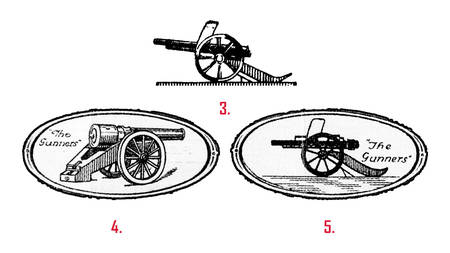
If you follow English Football, you must be familiar with the famous Cannon adorning the crest of Arsenal Football Club. In the place where the club originated from, there once resided another cannon, a very real one, they called it Aurangzheb’s gun, a thread. 1/15

Not so long ago, a massive cannon stood on the grounds in Infront of the Royal Artillery Barracks in London's Woolwich, not very far away from Royal Arsenal, a place that would be familiar to fans of Arsenal football. 2/15
This cannon was no ordinary run-of-the-mill cannon, its bronze barrel weighed 17.5 tons, had a caliber of 8 inches, and was 4.98 m in length. Its chase bore the inscription Muhammad, Aurangzeb, Alamgir, referring to the 6th Mughal King. 3/15
It was cast in 1677 as per Aurangzeb's own instructions. After Aurangzeb’s death and with the Mughal empire unstable, it probably moved from place to place until it landed in the hands of the Jat kings of the Kingdom of Bharatpur. 4/15
Now, in the early 19th century, the British East India Company had a stranglehold over the sub-continent. With Tipu Sultan out of the way the only power that stood in their way of complete supremacy were the Marathas. 5/15
The Anglo-Maratha wars pitted some of the most brilliant military minds against each other, with Yashwant Rao Holkar, the pride of the Marathas on one side, and Arthur Wellesley, the conqueror of Napoléon, on the other. 6/15
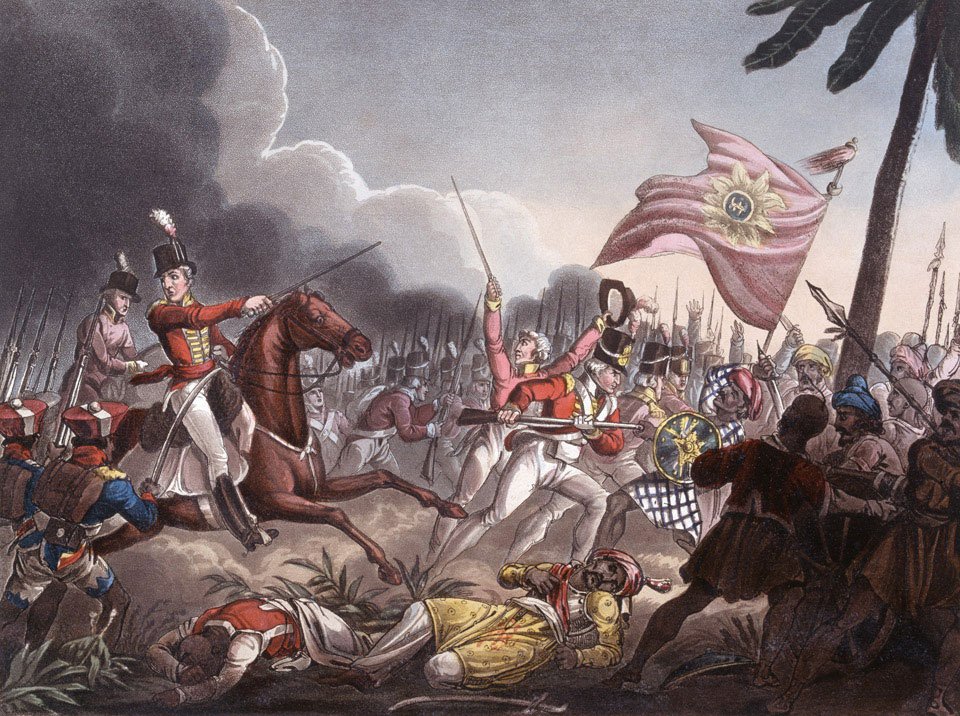
In November 1804, Yashwant Rao Holkar reached Deeg and sought help from Ranjit Singh, then ruler of Bharatpur, to which he agreed readily. The English Army though, hot on the heels of Holkar quickly besieged Deeg. 7/15
Facing the British from within the ramparts of the impregnable walls of the Deeg Fort stood Aurangzeb’s gun ready to hurt the enemy. 8/15
The British besieged Bharatpur for three months, but Lord Lake, commander of the British army who had fought on three continents, could not break through. Ranjit Singh then signed a peace treaty with the British, keeping Bharatpur out of company hands for another two decades.9/15
On October 2, 1825, Stapleton Cotton landed in Calcutta, under direct orders from Arthur Wellesley himself to capture Deeg fort and bring Bharatpur under the control of the EIC. 10/15
Cotton, also known as Lord Combermere, reached Bharatpur on 10 December and the fort was taken by January 18 after several breaches made in the walls allowed the British army to enter and storm it. 11/15
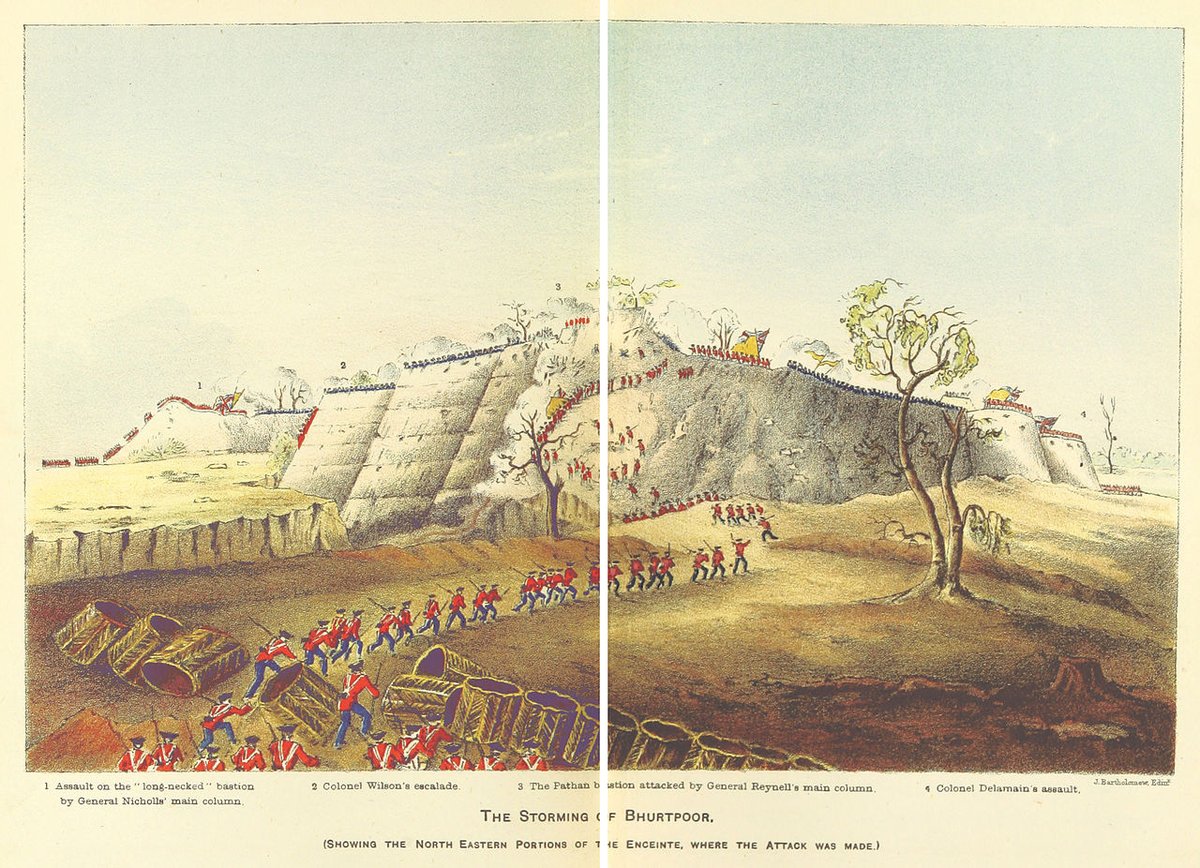
Among the spoils of war acquired by Cotton was Aurangzeb’s gun, or as it was then called, the Bharatpore Gun. A year later Cotton returned to England and took the gun with him. 12/15
Once in England, the gun’s wooden carriage was replaced by a cast-iron carriage built by the Royal Carriage Department. On 21 October 1828, Sir Alexander Dickson, the Master General wrote a letter to the Royal Regiment of Artillery. 13/15
The letter stated that it was the gracious intention of His Majesty (George IV) that the gun should be mounted in front of the barracks at Woolwich and placed in the charge and care of the corps of Royal Artillery and Engineers. 14/15
And there it stood till 2007 as a symbol of brilliant military craftsmanship. Who knows all those years back it might even have been an inspiration behind Arsenal football club’s iconic crest. 15/15
Sources: The Bhurtpore Gun, royalartillerymuseum.com
Image Attributes: The Storming of Bhurtpoor, from @WikiCommons; Bharatpore Gun, from @WikiCommons; Battle of Assaye, from @WikiCommons; The Arsenal Crest, from arsenal.com
Image Attributes: The Storming of Bhurtpoor, from @WikiCommons; Bharatpore Gun, from @WikiCommons; Battle of Assaye, from @WikiCommons; The Arsenal Crest, from arsenal.com

arsenal.com/news/news-arch…
The Arsenal Crest
The club’s first crest (1) initially appeared on 20 October, 1905, when the “Book of Football” publi...
royalartillerymuseum.com/news/object-of…
Object of the Month - May 2022 - The Royal Artillery Museum
Do you give consent for us to use cookies to track your session on our website? This allows us to an...
Loading suggestions...