

10 mental concepts that will probably make you smarter:
The Happiness Paradox
The more you search for happiness, the more it eludes you.
If you want to be happy, stop thinking about trying to be happy so much.
Happiness is a natural state that it occurs when you accept ‘what is’ and don't desire for anything else.
The more you search for happiness, the more it eludes you.
If you want to be happy, stop thinking about trying to be happy so much.
Happiness is a natural state that it occurs when you accept ‘what is’ and don't desire for anything else.
Hyperbolic Discounting
We prefer immediate rather than delayed rewards: we discount future events.
This is why bad habits are easy and good ones aren't.
Success mainly boils down to our ability to quell our mind's tendency towards the now and embrace monotonous consistency.
We prefer immediate rather than delayed rewards: we discount future events.
This is why bad habits are easy and good ones aren't.
Success mainly boils down to our ability to quell our mind's tendency towards the now and embrace monotonous consistency.
Do Nothing Tendency
We are more bothered by harm that comes from action than harm that comes from inaction, so we default to no action.
"Most of us have two lives: the life we live, and the unlived life within us"—
@SPressfield
Don't resort to no action as a means of comfort.
We are more bothered by harm that comes from action than harm that comes from inaction, so we default to no action.
"Most of us have two lives: the life we live, and the unlived life within us"—
@SPressfield
Don't resort to no action as a means of comfort.
Cognitive Switching Penalty
Every time you switch your attention from one subject to another, you incur this penalty.
Your brain spends time and energy thrashing, loading and reloading contexts.
To avoid unproductive switching, group similar tasks together.
Every time you switch your attention from one subject to another, you incur this penalty.
Your brain spends time and energy thrashing, loading and reloading contexts.
To avoid unproductive switching, group similar tasks together.
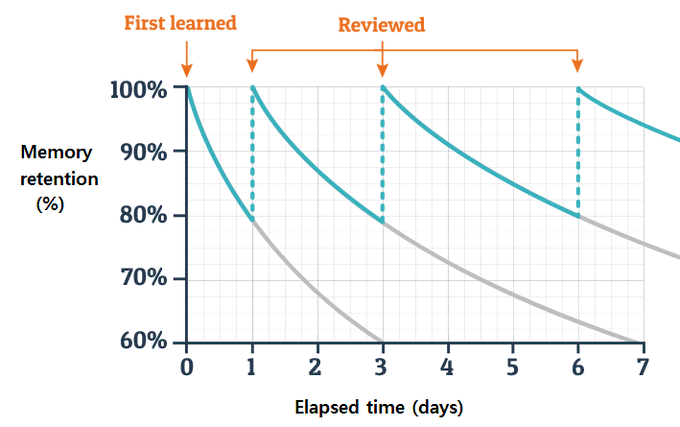
The Forgetting Curve
Memories weaken over time.
If we learn something new, but then make no attempt to relearn that information, we remember less and less of it as the hours, days and weeks go by.
The way to combat this curve is through spaced repetition.
Memories weaken over time.
If we learn something new, but then make no attempt to relearn that information, we remember less and less of it as the hours, days and weeks go by.
The way to combat this curve is through spaced repetition.
Goodhart's Law
“When a measure becomes a target, it ceases to be a good measure.”
When we set a specific goal, people tend to optimize for it regardless of the secondary consequences.
An employee is rewarded by the # of cars sold.
They try to sell more cars, even at a loss.
“When a measure becomes a target, it ceases to be a good measure.”
When we set a specific goal, people tend to optimize for it regardless of the secondary consequences.
An employee is rewarded by the # of cars sold.
They try to sell more cars, even at a loss.
Spotlight Effect
We overestimate how much people are paying attention to our behaviour and appearance.
Hard truth that will pull the weight off your shoulders: People care far more about themselves than they care about you.
Simple but hard antidote: Just be you.
We overestimate how much people are paying attention to our behaviour and appearance.
Hard truth that will pull the weight off your shoulders: People care far more about themselves than they care about you.
Simple but hard antidote: Just be you.
Suggestibility
We tend to accept and act on the suggestions of others.
We are influenced by the behavior of others without conscious awareness.
Yawning when others yawn is an example of suggestibility.
Lesson: Be aware of how you're affected by others' body behaviour.
We tend to accept and act on the suggestions of others.
We are influenced by the behavior of others without conscious awareness.
Yawning when others yawn is an example of suggestibility.
Lesson: Be aware of how you're affected by others' body behaviour.
First-Conclusion Bias
We settle on the first information or conclusion for a given problem.
This makes us resistant to asking further questions and searching for further alternatives.
Counter this urge by using decision checklists and objective reasoning—remove your emotions.
We settle on the first information or conclusion for a given problem.
This makes us resistant to asking further questions and searching for further alternatives.
Counter this urge by using decision checklists and objective reasoning—remove your emotions.
Strategic Underinvestment
Choose in advance what to fail at.
Don't try and do everything.
Nominate entire areas of your life (E.g., chores) where you won't expect excellence of yourself.
Focus your time and energy on only the most important, high-value tasks.
Choose in advance what to fail at.
Don't try and do everything.
Nominate entire areas of your life (E.g., chores) where you won't expect excellence of yourself.
Focus your time and energy on only the most important, high-value tasks.
That's a wrap!
Follow me @_alexbrogan for more thought-provoking content to help you get better at the game of life.
Follow me @_alexbrogan for more thought-provoking content to help you get better at the game of life.
If you like improving your thinking, you will love my weekly newsletter.
I share mental models (weekly), high-quality links to the best content I find (monthly), and exclusive subscriber resources (a few times per year).
You can join here: alexbrogan.beehiiv.com
I share mental models (weekly), high-quality links to the best content I find (monthly), and exclusive subscriber resources (a few times per year).
You can join here: alexbrogan.beehiiv.com
Loading suggestions...