

In Black Skins, White Masks, French psychiatrist Frantz Fanon says Black men get into relationships with White women because it fulfils their desire to be White.
“By loving me, she proves to me that I am worthy of a white love. I am loved like a white man. I am a white man.” 🧵
“By loving me, she proves to me that I am worthy of a white love. I am loved like a white man. I am a white man.” 🧵
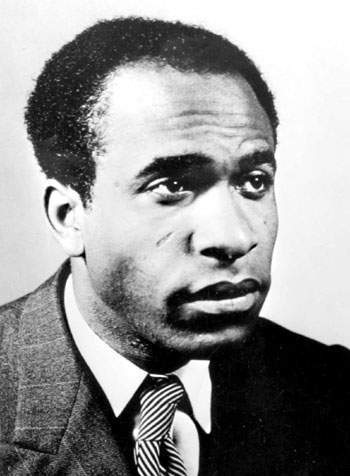
According to Fanon, being loved by a White woman makes the Black man feel he now exudes “white culture, white beauty, white whiteness.” He writes: “Between these white breasts that my wandering hands fondle, white civilisation and worthiness become mine.”
However, no matter how much the Black man immerses himself in “this [White ]culture [begins] to love this new world he ha[s] discovered and conquered for his own usage”, he finds “white folk refusing to accept him as one of their own.”
Fanon quotes the novelist René Maran, who wrote of a Black man, “Jean Veneuse”, who “through his intelligence and hard work has hoisted himself to the level of European thought and culture,” but cannot escape his race.
No matter how much the Black man immerses himself in White culture and begins to love this new world he has discovered and “conquered for his own usage”, he finds “white folk refusing to accept him as one of their own.”
The Black man looks for reassurance from a White man, who tells him, “you are like us; you are ‘us’. You think like us. You act like us...you only look like a black. For everything else, you think like a European. That’s why it’s only normal for you to love like a European.”
The Black man is reassured that he has nothing in common with Blacks. He is not Black; he is just “very, very dark.” As he is not like the other Blacks, he is not considered an authentic Black because the genuine Black is the savage, whereas he is civilised.
Fanon posits that Black men who get socially immersed in the White world think only “to gratify their appetite for white women.” Most of them, he adds, “marry less for love than for the satisfaction of dominating a European woman, spiced with a certain taste for arrogant revenge”
The Black man is conflicted. He wonders if marrying a European woman won’t give the impression that he despises women of his race and desires “White flesh that has been off limit to Blacks since the white man rules the world.”
This ‘civilised man’ is unhappy when he is among other Blacks of his native homeland. He feels “too lonely, too empty.” Like a White man, he feels deprived of all the comforts he needs but that these ‘savage’ Blacks “do not yet require.”
Fanon cites Louis T. Achille, who wondered if the Black man was not attempting to “[wipe] out in himself and in his own mind the colour prejudice from which he has suffered so long” by marrying White.
Achille suspected that some men (and women) marry White people who are otherwise beneath them culturally and in social class just as long as “they find access to complete equality with that illustrious race, the master of the world, the ruler of the peoples of colour.”
Even as he fights hard not to see himself as Black anymore, Fanon asserts that this type of Black man cannot shake the colour of his skin off and therefore struggles with low self-esteem. “He is terribly unsure of himself.”
Although he has chosen to be with a White woman, something deep inside tells him she could never really love him. “He demands repeated proof from his partner.” He has many fears: a fear of being a disappointment, a fear of displeasing, of being boring, of tiring.
Fanon deduces that this man is “a neurotic who needs to be released from his infantile fantasies.” He stresses that the desire to elevate oneself above Blackness is not typical of Black men but rather “represents a certain way for a neurotic, who happens to be black, to behave”
Fanon concludes with rhetorical questions asserting that as soon as the Black/White ‘split’ imposed by the Europeans was accepted, it was logical that the Black man would try to elevate himself to the White man’s level; to want to reach the highest level of this hierarchy.
There is only one solution, according to Fanon: restructuring the world. He says this is because “our aim is to enable healthy relations between Blacks and Whites”, which is evidently impossible under the current system. Ends.
Loading suggestions...