

"The Bhagavad Gita by Eknath Easwaran"
The Bhagavad Gita serves as a personal guide. It is not an external dialogue but an internal one: between the ordinary human personality, full of questions about the meaning of life, and our deepest Self, which is divine.
{Thread} 🧵
The Bhagavad Gita serves as a personal guide. It is not an external dialogue but an internal one: between the ordinary human personality, full of questions about the meaning of life, and our deepest Self, which is divine.
{Thread} 🧵
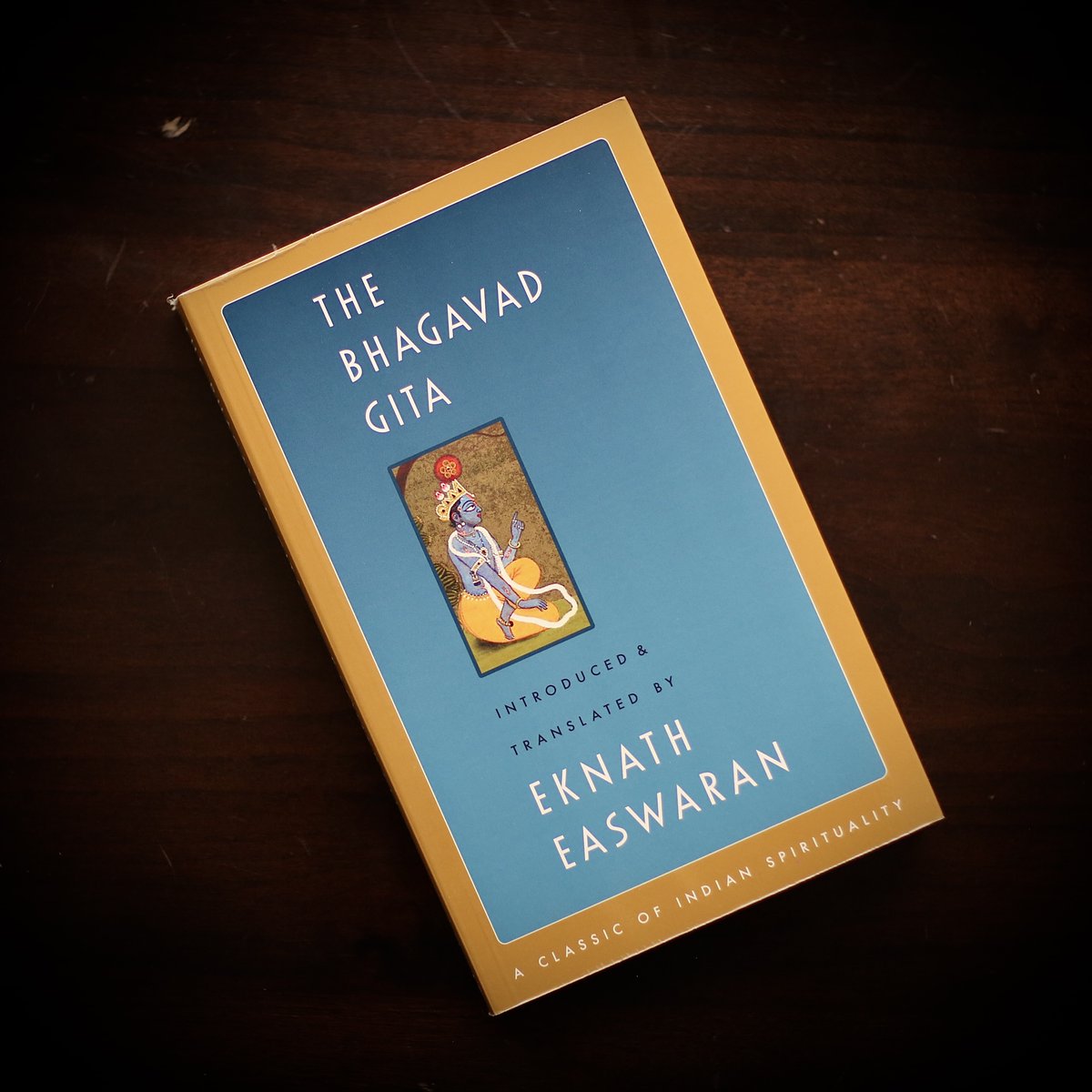
The Bhagavad Gita is a Hindu scripture, written in verses, that forms one part of the Mahabharata epic in ancient India.
It offers something to every seeker after God, of whatever temperament, by whatever path. It is a handbook for Self-realization and a guide to action.
It offers something to every seeker after God, of whatever temperament, by whatever path. It is a handbook for Self-realization and a guide to action.
There are eighteen chapters which are classified into three six-chapters.
The first third deals with karma yoga (the yoga of selfless actions), the second with jnana yoga (the yoga of knowledge) and the last with bhakti yoga (the yoga of devotion).
Lessons 👇
The first third deals with karma yoga (the yoga of selfless actions), the second with jnana yoga (the yoga of knowledge) and the last with bhakti yoga (the yoga of devotion).
Lessons 👇
1) You have the right to work, but never to the fruit of work. You should never engage in action for the sake of reward, nor should you long for inaction.
2) Strive constantly to serve the welfare of the world; by devotion to selfless work, one attains the supreme goal of life.
Do your work with the welfare of others always in mind. Perform all work carefully, guided by compassion.
Do your work with the welfare of others always in mind. Perform all work carefully, guided by compassion.
3) The wise see that there is action in the midst of inaction and inaction in the midst of action. Their consciousness is unified, and every act is done with complete awareness.
4) The immature think that knowledge and action are different, but the wise see them as the same. The person who is established in one path will attain the rewards of both.
5) Reshape yourself through the power of your will; never let yourself be degraded by self-will. The will is the only friend of the Self, and the will is the only enemy of the Self.
6) When meditation is mastered, the mind is unwavering like the flame of a lamp in a windless place. In the still mind, in the depths of meditation, the Self reveals itself.
Beholding the Self by means of the Self, an aspirant knows the joy and peace of complete fulfillment.
Beholding the Self by means of the Self, an aspirant knows the joy and peace of complete fulfillment.
7) When a person responds to the joys and sorrows of others as if they were his own, he has attained the highest state of spiritual union.
8) When a person is devoted to something with complete faith, I unify his faith in that. Then, when faith is completely unified, one gains the object of devotion. In this way, every desire is fulfilled by me.
9) Whatever you do, make it an offering to me – the food you eat, the sacrifice you make, the help you give, even your suffering. In this way you will be freed from the bondage of karma, and from its results both pleasant and painful.
10) Wherever you find strength, or beauty, or spiritual power, you may be sure that these have sprung from a spark of my essence. Just remember that I am, and that I support the entire cosmos with only a fragment of my being.
11) Those who know truly are free from pride and deceit. They are gentle, forgiving, upright, and pure, devoted to their spiritual teacher, filled with inner strength, and self-controlled.
12) It is the three gunas born of prakriti – sattva, rajas, and tamas – that bind the immortal Self to the body.
Sattva binds us to happiness; rajas binds us to action. Tamas, distorting our understanding, binds us to delusion.
Sattva binds us to happiness; rajas binds us to action. Tamas, distorting our understanding, binds us to delusion.
13) Cultivate vigor, patience, will, purity; avoid malice and pride. Then, you will achieve your divine destiny.
14) There are three gates to this self-destructive hell: lust, anger, and greed. Renounce these three.
15) To offer soothing words, to speak truly, kindly, and helpfully, and to study the scriptures: these are the disciplines of speech.
Calmness, gentleness, silence, self-restraint, and purity: these are the disciplines of the mind.
Calmness, gentleness, silence, self-restraint, and purity: these are the disciplines of the mind.
16) Those who are attached to personal reward will reap the consequences of their actions: some pleasant, some unpleasant, some mixed. But those who renounce every desire for personal reward go beyond the reach of karma.
17) Free from self-will, aggressiveness, arrogance, anger, and the lust to possess people or things, they are at peace with themselves and others and enter into the unitive state.
18) Those who teach this supreme mystery of the Gita to all who love me perform the greatest act of love; they will come to me without doubt.
Even those who listen to them with faith, free from doubts, will find a happier world where good people dwell.
Even those who listen to them with faith, free from doubts, will find a happier world where good people dwell.
One of the most appealing features of the Bhagavad Gita for our times is that it clears up misunderstandings about the spiritual life and shows it for what it is: active, joyful, intentional, a middle path between extremes that transfigures everyday living.
Thank you for going through the thread. Follow me at @readswithravi for more book learning, reviews, and lessons. Teach or share with others what you learn, that's how we grow.
Retweet the first tweet so you can share these lessons with others.
Retweet the first tweet so you can share these lessons with others.
Loading suggestions...