

Comms before the storm:
You need a crisis comms plan *before* crisis hits.
That plan should include
1) War room roles
2) Criteria for breaking the glass
3) Principles and priorities
4) Hour 1 actions and fact-finding
5) Messaging guidelines
6) Scenario plans and tactics
i.e.,
You need a crisis comms plan *before* crisis hits.
That plan should include
1) War room roles
2) Criteria for breaking the glass
3) Principles and priorities
4) Hour 1 actions and fact-finding
5) Messaging guidelines
6) Scenario plans and tactics
i.e.,
1) War room roles & responsibilities
Have a list of who needs to assemble in a crisis, with their cell numbers and locations.
Most likely the CEO, CFO, CTO, general counsel, and heads of comms, people, product, and investor relations.
Each will have specific responsibilities.
Have a list of who needs to assemble in a crisis, with their cell numbers and locations.
Most likely the CEO, CFO, CTO, general counsel, and heads of comms, people, product, and investor relations.
Each will have specific responsibilities.
2) Criteria for activating the war room
To avoid expensively convening people over a false alarm, agree in advance on what makes something a crisis for your company, eg:
- serious injuries or fatalities
- major disruption to operations
- material damage to finances
To avoid expensively convening people over a false alarm, agree in advance on what makes something a crisis for your company, eg:
- serious injuries or fatalities
- major disruption to operations
- material damage to finances

3) Priorities & principles
There won’t be enough time to attend to everything you want.
When making trade offs, put these things first:
- people (keep them safe and informed; know which people matter most)
- accuracy
- transparency
- speed
- legal compliance
There won’t be enough time to attend to everything you want.
When making trade offs, put these things first:
- people (keep them safe and informed; know which people matter most)
- accuracy
- transparency
- speed
- legal compliance
Principles for communicating in a crisis:
- speak decisively, no jargon or obfuscation
- use the most relevant mediums (social, email, industry press, etc)
- be aggressive about making corrections, before rumors ossify
- monitor your mentions in real time
- guard relationships
- speak decisively, no jargon or obfuscation
- use the most relevant mediums (social, email, industry press, etc)
- be aggressive about making corrections, before rumors ossify
- monitor your mentions in real time
- guard relationships
4) Hour 1 actions
Break-the-glass checklist:
- assemble war room
- establish comms protocols and regular check-ins, include legal counsel
- confirm relevant facts
- monitor social and press in real time
- confirm messaging
- assign people to key stakeholders (start w employees)
Break-the-glass checklist:
- assemble war room
- establish comms protocols and regular check-ins, include legal counsel
- confirm relevant facts
- monitor social and press in real time
- confirm messaging
- assign people to key stakeholders (start w employees)
Gather the facts:
A) What happened
- What, where, why, when, how
- Confidence levels and when you’ll know more
B) How bad it is
- Threat to people? Data? Finances?
- How many affected?
C) Help needed
- Outside counsel? PR firm? Law enforcement?
D) Reputation hit
(continued)
A) What happened
- What, where, why, when, how
- Confidence levels and when you’ll know more
B) How bad it is
- Threat to people? Data? Finances?
- How many affected?
C) Help needed
- Outside counsel? PR firm? Law enforcement?
D) Reputation hit
(continued)
As soon as possible, alert your social and marketing teams to be ready to pause any ongoing campaigns.
The last thing you need is a peppy or tonedeaf ad campaign running in the middle of a crisis.
You might need to cancel upcoming events too.
The last thing you need is a peppy or tonedeaf ad campaign running in the middle of a crisis.
You might need to cancel upcoming events too.
5) Messaging guidelines
Know your audience and your goals:
- What facts do they need to know?
- What emotions do you want them to feel?
- What actions are you asking them to take?
All messaging should include:
- Updated facts
- Context
- Your commitments
- Where to learn more
Know your audience and your goals:
- What facts do they need to know?
- What emotions do you want them to feel?
- What actions are you asking them to take?
All messaging should include:
- Updated facts
- Context
- Your commitments
- Where to learn more
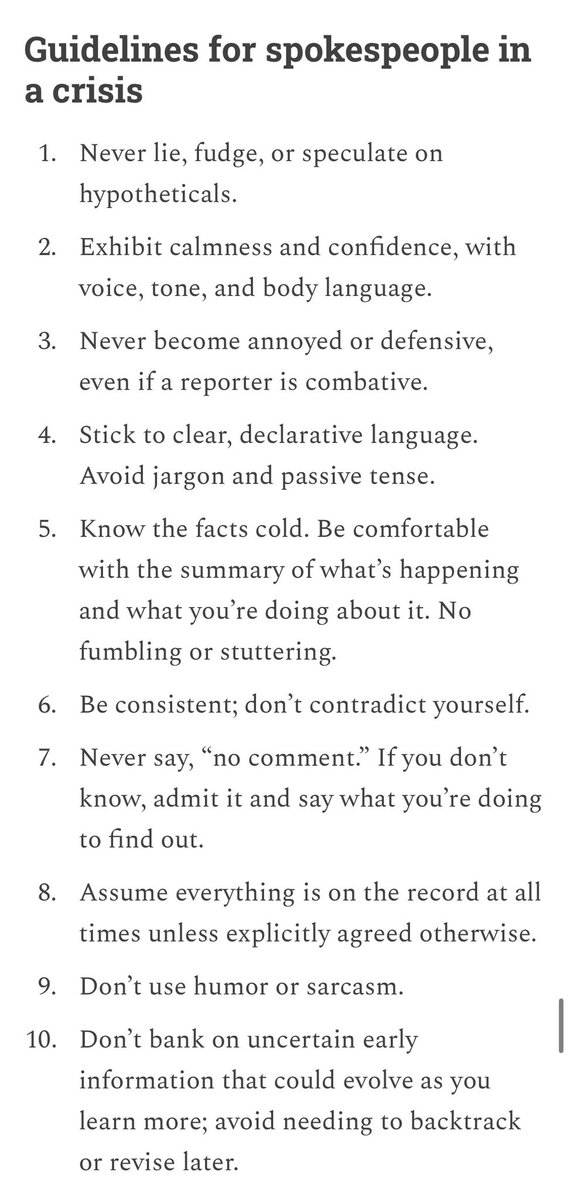
Guidelines for being a spokesperson during a crisis:
- Never lie, fudge, guess
- Don’t talk about calm, show calm (both words and body language)
- Never get defensive or annoyed
- Avoid jargon or mushy language
- Know the facts cold
- Never say “no comment”
Full list here
- Never lie, fudge, guess
- Don’t talk about calm, show calm (both words and body language)
- Never get defensive or annoyed
- Avoid jargon or mushy language
- Know the facts cold
- Never say “no comment”
Full list here
Handling confrontational or unfair questions:
- check your emotions
- correct the premise if needed
- use crisp answers and full sentences (less likely to be taken out of context)
- don’t use humor or sarcasm
- memorize your press inbox email!
- check your emotions
- correct the premise if needed
- use crisp answers and full sentences (less likely to be taken out of context)
- don’t use humor or sarcasm
- memorize your press inbox email!

6) Tactical execution
Identify in advance what your top risks are. Possibilities include:
- massive product failure
- political and regulatory risk
- data breach
- financial crisis
For each, draft generic plans and holding statements with blanks to quickly fill in if needed.
Identify in advance what your top risks are. Possibilities include:
- massive product failure
- political and regulatory risk
- data breach
- financial crisis
For each, draft generic plans and holding statements with blanks to quickly fill in if needed.
Crisis comms basics:
1) War room roles
2) Criteria for breaking the glass
3) Clear priorities
4) Hour 1 checklist
5) Messaging guidelines
6) Scenario plans and tactics
Here’s the full crisis comms playbook that you should save - and hopefully never need
getflack.com
1) War room roles
2) Criteria for breaking the glass
3) Clear priorities
4) Hour 1 checklist
5) Messaging guidelines
6) Scenario plans and tactics
Here’s the full crisis comms playbook that you should save - and hopefully never need
getflack.com
Loading suggestions...