

Kenya will from this month start importing diesel, super petrol and jet fuel on credit in a deal the government says is meant to ease demand for the dollar and prop up the battered shilling.
What does this mean?
What does this mean?
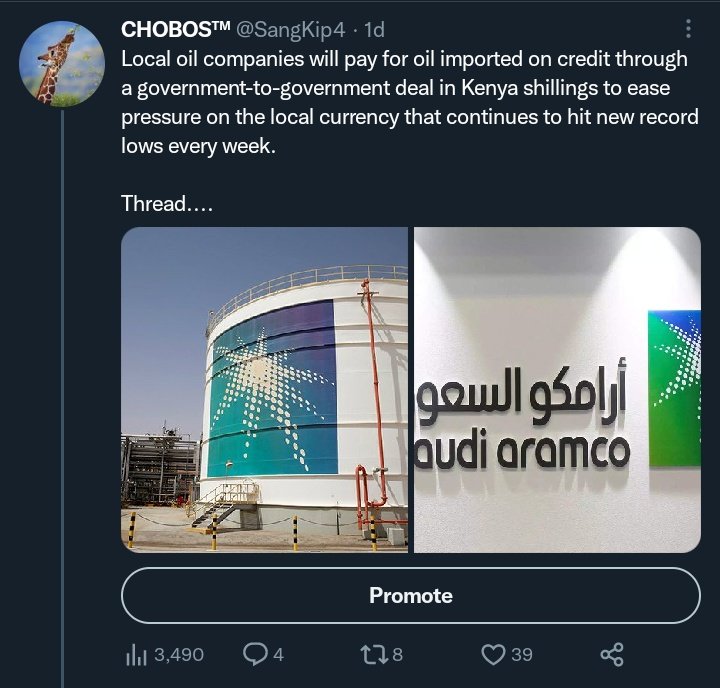
The deal with the United Arab Emirates and Saudi Arabia has elicited mixed reactions. Top officials have moved to defend it on grounds that it will ease the dollar demand in the short term amid questions on whether consumers will benefit in the form of reduced pump prices.
This is an import arrangement between the Kenyan government and the governments of the United Arab Emirates and Saudi Arabia. Under this deal, three State-owned oil firms from the two countries will nominate licensed oil companies in Kenya to import fuel for local and transit
The deal is meant to ease pressure on the dollar demand. It is estimated that oil companies need $500 million to pay for fuel imports every month, with the sector accounting for 28 percent of the import deal.
The government says that making payments in the seventh month will significantly ease the pressure on the dollar, allowing other traders and importers to access the currency for their bills.
This is a stop-gap measure intended to address the dollar demand and also help prop up the shilling that is currently hitting record lows every week.
Addressing the huge demand for dollars in the fuel importation market will free up dollars for other sectors, lower exchange rates for the greenback in the short-term and lower cost of imports.
The government expects that the fuel-importing OMC will be under reduced pressure to raise dollars before the expiry of the six month-credit period. All oil firms in Kenya scramble to get dollars every month to pay for their fuel imports.
The Ministry of Energy and Petroleum has not comprehensively explained why the local OMCs will be hand-picked by foreign oil firms instead of going through the Open Tender System.
The ministry only said that the oil firms of Saudi Arabia and the United Arab Emirates have for years dealt with the local OMCs and thus are in a better position to hand-pick them for this deal.
The Ministry of Energy and Petroleum reckons that if the deal eases the dollar crisis and helps prevent the shilling from sliding further in the next six months then Kenya will revert to the Open Tender System.
But if the dollar shortage continues and the shilling keeps falling, then Kenya will seek an extension of the government-to-government deal.
Oil companies in Kenya currently buy fuel in the global markets at spot prices. A spot price refers to the prevailing price for an asset—such as a security, commodity, or currency— bought or sold for immediate delivery.
Kenya will not purchase fuel under spot prices but will instead enjoy discounted prices from the suppliers. The discounted prices are in exchange for the assured market that Kenya will offer for the next six months.
Consumers are not likely to benefit from this deal due to the fact that the suppliers will factor in the refinancing costs of the product.
These companies are Saudi Aramco of Saudi Arabia, Emirates National Oil Company Group of Dubai and the Abu Dhabi National Oil Company
Saudi Aramco will supply two cargoes each for diesel and super petrol every month while ENOC will supply 3 cargoes of super petrol every month.
Saudi Aramco will supply two cargoes each for diesel and super petrol every month while ENOC will supply 3 cargoes of super petrol every month.
Loading suggestions...