
.:Hanafī fiqh: Eye-drops and contact lenses do not break the fast:.
There are some fatwas today which promote the idea that eye-drops and moist contact lenses break the fast due to their being a connection between the eyes and the throat, which was supposedly unknown in the past
There are some fatwas today which promote the idea that eye-drops and moist contact lenses break the fast due to their being a connection between the eyes and the throat, which was supposedly unknown in the past

However, this is a mistake. The reality is that eye-drops and contact lenses do not break the fast, and that there was some sort of connection between the eyes and the throat was not unknown to classical scholars, they were aware and yet did not rule that eye-drops break the fast
I shall present the comments and analysis of @ridawipress here, who has written an excellent critique of such fatawa.
First he comments on the following sentence from this fatwa: seekerspath.co.uk
First he comments on the following sentence from this fatwa: seekerspath.co.uk
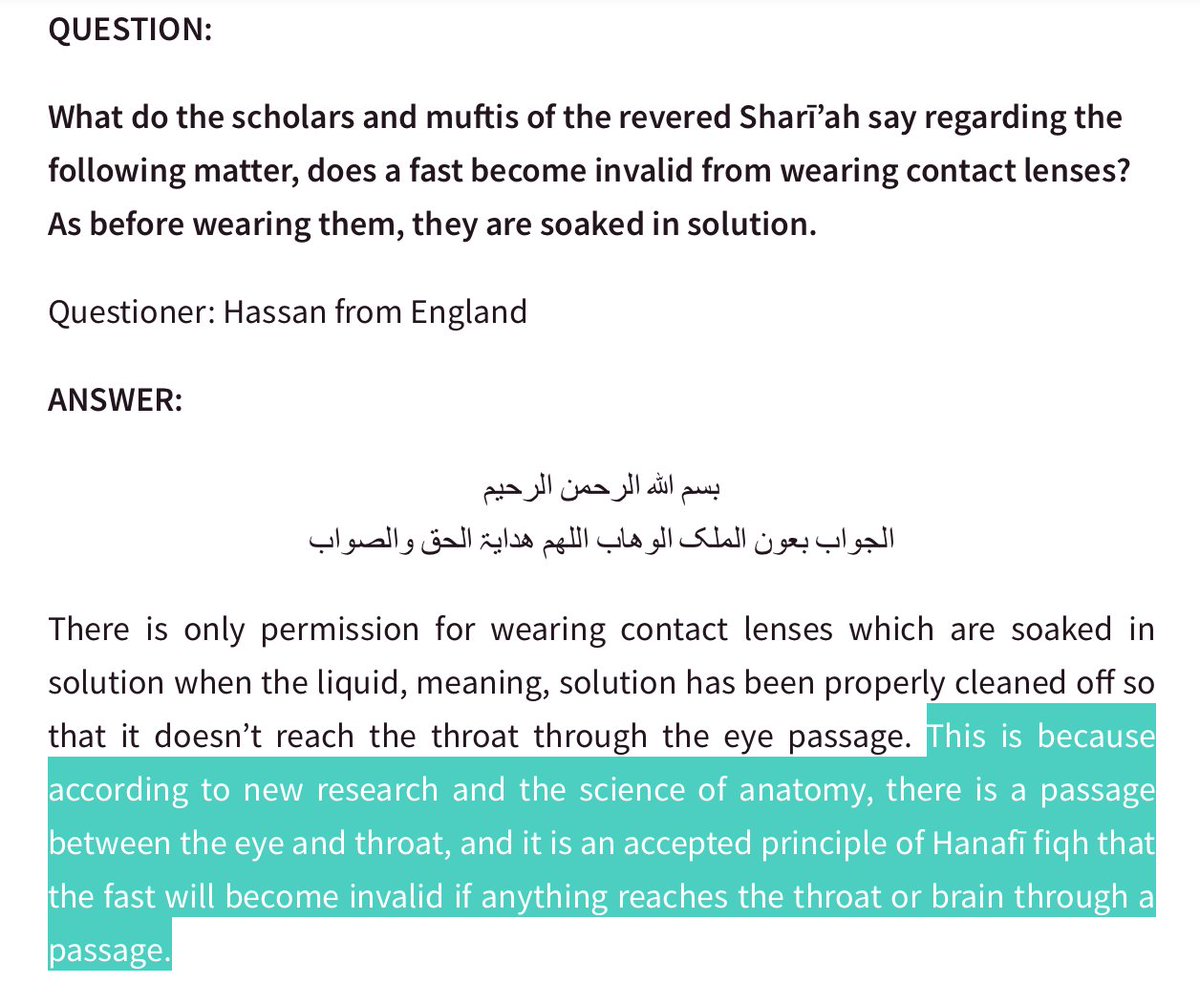
He writes:
FIRST.
i have a few objections on this clause, mainly 'anything':
1. the small amount of water left after rinsing the mouth [balal] does not break the fast.
FIRST.
i have a few objections on this clause, mainly 'anything':
1. the small amount of water left after rinsing the mouth [balal] does not break the fast.
2. dust or flour (in a mill) or smoke or some such thing that is difficult, if not impossible to avoid, reaches the throat does not break the fast.
3. or if the gums bled and this was swallowed.
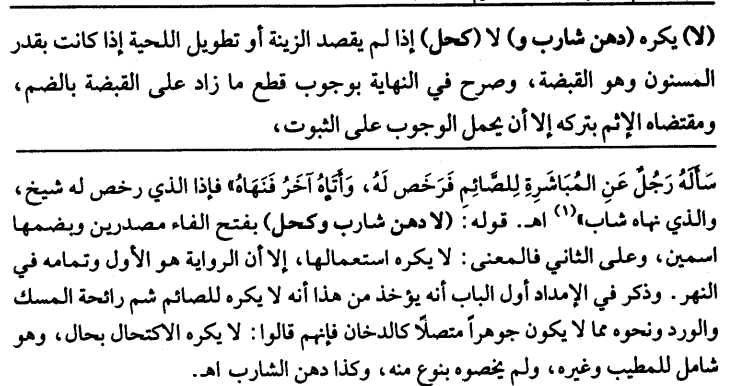
see radd al-muHtar, v3 p367 (DKI):
3. or if the gums bled and this was swallowed.
see radd al-muHtar, v3 p367 (DKI):

bahar e shariat: v1 p.982

so it is not absolute. also it is clarified that one should spit out all the water; the moisture that remains is exempt and it is not necessary to strain oneself to dry the mouth.
secondly early ulama were aware that there is a connection between the eye and the throat and knew about it from experience.
for example, in bahar shariat citing radd al-muhtar and jawharah:
...or applied oil or used kohl in the eyes, the fast will not break - even if the taste of the oil and kohl is felt in the throat; in fact, even if the traces of kohl are found in the spittle,
...or applied oil or used kohl in the eyes, the fast will not break - even if the taste of the oil and kohl is felt in the throat; in fact, even if the traces of kohl are found in the spittle,

even then the fast will not break.
so they knew that some of it would seep into the throat, even if they might not have known precisely how.
in jawharah al-nayyarah, the commentary on quduri by imam abu bakr ibn ali al-haddad al-zabidi [d.800 AH]:
so they knew that some of it would seep into the throat, even if they might not have known precisely how.
in jawharah al-nayyarah, the commentary on quduri by imam abu bakr ibn ali al-haddad al-zabidi [d.800 AH]:

imam al-Haddad passed away in 800 AH. so it was known six hundred years ago. we can go back even further: see al-muHit al-burhani fi'l fiqh al-nu'mani, by burhanuddin abu'l ma'ali maHmud ibn aHmad ibn mazah al-bukhari, d.616 AH.
in muhit burhani v2 p384:
"as for applying kohl (in the eyes) or using eye drops [lit. "dropping medicinal drops"] in the eyes will not break the fast according to our scholars. EVEN if one feels its taste in the throat.
"as for applying kohl (in the eyes) or using eye drops [lit. "dropping medicinal drops"] in the eyes will not break the fast according to our scholars. EVEN if one feels its taste in the throat.

And when one spits, if they see the traces of kohl in the spittle, will this invalidate the fast? shams al-ayimmah al-Halwani raHimahullah said that 'senior scholars [mashayikh] have differed on this, and most of them hold the position that it will not invalidate the fast."
SECOND.
the anatomy of the eye and how eye-drops or surma (kohl) etc. drain into the nose:
the lacrimal puncta are small orifices through which tears, eyedrops or other fluids (or kohl particles) can drain into the nose and also the throat.
the anatomy of the eye and how eye-drops or surma (kohl) etc. drain into the nose:
the lacrimal puncta are small orifices through which tears, eyedrops or other fluids (or kohl particles) can drain into the nose and also the throat.

grey's anatomy 19th century:

THIRD.
how big is this orifice? i.e. the punctum? and how much fluid flows in?
according to a medical website, the average size of the lacrimal punctum in the upper and lower eyelid was 0.57mm and 0.61mm respectively (even if the sample size was among a specific ethnic group).
how big is this orifice? i.e. the punctum? and how much fluid flows in?
according to a medical website, the average size of the lacrimal punctum in the upper and lower eyelid was 0.57mm and 0.61mm respectively (even if the sample size was among a specific ethnic group).

obviously, this will vary from person to person, but that is to just give an idea of how big the aperture is. anyone can get the idea of how much fluid can go in there.
see: koreamed.org
see: koreamed.org
why do tears flow on the cheeks? because, the lacrimal apparatus has a limited capacity to drain fluid and the rest will obviously will overflow. from the page mentioned above:

to put that in perspective, 0.007 ml at a time, assuming the eye is brimming with tears.
now, a standard eye-dropper dispenses about 0.05 ml of eyedrops. see here.
blogs.webmd.com
now, a standard eye-dropper dispenses about 0.05 ml of eyedrops. see here.
blogs.webmd.com

so how much of that 0.05 ml will drain in the nose?
and remember that this fluid does not directly go in the throat. only a part of that which is drained in the lacrimal ducts goes in the throat.
how much of that 0.007 ml is that?
and remember that this fluid does not directly go in the throat. only a part of that which is drained in the lacrimal ducts goes in the throat.
how much of that 0.007 ml is that?
compare this with the traces of water that are left in the mouth after rinsing and notice the following aspects:
- handful of water (try this. just now, i measured my scoop and it is about 25-30 ml)
- direct connection to the throat
- rinsing at least 5 x 3 times and maybe more.
- handful of water (try this. just now, i measured my scoop and it is about 25-30 ml)
- direct connection to the throat
- rinsing at least 5 x 3 times and maybe more.
YET, the fast is not invalid.
should such a micro quantity of the eye drop invalidate a fast even though it is not directly dropping in the throat, and it is far less than the traces of water that remains in the mouth after rinsing which does not invalidate the fast!
ponder.
should such a micro quantity of the eye drop invalidate a fast even though it is not directly dropping in the throat, and it is far less than the traces of water that remains in the mouth after rinsing which does not invalidate the fast!
ponder.
traces of water that remain, after rinsing the mouth and spitting it completely, will not invalidate the fast. the reasons for this are: that it is necessary and unavoidable. i.e. rinsing the mouth is necessary for ablution etc.
wAllahu a'alam.
wAllahu a'alam.
and to completely spit out everything is extremely difficult if not impossible. one can collect the saliva and spit it out a few times, but scholars said that it is not necessary to do it.
FOURTH.
for the sake of argument, if we suppose that such a quantity does indeed break the fast, we must then consider two other cases.
1. crying while fasting - if one cries so much that the water flows back in the nose and then in the throat - will it invalidate the fast?
for the sake of argument, if we suppose that such a quantity does indeed break the fast, we must then consider two other cases.
1. crying while fasting - if one cries so much that the water flows back in the nose and then in the throat - will it invalidate the fast?
in bahar e shariat it is said that if one or two drops of tears enter the mouth and one swallows it, the fast will not be invalidated; but if one swallows a lot of tears, it will invalidate the fast. bahar e shariat, v2 p988

if a tear drop entering the mouth externally does not invalidate the fast, how much will enter through the lacrimal punctum, and will it invalidate the fast? obviously, it will not. wAllahu a'alam.
2. washing ones face with water - water is splashed on the face during wuDu and much more in volume during ghusl (bathing). now, does this invalidate ones' fast? short answer: it doesn't.
now isn't the lacrimal punctum splashed with lots of water, far more than eye-drops? and we do that at least 15 times a day.
it is the same orifice and conventional wisdom says that the amount of water with such splashing entering the punctum should be far greater than the 0.05 ml eye drops put in the eye.
the point is, if the two cases above do not invalidate the fast, why should eye drops invalidate the fast?
besides, eye-drops are usually used only for medical reasons - whether dry eyes or conjunctivitis or some other ailment. of late, people are also using it for cosmetic reasons - to whiten the eyes.
in such a case, it is best avoided though i would think that all the arguments apply.
in radd al-muhtar: applying kohl during fasting, even it if is for cosmetic reasons is allowed.
Allah ta'ala knows best.
in radd al-muhtar: applying kohl during fasting, even it if is for cosmetic reasons is allowed.
Allah ta'ala knows best.
FIFTH: CONTACT LENSES
----
contact lenses are rinsed in a solution and then placed in the eye.
check this wikihow article: wikihow.com
so the two main steps are:
1. rinse the lens.
2. place it in the eye.
----
contact lenses are rinsed in a solution and then placed in the eye.
check this wikihow article: wikihow.com
so the two main steps are:
1. rinse the lens.
2. place it in the eye.
now compare the amount of solution that may be left on the lens at this time, with the amount of water left as traces in the mouth after rinsing.
secondly, the trace of the solution is less than one eye drop (i.e. 0.05 ml) that will eventually collect in the eye and MAY drain in the lacrimal duct and 0.007 ml of which go in the nose and a portion of which may trickle down in the throat.
now:
1. compare the surface area of the lens - with the surface area of the mouth. you get the idea how much of trace is left on the lens vs. left in the mouth.
1. compare the surface area of the lens - with the surface area of the mouth. you get the idea how much of trace is left on the lens vs. left in the mouth.
2. compare the indirect manner in which the fluid may reach the throat to the direct connection of the mouth and the throat.
unlike eye-drops, water splashing or tears, there is no direct dropping of fluid in the punctum, nor will this fill the eye such that excess will drain in the nose.
also, those who wear lenses, usually pull down the eyelid - that makes it even more difficult for fluid to enter the punctum.
contact lenses are used for both for vision correction and also for cosmetic reasons.
contact lenses are used for both for vision correction and also for cosmetic reasons.
regardless, the amount of the fluid that may actually reach the throat is extremely negligible and will certainly be less than the amount of water exempted which is left over after rinsing one's mouth. the main reason being that it is not possible to avoid this all the time.
therefore wearing contact lenses during fast will not invalidate the fast. and if you want to be ultra cautious, just press below the punctum while wearing the lens.
wAllahu a'alam.
wAllahu a'alam.
SIXTH: MITIGATION / PUNCTAL OCCLUSION.
----
if people are still apprehensive of using eye drops during fasting, and they have a medical need to do so, they can still do it.
mentalfloss.com
----
if people are still apprehensive of using eye drops during fasting, and they have a medical need to do so, they can still do it.
mentalfloss.com
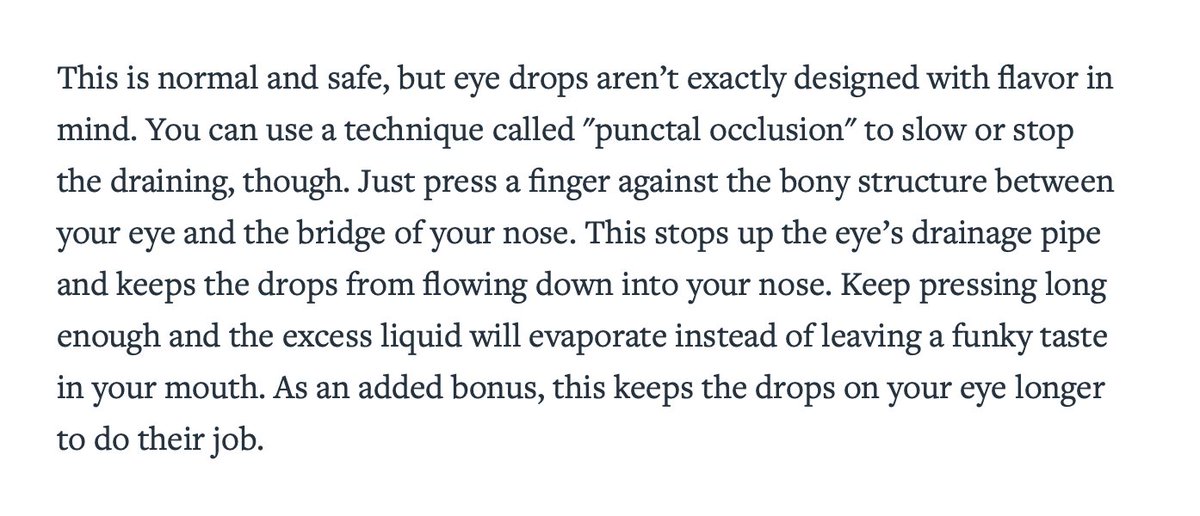
according to this page, merely closing the eyes will be enough for punctal occlusion.
glaucoma.org
glaucoma.org

here is advice from a respectable source:
ncbi.nlm.nih.gov
ncbi.nlm.nih.gov
so if you have a medical condition that requires you to use eye-drops, you can use them without any worry. if you want to be cautious, just close your eyes.
wAllahu a'alam wa ilmuhu atam wa aHkam.
wAllahu a'alam wa ilmuhu atam wa aHkam.
A fatwa of Mufti Muhammad Kaleem and approved of by Mufti Zahid Hussain was posted which permits the usage of eye-drops whilst fasting and states they shall not break the fast.
thesunniway.com
thesunniway.com

Mufti Qasim Zia, the one who gave the fatwa that eye-drops do break the fast responded to objections made to his original fatawa.
abu Hasan then critiqued this response.
abu Hasan then critiqued this response.
1. is this passage (lacrimal duct) similar to the passages in the mouth and nose?
2. how much of fluid (in volume) at any time can reach the throat? will any amount nullify the fast, even if it is merely a trace?
2. how much of fluid (in volume) at any time can reach the throat? will any amount nullify the fast, even if it is merely a trace?
3. is there a DIRECT connection from the eye to the throat, such that anything poured in the eye gets dropped in the throat?
suppose #1 is true, and you discount the size of the passage and treat it as the same?
suppose #1 is true, and you discount the size of the passage and treat it as the same?
4. is fast invalidated if water reaches the throat through the mouth, when put voluntarily, such as for rinsing one's mouth in wuDu?
if so, then splashing water in the eye will lead to the following questions:
if so, then splashing water in the eye will lead to the following questions:
5. does water splashed in the eyes reach the throat through the lacrimal duct?
6. obviously, if it is an open passage that allows eye-drops to enter the throat, what stops water from entering it?
6. obviously, if it is an open passage that allows eye-drops to enter the throat, what stops water from entering it?
7. does splashing water in the eyes voluntarily, invalidate the fast? this includes wuDu and ghusl and diving underwater.
8. if the answer to #7 above is no (i.e. voluntarily splashing water in the eye will not invalidate the fast), then why should eye drops invalidate the fast?
8. if the answer to #7 above is no (i.e. voluntarily splashing water in the eye will not invalidate the fast), then why should eye drops invalidate the fast?
9. secondly, why should water reaching the throat through the mouth voluntarily or involuntarily whilst being cognizant of being in the state of fast invalidates the fast, and why should water reaching the throat by way of the nasolacrimal duct NOT invalidate the fast?
1. will the water entering the eyes intentionally break the fast?
2. when you pour water on your face (intentionally, by the way), there is no way you can avoid it splashing on the nasolacrimal duct (unless you press it, to close it as explained below). does this break the fast?
2. when you pour water on your face (intentionally, by the way), there is no way you can avoid it splashing on the nasolacrimal duct (unless you press it, to close it as explained below). does this break the fast?

for example during wuDu, or ghusl, or say diving in water or for some other reason you immerse your head in water.
3. i would like to see a fatwa that clearly says that pouring water in the eyes will break the fast because it enters the nasolacrimal duct. instead of saying "IF it enters". because, why should eye-drops be so definite that they enter the orifice, and water is subject to doubt?
4. will the water/drops break the fast by merely entering the eyes, or ONLY if they reach the throat?
people use eye drops because they HAVE to. not because it is a recreational activity that one can 'avoid' it. we should be sensitive to the need of the people and a number of people need to use eye-drops due to their medical condition.

while previous fuqaha have already permitted it, revising it on the basis of "new research" or better understanding of anatomy, at the same time ignoring the nuance or finer points will only inconvenience the awam.
look at the kinds of dispensations given: injections for medicine will not invalidate the fast. pouring drops in the ear will not as long as the eardrum is not punctured (according to new research cited) but eye drops will break the fast!
the question is, if one taken an injection in the throat, will it invalidate the fast? or injections in the belly - will this invalidate the fast?
wa billahi't tawfiq.
wa billahi't tawfiq.
the nasolacrimal punctum was defined rightfully as a masaam (مسام) by earlier fuqaha. the nasolacrimal punctum should be treated as such instead of treating it as a 'passage' (منفذ) or an opening.
the sunniway fatwa cites alahazrat's fatawa riDawiyyah in this regard.
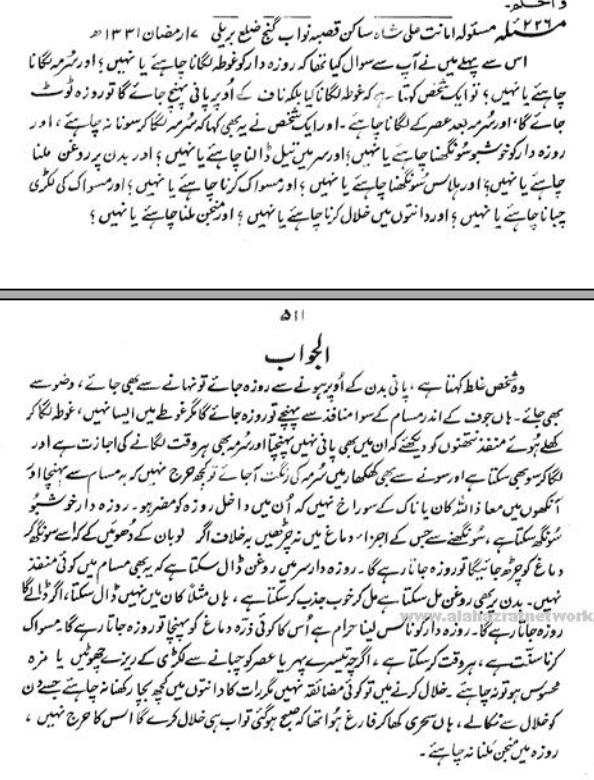
for example the pores of the skin - each of the pores is small, but collectively can absorb more than the amount a lacrimal punctum can take.
see this article to understand pores: ncbi.nlm.nih.gov
see this article to understand pores: ncbi.nlm.nih.gov
even if you discount all the arguments above, eye specialists say that pinching the area near the lacrimal punctum will block the passage and hence prevent fluid entering it.
should the fatwa not explain this process instead of flatly saying eye-drops invalidate fast?
should the fatwa not explain this process instead of flatly saying eye-drops invalidate fast?
wAllahu ta'ala a'alam.
see the second image on this page to how the fluid entering the punctum reaches the throat. notice that it is not direct.
pocketdentistry.com
pocketdentistry.com

so the balal, i was talking about is just to illustrate that the amount of water through the mouth, when it can reach the throat directly (and notice the size of the mouth and the amount of water you use when you rinse). this is exempt because it is unavoidable.
now, the eye drops - compare the volume of the eye drop - and that ALL of it won't simply pour in the throat. just traces of which, mixed with tears enter the punctum and from there to the nasolacrimal duct, and fraction of those traces trickle to the throat.
while water also reaches in the same manner, its taste is not detected. but the taste of eye-drops is detected.

just for perspective, in badayiy al-Sanayiy: 2/608:
if a person fasting applies kohl in the eyes, the fast does not break
even if he feels the taste in his throat, according to most ulama.
ibn abi layla said: this will break the fast.
if a person fasting applies kohl in the eyes, the fast does not break
even if he feels the taste in his throat, according to most ulama.
ibn abi layla said: this will break the fast.

as for us [hanafis]: our proof is the hadith reported by abdullah ibn mas'ud raDiyAllahu anhu who said: "RasulAllah sallAllahu alayhi wa sallam came out [of his house] in ramaDan and his eyes were full of kohl; umm salamah had applied kohl in his eyes."
this is because there is no direct pathway from the eye to the stomach/abdomen, nor to the brain [i.e. the frontal sinuses]; so the taste that one experiences is because of the traces [trickling down?] not because the thing itself is dropped per se [ayn];
and like dust and smoke it does not invalidate the fast.
similarly, if one applies oil in his hair [i.e. the head] or his body and it is absorbed, this will not harm - because it is the traces that reach, not that the substance reaches directly....
similarly, if one applies oil in his hair [i.e. the head] or his body and it is absorbed, this will not harm - because it is the traces that reach, not that the substance reaches directly....
imam sarakhsi also considers it analogous to dust and smoke.
if we treat the nasolacrimal punctum as a passage, pathway, 'route' etc. then why do we gloss over the fact that it opens in the nose and not in the throat?
if we treat the nasolacrimal punctum as a passage, pathway, 'route' etc. then why do we gloss over the fact that it opens in the nose and not in the throat?

from the anatomy we have read, there is no DIRECT passage from the eyes to the throat. specialists, please correct, if i am wrong.
with that caveat, read imam sarakhsi's fatwa.
with that caveat, read imam sarakhsi's fatwa.
"pores between the eyes and throat" sounds like bad anatomy, and does not make sense.
----
pores are tiny openings; so the lacrimal puncta can be treated as a pore. manafidh are open passages/pathways.
----
pores are tiny openings; so the lacrimal puncta can be treated as a pore. manafidh are open passages/pathways.

in badayiy, this is even demarcated:
"...the bodily orifices such as nose, ear or anus..."
"...the bodily orifices such as nose, ear or anus..."

the premise that there is a passage between eye and throat is itself flawed. there is a route, true, but it is not a direct route as amply demonstrated below. let us discount everything i have said below. let us cite mufti qasim zia sahib, from this fatwa here.

let us read it with some key words emphasised.
This is the lacrimal punctum. When you produce tears or have another liquid in your eyes, some of it drains
---> into these holes
---> and then into the lacrimal sac,
---> the nasolacrimal duct,
This is the lacrimal punctum. When you produce tears or have another liquid in your eyes, some of it drains
---> into these holes
---> and then into the lacrimal sac,
---> the nasolacrimal duct,
---> and eventually into the back of your nose
---> and throat, where you might get a taste.’
so where is this direct passage like that of the nose and mouth?
apart from mere conjecture about previous fuqaha that they did not know, people have glossed over a much bigger thing.
---> and throat, where you might get a taste.’
so where is this direct passage like that of the nose and mouth?
apart from mere conjecture about previous fuqaha that they did not know, people have glossed over a much bigger thing.
our hanafi imams have asserted that our scholars allowed kohl, because of the Hadith (see badayiy and others) - that RasulAllah sallAllahu alayhi wa sallam applied kohl while fasting;
does the theory that 'previous scholars were not aware of this passage' still hold, or is superseded by the action of the shaari'y?
if the illah is that, "if it is established, that a passage exists between eyes and throat (howsoever small), and if anything reaches the throat from this 'route' of the eyes, the fast is broken", then we need to answer:
1. what about washing/splashing water on eyes and water entering the same passage?
2. what about tears entering the passage?
3. what about kohl entering the passage?
the third one is very important here. this poses a major problem as follows:
2. what about tears entering the passage?
3. what about kohl entering the passage?
the third one is very important here. this poses a major problem as follows:
1. according to all the citations from hanafi books [unbeknown has pointed this out] the illah of the fast not breaking even if the taste is felt in the throat is because, it reaches there by the pores/masaam.
2. so, according to contemporary scholars, if this is mistaken understanding by earlier ulama as they didn't know that a passage exists, then it follows that the fast should break - because the kohl enters the throat by the passage/manfadh and so also eye drops and anything else.
3. if the above is true, that is according to "modern research" kohl entering the throat by way of eyes, breaks the fast, then how do you explain the hadith that RasulAllah sallAllahu alayhi wa sallam applied kohl while fasting?
who amongst us will dare to say (ma'adhAllah) that it was because of not knowing...? al-iyadhu billah.
mabsut sarakhsi, v3 p67:
mabsut sarakhsi, v3 p67:

4. and unlike other cases, there is not warning about being careful in fasting either. [in the hadith, RasulAllah sallAllahu alayhi wa sallam said, rinse your mouth and wash your nose freely except when you are fasting - and be careful when you are fasting.]
badayiy al-sanayiy, v2 p606
why is there no warning on being careful in not letting water in the eyes? who amongst us will dare to say (ma'adhAllah) that it was because of not knowing...? al-iyadhu billah.
why is there no warning on being careful in not letting water in the eyes? who amongst us will dare to say (ma'adhAllah) that it was because of not knowing...? al-iyadhu billah.

5. also, if you say that it is a special case (that is, applying kohl) then you should specify why so.
wAllahu a'alam.
wAllahu a'alam.
Taj al-Shari'ah Mufti Akhtar Raza Khan stated eye-drops do not break the fast:
youtube.com
youtube.com
Conclusion:
Eye-drops and moist contact lenses do not break the fast, as they do not reach the throat via a direct passage, rather it reaches indirectly similar to pores.
Washing the face during fasting and doesn't break the fast even if the water enters the eyes.
Eye-drops and moist contact lenses do not break the fast, as they do not reach the throat via a direct passage, rather it reaches indirectly similar to pores.
Washing the face during fasting and doesn't break the fast even if the water enters the eyes.
There has not been a new discovery, classical scholars were aware that there was an indirect connection between the eyes and the throat, and they permitted usage of kohl and eye-drops and did not rule them to break the fast.
RasulAllah ﷻ himself wore kohl whilst fasting, and if there was a chance of water directly reaching the throat from the eyes RasulAllah ﷺ would have cautioned regarding it as he did regarding water in the mouth.
Loading suggestions...