

Let's take a deep dive into the utility of composite endpoints and how this form of a primary end-point (PEP) was useful in TRILUMINATE

RCTs in the '80s and '90s used mortality as a PEP
But with more effective therapies, mortality has decreased!
e.g. SOLVD ('91) showed mortality in Rx arm of 35.2% vs mortality in Rx arm of EMPEROR-Reduced (2020) was 10% 😱
nejm.org
nejm.org


Effect of Enalapril on Survival in Patients with Reduced Left Ventricular Ejection Fractions and Congestive Heart Failure | NEJM
Original Article from The New England Journal of Medicine — Effect of Enalapril on Survival in Patie...
Cardiovascular and Renal Outcomes with Empagliflozin in Heart Failure | NEJM
Original Article from The New England Journal of Medicine — Cardiovascular and Renal Outcomes with E...
Check out this beautiful figure from Braunwald et al. that further illustrates the improvements in mortality over time⤵️
nejm.org
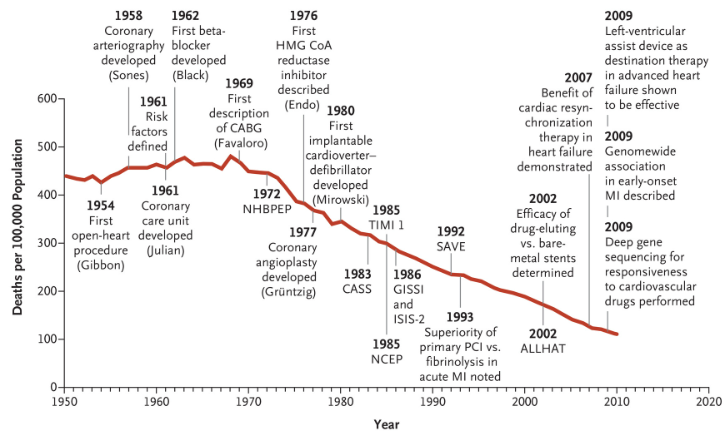

For more financially feasible and efficient trials, @DrCaliff_FDA et al. and Braunwald et al. argued for combining mortality & nonfatal events to ⬆️ the pace of innovation & expose fewer patients to ineffective therapies
pubmed.ncbi.nlm.nih.gov
pubmed.ncbi.nlm.nih.gov

Use of composite endpoints in thrombolysis trials of acute myocardial infarction - PubMed
Although preventing early mortality following acute myocardial infarction (MI) is the most important...
Left ventricular ejection fraction may not be useful as an end point of thrombolytic therapy comparative trials - PubMed
In the era of comparative and adjunctive trials in reperfusion therapy, the need to develop alternat...
The rationale was that each outcome is biologically related to the disease process and can therefore be combined thus:
🔸⬇️ sample size requirement
🔸⬇️ cost
🔸⬇️ time until event
🔸in some cases, helps avoid choosing arbitrarily between outcomes

Thus began the Composite Outcome Revolution‼️
Dr. Armstrong & @CindyWesterhout found 140 trials from 2011- 2016 in 4 leading journals that used some form of a composite end point‼️
pubmed.ncbi.nlm.nih.gov
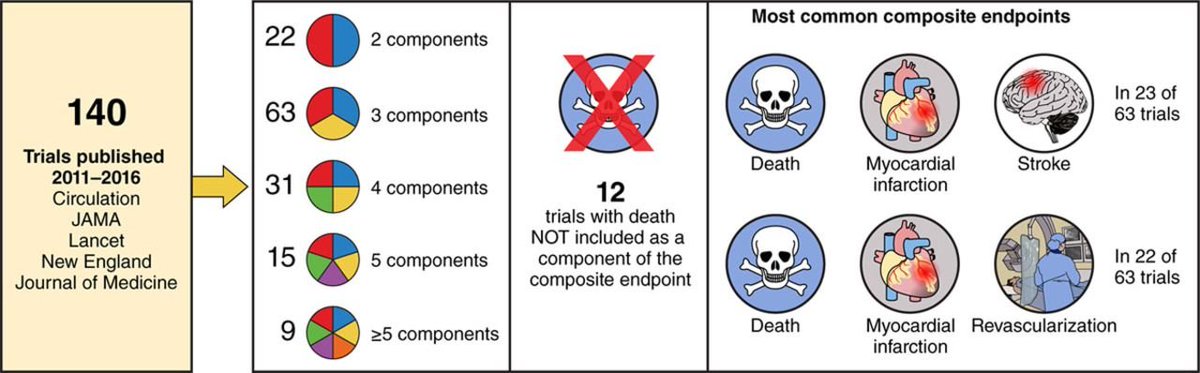

However, there have been numerous criticisms of this approach including:
👉analysis accounts for time to the first event which is usually the nonfatal event
👉fatal and nonfatal events have equal weight
👉repeat hospitalizations aren't counted

This is a great overview of the criticisms and possible solutions for composite endpoints 👇
pubmed.ncbi.nlm.nih.gov
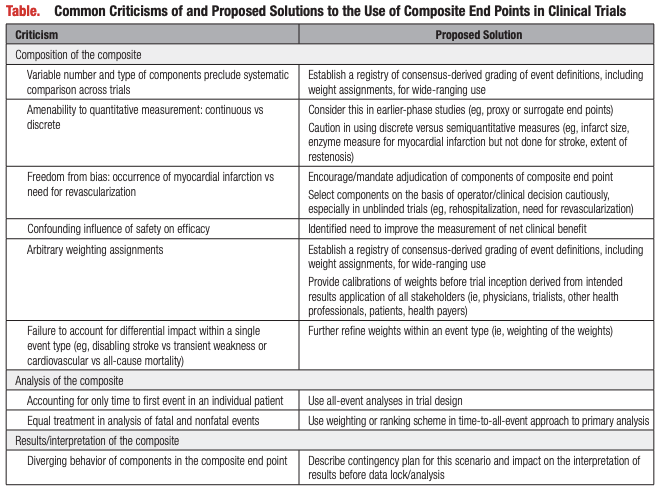
To overcome these criticisms, various methods have been proposed. There are too many to discuss in one 🧵 but let's get ready for #CardsJC & look at the method used in TRILUMINATE
✨THE WIN RATIO✨

@pocock_stuart et al proposed the win ratio to prioritize the more clinically important component of the composite and include more of those events in the analysis
pubmed.ncbi.nlm.nih.gov
So how does it work❓

Matched Pairs Method:
⭐️form matched pairs of patients (Rx vs control) based on their risk profile
⭐️for each pair, see if one of them had the major event (death) 1st
⭐️if neither had the major event, you go onto the next component (HF hospitalization)
⭐️Win Ratio = number of winners for the Rx arm (control group fared worse) ➗ Losers in Rx arm (Rx fared worse)
If it's difficult to match, then the Unmatched Pairs Method is used:
It is the same method except that every patient in the Rx arm is compared to every patient in the control arm
This approach was described by Finkelstein and Schoenfeld
cdn1.sph.harvard.edu
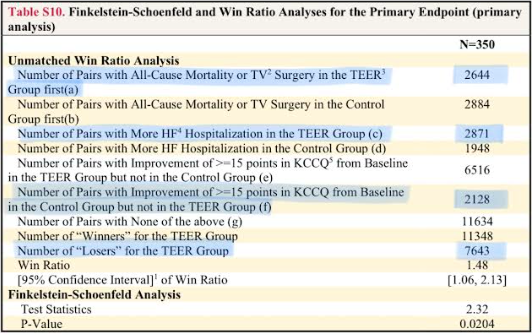
Let's apply this to the TRILUMINATE results
The 3 components of the composite outcome were:
1⃣All-cause mortality or tricuspid valve (TV) surgery
2⃣HF Hospitalization
3⃣Improvement of >=15 points in Kansas City Cardiomyopathy Questionnaire (KCCQ)
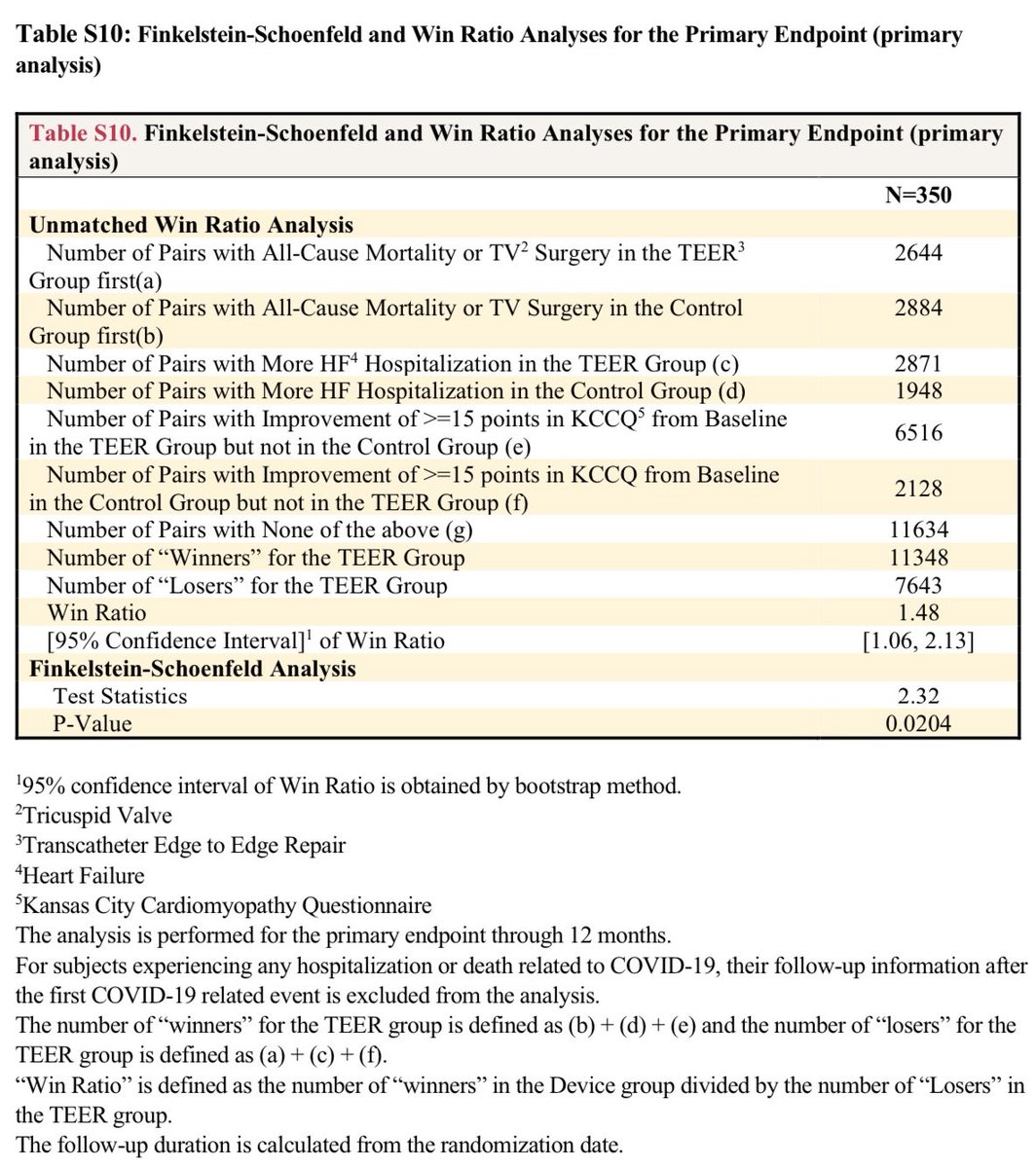
They used the unmatched approach:
Rx arm was the winner (i.e. control arm had more events):
2884 times in mortality/TV surgery
➕
1948 times in HF Hospitalization
➕
6516 in KCCQ
= 11348 wins

Rx arm was the loser (i.e. control arm had less events):
2644 times in mortality/TV surgery
➕
2871 times in HF Hospitalization
➕
2128 in KCCQ
= 7643 losses
Win Ratio = 11348/7643 = 1.48 and, therefore, demonstrates superiority
Now that we understand the methods used, Join @CardioNerds #HouseThomas #HouseEinthoven #CardsJC and our experts at 8PM EST to discuss the takeaways from TRILUMINATE!!!
Thanks for joining #CNstatsdemystified
Huge shoutout to @TDonisan @dinubalanescu @AmitGoyalMD for their guidance and for reviewing! And to the entire @CardioNerds family for being the best family around!
For further reading:
pubmed.ncbi.nlm.nih.gov
pubmed.ncbi.nlm.nih.gov
pubmed.ncbi.nlm.nih.gov
pubmed.ncbi.nlm.nih.gov
jamaevidence.mhmedical.com

Computing Methods for Composite Clinical Endpoints in Unprotected Left Main Coronary Artery Revascularization: A Post Hoc Analysis of the DELTA Registry - PubMed
In a large study of ULMCA revascularization, incorporating the clinical relevance of the individual...

Development and Evolution of a Hierarchical Clinical Composite End Point for the Evaluation of Drugs and Devices for Acute and Chronic Heart Failure: A 20-Year Perspective - PubMed
Traditional approaches to the assessment of new treatments for heart failure have generally evaluate...
Proposal for a new clinical end point to evaluate the efficacy of drugs and devices in the treatment of chronic heart failure - PubMed
Clinical trials designed to evaluate the effect of drugs and devices on the symptoms and clinical st...

Composite End Points | Users' Guides to the Medical Literature: A Manual for Evidence-Based Clinical Practice, 3rd ed | JAMAevidence | McGraw Hill Medical
Read chapter 12.4 of Users' Guides to the Medical Literature: A Manual for Evidence-Based Clinical P...

The "Utility" in Composite Outcome Measures: Measuring What Is Important to Patients - PubMed
The "Utility" in Composite Outcome Measures: Measuring What Is Important to Patients
Loading suggestions...