

I’ve long argued that countries should adopt well-designed industrial policies
▪️ Developed countries: maintain competitiveness of mfg. industries & manage the disruptive effects of dynamic global trade
▪️ Developing countries: need to industrialize
asia.nikkei.com
▪️ Developed countries: maintain competitiveness of mfg. industries & manage the disruptive effects of dynamic global trade
▪️ Developing countries: need to industrialize
asia.nikkei.com

Key words here: “well-designed”
▪️ Policies should fit the stage of economic development
▪️ What works for a lower-income country will be different from an advanced one
▪️ Comes down to identifying comparative advantages & targeted skills/tech accumulation
▪️ Policies should fit the stage of economic development
▪️ What works for a lower-income country will be different from an advanced one
▪️ Comes down to identifying comparative advantages & targeted skills/tech accumulation
I am encouraged to see us finally move to a “New Washington Consensus” outlined in Sullivan’s recent speech.
Took longer than necessary to get here, in part from having to swallow the bitter pill that the old “Washington Consensus” was flawed …
Took longer than necessary to get here, in part from having to swallow the bitter pill that the old “Washington Consensus” was flawed …
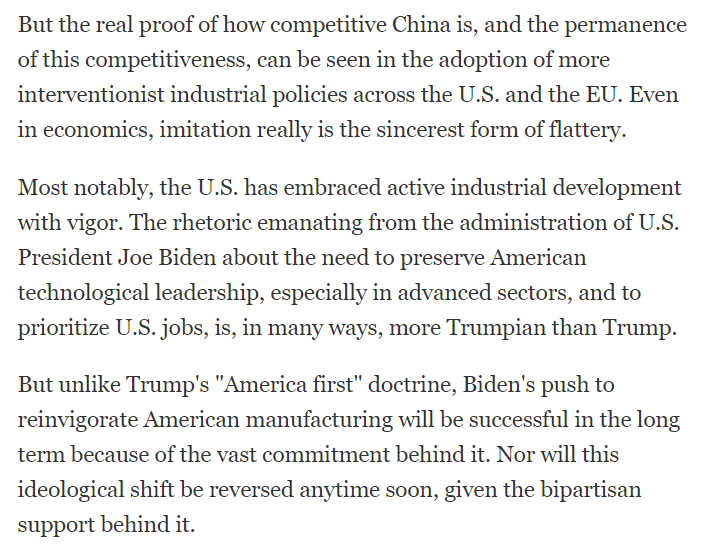
… esp. the over-reliance on “free markets” (e.g. privatization) as a substitute for the hard work that is often required to build an economy, particularly for lower-income economies
But recognizing the problem is a necessary step to addressing it
But recognizing the problem is a necessary step to addressing it
The author is right to point out that scale is important to any manufacturing industry.
Getting good at manufacturing is about repetition and having scale means more reps.
Manufacturing also means developing robust supply chains and leveraging the power of clustering effects.
Getting good at manufacturing is about repetition and having scale means more reps.
Manufacturing also means developing robust supply chains and leveraging the power of clustering effects.
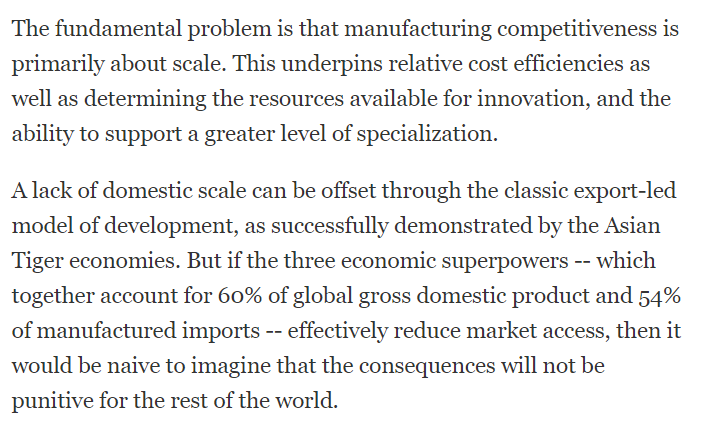
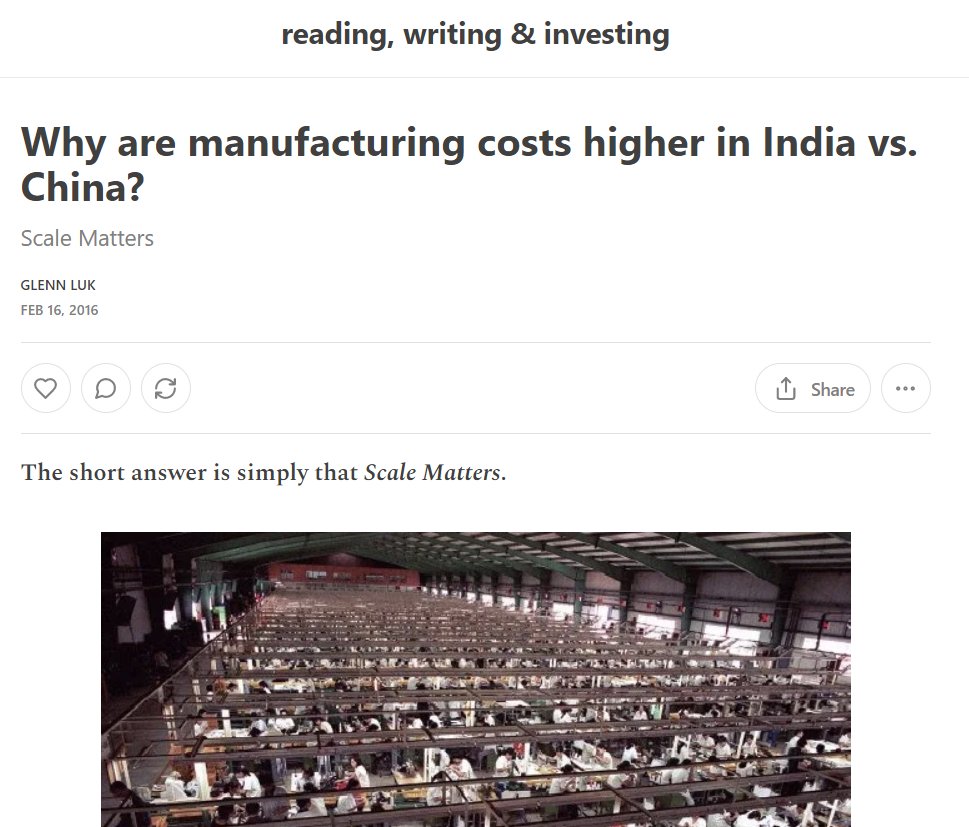
Where I disagree a bit is that lack of scale by itself is a death knell for smaller economies, particularly the Asian Tigers that are “at the same stage of industrial development” as the US and EU

This is because the laws of comparative advantage still hold true in a world with more industrial policy
No matter how big an economy, there are still resource constraints and you cannot do everything well.
You still need to pick and choose your battles.
No matter how big an economy, there are still resource constraints and you cannot do everything well.
You still need to pick and choose your battles.
Indeed part of a well-designed industrial policy should be the ability to correctly identify which industries fit an economy’s core strengths as well as whatever “strategic” industries they feel necessary to "win"
And then executing on these policies.
And then executing on these policies.
Take Taiwan as an example. It ranks 57th in world population and 139th in land area.
Yet it has figured out how to dominate chip manufacturing after accumulating skills, developing IP and know-how and investing capital with the support of well-designed industrial policy.
Yet it has figured out how to dominate chip manufacturing after accumulating skills, developing IP and know-how and investing capital with the support of well-designed industrial policy.
Will our newfound “strategic” emphasis on chip manufacturing become a headwind for Taiwan and TSMC?
Only if the US can accumulate more skills, more process knowledge and know-how than Taiwan and as I have mentioned elsewhere that is not going to be easy.
Only if the US can accumulate more skills, more process knowledge and know-how than Taiwan and as I have mentioned elsewhere that is not going to be easy.
People also seem to forget that Taiwan's chip industry has been competing against a scaled and well-capitalized China that makes prolific use of industrial policy for years ...
... yet has to date not been able to close the advanced node gap w/ Taiwan’s chipmaking capabilities.
... yet has to date not been able to close the advanced node gap w/ Taiwan’s chipmaking capabilities.
An economy the size of Taiwan’s just needs 1 or 2 TSMC-size companies to be very rich and at advanced levels of development.
Taiwan’s per capita GDP has reached the same level as Scandinavian countries like the Netherlands and Denmark.
Taiwan’s per capita GDP has reached the same level as Scandinavian countries like the Netherlands and Denmark.
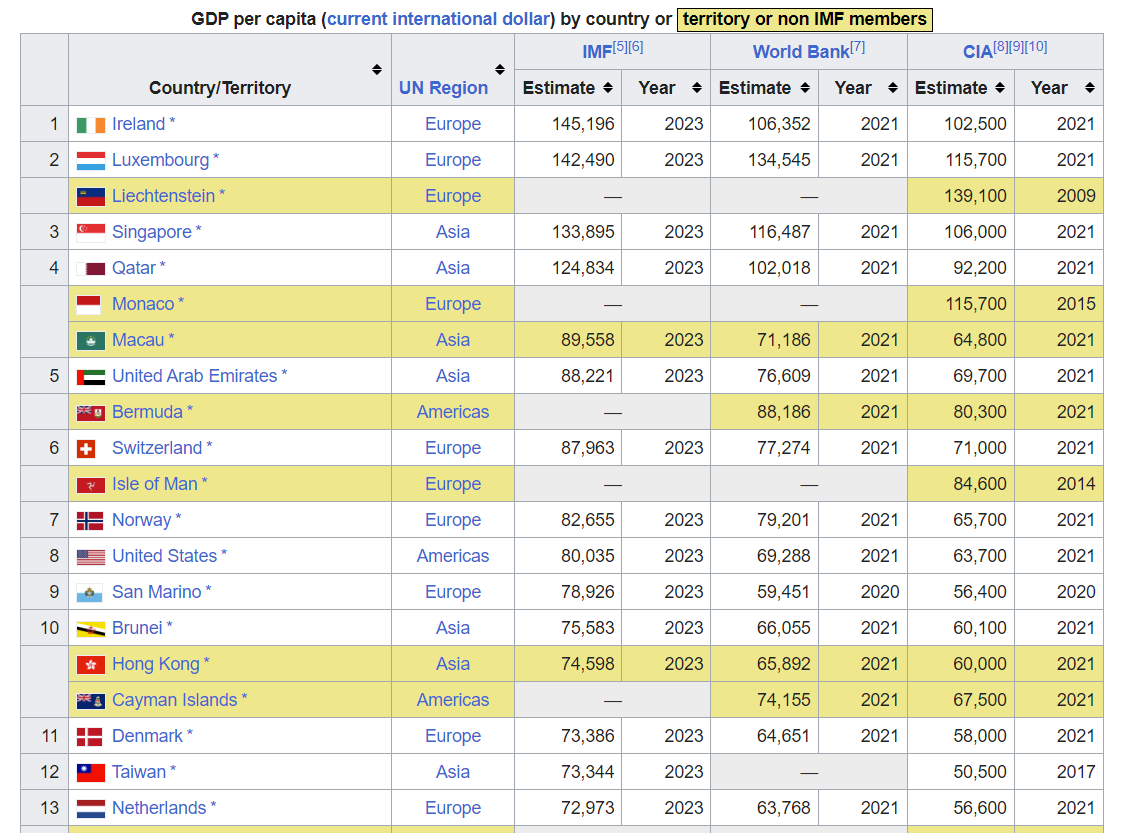
While larger countries have more scale & resources, they also need multiple TSMCs to be rich.
They will need to spread out their resources across multiple industries.
Large economies, like small ones, are still constrained by a finite amount of resources.
They will need to spread out their resources across multiple industries.
Large economies, like small ones, are still constrained by a finite amount of resources.
Larger economies cannot dominate every single available industry because that would mean potentially having to spread resources too thinly.
They still need to pick and choose how and where they allocate their finite resources like subsidy dollars and attention.
They still need to pick and choose how and where they allocate their finite resources like subsidy dollars and attention.
National resource allocation is ultimately where a well-designed industrial policy should come into play.
Industrial policies should be shaped by the specific comparative advantages of an economy and also reflect a country’s strategic priorities.
Industrial policies should be shaped by the specific comparative advantages of an economy and also reflect a country’s strategic priorities.
The beauty of comparative advantages is that every economy possesses them.
For advanced economies, it would be specific concentrations of industry knowledge and skillsets.
For lower-income economies, it is often a relatively low-cost labor pool.
For advanced economies, it would be specific concentrations of industry knowledge and skillsets.
For lower-income economies, it is often a relatively low-cost labor pool.
Following this, industrial policies for a lower-income economy should look very different from those for an advanced economy. Lower economies should be focused on finding labor-intensive jobs for their low-income labor force ...
... while advanced economies should be figuring out how to leverage existing pools of accumulated skills, technology and invested capital as well as which new, emerging industries they may want to re-deploy these assets.
Industrial policy (often associated with mercantilism) was a bit of an anathema for many years but I would argue that the nature of global trade has fundamentally changed in the post-WW2 era compared to a century or two ago.
First, it is a lot more specialized. Before there might have been a handful of mfg industries (textiles, steelmaking etc.).
Because of high transport costs, it made sense to vertically integrate the entire manufacturing process in one country, typically the leading economy.
Because of high transport costs, it made sense to vertically integrate the entire manufacturing process in one country, typically the leading economy.
Leading mfg economies would look to poor countries for raw materials and never re-locate any higher value-add mfg activities to these places (no zero spillover benefits).
More insidiously, trade “negotiations” were often conducted with gun barrels pointing at the poor countries or through literal enslavement of colonies.
Today, lower transport costs & technology have broken up the production of goods where certain steps can be farmed out to different players in the value chain.
There is almost an infinite array of consumer goods categories and richer set of skills categories needed to efficiently produce them.
It is possible to specialize in ways that were not possible before. This favors smaller countries.
It is possible to specialize in ways that were not possible before. This favors smaller countries.
With the age of imperialism thankfully over, we have global bodies that help facilitate the conduct of trade
While violence & coercion have not been completely eliminated, smaller + less-developed countries have greater agency in trading with each other today than a century ago
While violence & coercion have not been completely eliminated, smaller + less-developed countries have greater agency in trading with each other today than a century ago
In this more complex environment, industrial policies are less harmful because they can lead to greater fragmentation of the supply chain, resulting in offshoring pieces to trade partners that have greater comparative advantages.
In doing so, there are spillover benefits in skills and capital accumulation for trade partners that didn’t take place in global trade 100 years ago.
We are seeing this actively at play particularly in ASEAN where Asian Tiger and Chinese manufacturers are pro-actiely shifting global supply chains into countries like Vietnam, Cambodia and Indonesia.
From this perspective I don’t think East Asian economies are at a disadvantage in this new era.
One can even argue that they have an advantage, having effectively used industrial policy in the past to develop their own economies ...
One can even argue that they have an advantage, having effectively used industrial policy in the past to develop their own economies ...
... in the process establishing institutional frameworks and accumulating relevant policy experience that are particularly useful in conducting trade with developing economies and leveraging their respective comparative advantages.
At the end of the day, much like global trade itself, industrial policies will be a battleground of ideas, approaches and focuses across the massive and highly specialized global economy.
As I said before, it will come down to execution. Some countries will get it right. Others will get it wrong.
But every economy should develop a set of industrial policies that make sense for their unique set of economic characteristics.
But every economy should develop a set of industrial policies that make sense for their unique set of economic characteristics.
Loading suggestions...