
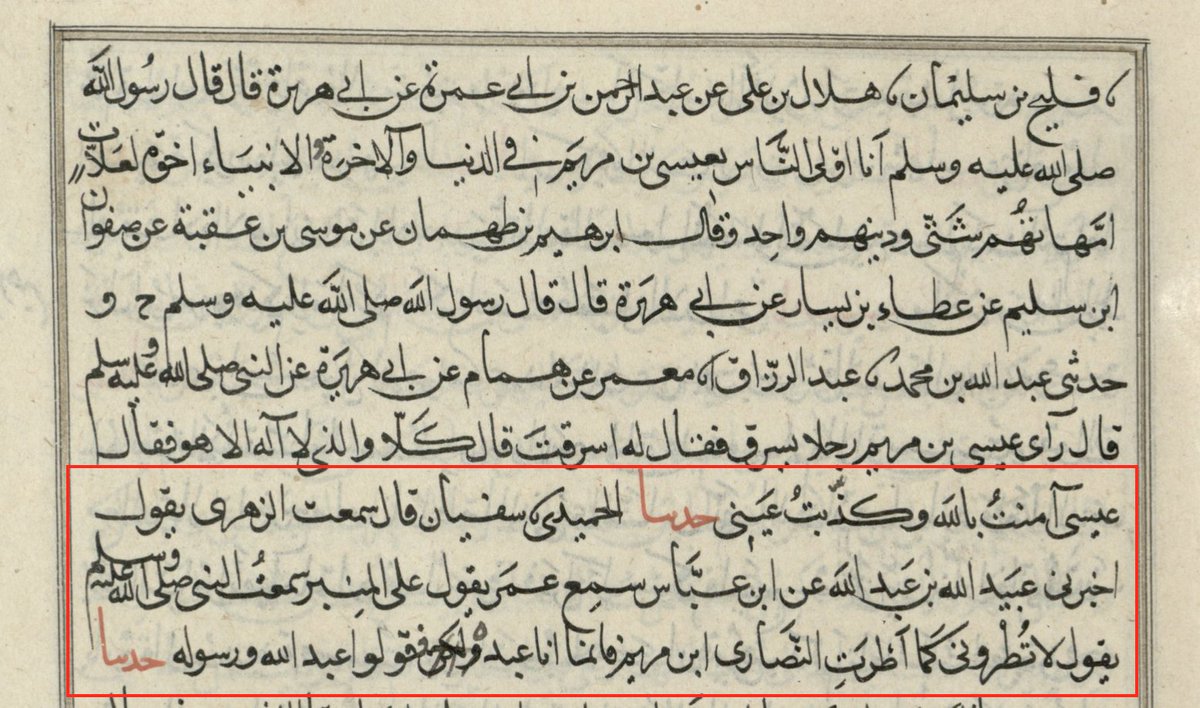
A more accurate translation:
“Do not flatter me, like the Christians have exaggerated the son of Maryam. For indeed, I am His slave [i.e. slave of Allāh] - so say [regarding me]: The slave of Allāh and His Messenger.”
— Bukhārī, #3445
Some commentaries of the hadīth beneath.
“Do not flatter me, like the Christians have exaggerated the son of Maryam. For indeed, I am His slave [i.e. slave of Allāh] - so say [regarding me]: The slave of Allāh and His Messenger.”
— Bukhārī, #3445
Some commentaries of the hadīth beneath.
Shaykh Abd al-Haqq Muhaddith al-Dihlawī [958-1052 AH / 1551-1642 CE] writes:
“Meaning, going beyond the limit and speaking falsehood in praise. He said: Just as the Christians declared regarding Jesus son of Mary that he is Allāh and the son of Allāh in exaggeration,
“Meaning, going beyond the limit and speaking falsehood in praise. He said: Just as the Christians declared regarding Jesus son of Mary that he is Allāh and the son of Allāh in exaggeration,
![Shaykh Abd al-Haqq Muhaddith al-Dihlawī [958-1052 AH / 1551-1642 CE] writes:
“Meaning, going beyond...](https://pbs.twimg.com/media/FvybQd6WcAwHaCC.png)
do not exaggerate regarding me as such.
I am not but the slave of Allāh and His Messenger. Slavehood is a distinct station and a special attribute of RasūlAllāh as the true slave is he, and he is more complete and perfect than all in this attribute.
I am not but the slave of Allāh and His Messenger. Slavehood is a distinct station and a special attribute of RasūlAllāh as the true slave is he, and he is more complete and perfect than all in this attribute.
The perfection of praise and expression of the lofty rank of RasūlAllāh is in this attribute, and there is no way for exaggeration in this.
Every attribute of perfection that is affirmed for him, and every praise that is said regarding him falls short from his status, except for affirmation of the attribute of divinity, for it is not correct.
Couplet:
Say not regarding him, ‘God’, due to the command of the Sharī'ah and for protection of religion,
Every other ascription of praise you wish to say regarding him, say it
Say not regarding him, ‘God’, due to the command of the Sharī'ah and for protection of religion,
Every other ascription of praise you wish to say regarding him, say it
In truth, none is aware of his reality besides Allāh, thus how shall you praise him, and that cognisance of Allāh which RasūlAllāh ﷺ received, where is that for any other?”
— Ashi’at al-Lam’āt, 4/52
— Ashi’at al-Lam’āt, 4/52
Mufti Ahmad Yar Khan [1314-1391 AH / 1894-1971 CE] writes:
“Meaning: To exaggerate, to praise falsely, exaggerating beyond the limit.
“Meaning: To exaggerate, to praise falsely, exaggerating beyond the limit.
![Mufti Ahmad Yar Khan [1314-1391 AH / 1894-1971 CE] writes:
“Meaning: To exaggerate, to praise fals...](https://pbs.twimg.com/media/FvybTWUWwAAk1DK.jpg)
Meaning: Do not say I am Allāh, nor the son of Allāh, nor the relative of Allāh, as these matters occur in those that are homogeneous, and the Lord, Exalted is He, is pure from genus.
Here, there is prohibition of a specific exaggeration, meaning the type of exaggeration which the Christians did with regard to Jesus, upon him be peace, do not do so regarding me.
The meaning of this is not that you do not say anything about me other than, ‘Slave of Allāh and His Messenger’, that you do not say, ‘Intercessor of Sinners’, nor, ‘Mercy for the Worlds’, rather the meaning is: Declare those attributes of mine which fall under slavehood,
do not utter attributes of divinity.
Therefore, this hadīth is not in opposition with those ahādīth, ‘I am the master of the sons of Adam’, or such as, ‘I am their speaker when they fall silent’.
Therefore, this hadīth is not in opposition with those ahādīth, ‘I am the master of the sons of Adam’, or such as, ‘I am their speaker when they fall silent’.
This hadīth is [seemingly] in opposition to the praising verse of the Noble Qur’ān, the Lord states:
‘O Prophet! We have sent thee as a witness, a bearer of glad-tidings, and a warner,
And a caller unto Allāh by His permission, and an illuminating lamp.’
‘O Prophet! We have sent thee as a witness, a bearer of glad-tidings, and a warner,
And a caller unto Allāh by His permission, and an illuminating lamp.’
However, the truth is that other than, ‘Son of Allāh’ and the like, whichever praise you are able to express, do so.
Imām Busīrī states:
‘Leave what the Christians have said regarding their Prophet,
Apart from this say in praise what you wish and be steadfast
Imām Busīrī states:
‘Leave what the Christians have said regarding their Prophet,
Apart from this say in praise what you wish and be steadfast
For the virtues of RasūlAllāh have no limit,
Such that an eloquent speaker may verbalise from his mouth’”
— Mir’āt al-Manājīh, 6/380
Such that an eloquent speaker may verbalise from his mouth’”
— Mir’āt al-Manājīh, 6/380
Mufti Sharīf’ul Haqq Amjadī [1340-1421 AH / 1921-2000 CE] writes:
“Meaning, say not in my praise those things which are not in me, such as do not say, ‘Allāh’, or ‘Son of Allāh’, as is apparent from the similitude.
“Meaning, say not in my praise those things which are not in me, such as do not say, ‘Allāh’, or ‘Son of Allāh’, as is apparent from the similitude.
![Mufti Sharīf’ul Haqq Amjadī [1340-1421 AH / 1921-2000 CE] writes:
“Meaning, say not in my praise th...](https://pbs.twimg.com/media/FvybhZcWcCId494.png)
However, those virtues and perfections which are true regarding me, narrate them.
The meaning of this is certainly not that you do not even narrate those virtues and perfections which Allāh has bestowed upon RasūlAllāh ﷺ in reality.
The meaning of this is certainly not that you do not even narrate those virtues and perfections which Allāh has bestowed upon RasūlAllāh ﷺ in reality.
To narrate those is not to go beyond the limit. Jāmī expressed it in his words:
‘In short, after Allāh, thou art the greatest’
‘In short, after Allāh, thou art the greatest’
Shaykh Abd al-Haqq Muhaddith Dihlawī, may Allāh have mercy upon him, stated:
‘Say not regarding him, “God”, due to the command of the Sharī'ah and for protection of religion,
Every other ascription of praise you wish to say regarding him, say it’
‘Say not regarding him, “God”, due to the command of the Sharī'ah and for protection of religion,
Every other ascription of praise you wish to say regarding him, say it’
Allāmah Busīrī wrote:
‘Leave what the Christians have said regarding their Prophet,
Apart from this say in praise what you wish and be steadfast’”
— Nuzhat al-Qārī, 4/460-461
‘Leave what the Christians have said regarding their Prophet,
Apart from this say in praise what you wish and be steadfast’”
— Nuzhat al-Qārī, 4/460-461
Shaykh al-Hadīth Allāmah Ghulām Rasūl Qādirī Rizawī Amritsarī [1323-1422 AH / 1906-2001 CE] writes:
“Meaning, do not praise me with false speech as the Christians falsely praised Jesus and considered him a god, and said Jesus is a third god.
“Meaning, do not praise me with false speech as the Christians falsely praised Jesus and considered him a god, and said Jesus is a third god.
![Shaykh al-Hadīth Allāmah Ghulām Rasūl Qādirī Rizawī Amritsarī [1323-1422 AH / 1906-2001 CE] writes:...](https://pbs.twimg.com/media/FvyblLAWIAEFBVQ.png)
They began to consider him the son of Allāh. This was the exaggeration in praise of Jesus, upon him be peace. For this reason, the Master of the World ﷺ would at times express humility.
In sum, false praise of the Master of the World ﷺ is prohibited, that one calls him god.
In sum, false praise of the Master of the World ﷺ is prohibited, that one calls him god.
Otherwise, besides this, whatever praise is done of him, he is deserving of more than that.
Allāmah Busīrī stated:
‘Leave what the Christians have said regarding their Prophet,
Apart from this say in praise what you wish and be steadfast
Allāmah Busīrī stated:
‘Leave what the Christians have said regarding their Prophet,
Apart from this say in praise what you wish and be steadfast
Attribute to his person what you wish of nobility,
And attribute to his rank what you wish of greatness
For the virtues of RasūlAllāh have no limit,
Such that an eloquent speaker may verbalise from his mouth’
And attribute to his rank what you wish of greatness
For the virtues of RasūlAllāh have no limit,
Such that an eloquent speaker may verbalise from his mouth’
Allāh has bestowed the Master of the World ﷺ with all perfections and great ranks, and whichever perfection was possible for a human to be bestowed, the Master of the World ﷺ was bestowed with it.
Thus, we humans are incapable of expressing his perfections, good qualities, and virtues. Other than divinity, all perfections are found in him ﷺ.”
— Tafhīm al-Bukhārī, 5/318
— Tafhīm al-Bukhārī, 5/318
Loading suggestions...