

How do you measure if your strategic planning is successful?
Here are ten KPIs to consider and a deep-dive into each of them 🧵
Here are ten KPIs to consider and a deep-dive into each of them 🧵
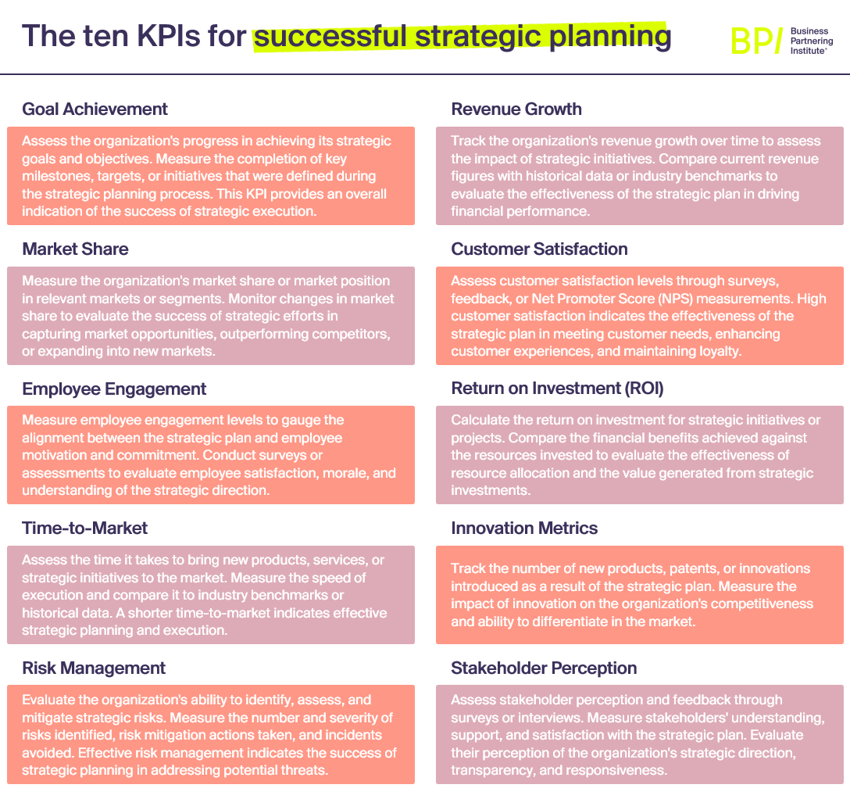
Here's an overview of the ten KPIs:
1. Execution rate
2. Revenue Growth
3. Market Share
4. Customer Satisfaction
5. Employee Engagement
6. ROI
7. Time-to-Market
8. Innovation Metrics
9. Risk Management
10. Stakeholder Perception
1. Execution rate
2. Revenue Growth
3. Market Share
4. Customer Satisfaction
5. Employee Engagement
6. ROI
7. Time-to-Market
8. Innovation Metrics
9. Risk Management
10. Stakeholder Perception
1/10 Strategy Execution Rate:
Measure the rate at which strategic initiatives and projects are successfully executed.
This KPI tracks the completion of key milestones and deliverables within the planned timeline.
Measure the rate at which strategic initiatives and projects are successfully executed.
This KPI tracks the completion of key milestones and deliverables within the planned timeline.
2/10 Revenue Growth
Track the organization's revenue growth over time to assess the impact of strategic initiatives.
Compare current revenue figures with historical data or industry benchmarks to evaluate the effectiveness of the strategic plan in driving financial performance.
Track the organization's revenue growth over time to assess the impact of strategic initiatives.
Compare current revenue figures with historical data or industry benchmarks to evaluate the effectiveness of the strategic plan in driving financial performance.
3/10 Market Share
Measure the organization's market share or market position in relevant markets or segments.
Monitor changes in market share to evaluate the success of strategic efforts in capturing market opportunities, outperforming competitors, or going into new markets.
Measure the organization's market share or market position in relevant markets or segments.
Monitor changes in market share to evaluate the success of strategic efforts in capturing market opportunities, outperforming competitors, or going into new markets.
4/10 Customer Satisfaction
Assess customer satisfaction levels through surveys, feedback, or Net Promoter Score (NPS).
High customer satisfaction indicates the effectiveness of the strategic plan in meeting customer needs, enhancing customer experiences, and sustaining loyalty.
Assess customer satisfaction levels through surveys, feedback, or Net Promoter Score (NPS).
High customer satisfaction indicates the effectiveness of the strategic plan in meeting customer needs, enhancing customer experiences, and sustaining loyalty.
5/10 Employee Engagement
Measure employee engagement levels through surveys or assessments.
Engaged employees are more likely to be aligned with the organization's strategic goals, contribute to their achievement, and drive overall organizational success.
Measure employee engagement levels through surveys or assessments.
Engaged employees are more likely to be aligned with the organization's strategic goals, contribute to their achievement, and drive overall organizational success.
6/10 Return on Investment (ROI)
Calculate the return on investment for strategic initiatives or projects.
Compare the financial benefits generated by the strategic initiatives against the costs incurred.
This KPI assesses the effectiveness of resource allocation.
Calculate the return on investment for strategic initiatives or projects.
Compare the financial benefits generated by the strategic initiatives against the costs incurred.
This KPI assesses the effectiveness of resource allocation.
7/10 Time-to-Market
Measure the time it takes to bring new products, services, or strategic initiatives to the market.
This KPI reflects the organization's agility and speed in executing strategic plans, responding to market needs, and gaining a competitive advantage.
Measure the time it takes to bring new products, services, or strategic initiatives to the market.
This KPI reflects the organization's agility and speed in executing strategic plans, responding to market needs, and gaining a competitive advantage.
8/10 Innovation Metrics
Track the number of new product/service ideas, patents filed, or successful innovation projects.
This KPI measures the organization's ability to foster innovation and incorporate it into the strategic planning process, driving differentiation and growth.
Track the number of new product/service ideas, patents filed, or successful innovation projects.
This KPI measures the organization's ability to foster innovation and incorporate it into the strategic planning process, driving differentiation and growth.
9/10 Strategic Alignment
Assess the level of alignment between individual goals, departmental objectives, and the overall strategic plan.
This KPI measures how employees and teams are aligned and working toward achieving the organization's strategic objectives.
Assess the level of alignment between individual goals, departmental objectives, and the overall strategic plan.
This KPI measures how employees and teams are aligned and working toward achieving the organization's strategic objectives.
10/10 Competitive Positioning
Evaluate the organization's competitive positioning relative to key competitors.
This can be measured through market research, surveys, etc.
Understanding the organization's position helps determine the success of strategic planning.
Evaluate the organization's competitive positioning relative to key competitors.
This can be measured through market research, surveys, etc.
Understanding the organization's position helps determine the success of strategic planning.
Which KPIs would you add to the list and how would you rate the usefulness of these 10 KPIs?
That's a wrap!
If you enjoyed this thread:
1. Follow me @LiuLindberg for more of these
2. RT this tweet to help others learn about Strategic Planning.
If you enjoyed this thread:
1. Follow me @LiuLindberg for more of these
2. RT this tweet to help others learn about Strategic Planning.
Loading suggestions...