

4-bit QLoRA is here to equalize the playing field for LLM exploration. You can now fine-tune a state-of-the-art 65B chatbot on one GPU in 24h.
Paper: arxiv.org
Code and Demo: github.com
Paper: arxiv.org
Code and Demo: github.com
arxiv.org/abs/2305.14314
QLoRA: Efficient Finetuning of Quantized LLMs
We present QLoRA, an efficient finetuning approach that reduces memory usage enough to finetune a 65...

github.com/artidoro/qlora
GitHub - artidoro/qlora: QLORA: Efficient Finetuning of Quantized LLMs
QLORA: Efficient Finetuning of Quantized LLMs. Contribute to artidoro/qlora development by creating...
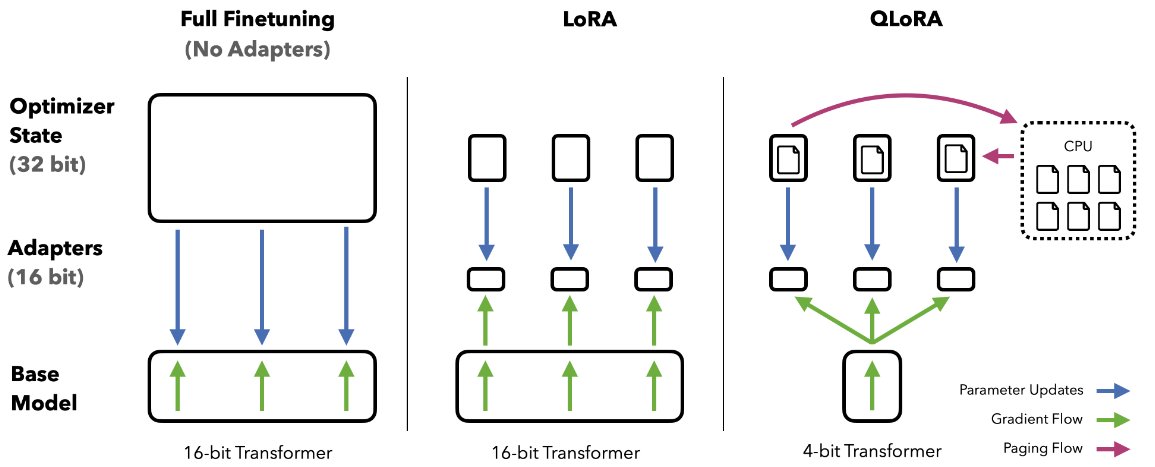
QLoRA uses a frozen 4-bit base model with adapters. We backpropagate through the 4-bit weights into the adapters. QLoRA incorporates the NF4 datatype, double-quantization, and paged optimizers. We show it is on par with 16-bit finetuning at a fraction of the memory footprint.
QLoRA tuning on the OpenAssistant dataset produces a state-of-the-art chatbot.
According to GPT-4 and human annotators, our models outperform all other open-source systems and are even competitive with ChatGPT.
According to GPT-4 and human annotators, our models outperform all other open-source systems and are even competitive with ChatGPT.

The paper arxiv.org contains lots of insights and considerations about instruction tuning and chatbot evaluation and points to areas for future work.
In particular:
- instruction tuning datasets are not necessarily helpful for chatbot performance
- quality of data rather than quantity is important for chatbots
- multitask QA benchmarks like MMLU are not always correlated with chatbot performance
- instruction tuning datasets are not necessarily helpful for chatbot performance
- quality of data rather than quantity is important for chatbots
- multitask QA benchmarks like MMLU are not always correlated with chatbot performance
- both human and automated evaluations are challenging when comparing strong systems
- using large eval datasets with many prompts, like the OA benchmark, is important for evaluation
- many possible improvements to our setup including RLHF explorations
- using large eval datasets with many prompts, like the OA benchmark, is important for evaluation
- many possible improvements to our setup including RLHF explorations
Guanaco is *far from perfect*, but the fact that it is remarkably easy to train with QLoRA while obtaining strong chatbot performance makes it a perfect starting point for future research.
Thank you to @Tim_Dettmers @universeinanegg @LukeZettlemoyer and the many people who made this project possible! In particular, @younesbelkada and the @huggingface team. It's been amazing working with you
Loading suggestions...