

The main factor that influences the price of a token is tokenomics.
I turned ChatGPT into a tokenomics pro.
Here’s how in 9 steps (+ free prompt): 🧵👇
I turned ChatGPT into a tokenomics pro.
Here’s how in 9 steps (+ free prompt): 🧵👇

This thread teaches you how to:
Train ChatGPT with a prompt and find the correct tokenomics information.
This way you can have a pocket AI analysis tool to help you with your investment strategy.
Fade this thread at your own peril: 👇
Train ChatGPT with a prompt and find the correct tokenomics information.
This way you can have a pocket AI analysis tool to help you with your investment strategy.
Fade this thread at your own peril: 👇
1: Finding a training tool
To train artificial intelligence you need to provide it with context and nuance.
Therefore you need to find sound information to feed ChatGPT what it needs.
There are not many better creators that you can use to train AI with than Edgy (@thedefiedge):
To train artificial intelligence you need to provide it with context and nuance.
Therefore you need to find sound information to feed ChatGPT what it needs.
There are not many better creators that you can use to train AI with than Edgy (@thedefiedge):
2: Training artificial intelligence
I’ll give you the prompt in the next tweet.
However, I want to explain that I simply copy and pasted the above Twitter thread to help train AI.
I then took some of the irrelevant information out, but left most of it as nuance and opinion is important.
I’ll give you the prompt in the next tweet.
However, I want to explain that I simply copy and pasted the above Twitter thread to help train AI.
I then took some of the irrelevant information out, but left most of it as nuance and opinion is important.
3: Free prompt #1
Copy and paste the following (three tweets) into ChatGPT:
I need some help analysing cryptocurrency tokenomics. First, I am going to explain what tokenomics is, what it does, and give you examples.
What I’ll be teaching you today:
• What is Tokenomics?
• Evaluating through Supply, Demand, and Incentives
• Tokenomics examples
• Free Tokenomics Checklist
What is Tokenomics?
Tokenomics studies the factors that drive the demand for tokens.
It includes:
• math
• supply vs. demand
• incentives
• value accrual
• human behavior & game theory
Tokenomics = Tokens + Econonmics
Some of my worst investments were because I didn't understand Tokenomics.
• The tokens were inflationary without enough utility.
• Concentration of tokens by VCs & whales led to retail getting dumped on.
Studying Tokenomics will help improve your crypto investments.
The easiest lens to start with Tokenomics is understanding Supply and Demand.
There are 10k @BoredApeYC out there with a floor price of 111 ETH.
What would happen if the supply doubled and there are now 20k apes?
The price would crash due to more supply.
Scarcity is good.
The Dollar
The U.S. Government printed 40% of the US Money Supply in 2020.
• Money flooded the market.
• The supply of housing remained roughly the same. (They couldn't build during COVID).
That's why 🏠 prices are out of control in the U.S.
Supply Side of Tokenomics
Here's what you should watch out for:
• How many tokens are in existence?
• How many tokens will there be in total?
• Who has the supply? WHEN can they sell?
• How will the supply change over time?
• What are their policies for changing?
How newcomers get Wrecked:
They see meme coins at $.000000002 and think they'll be rich once it hits a Dollar.
Understanding the market cap would show that it's impossible.
Hitting $1 would mean it's bigger than the world's entire money supply.
Supply Metrics You Should Know:
• Supply: How many tokens exist NOW
• Max supply: The most that can exist
• Market Cap: Current Price * circulating supply
• Fully Diluted MC: Price * max supply.
Why are the Above Metrics Important?
The metrics help you understand the future supply and scarcity.
For example, I wouldn't feel great if the circulating supply was only at 40%.
That means the supply will increase by 60%
More coins created will put pressure on the price.
Sound Money - Bitcoin
There will only be 21m Bitcoin in existence, and no one can create more Bitcoin.
• Bitcoin's supply is capped
• Demand is increasing
• The price should increase
This is why people compare Bitcoin to gold often.
Bitcoin Halvings
Besides token supply, make sure you consider the emissions rate.
At what SPEED are new tokens printed?
Although miners created new Bitcoin, the emissions have slowed down.
At each halving event, the reward emissions for Bitcoin gets cut in half.
Inflationary Token - Dogecoin
The supply of Dogecoin is increasing each year, and there's no CAP on the supply.
This isn't good for Tokenomics because it's the opposite of Scarcity.
(Note: The price of Dogecoin still went up last year despite bad tokenomics)
Deflationary Token
Some coins can become deflationary when the supply DECREASES over time.
The protocol can buy back tokens, and burn them.
A burned coin = is lost forever.
Decreasing supply should increase the value of the token (in theory)
Burberry Burns its Bags
Burberry creates luxury handbags, and exclusivity is part of its appeal.
Some of their handbags don't sell - rather than sell them at a discount, they burn their bags.
This keeps the bags "exclusive"
A real-life example of the "burning" mechanism.
Can Ethereum Becoming Ultrasound?
•The Merge to Proof of Stake lowers the inflation supply of ETH
•EIP-1559 takes a bit of the transaction fees and burns it.
These combined (and higher demand) means Ethereum could become deflationary.
Copy and paste the following (three tweets) into ChatGPT:
I need some help analysing cryptocurrency tokenomics. First, I am going to explain what tokenomics is, what it does, and give you examples.
What I’ll be teaching you today:
• What is Tokenomics?
• Evaluating through Supply, Demand, and Incentives
• Tokenomics examples
• Free Tokenomics Checklist
What is Tokenomics?
Tokenomics studies the factors that drive the demand for tokens.
It includes:
• math
• supply vs. demand
• incentives
• value accrual
• human behavior & game theory
Tokenomics = Tokens + Econonmics
Some of my worst investments were because I didn't understand Tokenomics.
• The tokens were inflationary without enough utility.
• Concentration of tokens by VCs & whales led to retail getting dumped on.
Studying Tokenomics will help improve your crypto investments.
The easiest lens to start with Tokenomics is understanding Supply and Demand.
There are 10k @BoredApeYC out there with a floor price of 111 ETH.
What would happen if the supply doubled and there are now 20k apes?
The price would crash due to more supply.
Scarcity is good.
The Dollar
The U.S. Government printed 40% of the US Money Supply in 2020.
• Money flooded the market.
• The supply of housing remained roughly the same. (They couldn't build during COVID).
That's why 🏠 prices are out of control in the U.S.
Supply Side of Tokenomics
Here's what you should watch out for:
• How many tokens are in existence?
• How many tokens will there be in total?
• Who has the supply? WHEN can they sell?
• How will the supply change over time?
• What are their policies for changing?
How newcomers get Wrecked:
They see meme coins at $.000000002 and think they'll be rich once it hits a Dollar.
Understanding the market cap would show that it's impossible.
Hitting $1 would mean it's bigger than the world's entire money supply.
Supply Metrics You Should Know:
• Supply: How many tokens exist NOW
• Max supply: The most that can exist
• Market Cap: Current Price * circulating supply
• Fully Diluted MC: Price * max supply.
Why are the Above Metrics Important?
The metrics help you understand the future supply and scarcity.
For example, I wouldn't feel great if the circulating supply was only at 40%.
That means the supply will increase by 60%
More coins created will put pressure on the price.
Sound Money - Bitcoin
There will only be 21m Bitcoin in existence, and no one can create more Bitcoin.
• Bitcoin's supply is capped
• Demand is increasing
• The price should increase
This is why people compare Bitcoin to gold often.
Bitcoin Halvings
Besides token supply, make sure you consider the emissions rate.
At what SPEED are new tokens printed?
Although miners created new Bitcoin, the emissions have slowed down.
At each halving event, the reward emissions for Bitcoin gets cut in half.
Inflationary Token - Dogecoin
The supply of Dogecoin is increasing each year, and there's no CAP on the supply.
This isn't good for Tokenomics because it's the opposite of Scarcity.
(Note: The price of Dogecoin still went up last year despite bad tokenomics)
Deflationary Token
Some coins can become deflationary when the supply DECREASES over time.
The protocol can buy back tokens, and burn them.
A burned coin = is lost forever.
Decreasing supply should increase the value of the token (in theory)
Burberry Burns its Bags
Burberry creates luxury handbags, and exclusivity is part of its appeal.
Some of their handbags don't sell - rather than sell them at a discount, they burn their bags.
This keeps the bags "exclusive"
A real-life example of the "burning" mechanism.
Can Ethereum Becoming Ultrasound?
•The Merge to Proof of Stake lowers the inflation supply of ETH
•EIP-1559 takes a bit of the transaction fees and burns it.
These combined (and higher demand) means Ethereum could become deflationary.
Allocation & Distribution
How are the initial tokens distributed? There are roughly 2 ways:
Pre Mined:
1. The team distributes tokens to itself.
2. Distribution to insiders such as the team and venture capitalists
Fair Launch:
100% fair. Everyone has equal access.
Why Does This Matter?
VCs and Insiders could dump their tokens and cause a price crash.
Vesting means when they're allowed to sell the tokens.
You want to make sure that the early backers are INCENTIVIZED with the protocol long-term.
VCs Aren't Evil
By the way, I'm not trying to label insiders as bad.
They can help create VALUE for the founding team through advice, distribution, and connections.
Not all VCs are equal.
Some want to create value for their investments, others want a quick payday.
The Teams Can Also Sell Their Tokens
1. Those huge incentive funds? It comes from selling tokens.
2. They sell to raise capital. People forget that some salaries and expenses get paid in fiat.
Selling from the team leads to downward pressure on prices.
The Other Half of the Equation: DEMAND
Demand: The factors that drive the desire for people to buy, and the price they're willing to pay.
Despite the inflation, the U.S. $ is in high demand because of its UTILITY.
The world's running on USD (for now)
What Drives the Demand for Tokens?
I'd put demand into (3) broad categories.
• Utility
• Value Accrual
• The Memes and Narratives
Utility - Gas Fees
This is payment to use the network.
• Want to buy an NFT on @opensea? You'll need ETH to pay for the gas fees.
• Want access to the sick degen farms on @fantomfoundation? You need FTM.
The more popular the network / DAPP, the higher the demand.
Utility - Fun
GameFi has insane potential once the games ACTUALLY become fun.
Look at how much money GTA and Fortnite are printing.
I'm excited for Triple-A games like @illuvium. That's how we onboard more normies.
p.s. Are any crypto MOBAs coming?
Utility - Adoption
Crypto is slowly adding in more real-world usage thus driving demand.
• Bitcoin exploded when TSLA added it to its balance sheet to hedge against inflation.
• Dogecoin spiked when AMC announced they'd accept it.
Value Accrual
The protocol's kicking ass.
The protocol's printing money.
But investors are not getting a piece of the action.
We saw this happen with most DeFi 1.0 giants such as Uniswap and Compound.
People want value, not just governance tokens.
Value Accrual - xStaking
Last year we saw the rise of xTokens.
Staking the token will earn you a % of the platform revenue fee.
• xSushi from Sushi swap
• fBeets from Beethoven
• sSpell from MIM spell
This added more value to the Tokens.
Value Accrual - Governance
DeFi 1.0 saw a lot of protocols print tokens that had no utility other than governance.
People would farm the APRs and then sell the tokens.
This is how SushiSwap took so many users away from Uniswap when they first launched.
Stopping the Mercenaries
People can be mercenaries in DeFi.
The Farm APRs drop over time, and you might rotate to a farm with more percentage.
The protocol still needs liquidity.
So how do they incentivize people to HOLD their tokens, instead of chasing APR's?
Incentivizing Long Term Holding
We saw a lot of new innovations last year in how protocols motivate long-term holding.
Having these in place lowers the selling pressure of the token.
Let's look at some of them:
The Main Mechanism These Days is Locking
How do you stop selling pressure?
You ask people to lock their tokens up (sometimes for years)
The key is figuring out the INCENTIVES for people to do that.
(1) there are risks in locking up
(2) the opportunity costs of liquidity
Holding - veTokens (Curve)
Curve had a big innovation when it introduced veTokens.
Ve = Vote Escrow.
• Locking up your tokens = Voting power.
• The LONGER you lock it up, the MORE Voting power. (up to 4 years)
How are the initial tokens distributed? There are roughly 2 ways:
Pre Mined:
1. The team distributes tokens to itself.
2. Distribution to insiders such as the team and venture capitalists
Fair Launch:
100% fair. Everyone has equal access.
Why Does This Matter?
VCs and Insiders could dump their tokens and cause a price crash.
Vesting means when they're allowed to sell the tokens.
You want to make sure that the early backers are INCENTIVIZED with the protocol long-term.
VCs Aren't Evil
By the way, I'm not trying to label insiders as bad.
They can help create VALUE for the founding team through advice, distribution, and connections.
Not all VCs are equal.
Some want to create value for their investments, others want a quick payday.
The Teams Can Also Sell Their Tokens
1. Those huge incentive funds? It comes from selling tokens.
2. They sell to raise capital. People forget that some salaries and expenses get paid in fiat.
Selling from the team leads to downward pressure on prices.
The Other Half of the Equation: DEMAND
Demand: The factors that drive the desire for people to buy, and the price they're willing to pay.
Despite the inflation, the U.S. $ is in high demand because of its UTILITY.
The world's running on USD (for now)
What Drives the Demand for Tokens?
I'd put demand into (3) broad categories.
• Utility
• Value Accrual
• The Memes and Narratives
Utility - Gas Fees
This is payment to use the network.
• Want to buy an NFT on @opensea? You'll need ETH to pay for the gas fees.
• Want access to the sick degen farms on @fantomfoundation? You need FTM.
The more popular the network / DAPP, the higher the demand.
Utility - Fun
GameFi has insane potential once the games ACTUALLY become fun.
Look at how much money GTA and Fortnite are printing.
I'm excited for Triple-A games like @illuvium. That's how we onboard more normies.
p.s. Are any crypto MOBAs coming?
Utility - Adoption
Crypto is slowly adding in more real-world usage thus driving demand.
• Bitcoin exploded when TSLA added it to its balance sheet to hedge against inflation.
• Dogecoin spiked when AMC announced they'd accept it.
Value Accrual
The protocol's kicking ass.
The protocol's printing money.
But investors are not getting a piece of the action.
We saw this happen with most DeFi 1.0 giants such as Uniswap and Compound.
People want value, not just governance tokens.
Value Accrual - xStaking
Last year we saw the rise of xTokens.
Staking the token will earn you a % of the platform revenue fee.
• xSushi from Sushi swap
• fBeets from Beethoven
• sSpell from MIM spell
This added more value to the Tokens.
Value Accrual - Governance
DeFi 1.0 saw a lot of protocols print tokens that had no utility other than governance.
People would farm the APRs and then sell the tokens.
This is how SushiSwap took so many users away from Uniswap when they first launched.
Stopping the Mercenaries
People can be mercenaries in DeFi.
The Farm APRs drop over time, and you might rotate to a farm with more percentage.
The protocol still needs liquidity.
So how do they incentivize people to HOLD their tokens, instead of chasing APR's?
Incentivizing Long Term Holding
We saw a lot of new innovations last year in how protocols motivate long-term holding.
Having these in place lowers the selling pressure of the token.
Let's look at some of them:
The Main Mechanism These Days is Locking
How do you stop selling pressure?
You ask people to lock their tokens up (sometimes for years)
The key is figuring out the INCENTIVES for people to do that.
(1) there are risks in locking up
(2) the opportunity costs of liquidity
Holding - veTokens (Curve)
Curve had a big innovation when it introduced veTokens.
Ve = Vote Escrow.
• Locking up your tokens = Voting power.
• The LONGER you lock it up, the MORE Voting power. (up to 4 years)
So why care about the voting power?
Well, Stablecoins are the backbone of DeFi. And Protocols are in a war to get more liquidity / adoption for their stablecoins.
Each week, Curve has a vote on which pools get the most rewards.
And some of these protocols will bribe you to vote for them!
Holding - Farm Boosting
We're seeing AMM's adopt this model of farm boosting.
Locking up tokens gives you the right to vote for the pools.
Protocols are in a war now to acquire governance power to benefit themselves.
Holding - Unstake You Lose it
Platypus Finance introduced one of the most interesting mechanisms for Ve.
• Staking $PTP gets you $vePTP. This gives you a higher APR on your stablecoin yields.
• Unstaking $vePTP? You lose ALL your vePTP.
Not easy to sell then.
Holding - Rebasing
$OHM introduced the concept of rebasing, and other protocols desecrated the concept.
Rebasing is a form of gamification.
It LOOKS like you're getting 50k% APR. In reality, it's paid out through the tokens. Your % of the market cap remains the same.
Holding - Rewards / Raffles
Some tokens allows staking which is revenue share.
They also have:
• Staking xTOKEN / xTOKEN enters you into lotteries for airdrops. This includes valuable items.
• The more you stake, the more raffle tickets you earn.
Holding - Unlock / Lock Rates
Memes and Narratives
Human desire is strange.
I watched a YouTube video of someone paying $2k for a golden steak from Salt Bae.
Coins CAN pump despite horrible tokenomics.
Sometimes the meme, narratives, and marketing can be THAT strong.
The Curious Case of Dogecoin
Dogecoin had an insane rise last year.
The richest man in the world, Elon, had a strange obsession with Dogecoin.
And it peaked with his appearance on Saturday Night Live.
People bought hoping Elon would keep pumping Dogecoin up.
People Buy What They Think Will Make Them Money
Take your nerd hat off, and put your human hat on.
There are some protocols with GREAT tokenomics, but their prices are garbage.
It could be because of the Narratives - People are chasing the next bright shiny object.
Bad Tokenomics - PancakeSwap
PancakeSwap hit its peak a year ago and has been on a downward trend.
1. It’s an inflationary token. (supply)
2. There’s no utility for the token.(demand)
Pancake “prints” Cake and the users immediately sell it.
Tokenomics Overhaul
I'm fascinated when protocols overhaul their Tokenomics.
Trader Joe had a basic tokenomics structure when it first launched.
They overhauled their model in Quarter 1.
Before it was stake Joe, and you get a % of the protocol's revenue.
Here's what's new:
Stake Joe and now...
• rJOE - Get access to launch pads
• sJOE - earn a % of platform revenue paid in stablecoins
• veJOE - farm boosts + governance. (unstake, you lose it just like PTP)
They're increasing demand by varying incentives.
Now that you have a full understanding of cryptocurrency tokenomics with examples, I want you to act like a professional cryptocurrency tokenomics analyser and to provide me with your analysis on the following checklist:
Tokenomics Checklist:
Supply:
What is the supply and max supply?
What is the marketcap and fully diluted marketcap?
How were the tokens initially allocated? Fair launch or pre mine?
How are the tokens distributed now among team, insiders, whales, and retail?
What's the vesting / unlocking schedule?
What is the inflation and emission?
Demand:
What is the use case for the token?
How does the token accural value?
Vibe check:
How does the community feel?
Long Term Incentives:
How does the protocol reward long term holders?
How does the protocol decrease sell pressure?
You can take take an understanding from some the examples above and from your data. Are you ready to become a tokenomics analyst? If so, respond with ‘YES’ and nothing else.
Well, Stablecoins are the backbone of DeFi. And Protocols are in a war to get more liquidity / adoption for their stablecoins.
Each week, Curve has a vote on which pools get the most rewards.
And some of these protocols will bribe you to vote for them!
Holding - Farm Boosting
We're seeing AMM's adopt this model of farm boosting.
Locking up tokens gives you the right to vote for the pools.
Protocols are in a war now to acquire governance power to benefit themselves.
Holding - Unstake You Lose it
Platypus Finance introduced one of the most interesting mechanisms for Ve.
• Staking $PTP gets you $vePTP. This gives you a higher APR on your stablecoin yields.
• Unstaking $vePTP? You lose ALL your vePTP.
Not easy to sell then.
Holding - Rebasing
$OHM introduced the concept of rebasing, and other protocols desecrated the concept.
Rebasing is a form of gamification.
It LOOKS like you're getting 50k% APR. In reality, it's paid out through the tokens. Your % of the market cap remains the same.
Holding - Rewards / Raffles
Some tokens allows staking which is revenue share.
They also have:
• Staking xTOKEN / xTOKEN enters you into lotteries for airdrops. This includes valuable items.
• The more you stake, the more raffle tickets you earn.
Holding - Unlock / Lock Rates
Memes and Narratives
Human desire is strange.
I watched a YouTube video of someone paying $2k for a golden steak from Salt Bae.
Coins CAN pump despite horrible tokenomics.
Sometimes the meme, narratives, and marketing can be THAT strong.
The Curious Case of Dogecoin
Dogecoin had an insane rise last year.
The richest man in the world, Elon, had a strange obsession with Dogecoin.
And it peaked with his appearance on Saturday Night Live.
People bought hoping Elon would keep pumping Dogecoin up.
People Buy What They Think Will Make Them Money
Take your nerd hat off, and put your human hat on.
There are some protocols with GREAT tokenomics, but their prices are garbage.
It could be because of the Narratives - People are chasing the next bright shiny object.
Bad Tokenomics - PancakeSwap
PancakeSwap hit its peak a year ago and has been on a downward trend.
1. It’s an inflationary token. (supply)
2. There’s no utility for the token.(demand)
Pancake “prints” Cake and the users immediately sell it.
Tokenomics Overhaul
I'm fascinated when protocols overhaul their Tokenomics.
Trader Joe had a basic tokenomics structure when it first launched.
They overhauled their model in Quarter 1.
Before it was stake Joe, and you get a % of the protocol's revenue.
Here's what's new:
Stake Joe and now...
• rJOE - Get access to launch pads
• sJOE - earn a % of platform revenue paid in stablecoins
• veJOE - farm boosts + governance. (unstake, you lose it just like PTP)
They're increasing demand by varying incentives.
Now that you have a full understanding of cryptocurrency tokenomics with examples, I want you to act like a professional cryptocurrency tokenomics analyser and to provide me with your analysis on the following checklist:
Tokenomics Checklist:
Supply:
What is the supply and max supply?
What is the marketcap and fully diluted marketcap?
How were the tokens initially allocated? Fair launch or pre mine?
How are the tokens distributed now among team, insiders, whales, and retail?
What's the vesting / unlocking schedule?
What is the inflation and emission?
Demand:
What is the use case for the token?
How does the token accural value?
Vibe check:
How does the community feel?
Long Term Incentives:
How does the protocol reward long term holders?
How does the protocol decrease sell pressure?
You can take take an understanding from some the examples above and from your data. Are you ready to become a tokenomics analyst? If so, respond with ‘YES’ and nothing else.
4: Result
“YES”
You’ve now got a trained tokenomics analyst.
“YES”
You’ve now got a trained tokenomics analyst.

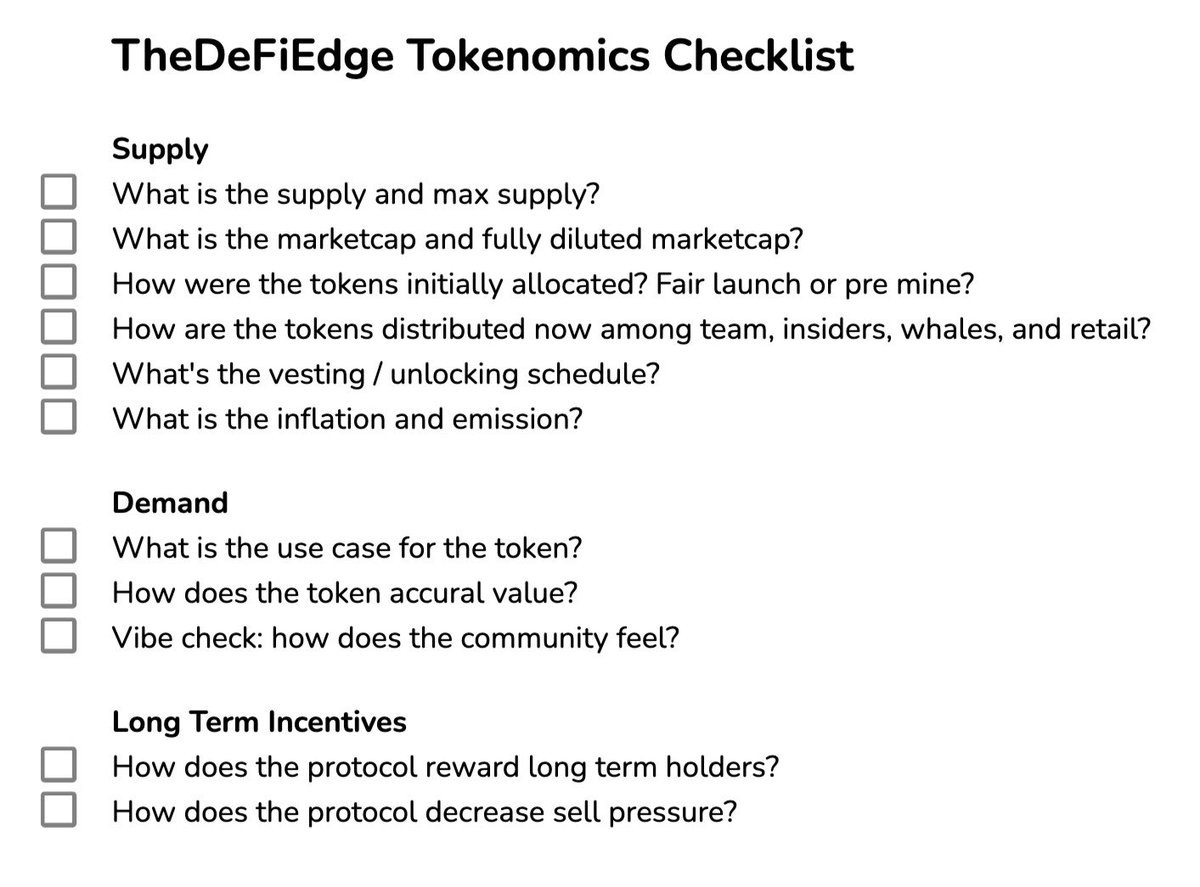
5: Tokenomics checklist
To help our trained analyst provide intel we need to find information on the following checklist provided by Edgy:
Supply:
- What is the supply and max supply?
- What is the marketcap and fully diluted marketcap?
- How were the tokens initially allocated? Fair launch or pre mine?
- How are the tokens distributed now among team, insiders, whales, and retail?
- What's the vesting / unlocking schedule?
- What is the inflation and emission?
Demand:
- What is the use case for the token?
- How does the token accural value?
Vibe check:
- How does the community feel?
Long Term Incentives:
- How does the protocol reward long term holders?
- How does the protocol decrease sell pressure?
To help our trained analyst provide intel we need to find information on the following checklist provided by Edgy:
Supply:
- What is the supply and max supply?
- What is the marketcap and fully diluted marketcap?
- How were the tokens initially allocated? Fair launch or pre mine?
- How are the tokens distributed now among team, insiders, whales, and retail?
- What's the vesting / unlocking schedule?
- What is the inflation and emission?
Demand:
- What is the use case for the token?
- How does the token accural value?
Vibe check:
- How does the community feel?
Long Term Incentives:
- How does the protocol reward long term holders?
- How does the protocol decrease sell pressure?
6: Where do I find this information?
Tokenomics tools:
• @Token_Unlocks
• @MessariCrypto
• @Coingecko
• @DefiLlama
• @VestLab
• @ReveloIntel (use HOEM10 for 10% discount).
Courtesy of: @thedefiedge
Tokenomics tools:
• @Token_Unlocks
• @MessariCrypto
• @Coingecko
• @DefiLlama
• @VestLab
• @ReveloIntel (use HOEM10 for 10% discount).
Courtesy of: @thedefiedge
7: Free prompt #2
I’m using Curve as an example, input your own data (+ add extra data):
Acting as a cryptocurrency tokenomics analyst with the above information in mind, please analyse the following tokenomics from the following checklist:
Max supply: 3,303,030,299
Total supply: 1,955,720,770
Circulating supply: 818,815,872
Market cap: $701,362,570
Fully diluted market cap: $2,828,903,652
Initial allocation:
The initial supply was distributed to community liquidity providers, shareholders (team and investors), employees, and the community reserve. The initial distribution of CRV allowed for a community fund of 5% of the total CRV supply to be used in cases of emergencies or awarded to community-led initiatives or grants.
I’m using Curve as an example, input your own data (+ add extra data):
Acting as a cryptocurrency tokenomics analyst with the above information in mind, please analyse the following tokenomics from the following checklist:
Max supply: 3,303,030,299
Total supply: 1,955,720,770
Circulating supply: 818,815,872
Market cap: $701,362,570
Fully diluted market cap: $2,828,903,652
Initial allocation:
The initial supply was distributed to community liquidity providers, shareholders (team and investors), employees, and the community reserve. The initial distribution of CRV allowed for a community fund of 5% of the total CRV supply to be used in cases of emergencies or awarded to community-led initiatives or grants.
Community LP: 1,116,589,599 CRV
Team and Investors: 909,090,909 CRV
Early Users: 151,515,152 CRV
Community Reserve: 151,515,152 CRV
TokenUnlocks:
Employees: 90,909,091 CRV
Vesting/unlocking schedule:
Community LP: 57%, 1,116,589,599.11, 6 years linearly decreasing inflation starting from TGE.
Team and Investors: 30%, 909,090,909, 4 years linearly vesting starting from TGE
Employees: 3%, 90,909,091, 2 years linearly vesting starting from TGE
Early Users: 5%, 151,515,151.52, 1 year linearly vesting starting from TGE
Community Reserve: 5%, 151,515,151.51, Fully unlocked at TGE
Inflation: 28.01%
Emissions from 13.08.23: 447,688 CRV a day.
Use case:
The flywheel relies on the assumption that favorable market conditions for LPs will attract more liquidity, which will lower the slippage and attract more volume, thus generating more revenue for veCRV holders. Ideally, the action of accumulating veCRV would cause the CRV price to increase and lead to a higher total.
Slippage is dependent on trading volume but is not the only factor affecting the number of trades that take place in a pool.
The price of CRV is dependent on public perception and trading volume has no primary effect other than distributing revenue from fees to users who lock CRV.
More liquidity leads to lesser slippage, which attracts more traders and exchange aggregators, in turn generating more fees.
Community:
Positive and optimistic community who enjoy the developments being made.
Team and Investors: 909,090,909 CRV
Early Users: 151,515,152 CRV
Community Reserve: 151,515,152 CRV
TokenUnlocks:
Employees: 90,909,091 CRV
Vesting/unlocking schedule:
Community LP: 57%, 1,116,589,599.11, 6 years linearly decreasing inflation starting from TGE.
Team and Investors: 30%, 909,090,909, 4 years linearly vesting starting from TGE
Employees: 3%, 90,909,091, 2 years linearly vesting starting from TGE
Early Users: 5%, 151,515,151.52, 1 year linearly vesting starting from TGE
Community Reserve: 5%, 151,515,151.51, Fully unlocked at TGE
Inflation: 28.01%
Emissions from 13.08.23: 447,688 CRV a day.
Use case:
The flywheel relies on the assumption that favorable market conditions for LPs will attract more liquidity, which will lower the slippage and attract more volume, thus generating more revenue for veCRV holders. Ideally, the action of accumulating veCRV would cause the CRV price to increase and lead to a higher total.
Slippage is dependent on trading volume but is not the only factor affecting the number of trades that take place in a pool.
The price of CRV is dependent on public perception and trading volume has no primary effect other than distributing revenue from fees to users who lock CRV.
More liquidity leads to lesser slippage, which attracts more traders and exchange aggregators, in turn generating more fees.
Community:
Positive and optimistic community who enjoy the developments being made.
8: Result
Wow 👇
Wow 👇

9: Further questions
- What do you think about this as an investment?
(+ anything else you want to understand, this is your chance to ask the tokenomic expert)
- What do you think about this as an investment?
(+ anything else you want to understand, this is your chance to ask the tokenomic expert)

Summary:
Train ChatGPT from a pros knowledge.
Input data into ChatGPT using some of the tools given.
Get ChatGPT to conduct its analysis.
You now have a pocket tokenomics expert! Enjoy!
Train ChatGPT from a pros knowledge.
Input data into ChatGPT using some of the tools given.
Get ChatGPT to conduct its analysis.
You now have a pocket tokenomics expert! Enjoy!
Every Sunday I release my weekly newsletter to 7000+ pirates to keep you updated on:
- Latest crypto news
- Latest crypto trends
- Latest crypto alpha
- Latest crypto technicals
You can get it for FREE by clicking the tagged tweet below and subscribing: 👇
- Latest crypto news
- Latest crypto trends
- Latest crypto alpha
- Latest crypto technicals
You can get it for FREE by clicking the tagged tweet below and subscribing: 👇
This was genuinely one of my favourite threads I’ve created recently!
You can help me (a tonne) by doing the following to the tagged tweet below!
- liking it
- retweeting it
- replying to it
- bookmarking it for the future
This prompt is a beast, and holds LOADS of value:
You can help me (a tonne) by doing the following to the tagged tweet below!
- liking it
- retweeting it
- replying to it
- bookmarking it for the future
This prompt is a beast, and holds LOADS of value:
Loading suggestions...