
Happy Memorial Day.
Roosevelt did Pearl Harbor. Mega 🧵
1/
Roosevelt did Pearl Harbor. Mega 🧵
1/

The common mythology of Pearl Harbor goes something like this:
Prior to December 7th, 1941, the FDR admin was engaged in ongoing, good faith negotiations with Japan. Then the latter carried out her dastardly, unprovoked surprise attack, forcing the US into entering WWII.
2/
Prior to December 7th, 1941, the FDR admin was engaged in ongoing, good faith negotiations with Japan. Then the latter carried out her dastardly, unprovoked surprise attack, forcing the US into entering WWII.
2/

Because Japan was working with Germany in an evil Axis bent on world domination, the US was forced to go to war with them too. Notice how nicely this fits with the broader 20th century story of the US utterly destroying all her enemies and conquering the world in self-defense.
3/
3/
The problem with this story is that every part of it is wrong and the opposite true. The “negotiations” in question were anything but good-faith, Japan’s attack was neither a surprise nor unprovoked, and FDR had been looking for well over a year for an excuse to enter the war.
4/
4/
Since the late 30s, FDR had been making preparations for war with Germany well before her first conquest. After the fall of France in May 1940, FDR’s primary geopolitical concern was that a fallen Britain could open the way for a German invasion of the US (lol).
5/
5/

The notion was, of course, ridiculous, but the Nazi hate/paranoia was very real (e.g. why by early 1942, US military power was mostly concentrated in Europe, not the Pacific).
Note also that this hate pre-existed Nazi invasions or crimes, and was not a function of them.
6/
Note also that this hate pre-existed Nazi invasions or crimes, and was not a function of them.
6/
But FDR had a major problem: democracy. Before December of 1941 American opinion on entering the war on Britain’s behalf hovered between ambivalence and decisive opposition, including from major progressive outlets like mainline Protestant flagship “Christian Century.”
7/
7/


FDR spent a great deal of time & effort to turn US opinion in favor of entering the war. From May 1940 on, Churchill’s covert “British Security Coordination” out of Rockefeller Center would employ political warfare, forgery and propaganda to this end, with his clear blessing.
8/
8/

Nonetheless, FDR knew a direct attack on the US was the only way to make this happen; the only way to generate enough popular will to sustain the American people through the sacrifice of a generation of young men on the altar of global liberalism in another European slaughter.
9/
9/
The PH “surprise attack” worked exactly as intended. By the time a congressional committee published 20 clear warnings in ‘46 (the number would later grow to over 230), the war had been won with the slogan “Remember Pearl Harbor!” The story was already established history.
10/
10/


FDR’s critics were not unwise to his dangerous conflict of interests, and the ships were still burning when rumors began that he had instigated the attack.
To deflect these accusations, the administration made a number of assertions ranging from speculation to outright lies.
11/
To deflect these accusations, the administration made a number of assertions ranging from speculation to outright lies.
11/
Their defense hinged on a few key claims, including negligence by the Hawaii commanders, laxity and poor discipline among the personnel there (later investigations would disprove both these claims), and most importantly:
No warning.
Now, some specifics, from the beginning.
12/
No warning.
Now, some specifics, from the beginning.
12/
Some key things to remember when reading this (highly condensed/simplified) timeline:
1) FDR was noted by several of his biographers to have been an obsessive reader not only of intelligence summaries, but also raw field reports and diplomatic/military intercepts themselves
13/
1) FDR was noted by several of his biographers to have been an obsessive reader not only of intelligence summaries, but also raw field reports and diplomatic/military intercepts themselves
13/
2) USG’s initial claim that it had not broken the key Japanese naval code JN-25 before 7 December is directly contradicted by witness testimony, declassified NSA documents, and the 1945 congressional inquiry. FDR was personally briefed on raw JN-25 intercepts twice daily.
14/
14/


1932 - Adm. Schofield, Pacific Fleet Commander, predicts that at the outset of a war Japan would cross the remote “vacant sea” to attack Oahu from the north (exactly what they did).
War games through ‘41 are designed on this basis, which include use of carrier-based planes.
15/
War games through ‘41 are designed on this basis, which include use of carrier-based planes.
15/

May 1940 - France falls. For no clear reason, FDR orders the main force of the Pac fleet to Hawaii over objections of Fleet CinC Adm. Richardson (& other Navy leadership) that the position offered no protection from air and sea attack.
Richardson was soon fired and replaced.
16/
Richardson was soon fired and replaced.
16/


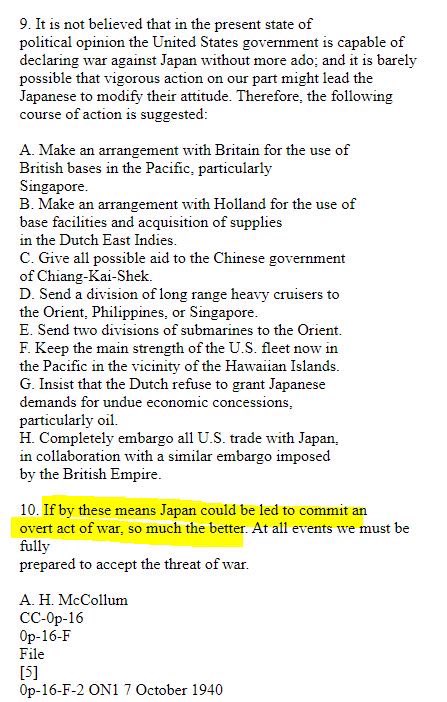
Oct 7, 1940 - Arthur McCollum, director for Far East Asia at ONI, authors a memo (classified until ‘94) detailing eight steps to “deter” Japan, ending with “If by these means Japan could be led to commit an overt act of war, so much the better.” By Dec ‘41, all would be done.
17/
17/
Oct 23, 1940 - FDR reaffirms ostensible commitment to neutrality at a speech in Philadelphia: “We will not participate in foreign wars, and we will not send our army, naval or air forces to fight in foreign lands outside of the Americas, except in case of attack.”
18/
18/

Jan 1941 - Japanese begin planning to attack PH. Several concerned members of Imperial War Ministry divulge this development to US Ambassador Joseph Grew: “The American Fleet will disappear.”
First recorded explicit warning, forwarded by State Dept to Roosevelt personally.
19/
First recorded explicit warning, forwarded by State Dept to Roosevelt personally.
19/

Jan 1941- Kilsoo Haan of the Sino-Korean People’s League tells Col. George Patton of Japanese plan to attack PH.
Haan would send Secretary of State Cordell Hull similar warnings in March and October of ‘41, specifying the attack would happen before Christmas.
20/
Haan would send Secretary of State Cordell Hull similar warnings in March and October of ‘41, specifying the attack would happen before Christmas.
20/

Feb - London-based diplomat Tyler Kent discovers and attempts to publish (before being caught and imprisoned) secret communications between Roosevelt and Churchill, indicating Roosevelt’s intent to circumvent offiicial US neutrality and enter the war. Read the highlights:
21/
21/


June - A U.S. military attaché in Mexico City informs Washington that Japan is building “midget submarines for attacking the American fleet in Pearl Harbor.”
The USS Ward would spot & sink one of these five subs at 6:45 AM on 7 December, the opening shot of the Pacific War.
22/
The USS Ward would spot & sink one of these five subs at 6:45 AM on 7 December, the opening shot of the Pacific War.
22/


June - Undercover US agent Warren Clear receives and forwards information by British intelligence in Singapore regarding PH attack. In 1967 he wrote “my evidence will show that Washington D.C. had solid evidence prior to [Pearl Harbor] that Japan would … [attack] Hawaii.”
23/
23/

August - German/British double agent Dusan Popov is sent to Hawaii with instructions to gather information on PH defenses. The same month, he reveals in an FBI interview that the info is intended for use in planning an attack on PH using carrier-based torpedo bombers.
24/
24/


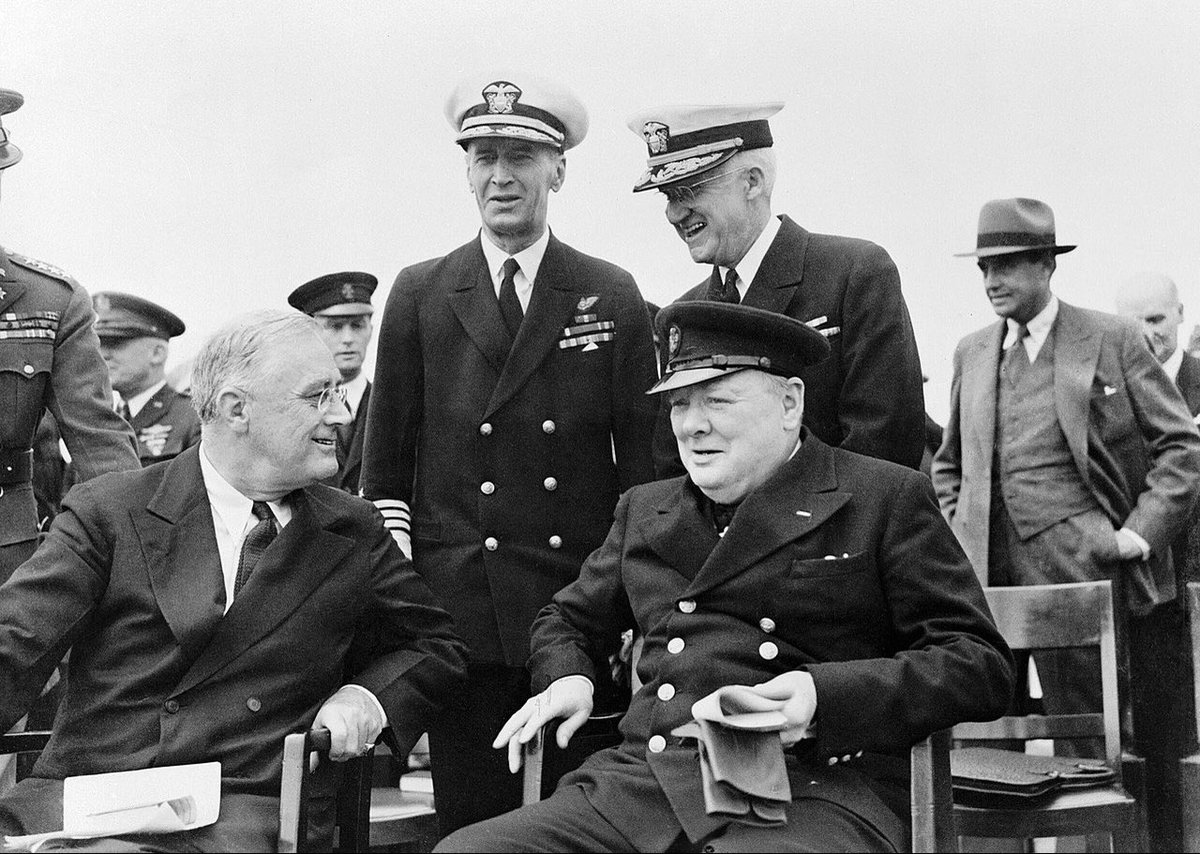
August - At the Atlantic Conference (Roosevelt and Churchill discuss their postwar vision), the latter notes the “astonishing depth of Roosevelt’s intense desire for war.” Churchill cabled his cabinet that “he obviously was very determined that [the US] should come in.”
25/
25/
Sep 24 - first of several dozen “bomb plot” messages from Tokyo intercepted and translated by US Naval Intelligence, asking spies in Hawaii for precise locations & dispositions of US warships.
More bomb plots would be sent and intercepted regularly until Dec 7.
26/
More bomb plots would be sent and intercepted regularly until Dec 7.
26/


Oct - Richard Sorge, head of a Soviet spy ring in Japan, radioes Moscow, “Japanese air force attacking United States Navy at Pearl Harbor probably dawn November six. Source reliable.”
It was his understanding that Moscow passed the warning to Washington.
27/
It was his understanding that Moscow passed the warning to Washington.
27/

Nov - Don Smith, director of the War Service for the American Red Cross, is called to the White House to discuss a “top secret matter” with FDR, at which he requests Smith to surge medical personnel and supplies to Pearl Harbor.
His daughter recounted the meeting in 1995:
28/
His daughter recounted the meeting in 1995:
28/

That FDR would explicitly divulge the conspiracy to Smith sounds almost fanciful, and one might be justified in dismissing it, except for one thing: records indicate there actually was a surge of medical personnel & supplies to PH just before Dec 7th.
29/
usni.org
29/
usni.org
Nov 14 - the information requested/given in intercepted Japanese Naval messages grows even more detailed, now concerns specifics regarding systems and methods of defense against air attack, including barrage balloons and torpedo nets.
30/
30/


25 Nov - War Secretary Henry Stimson notes in his diary that FDR stated the attack would come “perhaps as soon as next Monday [...] The question was how we should maneuver them into the position of firing the first shot without allowing too much danger to ourselves.”
31/
31/

25 Nov - Radio transmission intercepted from Yamamoto to Japanese task force with explicit orders to set out from Hitokappu Bay and attack Hawaii, dealing it a “mortal blow”.
Decoded by British on 25 Nov and Dutch on 27 Nov. When the US decoded it has never been disclosed.
32/
Decoded by British on 25 Nov and Dutch on 27 Nov. When the US decoded it has never been disclosed.
32/

3 AM, 26 Nov - Churchill sends urgent secret message to FDR, almost certainly concerning the 25 Nov intercept (message has never been released).
CIA director William Casey would later write "The British had sent word that a Japanese fleet was steaming east toward Hawaii."
33/
CIA director William Casey would later write "The British had sent word that a Japanese fleet was steaming east toward Hawaii."
33/

26 Nov - Admiral Kimmel at PH receives “suggestion” from Washington that he dispatch the two aircraft carriers stationed there, USS Enterprise and USS Lexington, to reinforce Midway and Wake Island. Both would be thus absent from port on 7 December, spared from destruction.
34/
34/


26 Nov - Hull issues final ultimatum demanding Japan’s full withdrawal from China & Indochina. FDR's Ambassador to Japan would call this "The document that touched the button that started the war." No one expects Japan to consider the terms and all involved know it means war.
35/
35/

Late Nov - Frustrated with his three previous ignored warnings, Haan contacts Senator Guy Gillette, telling him the Japanese Fleet had sailed under battle orders, east, not south, to attack Pearl Harbor. Gillette forwarded the information to the Depts of State, War, and Navy.
36/
36/

1-2 Dec - Japanese envoy Kurusu Saburo warns Hull that Japan is planning to go to war with the US.
Hull later testified: “Ambassador Nomura and Mr. Kurusu talked emphatically about the urgency of the situation and intimated vigorously that this was Japan’s last word.”
37/
Hull later testified: “Ambassador Nomura and Mr. Kurusu talked emphatically about the urgency of the situation and intimated vigorously that this was Japan’s last word.”
37/

3 Dec - Japanese intercept gives moorings of US warships in the harbor, ends with, “So far they do not seem to be alerted.”
6 Dec, 1941 - Another intercept “There are no barrage balloons up and there is an opportunity left for a surprise attack against these places.”
38/
6 Dec, 1941 - Another intercept “There are no barrage balloons up and there is an opportunity left for a surprise attack against these places.”
38/

Info regarding American alertness/defensive posture at PH was crucial for both the Japanese and Roosevelt, as his Chief of Intelligence Sherman Miles had assessed the Japanese would only carry out an initial attack on an unprepared target.
39/
39/

Relatedly, when asked why warnings concerning Japanese intercepts were so long withheld from PH (despite many attempts by lower ranking officers), Marshall would testify: “they must not send anything that would produce an operational reaction…for attack or defense.”
40/
40/


Also relatedly, the common claim (made still today) that Naval Intel couldn’t have known about the incoming attack because the Japanese fleet maintained complete radio silence is flatly untrue—many of the intercepted messages were sent from one part of the fleet to another.
41/
41/

It’s unclear exactly how many of these Naval dispatches (roughly 188, declassified in 1991) were decoded and translated before 7 Dec—primarily because the NSA has “lost” over 100,000 of the relevant documents that would tell us this—but we know the number was substantial.
42/
42/
It was substantial enough that ONI director CPT Alan Kirk proposed in October sending the intercepts to Admiral Kimmel at PH to warn him of imminent attack. His request was denied, and he was fired and replaced soon after.
43/
43/

MacArthur’s intel chief Charles Willoughby later remarked: “The sequence of messages…beginning with November 14th, would have led instantly to the inescapable conclusion that Pearl Harbor naval installations were a target for attack…for some sort of naval seaborne sortie.
44/
44/

4 Dec, 1941 - Haan phones State Dept official Maxwell Hamilton, warns that Pearl Harbor attack is coming that weekend. A memo addressed to Hull by special adviser Stanley Hornbeck confirms he personally received at least one of Haan’s five warnings, all of which were ignored.
45/
45/


5 Dec - British Intel in Singapore determines via radio direction finding that Japanese fleet has turned South toward Hawaii, informs Washington. Their commander on 8 December: “With all the information we gave them, how could the Americans have been caught unprepared?”
46/
46/

7:20 AM, Saturday 6 Dec - Tokyo sends Nomura what would become known as the “pilot message” indicating negotiations are over. Decoded in Washington by 2 PM. Five U.S. cryptographers took the message to mean Japan planned to attack within the next day.
47/
47/

A member of the army’s Signal Intelligence Service later wrote, “Shortly after midday on Saturday…[we] knew that war was as certain as death” and “it was known in our agency that Japan would surely attack us in the early afternoon of the following day…Not an iota of doubt.”
48/
48/
2 PM, 6 Dec - Johann Ranneft, Dutch attaché to ONI, notes in his diary: “At my request, they show me the location of the 2 carriers west of Honolulu.”
The carriers were located the day prior by the San Francisco naval station via radio direction and reported directly to FDR.
49/
The carriers were located the day prior by the San Francisco naval station via radio direction and reported directly to FDR.
49/
7:30 PM, 6 Dec - Lt. Lester Schulz delivers the pilot message (and about a dozen other intercepts) to FDR while in a meeting with special advisor Harry Hopkins (later revealed to be a Soviet agent), noting his unhurried demeanor as he read them and commented “This means war.”
50/
50/

Hopkins commented that it was “too bad” Japan would have the advantage of striking the first blow and the US could not, to which Roosevelt replied, “No, we can’t do that. We are a democracy and a peaceful people. But we have a good record.”
No warning sent to Pearl Harbor.
51/
No warning sent to Pearl Harbor.
51/
Of all the above warnings & indicators, none was sent or made known to Adm. Kimmel or General Short at PH, with the single exception of a notable Japanese civilian radio transmission (known as a “Winds Execute”), which only reached Short on 4 Dec via British intel directly.
52/
52/
7:53 AM, 7 Dec - “Tora, Tora, Tora” sent from Japanese air commander Fuchido to the fleet flagship Akagi, indicating complete surprise at Pearl Harbor has been achieved.
7:55 AM - Air raid signal, Pearl Harbor.
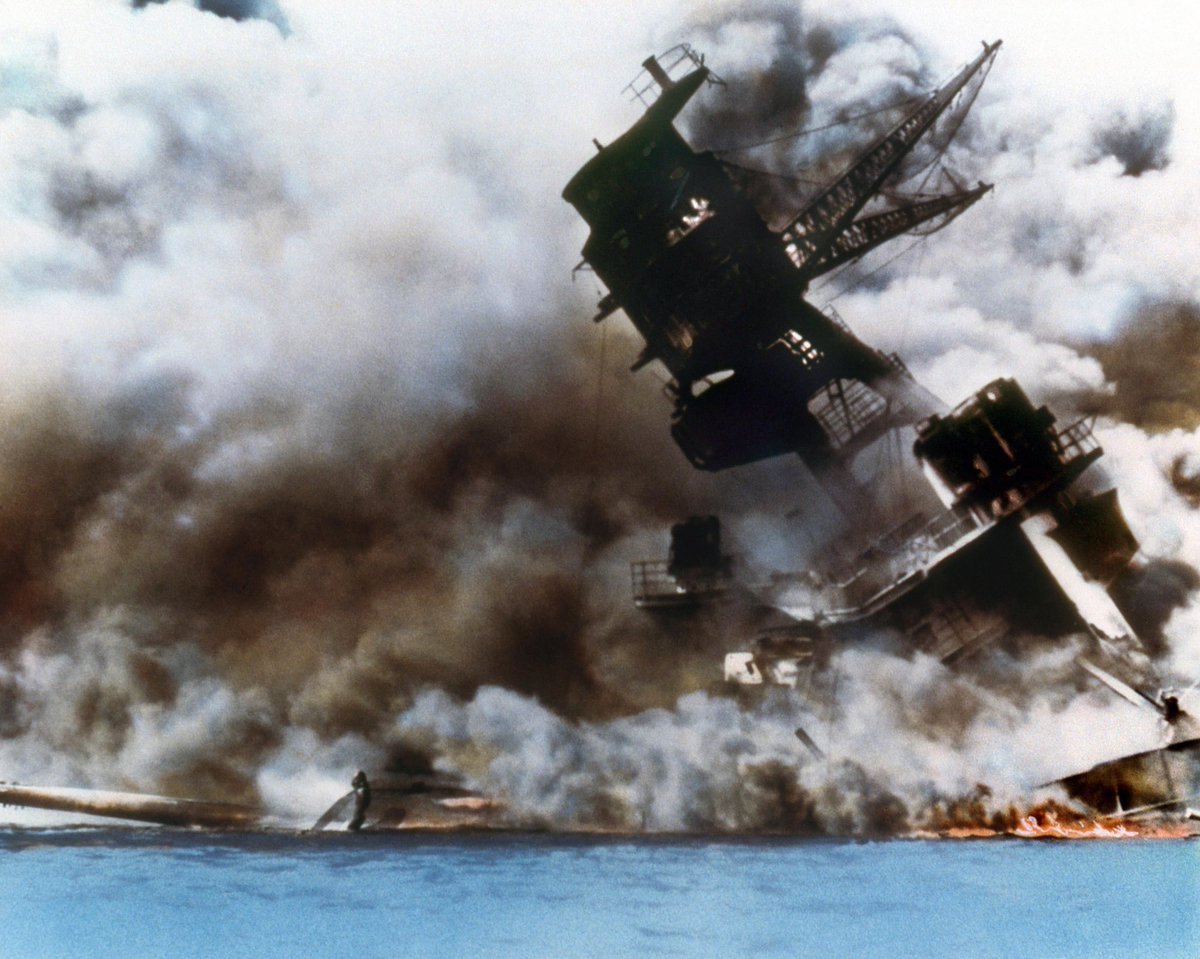
By 9 AM, over 2,000 Americans are dead or mortally wounded.
53/
7:55 AM - Air raid signal, Pearl Harbor.
By 9 AM, over 2,000 Americans are dead or mortally wounded.
53/

Again, this only accounts for a tiny fraction of the evidence of FDR’s foreknowledge, and USG actions to suppress evidence, coerce and discredit witnesses, and divert investigators afterward absolutely confirms foul play.
See Toland, Victor, and Stinnett’s books for this.
54/
See Toland, Victor, and Stinnett’s books for this.
54/


For a primary source play-by-play of FDR and his inner circle’s egregious negligence on 6-7 December, see the Minority Report to the ‘46 congressional investigation (the official finding left FDR’s culpability unanswered), starting at No. 20.
ibiblio.org
55/
ibiblio.org
55/
It is simply inconceivable that given
a) the *many* warnings and indicators that high-level admin officials received prior to Dec 7
b) US knowledge of Japanese war plans
c) intercepted Japanese communications, that PH was in any sense whatsoever a “surprise attack”.
56/
a) the *many* warnings and indicators that high-level admin officials received prior to Dec 7
b) US knowledge of Japanese war plans
c) intercepted Japanese communications, that PH was in any sense whatsoever a “surprise attack”.
56/
It was definitely a surprise to the poor souls in Hawaii, sacrificed as unwitting pawns in Roosevelt’s criminal Machiavellian game, but it sure as hell wasn’t a surprise to Roosevelt, his Cabinet, his General Staff, or the Washington intelligence apparatus.
57/
57/

Keep in mind also that the beltway establishment of 1941 was superbly competent. It defies reason that an accurate intel picture—especially one of this volume and importance—would be withheld from those who needed it most (the PH commanders) by mere oversight.
58/
58/
Similar intel to that above was also collected which implicated US forces elsewhere in the Pacific. MacArthur and Hart at Manila received the warnings, Short and Kimmel did not.
MacArthur—despite losing the Phillipines—was soon promoted, while Short & Kimmel made scapegoats.
59/
MacArthur—despite losing the Phillipines—was soon promoted, while Short & Kimmel made scapegoats.
59/

What’s uniquely astounding about the Pearl Harbor conspiracy is that despite the clear evidence of malfeasance—largely revealed through the government’s own investigations and inquiries—the initial “neutrality before surprise attack” narrative remains as strong as ever.
60/
60/

So why do Americans still believe the original story? Probably the same reason they still believe all other creedal WWII myths—e.g. that the US fought to save the Jews, that something called “The Axis” existed, that Germans embraced Naziism because of le public speaking, etc
61/
61/

“Pearl Harbor Myth” author George Victor says the persistent ahistorical WWII narrative is basically an emotional problem: “A nation often pulls itself out of [crisis] by creating myth—a melodramatic account, mixing fact and fantasy—which becomes a sacred part of its history”
62/
62/
But as Adams said, “facts are stubborn things.” The evidence is there, and has been for decades.
FDR knew.
Pearl Harbor was the result of a criminal conspiracy at the highest levels of government to manipulate the American people into a European war they did not want.
63/
FDR knew.
Pearl Harbor was the result of a criminal conspiracy at the highest levels of government to manipulate the American people into a European war they did not want.
63/
Loading suggestions...