

Today marks 39 years since the Brahmanical Indian state declared war on Sikhs in an attack that was given the codename Operation Bluestar. In the lead up to June 1984, up to 160k troops consisting of 7 divisions, were deployed to Punjab equipped with tanks & helicopter gunships.
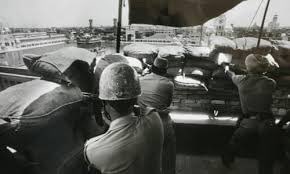


Under the false pretext of apprehending ‘militants’ and ‘terrorists’, the Indian state used its army to unleash 10 days of terror, bloodshed and horrendous human rights abuses, unprecedented in post-independence India.
Punjab was sealed off from the rest of the world, journalists were expelled, and a complete communication blackout was enforced, ensuring there were minimal witnesses to the carnage and horror conducted by the Indian state against the Sikh population.
For 39 years the world has been fed propaganda, and Sikhs have been gaslit into believing, that Sikhs were responsible for the invasion and desecration of our holiest of shrines, Sachkhand Sri Darbar Sahib, the very heart of Sikhi and our highest temporal Takht.
Contrary to Indian state propaganda, Darbar Sahib wasn’t invaded to flush out ‘militants’ or ‘terrorists’. Nor was it an unplanned attack conducted out of necessity, or in the interest of public safety, as has been falsely propagated by the Indian state for the last 39 years.
It was part of a strategy designed to crush a revolution and to kill the spirit of a community. It was to punish Sikhs for our demands to exercise religious, economic, and political sovereignty as set out in the Anandpur Sahib Resolution.


The attack on Darbar Sahib was conceived long before it was executed. Indira Gandhi had initially asked Lt. General SK Sinha to lead Operation Bluestar however, Sinha refused and advised that alternative solutions should be adopted. In an interview conducted by the
Spokesman with Sinha on July 16 1984, he provided an in-depth account of the events leading up to Operation Bluestar: "The Army action was not ‘the last resort' as Prime Minister Indira Gandhi would have us believe…It had been in her mind for more than 18 months…”.
According to Sinha, planning for Operation Bluestar commenced 18 months beforehand, shortly after the Dharam Yudh Morcha in 1982; the peaceful agitation for the Anandpur Sahib Resolution. The Army began rehearsals of a commando raid of Darbar Sahib at the secret 22 Establishment
near the Chakrata Cantonment in the Doon Valley of Uttar Pradesh, where a complete model of the Darbar Sahib complex had been built.
Training involving Aviation Research Centre Commandos was also provided at Sarsawa and Yamuna bed, near Saharanpur,
Training involving Aviation Research Centre Commandos was also provided at Sarsawa and Yamuna bed, near Saharanpur,
where helicopters converted into gunships were used and additional models of Darbar Sahib had been built.
It was in these locations that India’s military began practicing their unprovoked and deliberately deadly attack, in 1982.
It was in these locations that India’s military began practicing their unprovoked and deliberately deadly attack, in 1982.
It’s vital to note that at this time, Sant Jarnail Singh ji Khalsa Bhindranwale, the man claimed by the Indian state to be a Sikh ‘terrorist’ leader and the reason for the invasion, was not residing at Darbar Sahib.
On October 7 1983, two ordinances were passed: the Punjab Disturbed Areas Ordinance and the Chandigarh Disturbed Areas Ordinance. The Armed Forces (Punjab and Chandigarh) Special Powers Ordinance, 1983, was then passed on October 15, 1983.
A full six months before unleashing hell on the Sikhs in Punjab, the Central government had laid the legal foundation for what was to come.
The date for the attack was changed multiple times in the lead up to it. General K Sundarji, who was overall in charge
The date for the attack was changed multiple times in the lead up to it. General K Sundarji, who was overall in charge
of Operation Bluestar, is quoted as saying “I was told by the Defence Minister to prepare for the Operation on January 15, 1984”. Source: Inder Malhotra; Indira Gandhi: A Personal and Political Biography.
This date, falling right before Guru Gobind Singh ji’s Gurpurab,
This date, falling right before Guru Gobind Singh ji’s Gurpurab,
would have ensured maximum crowds were present.
The reason this date did not go ahead was because there were difficulties to overcome within the Army. In a letter from Simranjit Singh Mann to President Zail Singh it is stated “Maj General Kuldip Brar
The reason this date did not go ahead was because there were difficulties to overcome within the Army. In a letter from Simranjit Singh Mann to President Zail Singh it is stated “Maj General Kuldip Brar
who accepted to undertake the operation, was not able to deploy his troops immediately as Maj Gen J.S. Jamwal, who was deputed earlier, refused to carry out the massacre of the Sikhs stating that, as a professional soldier, he could not butcher his own people”.
Eventually, the timing of the attack was deliberately scheduled to coincide with another significant religious day for Sikhs; Guru Arjan Dev ji’s Gurpurab, a time during which tens of thousands of Sikh pilgrims gather at Darbar Sahib every year.
Prior to the invasion, the Indian state ramped up its campaign of creating violence and unrest against Sikhs. In February 1984, the CM of Haryana provoked Hindu mobs to attack Sikhs, in a speech warning the Sikh leaders campaigning for the Anandpur Sahib Resolution that
“Hindu patience is running out and retaliation is near”.
Following this speech, frenzied Hindu mobs began to attack Sikhs in Haryana on February 15 while the police stood idly by and allowed the situation to escalate.
Following this speech, frenzied Hindu mobs began to attack Sikhs in Haryana on February 15 while the police stood idly by and allowed the situation to escalate.
On February 17, the Hindu mobs set cars and buses ablaze, blocked off traffic near Panipat and began pulling Sikhs out of buses and attacking them while police watched on and did nothing. On February 19 the violence intensified further as the 'Haryana Desam' organisation

mobilised more Hindu rioters who looted Sikh homes and businesses, burned down 6 Gurdwaras, and killed Sikhs.
During this time, Satish Jacob of the BBC reporting seeing police looking on as Hindu mobs burnt down a Gurudwara in Panipat. He also saw Sikhs pulled out of buses and
During this time, Satish Jacob of the BBC reporting seeing police looking on as Hindu mobs burnt down a Gurudwara in Panipat. He also saw Sikhs pulled out of buses and

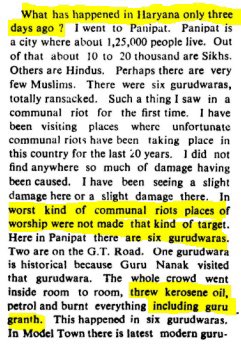

forcibly shaved and Sikh shops being looted. He witnessed 8 Sikhs being clubbed to death by Hindu mobs.
Former Punjab Police IG (Intelligence), HS Randhawa, has on public record stated that “the Air force had helicopters flying over the Golden Temple a full two months before
Former Punjab Police IG (Intelligence), HS Randhawa, has on public record stated that “the Air force had helicopters flying over the Golden Temple a full two months before
Operation Bluestar, which shows that they were photographing and observing the entire area and the complex specifically. The Army was holding daily meetings with the Intelligence Bureau over the heads of the Punjab Police”. The Army, in CRPF uniform, had already surrounded
Darbar Sahib two months before the invasion.
By the end of May, it was widely known in Punjab that the Army was going to attack Darbar Sahib, and because of this there was tremendous tension in Amritsar and its surrounding areas.
By the end of May, it was widely known in Punjab that the Army was going to attack Darbar Sahib, and because of this there was tremendous tension in Amritsar and its surrounding areas.
On 1 June, these fears became a reality when the security forces, who had spent months surrounding the complex and building fortifications on the multi-storey buildings around it, started firing.
At approximately 12.30pm on the afternoon of 1 June 1984, India’s Border Security Force and the Central Reserve Police Force, under the orders of the Army, suddenly began firing without provocation upon the Darbar Sahib complex, aiming at the people inside the Parikarmas.
The firing continued for 7 hours, resulting in the death of 8 Sikhs on that day, including Shaheed Bhai Kulwant Singh Babbar who attained Shaheedi while bravely defending the complex against the Indian state’s pre-planned attack on Sikhi. The Battle of Amritsar had begun.
Loading suggestions...