

Project 112
How The United States of America tested its bioweapons on its own citizens...!!
Let's explore:
#CIA #Bioweapons #USA
How The United States of America tested its bioweapons on its own citizens...!!
Let's explore:
#CIA #Bioweapons #USA

1. The toys to play around
The United States' first attempt at biological warfare came during World War I. The agent the U.S. tested was the toxin ricin a product of the castor plant. The U.S. conducted tests concerning two methods of ricin dissemination, firstly, adhering the toxin to shrapnel for delivery by an artillery shell, which was successful. Secondly, delivering an aerosol cloud of ricin.
#CIA #Bioweapons #USA
The United States' first attempt at biological warfare came during World War I. The agent the U.S. tested was the toxin ricin a product of the castor plant. The U.S. conducted tests concerning two methods of ricin dissemination, firstly, adhering the toxin to shrapnel for delivery by an artillery shell, which was successful. Secondly, delivering an aerosol cloud of ricin.
#CIA #Bioweapons #USA

2. The Silence in between
In the 1920s suggestions started coming up that the U.S. begin a biological weapons program were coming from within the Chemical Warfare Service (CWS). Chief of the CWS, Amos Fries, decided that such a program would not be "profitable" for the U.S. So from World War 1 to world war 2 there was a brief policy silence in the US.
#CIA #Bioweapons #USA
In the 1920s suggestions started coming up that the U.S. begin a biological weapons program were coming from within the Chemical Warfare Service (CWS). Chief of the CWS, Amos Fries, decided that such a program would not be "profitable" for the U.S. So from World War 1 to world war 2 there was a brief policy silence in the US.
#CIA #Bioweapons #USA

3. The fire ignited
Initial US interest in biological weapons by the Chemical Warfare Service began in 1941. That fall, U.S. Secretary of War Henry L. Stimson requested that the National Academy of Sciences (NAS) undertake consideration of U.S. biological warfare.
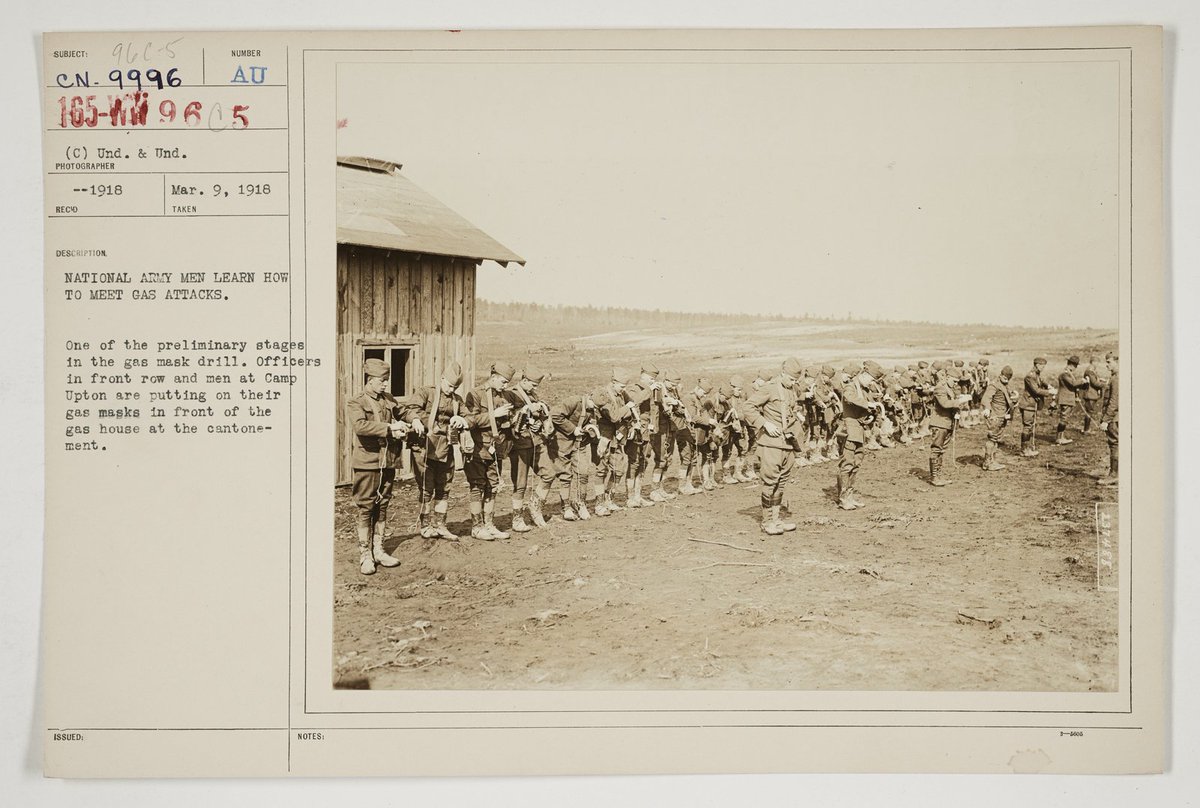
(A world war 1 drill by Chemical Warfare Service to survive the gas attack)
#CIA #Bioweapons #USA
Initial US interest in biological weapons by the Chemical Warfare Service began in 1941. That fall, U.S. Secretary of War Henry L. Stimson requested that the National Academy of Sciences (NAS) undertake consideration of U.S. biological warfare.
(A world war 1 drill by Chemical Warfare Service to survive the gas attack)
#CIA #Bioweapons #USA
4. The signatures of death
NAS formed a committee, the War Bureau of Consultants (WBC), which issued a report on the subject in February 1942. The report recommended the research and development of an offensive biological weapons program. The British, and the research undertaken by the WBC, pressured the U.S. to begin biological weapons research and development and in November 1942 U.S. President Franklin Roosevelt officially approved an American biological weapons program.
#CIA #BioWeapons #USA
NAS formed a committee, the War Bureau of Consultants (WBC), which issued a report on the subject in February 1942. The report recommended the research and development of an offensive biological weapons program. The British, and the research undertaken by the WBC, pressured the U.S. to begin biological weapons research and development and in November 1942 U.S. President Franklin Roosevelt officially approved an American biological weapons program.
#CIA #BioWeapons #USA

5. The Lurking Shadows
In response to the information provided by the WBC, Roosevelt ordered Stimson to form the War Research Service (WRS). The WRS' was established within the Federal Security Agency and its stated purpose was to promote "public security and health", but, in reality, the WRS was tasked with coordinating and supervising the U.S. biological warfare program. In the spring of 1943, the U.S. Army Biological Warfare Laboratories were established at Fort (then Camp) Detrick in Maryland.
#CIA #USA #BioWeapons
In response to the information provided by the WBC, Roosevelt ordered Stimson to form the War Research Service (WRS). The WRS' was established within the Federal Security Agency and its stated purpose was to promote "public security and health", but, in reality, the WRS was tasked with coordinating and supervising the U.S. biological warfare program. In the spring of 1943, the U.S. Army Biological Warfare Laboratories were established at Fort (then Camp) Detrick in Maryland.
#CIA #USA #BioWeapons

6. The public secret no one knew about and celebrations unabashed
By November 1943 the biological weapons facility at Fort Detrick was completed, and the United States constructed three more facilities - a biological agent production plant at Vigo County near Terre Haute, Indiana, a field-testing site on Horn Island in Mississippi, and another field site near Granite Peak in Utah. The elaborate security precautions taken at Camp Detrick were so effective that it was not until January 1946, 4 months after VJ Day, that the public learned of the wartime research in biological weapons".
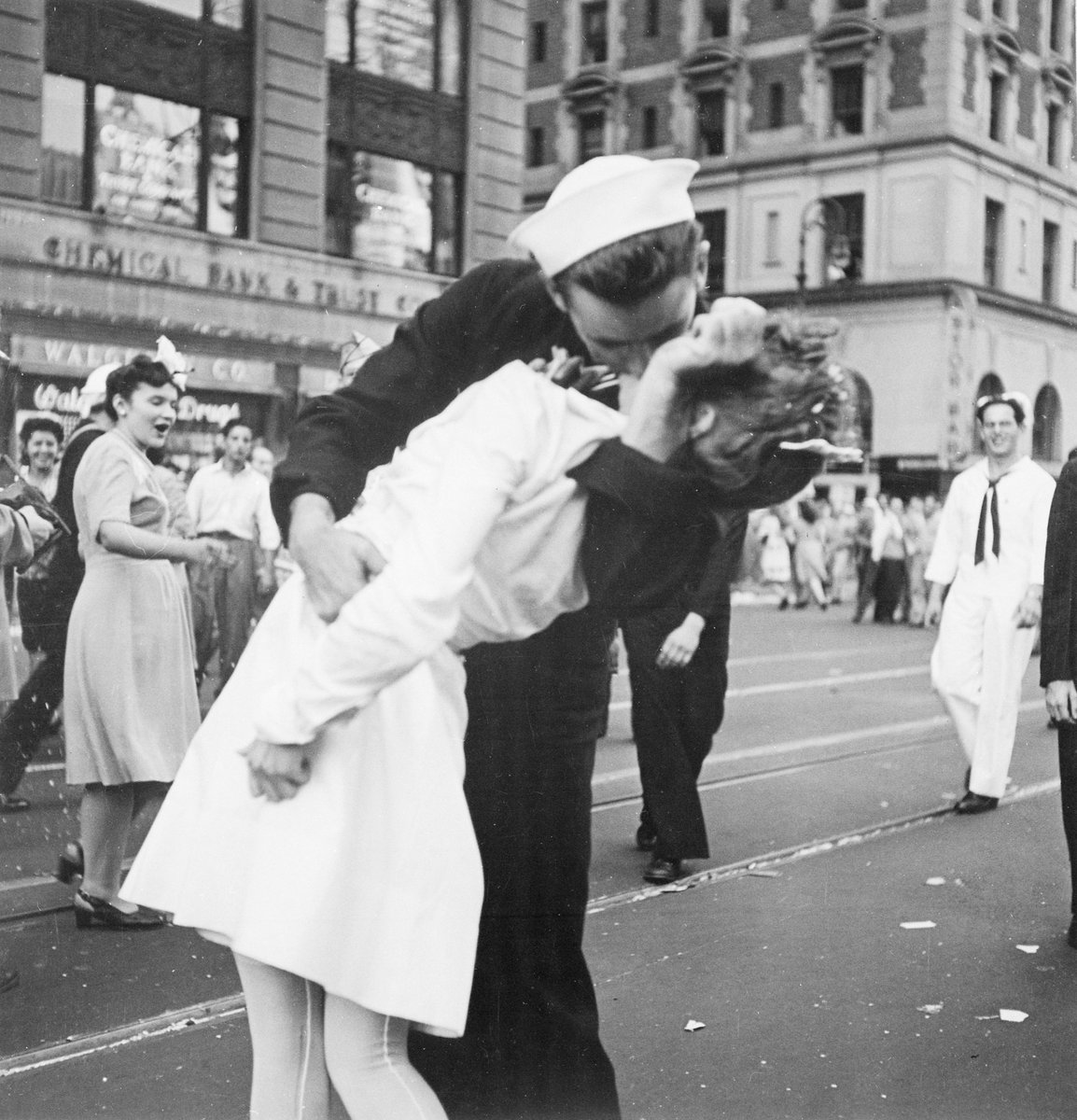
(The immortal photograph of a Navy sailor kissing a nurse clicked by the photographer Alfred Eisenstaedt at times square during "Victory over Japan" day celebrations, NewYork Magazine and published in Life Magazine in the year 1945).
#CIA #USA #Bioweapon
By November 1943 the biological weapons facility at Fort Detrick was completed, and the United States constructed three more facilities - a biological agent production plant at Vigo County near Terre Haute, Indiana, a field-testing site on Horn Island in Mississippi, and another field site near Granite Peak in Utah. The elaborate security precautions taken at Camp Detrick were so effective that it was not until January 1946, 4 months after VJ Day, that the public learned of the wartime research in biological weapons".
(The immortal photograph of a Navy sailor kissing a nurse clicked by the photographer Alfred Eisenstaedt at times square during "Victory over Japan" day celebrations, NewYork Magazine and published in Life Magazine in the year 1945).
#CIA #USA #Bioweapon
5. Let us say a "Biological Hello" to our owns
The US biological weapons program started during World War II. But the first real public test happened in 1949 when scientists put harmless bacteria in the air conditioning system at the Pentagon to see what a biological weapon might look like.
#CIA #BioWeapons #USA
The US biological weapons program started during World War II. But the first real public test happened in 1949 when scientists put harmless bacteria in the air conditioning system at the Pentagon to see what a biological weapon might look like.
#CIA #BioWeapons #USA

6. Hunters were Hunted
Ira Baldwin, Camp Detrick’s scientific director during World War II, left his position after the Allied victory in 1945 and returned to teaching at the University of Wisconsin. He continued to advise the government on issues concerning biological weapons, however, particularly the threat that might be posed by enemy spies releasing biological agents in American cities.
In an October 1948 report, Baldwin posited that the U.S. was “particularly vulnerable to this type of attack.” The Army’s Chemical Corps, which ran Camp Detrick, agreed with Baldwin’s assessment and set up a Special Operations Division at Camp Detrick to carry out the tests. Its first target was to be the Pentagon.
#CIA #Pentagon #BioWeapons
(Ira Baldwin - Left)
Ira Baldwin, Camp Detrick’s scientific director during World War II, left his position after the Allied victory in 1945 and returned to teaching at the University of Wisconsin. He continued to advise the government on issues concerning biological weapons, however, particularly the threat that might be posed by enemy spies releasing biological agents in American cities.
In an October 1948 report, Baldwin posited that the U.S. was “particularly vulnerable to this type of attack.” The Army’s Chemical Corps, which ran Camp Detrick, agreed with Baldwin’s assessment and set up a Special Operations Division at Camp Detrick to carry out the tests. Its first target was to be the Pentagon.
#CIA #Pentagon #BioWeapons
(Ira Baldwin - Left)

7. Operation Sea Spray
The Bioweapon testing operations moved to larger scale testing, releasing clouds containing supposedly harmless bacteria from Navy ships off Norfolk, Virginia, in April 1950, and the San Francisco coast in September 1950. The San Francisco experiments showed exposure among almost all of the city’s 800,000 residents. Had the bacteria released been anthrax bacteria or some other virulent pathogen, the results would have been catastrophic.
#CIA #BioWeapons
The Bioweapon testing operations moved to larger scale testing, releasing clouds containing supposedly harmless bacteria from Navy ships off Norfolk, Virginia, in April 1950, and the San Francisco coast in September 1950. The San Francisco experiments showed exposure among almost all of the city’s 800,000 residents. Had the bacteria released been anthrax bacteria or some other virulent pathogen, the results would have been catastrophic.
#CIA #BioWeapons
8. How Operation Sea Spray was executed
Starting on September 20, 1950, and continuing until September 27, the U.S. Navy released the two types of bacteria from a ship off the shore of San Francisco, believing them to be harmless to humans. Based on results from monitoring equipment at 43 locations around the city, the Army determined that San Francisco had received enough of a dose for nearly all of the city's 800,000 residents to inhale at least 5,000 of the particles. This is prescribed within the range of infectivity for anthrax.
#CIA #BioWeapons
Starting on September 20, 1950, and continuing until September 27, the U.S. Navy released the two types of bacteria from a ship off the shore of San Francisco, believing them to be harmless to humans. Based on results from monitoring equipment at 43 locations around the city, the Army determined that San Francisco had received enough of a dose for nearly all of the city's 800,000 residents to inhale at least 5,000 of the particles. This is prescribed within the range of infectivity for anthrax.
#CIA #BioWeapons
9. Up in the air
In the 1950s, army researchers dispersed zinc cadmium sulfide (now a known cancer-causing agent) over Minnesota and other Midwestern states to see how far they would spread in the atmosphere. The particles were detected more than 1,000 miles away in New York state.
#CIA #USARMY #Bioweaopns
(A C-119 Flying Boxcar, one type of plane used to release chemicals)
In the 1950s, army researchers dispersed zinc cadmium sulfide (now a known cancer-causing agent) over Minnesota and other Midwestern states to see how far they would spread in the atmosphere. The particles were detected more than 1,000 miles away in New York state.
#CIA #USARMY #Bioweaopns
(A C-119 Flying Boxcar, one type of plane used to release chemicals)

10. The St Jo Program and Large Area Concept
As per a US Air Force request, in 1953 the Army Chemical Corps created the St Jo Program and operatives staged mock anthrax attacks on St. Louis, Minneapolis, and Winnipeg. The bacteria were released from generators placed on top of cars, and local governments were told that “invisible smokescreens” were being deployed to mask the city on enemy radar.
#Bioweapons #USA
As per a US Air Force request, in 1953 the Army Chemical Corps created the St Jo Program and operatives staged mock anthrax attacks on St. Louis, Minneapolis, and Winnipeg. The bacteria were released from generators placed on top of cars, and local governments were told that “invisible smokescreens” were being deployed to mask the city on enemy radar.
#Bioweapons #USA
11. The St Jo Program and Large Area Concept - part 2
The next stage was to increase dispersal patterns, dispensing particles from airplanes to find out how wide of an area they would affect. The first Large Area Concept experiment, in 1957, involved dispersing microorganisms over a swath from South Dakota to Minnesota; monitoring revealed that some of the particles eventually traveled some 1200 miles away. Further tests covered areas from Ohio to Texas and Michigan to Kansas. In the Army’s words, these experiments “proved the feasibility of covering large areas of the country with biological weapons agents.”
#Bioweapons #USA
The next stage was to increase dispersal patterns, dispensing particles from airplanes to find out how wide of an area they would affect. The first Large Area Concept experiment, in 1957, involved dispersing microorganisms over a swath from South Dakota to Minnesota; monitoring revealed that some of the particles eventually traveled some 1200 miles away. Further tests covered areas from Ohio to Texas and Michigan to Kansas. In the Army’s words, these experiments “proved the feasibility of covering large areas of the country with biological weapons agents.”
#Bioweapons #USA
12. Serratia marcescens bacteria Test
Open-air testing continued through the 1960s, with the Special Operations Division operatives simulating even more audacious assaults. In 1965 they spread bacteria throughout Washington’s National Airport; a year later, agents dropped light bulbs filled with organisms onto the tracks in New York’s subway system.
#USA #Bioweapons
Open-air testing continued through the 1960s, with the Special Operations Division operatives simulating even more audacious assaults. In 1965 they spread bacteria throughout Washington’s National Airport; a year later, agents dropped light bulbs filled with organisms onto the tracks in New York’s subway system.
#USA #Bioweapons
13. White vs Black
In 1951, tests were also carried out at the Norfolk Naval Supply Center in Virginia, a massive base that equips the US Navy. Fungal spores were dispersed to see how they would infect workers unpacking crates there. Most of the workers were African American and the scientists wanted to test a theory that they were more susceptible to fungal disease than Caucasians.
#USA #Bioweapons
In 1951, tests were also carried out at the Norfolk Naval Supply Center in Virginia, a massive base that equips the US Navy. Fungal spores were dispersed to see how they would infect workers unpacking crates there. Most of the workers were African American and the scientists wanted to test a theory that they were more susceptible to fungal disease than Caucasians.
#USA #Bioweapons
14. Project 112 arrives
There was a massive increase in testing in 1962 when then US Secretary of Defence, Robert McNamara, authorized Project 112. The project expanded bioweapons testing and pumped new funds into research. One of the more controversial tests took place in 1966 on the New York subway. Scientists filled light bulbs with Bacillus globigii bacteria and then smashed them open on the tracks. The bacteria traveled for miles around the subway system, being breathed in by thousands of civilians and covering their clothes.
#USA #Bioweapons
There was a massive increase in testing in 1962 when then US Secretary of Defence, Robert McNamara, authorized Project 112. The project expanded bioweapons testing and pumped new funds into research. One of the more controversial tests took place in 1966 on the New York subway. Scientists filled light bulbs with Bacillus globigii bacteria and then smashed them open on the tracks. The bacteria traveled for miles around the subway system, being breathed in by thousands of civilians and covering their clothes.
#USA #Bioweapons

15. The Cancer of Experiments
In 1997, the National Research Council revealed that the US also used chemicals to test the potential of biological weapons in the 1950s. Zinc cadmium sulfide was dispersed by plane and sprayed over a number of cities, including St Louis in Missouri and Minneapolis in Minnesota. These cities were chosen because they were similar to Soviet targets such as Moscow in terms of terrain, weather, and population. In later decades these cities had one of the highest rates of cancer among their populations!!
#USA #Bioweapons
In 1997, the National Research Council revealed that the US also used chemicals to test the potential of biological weapons in the 1950s. Zinc cadmium sulfide was dispersed by plane and sprayed over a number of cities, including St Louis in Missouri and Minneapolis in Minnesota. These cities were chosen because they were similar to Soviet targets such as Moscow in terms of terrain, weather, and population. In later decades these cities had one of the highest rates of cancer among their populations!!
#USA #Bioweapons
16. What was Project 112?
Project 112 was a biological and chemical weapon experimentation project conducted by the United States Department of Defense from 1962 to 1973.
The project started under John F. Kennedy's administration and was authorized by his Secretary of Defense Robert McNamara, as part of a total review of the US military.
#USA #Bioweapons
Project 112 was a biological and chemical weapon experimentation project conducted by the United States Department of Defense from 1962 to 1973.
The project started under John F. Kennedy's administration and was authorized by his Secretary of Defense Robert McNamara, as part of a total review of the US military.
#USA #Bioweapons

14. Why it was named Project 112?
The name "Project 112" refers to this project's number in the 150-project review process authorized by then Secretary of Defense Robert McNamara. Funding and staff were contributed by every branch of the U.S. armed services and intelligence agencies, a cover name for the Office of Technical Services of the Central Intelligence Agency's Directorate of Science & Technology. Canada and the United Kingdom also participated in some Project 112 activities.
#USA #Bioweapons
The name "Project 112" refers to this project's number in the 150-project review process authorized by then Secretary of Defense Robert McNamara. Funding and staff were contributed by every branch of the U.S. armed services and intelligence agencies, a cover name for the Office of Technical Services of the Central Intelligence Agency's Directorate of Science & Technology. Canada and the United Kingdom also participated in some Project 112 activities.
#USA #Bioweapons
15. What was the scope of Project 112?
Project 112 mainly dealt with the use of aerosols to disseminate biological and chemical agents that could produce "controlled temporary incapacitation" (CTI). The test program would be conducted on a large scale at "extracontinental test sites" in the Central and South Pacific and Alaska in conjunction with Britain, Canada, and Australia.
(YAG 39 USS George Eastman, after being refitted with scientific equipment for Project 112)
#USA #Bioweapons
Project 112 mainly dealt with the use of aerosols to disseminate biological and chemical agents that could produce "controlled temporary incapacitation" (CTI). The test program would be conducted on a large scale at "extracontinental test sites" in the Central and South Pacific and Alaska in conjunction with Britain, Canada, and Australia.
(YAG 39 USS George Eastman, after being refitted with scientific equipment for Project 112)
#USA #Bioweapons

16. The Writ of Power and Project 112
At least 50 trials were conducted and out of these at least 18 tests involved simulants of biological agents (such as BG), and at least 14 involved chemical agents including sarin and VX, but also tear gas and other stimulants. Test sites included Porton Down (UK), Ralston (Canada), and at least 13 US warships, the shipborne trials were collectively known as Shipboard Hazard and Defense (SHAD). The project was coordinated from Deseret Test Center, Utah.
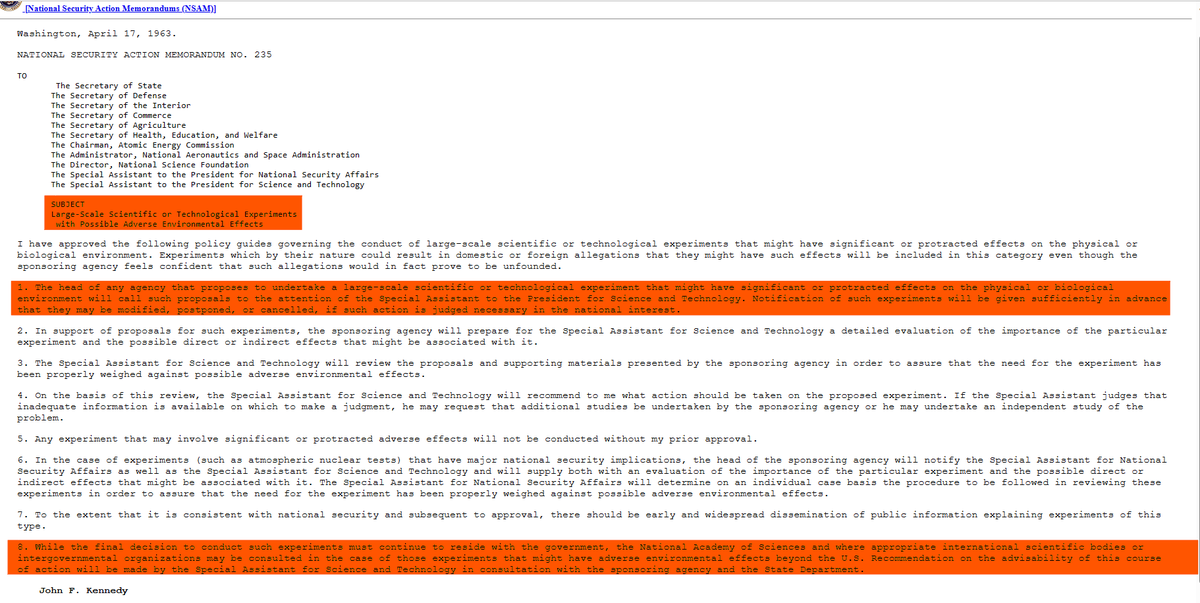
(National Security Action Memorandum 235 (NSAM 235, signed by President Kennedy resulting in the start of Project 112).
#USA #Bioweapon
At least 50 trials were conducted and out of these at least 18 tests involved simulants of biological agents (such as BG), and at least 14 involved chemical agents including sarin and VX, but also tear gas and other stimulants. Test sites included Porton Down (UK), Ralston (Canada), and at least 13 US warships, the shipborne trials were collectively known as Shipboard Hazard and Defense (SHAD). The project was coordinated from Deseret Test Center, Utah.
(National Security Action Memorandum 235 (NSAM 235, signed by President Kennedy resulting in the start of Project 112).
#USA #Bioweapon

17. A pie of the biological sky
Project 112 was a highly classified military testing program that was aimed at both offensive and defensive human, animal, and plant reactions to biological and chemical warfare in various combinations of climate and terrain. The U.S. Army Chemical Corps sponsored the United States portion of an agreement between the U.S., Britain, Canada, and Australia to negotiate, host, conduct, or participate in mutual interest research and development activity and field testing.
#USA #Bioweapons
Project 112 was a highly classified military testing program that was aimed at both offensive and defensive human, animal, and plant reactions to biological and chemical warfare in various combinations of climate and terrain. The U.S. Army Chemical Corps sponsored the United States portion of an agreement between the U.S., Britain, Canada, and Australia to negotiate, host, conduct, or participate in mutual interest research and development activity and field testing.
#USA #Bioweapons
18. The Devil's Lares
The command structure for the Deseret Test Center, which was organized to oversee Project 112, bypassed standard Defense Department channels and reported directly to the Joint Chiefs of Staff and US Cabinet consisting of the Secretary of Defense, Secretary of State, and a much smaller extent, the Secretary of Agriculture. Experiments were planned and conducted by the Deseret Test Center and Deseret Chemical Depot at Fort Douglas, Utah. The tests were designed to test the effects of biological weapons and chemical weapons on personnel, plants, animals, insects, toxins, vehicles, ships, and equipment.
#Bioweapons #USA
The command structure for the Deseret Test Center, which was organized to oversee Project 112, bypassed standard Defense Department channels and reported directly to the Joint Chiefs of Staff and US Cabinet consisting of the Secretary of Defense, Secretary of State, and a much smaller extent, the Secretary of Agriculture. Experiments were planned and conducted by the Deseret Test Center and Deseret Chemical Depot at Fort Douglas, Utah. The tests were designed to test the effects of biological weapons and chemical weapons on personnel, plants, animals, insects, toxins, vehicles, ships, and equipment.
#Bioweapons #USA

19. Death has many names
Project 112 tests used the following agents and simulants: Francisella tularensis, Serratia marcescens, Escherichia coli, Bacillus globii, staphylococcal enterotoxin Type B, Puccinia graminis var. tritici (stem rust of wheat). Agents and simulants were usually dispensed as aerosols using spraying devices or bomblets.
#Bioweapons #USA
Project 112 tests used the following agents and simulants: Francisella tularensis, Serratia marcescens, Escherichia coli, Bacillus globii, staphylococcal enterotoxin Type B, Puccinia graminis var. tritici (stem rust of wheat). Agents and simulants were usually dispensed as aerosols using spraying devices or bomblets.
#Bioweapons #USA
20. No one is spared by the Devil
In May 1965, vulnerability tests in the U.S. using the anthrax simulant Bacillus globigii were performed in the Washington D.C. area by SOD covert agents. One test was conducted at the Greyhound bus terminal and the other at the north terminal of the National Airport. In these tests, the bacteria were released from spray generators hidden in specially built briefcases.
#Bioweapons #USA
In May 1965, vulnerability tests in the U.S. using the anthrax simulant Bacillus globigii were performed in the Washington D.C. area by SOD covert agents. One test was conducted at the Greyhound bus terminal and the other at the north terminal of the National Airport. In these tests, the bacteria were released from spray generators hidden in specially built briefcases.
#Bioweapons #USA
21. Project 112 - SHAD - The Baby Sister of Project 112
Project 112 consisted of both land-based and sea-based tests. The sea-based tests, called Project SHAD were primarily launched from other ships such as the USS Granville S. Hall and USS George Eastman, Army tugboats, submarines, or fighter aircraft and were designed to identify U.S. warships' vulnerabilities to attacks with chemical or biological warfare agents and to develop decontamination and other methods to counter such attacks while maintaining a war-fighting capability.
#Bioweapons #USA
Project 112 consisted of both land-based and sea-based tests. The sea-based tests, called Project SHAD were primarily launched from other ships such as the USS Granville S. Hall and USS George Eastman, Army tugboats, submarines, or fighter aircraft and were designed to identify U.S. warships' vulnerabilities to attacks with chemical or biological warfare agents and to develop decontamination and other methods to counter such attacks while maintaining a war-fighting capability.
#Bioweapons #USA
22. Operation Whitecoat - Little Baby of the Project 112
It was a biodefense medical research program carried out by the United States Army at Fort Detrick, Maryland between 1954 and 1973. The program pursued medical research using volunteer enlisted personnel who were eventually nicknamed "Whitecoats".
(A consent letter for the participant of Project WhiteCoat)
#Bioweapons
It was a biodefense medical research program carried out by the United States Army at Fort Detrick, Maryland between 1954 and 1973. The program pursued medical research using volunteer enlisted personnel who were eventually nicknamed "Whitecoats".
(A consent letter for the participant of Project WhiteCoat)
#Bioweapons

22. Who were White Coats?
White Coat volunteers, were all naive objectors including many members of the Seventh-day Adventist Church, who were informed of the purpose and goals of each project before providing consent to participate in any project. The stated purpose of the research was to defend troops and civilians against biological weapons and it was believed that the Soviet Union was engaged in similar activities. Although the program was discontinued in 1973, similar medical research for biodefense purposes is still conducted at the U.S. Army Medical Research Institute of Infectious Diseases (USAMRIID) at Fort Detrick and at other government and civilian research institutes.
#Bioweapons #USA
White Coat volunteers, were all naive objectors including many members of the Seventh-day Adventist Church, who were informed of the purpose and goals of each project before providing consent to participate in any project. The stated purpose of the research was to defend troops and civilians against biological weapons and it was believed that the Soviet Union was engaged in similar activities. Although the program was discontinued in 1973, similar medical research for biodefense purposes is still conducted at the U.S. Army Medical Research Institute of Infectious Diseases (USAMRIID) at Fort Detrick and at other government and civilian research institutes.
#Bioweapons #USA
23. Cricket Cricket why so Wicked
The United States seriously researched the potential of entomological warfare (EW) during the Cold War. EW is a specific type of biological warfare that aims to use insects as weapons, either directly or through their potential to act as vectors. During the 1950s the United States conducted a series of field tests using entomological weapons. Operation Big Itch, in 1954, was designed to test munitions loaded with uninfected fleas (Xenopsylla cheopis). In May 1955 over 300,000 yellow fever mosquitoes (Aedes aegypti) were dropped over parts of the U.S. state of Georgia to determine if the air-dropped mosquitoes could survive to take meals from humans. The mosquito tests were known as Operation Big Buzz. The U.S. engaged in at least two other EW testing programs, Operation Drop Kick and Operation May Day.
#Bioweapons
The United States seriously researched the potential of entomological warfare (EW) during the Cold War. EW is a specific type of biological warfare that aims to use insects as weapons, either directly or through their potential to act as vectors. During the 1950s the United States conducted a series of field tests using entomological weapons. Operation Big Itch, in 1954, was designed to test munitions loaded with uninfected fleas (Xenopsylla cheopis). In May 1955 over 300,000 yellow fever mosquitoes (Aedes aegypti) were dropped over parts of the U.S. state of Georgia to determine if the air-dropped mosquitoes could survive to take meals from humans. The mosquito tests were known as Operation Big Buzz. The U.S. engaged in at least two other EW testing programs, Operation Drop Kick and Operation May Day.
#Bioweapons
24. The Closure
In November 1969 then-US President Richard Nixon ordered a closure of the US Biological weapons offensive program, but scientists at Fort Detrick worked on one toxin, Staphylococcus enterotoxin type B (SEB), for several more months. President Nixon ended the debate when he added toxins to the bioweapons ban in February 1970. The U.S. also ran a series of experiments with anthrax, code-named Project Bacchus, Project Clear Vision, and Project Jefferson in the late 1990s and early 2000s.
#USA #Bioweapons
In November 1969 then-US President Richard Nixon ordered a closure of the US Biological weapons offensive program, but scientists at Fort Detrick worked on one toxin, Staphylococcus enterotoxin type B (SEB), for several more months. President Nixon ended the debate when he added toxins to the bioweapons ban in February 1970. The U.S. also ran a series of experiments with anthrax, code-named Project Bacchus, Project Clear Vision, and Project Jefferson in the late 1990s and early 2000s.
#USA #Bioweapons
25. So post Nixon declaration US Bioweapon program moved to the confines of the labs but after the Biological Weapons Anti-Terrorism Act of 1989 was enacted, even then US Bioweapons program kept going on which we saw in the form of the US Biolabs in Ukraine. So if any endemic or…
Loading suggestions...