

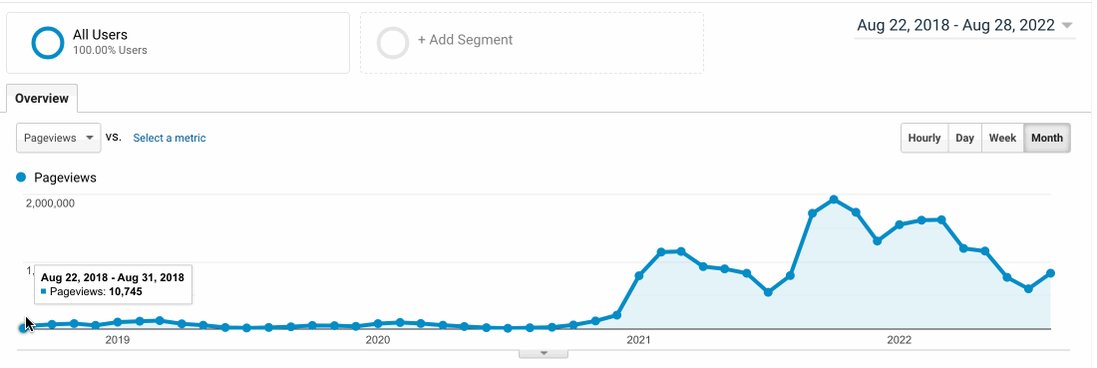
I built a $7m portfolio of internet businesses powered by aged (and abandoned) websites.
Using cold email.
Here's how to do it:
Using cold email.
Here's how to do it:
1/ Get really good at searching Google
There are certain fingerprints you can search for to find sites that are abandoned:
- "this website is for sale"
- "website is no longer updated"
- "website is closing down"
The quotes will find only those exact matches. But wait...
There are certain fingerprints you can search for to find sites that are abandoned:
- "this website is for sale"
- "website is no longer updated"
- "website is closing down"
The quotes will find only those exact matches. But wait...
You can also combine these with specific topics or years:
- travel + "this website is no longer updated"
- garden + "website last updated" + 2011
(tip: use some of the operators listed in this @ahrefs article)
ahrefs.com
- travel + "this website is no longer updated"
- garden + "website last updated" + 2011
(tip: use some of the operators listed in this @ahrefs article)
ahrefs.com

2/ Develop a "sixth sense" for potential targets (I see dead p̶e̶o̶p̶l̶e̶ presidents 🤑)
If we take the garden example above, one of the sites in the SERPs that stands out is exoticrainforest.com
According to the site it hasn't been updated since 2011 and has decent metrics.
If we take the garden example above, one of the sites in the SERPs that stands out is exoticrainforest.com
According to the site it hasn't been updated since 2011 and has decent metrics.
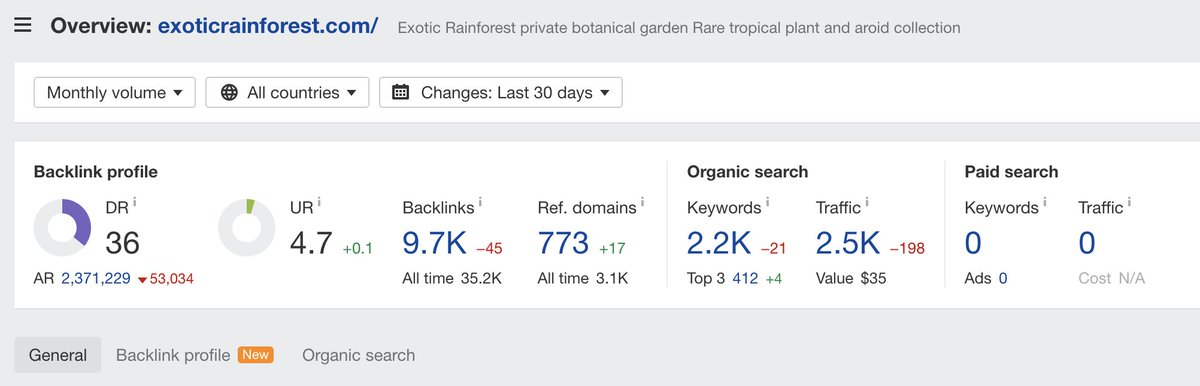

It looks to be owned by a botanical garden in Arkansas, so they probably won't sell - but email them anyway!
Email as many sites as you can, as often as you can. You never know who might be retiring or looking to move onto something else.
So what would I do if I bought this?
Email as many sites as you can, as often as you can. You never know who might be retiring or looking to move onto something else.
So what would I do if I bought this?
Well, according to some sources, @PictureThisAI earns $10m+ PER MONTH, so the plant niche is pretty lucrative!
I would be looking to leverage AI to create tools like this. With the topical authority of the site you already have an audience and only need a sliver of the market.
I would be looking to leverage AI to create tools like this. With the topical authority of the site you already have an audience and only need a sliver of the market.
Other ideas could include digital products teaching people how to care for plants, a community of like-minded plant growers, or even a course on how to build a profitable plant-growing business.
You get the idea - lots of lucrative options available!
You get the idea - lots of lucrative options available!
3/ Finding alternative ways to discover targets
These types of Google search have been common for a long time and it might be that most of the sites you find have already been outreached. That's okay.
Here are a couple of other ways to find leads:
These types of Google search have been common for a long time and it might be that most of the sites you find have already been outreached. That's okay.
Here are a couple of other ways to find leads:
SHAMELESS PLUGIN #1:
I built AgedAssets.com for this exact reason. It has ~8,500 sites and lets you filter by a bunch of different criteria and SEO metrics.
It's sold 99 copies, which is great for me, but also great for you because there's still plenty of opportunity!
I built AgedAssets.com for this exact reason. It has ~8,500 sites and lets you filter by a bunch of different criteria and SEO metrics.
It's sold 99 copies, which is great for me, but also great for you because there's still plenty of opportunity!

You can also use BuiltWith (which is WAY more expensive) but it lets you discover sites using specific technologies.
So if you want to try and find sites running on WordPress 3.4 (which is super old and is likely a sign its abandoned) you can do that:
So if you want to try and find sites running on WordPress 3.4 (which is super old and is likely a sign its abandoned) you can do that:
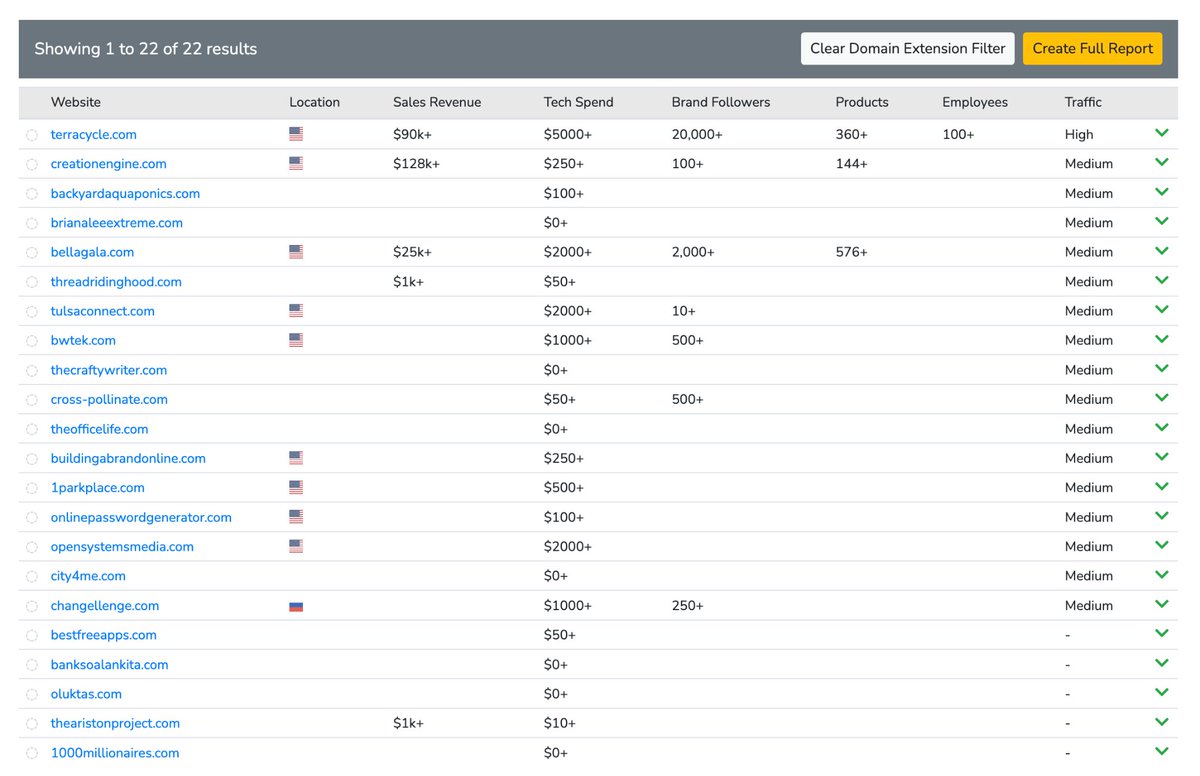
One of those sites springs out at me right away: theofficelife.com
Last blog post was 8 years ago, design is very outdated (but I lowkey love it!) and it's in a niche I think could do very well.
It also comes with a little digital product that has customers!
Last blog post was 8 years ago, design is very outdated (but I lowkey love it!) and it's in a niche I think could do very well.
It also comes with a little digital product that has customers!

Here's how I would grow this if I acquired it:
First, I'd keep the quirky language and style of the site. It's a really playful brand!
Next, I'd use programmatic SEO to expand the business jargon dictionary.
First, I'd keep the quirky language and style of the site. It's a really playful brand!
Next, I'd use programmatic SEO to expand the business jargon dictionary.
Each word would have its own page with real-world examples of its use, definition, and an ultra-realistic AI voice pronunciation.
This type of section would be killer for ESL business professionals.
This type of section would be killer for ESL business professionals.
In fact, a site I tried to acquire years ago was charging $49/mo for business English lessons to non-native speakers + they were making somewhere around 100 sales a month with very low churn!
I forget the name but it was SUPER SIMPLE. I think it's easier than ever to build that.
I forget the name but it was SUPER SIMPLE. I think it's easier than ever to build that.
This is the type of site you could get social with too and hit the desk setup niche with videos and reels about awesome home offices.
Herman Miller pay up to 10% affiliate commission, and my Aeron chair cost £1k, so this could be a great revenue stream too!
Herman Miller pay up to 10% affiliate commission, and my Aeron chair cost £1k, so this could be a great revenue stream too!
4/ Finding contact information
Finding the sites is the easy part (SHAMELESS PLUG #2: especially if you use AgedAssets.com)
The hard part is actually reaching out to the site owners and, more importantly, getting a reply!
Finding the sites is the easy part (SHAMELESS PLUG #2: especially if you use AgedAssets.com)
The hard part is actually reaching out to the site owners and, more importantly, getting a reply!
You need to get your Sherlock Holmes on and hunt down the contact info. With old sites, they are often not listed or have email addresses that bounce.
Here’s a list of typical places and ways you can find them:
Here’s a list of typical places and ways you can find them:
• Site footer, contact page, about me page
• Privacy policy or terms page
• Whois lookup
• If there is a name on the site, search Google to try and find other sites they own (that may have contact info on)
• Same as above but for author photo
• Privacy policy or terms page
• Whois lookup
• If there is a name on the site, search Google to try and find other sites they own (that may have contact info on)
• Same as above but for author photo
• Same as above but look for posts from the author on forums, social media sites, etc)
• Find other sites they have by running a reverse Analytics/AdSense search with DNSlytics dnslytics.com
• Find other sites they have by running a reverse Analytics/AdSense search with DNSlytics dnslytics.com
• Check social links from the site (do they accept DMs? Who do they follow? Who follows them?)
• Put URLs in Buzzstream buzzstream.com and let it find contacts for you
• Check backlinks in Ahrefs or SEMrush to see if they have links from an owner blog or other sites
• Put URLs in Buzzstream buzzstream.com and let it find contacts for you
• Check backlinks in Ahrefs or SEMrush to see if they have links from an owner blog or other sites

• If the site is on WordPress, add /wp-json/wp/v2/users to the end of the home page URL and see if you can find an owner name (use JSON Formatter jsonformatter.curiousconcept.com to make it legible)
• Look up the domain name on whoxy.com (do they have other sites?)
• Look up the domain name on whoxy.com (do they have other sites?)

jsonformatter.curiousconcept.com
JSON Formatter & Validator
Format and validate JSON data so that it can easily be read by human beings.

whoxy.com/whois-history/
WHOIS History API | Domain WHOIS History | Free WHOIS History
WHOIS History lets you see all the historical WHOIS records of a domain name. This is useful to chec...
Like everything I do, you need to think differently and persevere. The thrill of chasing and finding contact info is really fun.
I’ve called random numbers, emailed business partners and spouses of the target webmaster, anything to try and get hold of the right person.
I’ve called random numbers, emailed business partners and spouses of the target webmaster, anything to try and get hold of the right person.
5/ Getting webmasters to respond
There is no innovation here. The process is a game of cat and mouse.
Send a lot of emails, get virtually zero replies, and the replies you get will often be rejections.
You need this feedback loop to learn what works best for you!
There is no innovation here. The process is a game of cat and mouse.
Send a lot of emails, get virtually zero replies, and the replies you get will often be rejections.
You need this feedback loop to learn what works best for you!
If you think of this in terms of email marketing and copywriting, the process is basically the same:
1. get them to open the email
2. get them to read the first line, which makes them want to
3. read the next line etc
4. ...
5. which makes them want to reply to you!
1. get them to open the email
2. get them to read the first line, which makes them want to
3. read the next line etc
4. ...
5. which makes them want to reply to you!
You need to be persuasive, but not pushy, and come across as genuine and not spammy.
For example, if you mention the site name, don’t use the URL. “coolproject.com” in the subject doesn’t look as natural as “Cool Project”.
A few subject line examples I've used:
For example, if you mention the site name, don’t use the URL. “coolproject.com” in the subject doesn’t look as natural as “Cool Project”.
A few subject line examples I've used:
• {Site name} question
• Question about your site
• Question about {site name}
• Is {site name} still active?
• Broken link on {site name}
• 404 error
• Site not working?
• Site for sale?
• {Site name} for sale?
• I want to buy your site
• I want to buy {site name}
• Question about your site
• Question about {site name}
• Is {site name} still active?
• Broken link on {site name}
• 404 error
• Site not working?
• Site for sale?
• {Site name} for sale?
• I want to buy your site
• I want to buy {site name}
Don’t take these and use them verbatim. The whole point is to NOT do what everyone else is doing. Stand out and do things your own way.
For example: sometimes I just offer up a number right off the bat instead of negotiating to stand out from the "how much do you want" crowd!
For example: sometimes I just offer up a number right off the bat instead of negotiating to stand out from the "how much do you want" crowd!
6/ Learn how to overcome objections
Good salespeople know that if you want people to take action, you need to be able to overcome any barriers or objections.
If the site is very old, it’s very likely to be a labour of love for them and there may be obstacles to overcome.
Good salespeople know that if you want people to take action, you need to be able to overcome any barriers or objections.
If the site is very old, it’s very likely to be a labour of love for them and there may be obstacles to overcome.
Some common objections you might experience:
• Email accounts. A lot of people have email tied to the domain name which is used for many things. If you can preempt that and offer them the ability to keep it for however long they need it, you’re more likely to do a deal.
• Email accounts. A lot of people have email tied to the domain name which is used for many things. If you can preempt that and offer them the ability to keep it for however long they need it, you’re more likely to do a deal.
• Keeping the content free. These webmasters have probably spent many hours creating the content with no expectation of money. You can assure them that you plan to keep the existing content freely and publicly available.
• Still wanting to contribute. Many webmasters don’t have the time to operate the site, but do still want to be involved and contribute. You can overcome this by offering to pay them to create new content.
(In my experience, any contributions are short lived, but it’s a subject matter expert to create content for you - which can only be a good thing!)
• Maintaining the site for the long term. Most site owners won’t just hand over the keys unless they trust that you have the best interest of their site at heart.
I overcome this fear that the site could be deleted or quickly sold on by showing them examples of previous projects I’ve acquired and revamped. I’ve also provided references of others I've bought from.
Obviously you can’t cover all of these in a short and sweet email, but if you’re able to get a back and forth going with the seller, you can explain more about your plan for the site.
6/ Make your emails personal
Most spammy outreach is obviously, blatantly, templated. I used to use Buzzstream and send very simple, non-personal template emails. It kinda worked, but the reply rate was awful. Now I write each email uniquely and tailor it to the person:
Most spammy outreach is obviously, blatantly, templated. I used to use Buzzstream and send very simple, non-personal template emails. It kinda worked, but the reply rate was awful. Now I write each email uniquely and tailor it to the person:
• Mention their name and site name
• Pick something unique about their site that I like
• Briefly give example of a similar project I’ve acquired
• Try to be “likeable”
• Pick something unique about their site that I like
• Briefly give example of a similar project I’ve acquired
• Try to be “likeable”
Often I’ll put an offer amount in the first email just based on what I predict the site might be worth using tools like Ahrefs and SEMrush.
If you do this, make sure you don’t low ball because that could disqualify you right off the bat. I try to do some simple math on these and offer about 12x their monthly earnings on a $5 RPM.
So, if I think the site might be getting 30k visitors a month, I’ll start my offer at around $1,800. This is totally flexible too, so if I know that the niche will likely have a $10 RPM, I’ll offer $3-4k.
The most I ever paid was 83x for a site making $600 a month, because I knew it had huge potential. A year later, and it’s making 10x what it was when I acquired it!
7/ ALWAYS FOLLOW UP
If you learn nothing else from this thread: always follow up!
There’s a fine line between following up and being very annoying. Luckily, most webmasters that I email are not savvy internet people and don’t get salty like your average journalist.
If you learn nothing else from this thread: always follow up!
There’s a fine line between following up and being very annoying. Luckily, most webmasters that I email are not savvy internet people and don’t get salty like your average journalist.
The vast majority of people will not respond to you after one email. There’s too many spammy SEO agency emails flying around and your email will likely be considered the same.
By following up 2-3 more times over the following weeks, I increase my reply rate by 5x. Generally, I follow a schedule something like:
• 1 week later: “Hi John, just following up to see if you received my email last week? I’m really interested to buy Cool Project so please do let me know if you’d be open to it!”
• 2 weeks later: “Hey John, I know you’re probably very busy so I won’t continue to bother you. If you do decide to sell Cool Project I’d be willing to pay around 3-4x your annual earnings for it. Let me know either way!”
• 4 weeks later (optional): “Hi John, I haven’t been able to find anything nearly as good as Cool Project, so I’d like to offer you $5k for the site in cash. If you’d be willing to sell for that price, please let me know!”
It’s important to note that these snippets are all just examples. I don’t follow a set formula and try different things all the time depending on who the person is.
If I don’t have much information about them, it’s more basic, but I’ve written much longer emails to people where I think a more honest approach will work better.
For the last email, if I do decide to send it, I go in hard with the absolute highest price I’d be willing to pay just to see if I can grab their attention with cold, hard $$$.
8/ Handling a "no"
You might think that once you get a reply that you’ve got one foot in the door, but 9 times out of 10, the reply will be some form of “no”. There can be many reasons for this:
• I want $1m cash!
• I’m not selling ever, ever, ever
You might think that once you get a reply that you’ve got one foot in the door, but 9 times out of 10, the reply will be some form of “no”. There can be many reasons for this:
• I want $1m cash!
• I’m not selling ever, ever, ever
• I still have plans for the site, just been busy, etc
For the first two, I just reply saying “thanks for getting back to me, if you ever change your mind please let me know”. They’re never gonna sell so don’t waste any more time on it.
For the first two, I just reply saying “thanks for getting back to me, if you ever change your mind please let me know”. They’re never gonna sell so don’t waste any more time on it.
It’s this last group of people that are most interesting. A lot of times, they want to work on the site but life just gets in the way. They think it still has potential, but in my experience they almost never do go back to them.
I’m very patient and will follow up with people every 6-12 months just to see how they are, how the site is, and whether their situation has changed.
You never know when or how people’s situation will change, so it’s worth checking in on them as you would with an old friend.
You never know when or how people’s situation will change, so it’s worth checking in on them as you would with an old friend.
8/ Putting it all together
As you can see, my process is very simple and just follows best practices when doing any kind of email marketing, link building, or cold outreach.
As you can see, my process is very simple and just follows best practices when doing any kind of email marketing, link building, or cold outreach.
I’m not an expert at this I’m just very determined and very patient. I get enjoyment from finding projects for sale that will never, ever, be listed on a marketplace and growing them into something amazing.
Here’s a very rough example of the type of email I might send to try and acquire a project:
gist.github.com
There’s no one-size-fits-all so take the elements you like, remix them with other techniques you think work better.
gist.github.com
There’s no one-size-fits-all so take the elements you like, remix them with other techniques you think work better.

And that's it! Follow me @iannuttall for more threads like this.
Hit the like/retweet on the first tweet below if you can 🙏
Hit the like/retweet on the first tweet below if you can 🙏
Loading suggestions...