
Before we tackle the UA #counteroffnsive in general, I want to investigate a seismic change that may have occurred in the tactical reality of the war. It is related to where and how it is easier or at least possible, to advance.
In order to do that, let's first take a look at
In order to do that, let's first take a look at
good and poor small unit tactics. First, let's look at an example of where a basic (not advanced by any means) combined arms advance against poorly equipped (and/or trained and led) Russian troops caused a one sided advance and respective collapse. This back when Wagner forces

were finishing the capture of Bakhmut, and were expressing concern for the northern and southern flanks around the city, which the Russian MOD had to secure. Both these videos by DeepStateUA show the UA 56th mechanized brigade attacking Russian positions on the northern flank of

Bakhmut. Without getting too deep into analysis about it, what it shows is a very basic combined arms advance, in that armor is used to support an infantry advanced, overwhelming entrenched infantry that apparently have no weapons to deal with armor. These situations require
either an organized withdrawal as armor approaches to rear defensive lines as artillery and air assets destroy the advancing enemy armor in designated killing zones, and then an infantry counterattack to recapture the lost positions; or a stiffer defense on the front line with
infantry troops possessing the necessary anti-tank weaponry to deal with modern armor. Evidently in these situations, though of course the footage is limited and edited, neither was used. Russian troops in those trenches were abandoned in a hopeless situation. Either the overall
quality of the unit and/or its command and logistics was responsible for these painful failures. I myself have been in a situation where we faced a high probably of enemy armor coming our way, being the first line of defense, and not having the equipment to deal with it. Highly
frustrating to say the least (thankfully in the event they did not arrive).
Now on the other hand, let us look at some regular Russian forces advance against a determined and entrenched enemy, who does posses anti-tank weaponry.
Now on the other hand, let us look at some regular Russian forces advance against a determined and entrenched enemy, who does posses anti-tank weaponry.
@ArmchairW does an excellent analysis (above) of these advances at Spirne, and no need to elaborate here. The full video released is here:
open.substack.com
We should note that these are not elite troops but rather a well commanded and manned company. Their quality is less
open.substack.com
We should note that these are not elite troops but rather a well commanded and manned company. Their quality is less
surprising if we take into account that they are reportedly an old LPR volunteer unit, now integrated into the Russian army and strengthened with Russian reserves. So plenty of motivation and experience. However, they are still very basically equipped and not elite troops. Spirne
along with the whole Siversk front is very well defended and commanded from the Ukrainian side, as it has resisted many attempts at advance for many many months. While Russia has not yet turned its focus on the Siversk salient in an all out effort, there has been many local
attempts at advance that have been thwarted. This enterprising unit has succeeded. The UA defenders do indeed have anti-tank weapons (footage shows two tanks hit, including one tank hit with an RPG, and reports the gunner killed). They were well backed with responsive artillery
and mutually supporting infantry entrenchments. The advance here was complicated and dangerous, and from what we can tell, between fairly evenly sized units. No one here had overwhelming firepower or numbers. This goes to show once again how important the quality of individual
units, commanders, and even individual solders is. The grandest strategic plans can be overturned by the quick-thinking and audacity of small units and their commanders. In both of these examples, we see attacks over relatively open ground, towards fortified positions along
forest lines (and some very light built up areas). Much of Ukraine and the battlefield look like this. While in theory this is excellent terrain for armored spearheads and fast advance, things have begun to change and the warring parties are noticing. This leads us to the main
idea I want to relate in this thread... and so will be adding it in the next few minutes.
Continuing the above thread. Normal military thinking envisions that it is easier to attack over open terrain and that just about the most difficult terrain to advance over is urban terrain (cities). During this war, especially early on this tended to be the case. Early in the
war, Russian units were able to go almost uncontested between urban areas across open terrain, especially in the south where it was flatter and dryer, and Ukrainian units would only defend from urban territory. This then expanded to UA units defending in forest belts and urban
terrain, but still avoiding the open fields. Open fields offer little cover, and with today's advanced optics, enemy forces can easily be targeted. Forest belts offered cover from optics as well as from fire. Urban terrain even more so of both. Russian units on the other hand
avoided forest belts and tried to avoid fighting in urban environments if possible. More recently let us observe how much this picture has changed. And it is the Russian command that seems to have grasped the change more so than the UA. Think back to the recent weeks and months.
A largely static and long front line, with significant advances only happening in a dense urban environment, Bakhmut. Now, one has to compare apples to apples, so was Wagner in Bakhmut advancing consistently because of its quality, and/or because of the urban terrain? Could
Wagner forces advance as easily (or more easily) in open ground?
It is still too early to tell for sure, but I believe what may be happening is the following. Advance over open ground is still easier for a mechanized attacker especially but for two factors. The first is that the
It is still too early to tell for sure, but I believe what may be happening is the following. Advance over open ground is still easier for a mechanized attacker especially but for two factors. The first is that the
open ground is no longer open. Armor is not free to advance along this terrain and battle with other units out in the open.. to easily punch through them or bypass them and encircle them. Most of the front is now heavily fortified. Russia's lack of manpower early in the war gave
UA command the time it needed to fortify the rest of the front, while the Donetsk front has been fortified continuously for nearly a decade (that's why the Russian advance was on its northern and southern flanks and not directly through the fortified positions even from day one).
So now attack over "open ground" really means that the exposed attacking units are on open ground, while the defenders are under cover. Due to the many forest lines between fields, they tend to be under cover from visual identification, and under cover from fire (trenches,
bunkers, etc). The second issue is the proloferation and improvement of optics. The increased use of drones, satellite imagery, and long range optics (including night vision and thermal) and radars makes being unseen ever more difficult. If you move, you are seen. And if you are
seen, you are targeted. The rise in precision weapons has made the effect of the increased optics exponentially greater. If you are seen you are targeted, and if you are targeted you are hit. It is ever more difficult to move now out of any entrenched position and survive for any
length of time. Forest belts and urban territory offer cover from both the detection by optics and the fire of the precision weapons. So ironically, while advancing through urban terrain remains extremely difficult (urban terrain multiplies many of the defender's advantages and
complicates advance and attack), it is now very difficult but possible, compared to advance along open ground towards prepared positions in depth which is becoming nearly impossible. In this:
and other threads I imagined the attack from the southwest that
and other threads I imagined the attack from the southwest that
reaches the river and forest belt, thus encircling Bilohorivka and cutting off the UA forces in the Kreminna forest belt is the best course of action. I was surprised that the Russians chose instead to press southeast from Kreminna along the forest belt. Typically, UA units had
not only used forest belts as "highways" to attack Russian positions in the rear, but also areas where they excelled in defense. But this was an early sign of the change being understood by the RU command. Advance along forests and perhaps even urban terrain is now easier (for
either side, than advance along open terrain against an entrenched opponent). Note how the most stubborn UA perpetration into Russia proper has been under the cover of a forest belt (under very heavy shelling). Not how in the Kupiansk front, Russian forces, including Storm PMC,
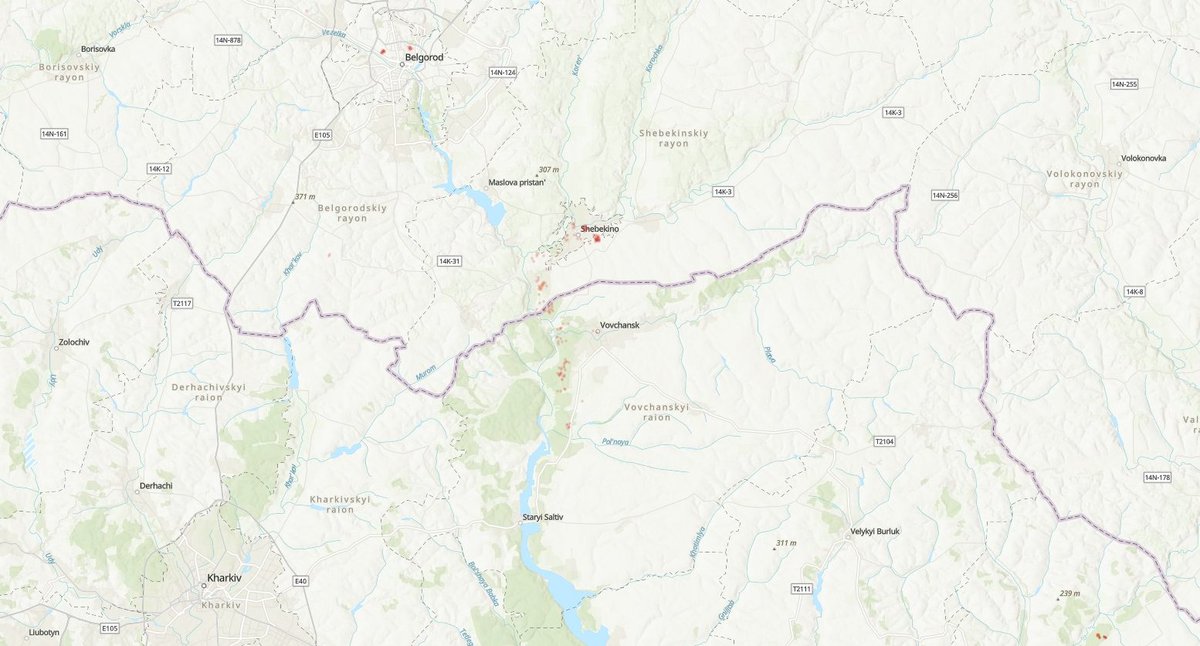
advanced along a thick forest belt and captured significant strategic positions. From there they even were able to cross the Oskol river and capture positions on the opposing high ground. Now threatening Dvorichna with an operational encirclement. If this change is truly of the
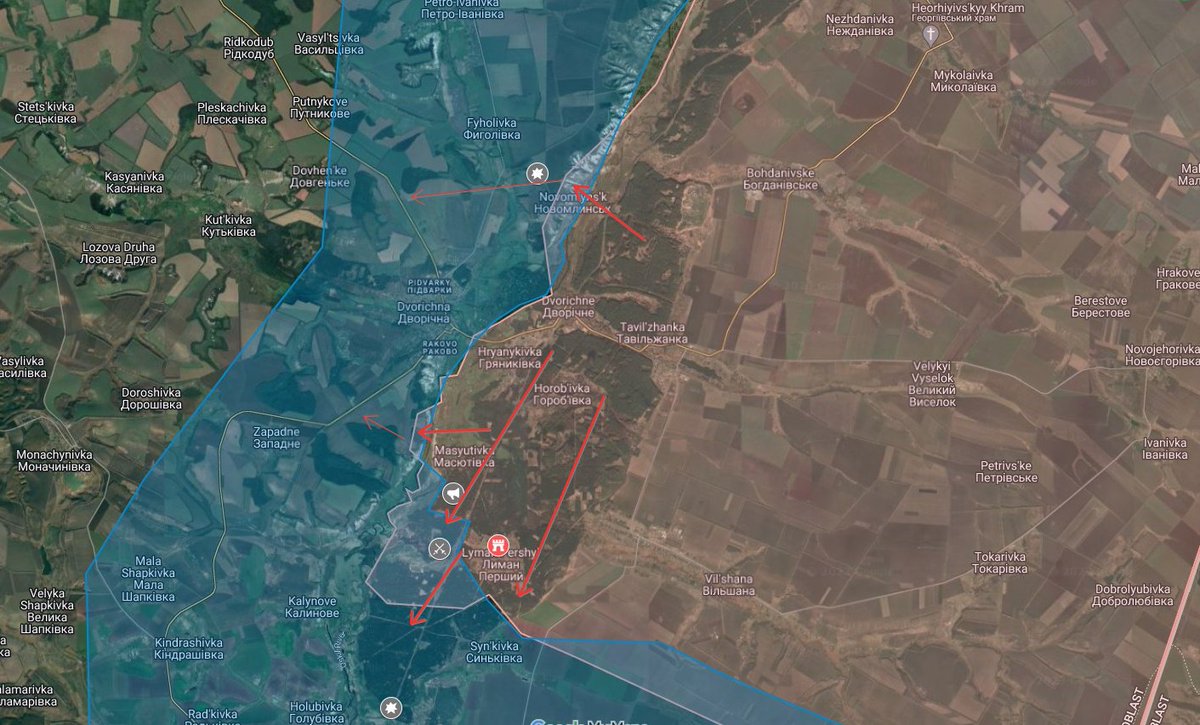
magnitude of which it seems to be, the implications are very far reaching and change the operation and strategic pictures for both commands. The thus far smashing of the prized newly formed and refitted Ukrainian brigades against the prepared formations of the Russian defense
would show a UA command that does not yet appreciate this reality. This is not to say that advance on open ground is impossible, in this very thread we discussed an excellent example of small unit tactics to overcome the discussed impediments, but depending on the situation it is
becoming more and more difficult. Ironically it is against Russian positions that this changing reality is even more true than vice versa due to various factors including Russia's superior control of the battlefield airspace. It is the Russian command that seems thus far to be
more attuned to this change, and this leads us to speculate on what Russia may do to relieve its Belgorod front problem. We discussed these attacks at length
and the "force multiplier" effect of the "one way" front several times including
and the "force multiplier" effect of the "one way" front several times including
here:
and elsewhere. UA command has correctly realized the massive implications of a long border that only they have to worry about and not the Russians. They are doing everything they can to correct this (maybe they read my posts haha). While the typical
and elsewhere. UA command has correctly realized the massive implications of a long border that only they have to worry about and not the Russians. They are doing everything they can to correct this (maybe they read my posts haha). While the typical
suicide missions (incursions) are less useful long term, the mere shelling of the Russian front makes the situation unbearable for the Russian state. Many believe Russia will thus simply advance along the border and make a buffer zone to decrease the shelling and incursions into
Russia proper. That indeed may be what they do but I believe it would not be very wise. Again, advancing one meter into Ukraine across the line makes the front a two way front once again and has distinct disadvantages for Russia. Aside from this, we we are discussing such advance
is highly difficult as it is. Given the facts that we have discussed in this long thread, I believe what we may see, and a wiser move, would be a different operation from the Russian side. I will discuss this in following tweets to this long thread in the coming minutes.
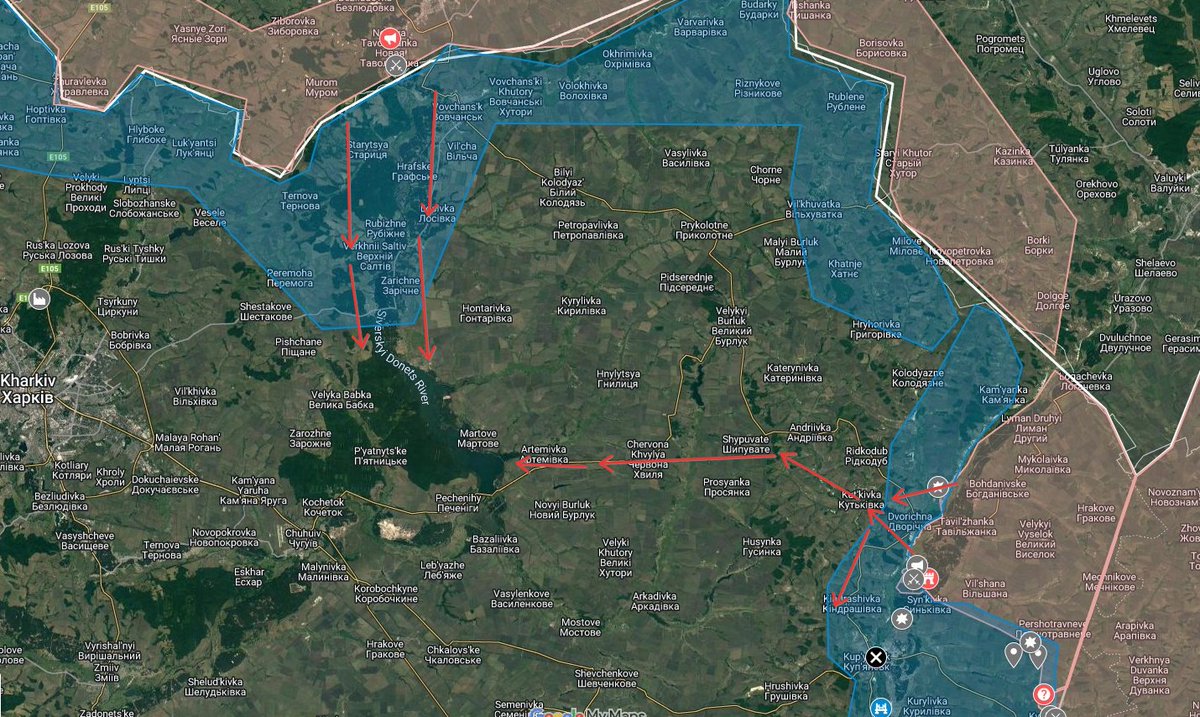
Again using the DPA map, we can see that by advancing through forested areas towards Dvorichna, not only is the strategic city & logistics hub of Kupiansk threatened, but that an advanced towards the Siverskyi Donets river is possible. Together with an advance from the north…

Loading suggestions...