

The Biggest Enemy of Traders with Stoploss.
SHAKEOUTS:
HBL: A 78% move in 49 days from a shakeout candle.
But most beginners don't know how to identify Shakeouts correctly
In this 🧵, I will tell you:
What is a shakeout & what is NOT
Can Shakeout have multiple candles?
1/n
SHAKEOUTS:
HBL: A 78% move in 49 days from a shakeout candle.
But most beginners don't know how to identify Shakeouts correctly
In this 🧵, I will tell you:
What is a shakeout & what is NOT
Can Shakeout have multiple candles?
1/n

What is a Shakeout (SO)
A down move at the end of a correction, quickly negated by an up move on the same candle or the subsequent candle(s)
So, Yes SO can have multiple candles.
Single candlestick SOs are Bullish PINBARS:
But, Can any bullish pinbar be called a shakeout?
2/n
A down move at the end of a correction, quickly negated by an up move on the same candle or the subsequent candle(s)
So, Yes SO can have multiple candles.
Single candlestick SOs are Bullish PINBARS:
But, Can any bullish pinbar be called a shakeout?
2/n

NOT all Pin Bars:
Not all Pin bars (candles with a long tail and a small body) can be called a shakeout.
But why?
Because LOCATION matters bro.
The down move should take the price out of a well-established range, or a key pivotal Point.
But what are these Pivotal Points?
example of a pin bar but not a shakeout and a shakeout in KPIT below
3/n
Not all Pin bars (candles with a long tail and a small body) can be called a shakeout.
But why?
Because LOCATION matters bro.
The down move should take the price out of a well-established range, or a key pivotal Point.
But what are these Pivotal Points?
example of a pin bar but not a shakeout and a shakeout in KPIT below
3/n
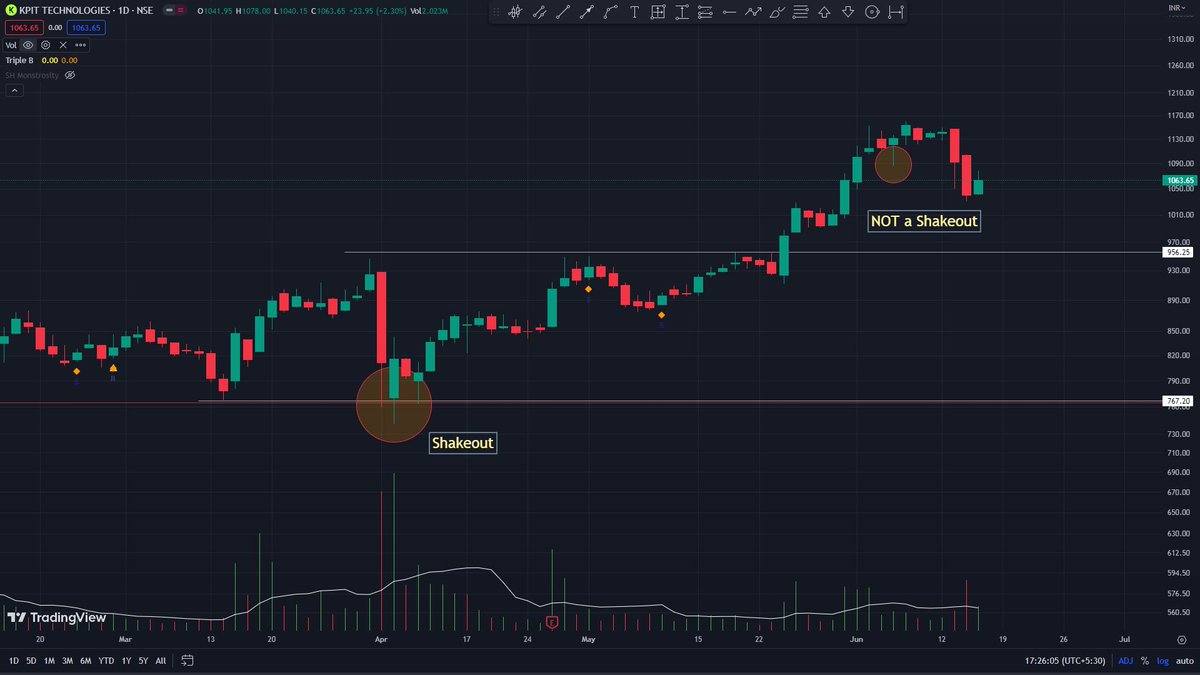
The low of the Shakeout has to cross a pivotal point. This point can be the following:
1. A swing low
2. A Gap Boundary
3. A Trendline support
4. A key MA (that the price has been respecting for some time)
You get the idea now, Right?
4/n
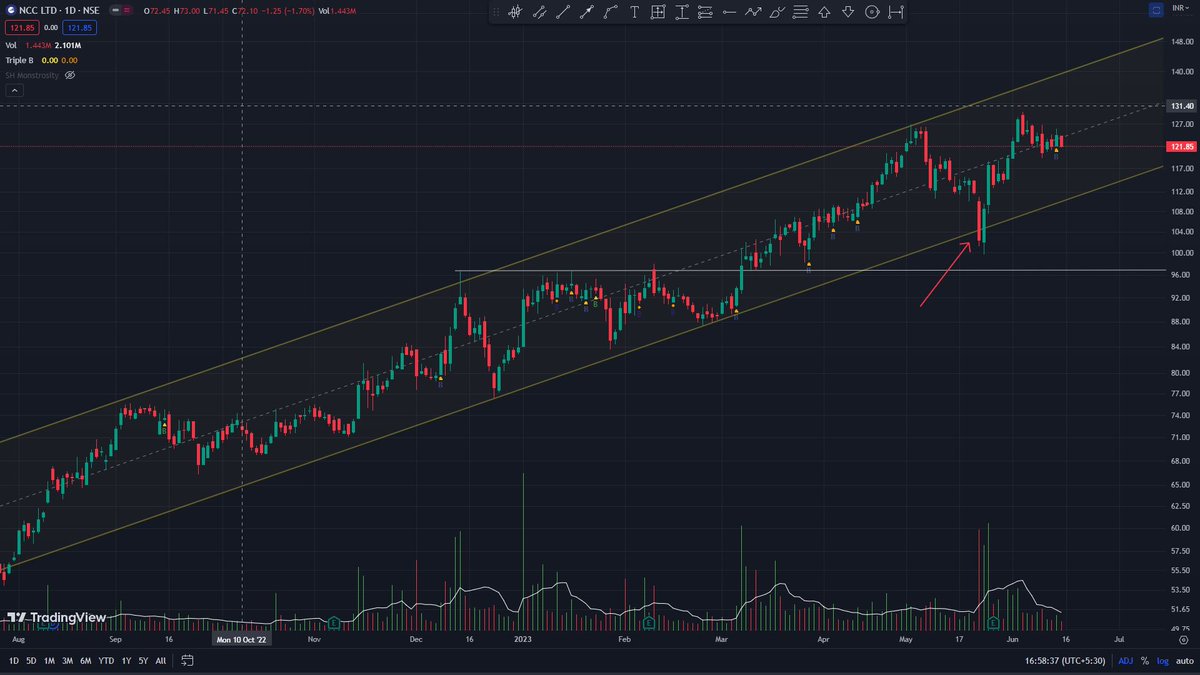
See an example of a shakeout in NCC. What is it breaking?
The Ascending channel Support.
How fast should the price come back inside?
1. A swing low
2. A Gap Boundary
3. A Trendline support
4. A key MA (that the price has been respecting for some time)
You get the idea now, Right?
4/n
See an example of a shakeout in NCC. What is it breaking?
The Ascending channel Support.
How fast should the price come back inside?

But why call it a Shakeout?
5/n
Because, as the down move breaches a key pivot, there is a high possibility this move would trigger many SL limit sell orders of the trend-following traders/investors. Shaking them out of the trade, before reversing swiftly. Hence the name “SHAKEOUT”.
That was me, I got shaken out of this one. It sucked.
5/n
Because, as the down move breaches a key pivot, there is a high possibility this move would trigger many SL limit sell orders of the trend-following traders/investors. Shaking them out of the trade, before reversing swiftly. Hence the name “SHAKEOUT”.
That was me, I got shaken out of this one. It sucked.
What's the theory?
6/n
This series of sell orders around similar price levels bunched together makes the level a high liquidity area. When triggered, it accentuates the quick down move. This in turn provides the liquidity that institutions crave.
(I have no way to test this).
Big money gets what big money wants.
6/n
This series of sell orders around similar price levels bunched together makes the level a high liquidity area. When triggered, it accentuates the quick down move. This in turn provides the liquidity that institutions crave.
(I have no way to test this).
Big money gets what big money wants.
Fun fact.
It is often believed that this action is a planned maneuver by the smart money to shake out the weak hands (like you and me, retail) and accumulate more shares before marking the price up higher.
I don't know for sure.
7/n
It is often believed that this action is a planned maneuver by the smart money to shake out the weak hands (like you and me, retail) and accumulate more shares before marking the price up higher.
I don't know for sure.
7/n

If you learned something useful, then:
1. Follow me @SakatasHomma for more useful content.
2. RT the tweet below to share this thread with your audience
If you want to read more on Shakeouts and how to trade them, I write about it this Saturday for THE TECHNICAL TAKE.
Please subscribe to it for free, Link in BIO.
8/8 End 🧵
1. Follow me @SakatasHomma for more useful content.
2. RT the tweet below to share this thread with your audience
If you want to read more on Shakeouts and how to trade them, I write about it this Saturday for THE TECHNICAL TAKE.
Please subscribe to it for free, Link in BIO.
8/8 End 🧵
Loading suggestions...