

How can CFOs define the right KPIs for running the business?
Here is a 10-step process for all CFOs and senior finance leaders to follow 🧵.
Here is a 10-step process for all CFOs and senior finance leaders to follow 🧵.
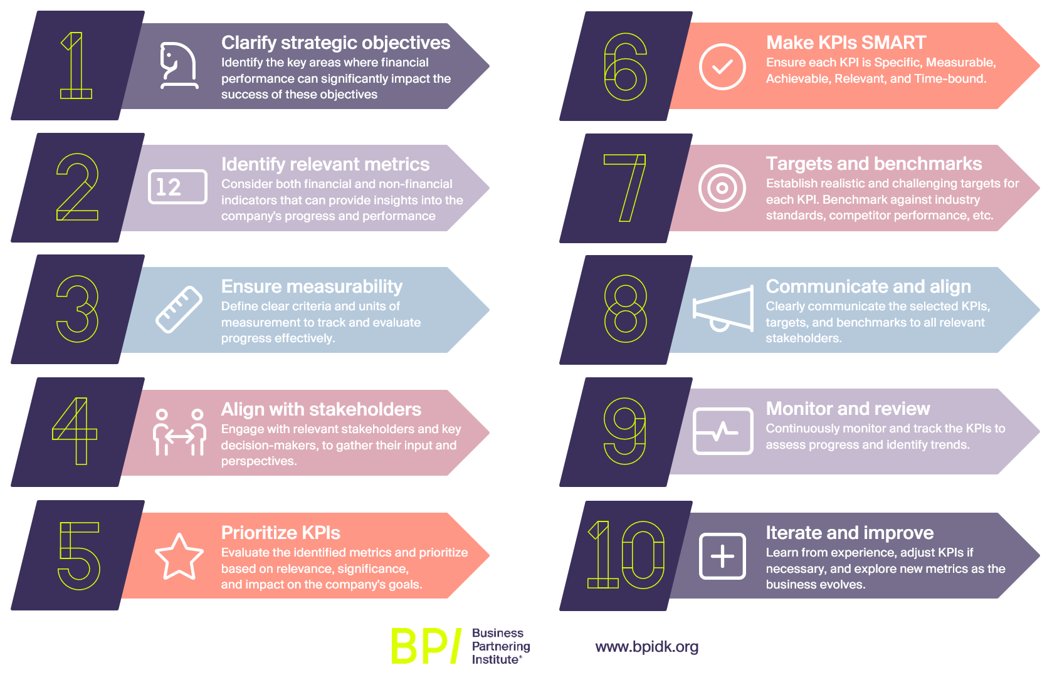
First an overview of the ten steps...
1. Clarify strategic objectives
2. Identify relevant metrics
3. Ensure measurability
4. Align with stakeholders
5. Prioritize KPIs
6. Make KPIs SMART
7. Targets and benchmarks
8. Communicate
9. Monitor and review
10. Iterate and improve
1. Clarify strategic objectives
2. Identify relevant metrics
3. Ensure measurability
4. Align with stakeholders
5. Prioritize KPIs
6. Make KPIs SMART
7. Targets and benchmarks
8. Communicate
9. Monitor and review
10. Iterate and improve
1/10 Clarify strategic objectives
Start by understanding the company's overall strategic objectives.
Identify the key areas where financial performance can significantly impact the success of these objectives.
Start by understanding the company's overall strategic objectives.
Identify the key areas where financial performance can significantly impact the success of these objectives.
2/10 Identify relevant metrics
Determine the specific metrics that align with each strategic objective.
Consider both financial and non-financial indicators that can provide insights into the company's progress and performance.
Determine the specific metrics that align with each strategic objective.
Consider both financial and non-financial indicators that can provide insights into the company's progress and performance.
3/10 Ensure measurability
Ensure that each chosen metric is measurable and quantifiable.
Define clear criteria and units of measurement to track and evaluate progress effectively.
Avoid vague or subjective metrics that are difficult to measure.
Ensure that each chosen metric is measurable and quantifiable.
Define clear criteria and units of measurement to track and evaluate progress effectively.
Avoid vague or subjective metrics that are difficult to measure.
4/10 Align with stakeholders
Engage with relevant stakeholders, such as executives, department heads, and key decision-makers, to gather their input and perspectives.
Understand their priorities and concerns to ensure KPIs reflect a comprehensive view.
Engage with relevant stakeholders, such as executives, department heads, and key decision-makers, to gather their input and perspectives.
Understand their priorities and concerns to ensure KPIs reflect a comprehensive view.
5/10 Prioritize KPIs
Evaluate the identified metrics and prioritize them based on their relevance, significance, and impact on the company's goals.
Focus on a manageable number of KPIs to avoid overwhelming the reporting and analysis process.
Evaluate the identified metrics and prioritize them based on their relevance, significance, and impact on the company's goals.
Focus on a manageable number of KPIs to avoid overwhelming the reporting and analysis process.
6/10 Make KPIs SMART
Ensure each KPI is Specific, Measurable, Achievable, Relevant, and Time-bound (SMART).
This framework helps in setting clear targets and measuring progress effectively.
Ensure each KPI is Specific, Measurable, Achievable, Relevant, and Time-bound (SMART).
This framework helps in setting clear targets and measuring progress effectively.
7/10 Set targets and benchmarks
Establish realistic and challenging targets for each KPI.
Benchmark against industry standards, historical data, or competitor performance to provide context and reference points for evaluation.
Establish realistic and challenging targets for each KPI.
Benchmark against industry standards, historical data, or competitor performance to provide context and reference points for evaluation.
8/10 Communicate and align
Clearly communicate the selected KPIs, targets, and benchmarks to all relevant stakeholders.
Ensure everyone understands their role in achieving these objectives and how their actions contribute to the overall performance.
Clearly communicate the selected KPIs, targets, and benchmarks to all relevant stakeholders.
Ensure everyone understands their role in achieving these objectives and how their actions contribute to the overall performance.
9/10 Monitor and review
Continuously monitor and track the KPIs to assess progress and identify trends.
Regularly review the KPIs in light of changing circumstances, business priorities, and feedback from stakeholders.
Adapt and refine them as needed.
Continuously monitor and track the KPIs to assess progress and identify trends.
Regularly review the KPIs in light of changing circumstances, business priorities, and feedback from stakeholders.
Adapt and refine them as needed.
10/10 Iterate and improve
Embrace a culture of continuous improvement.
Learn from experience, adjust KPIs if necessary, and explore new metrics as the business evolves.
Regularly assess the effectiveness of the chosen KPIs and refine the process over time.
Embrace a culture of continuous improvement.
Learn from experience, adjust KPIs if necessary, and explore new metrics as the business evolves.
Regularly assess the effectiveness of the chosen KPIs and refine the process over time.
Do you think this is a good process for CFOs to define their KPIs?
Anything you'd add or change to the process?
Anything you'd add or change to the process?
That's a wrap!
If you enjoyed this thread:
1. Follow me @LiuLindberg for more of these
2. RT this tweet to help CFOs become better at defining their KPIs
If you enjoyed this thread:
1. Follow me @LiuLindberg for more of these
2. RT this tweet to help CFOs become better at defining their KPIs
Check out how we help finance teams elevate the influence they have in their company at bpidk.org.

Loading suggestions...