

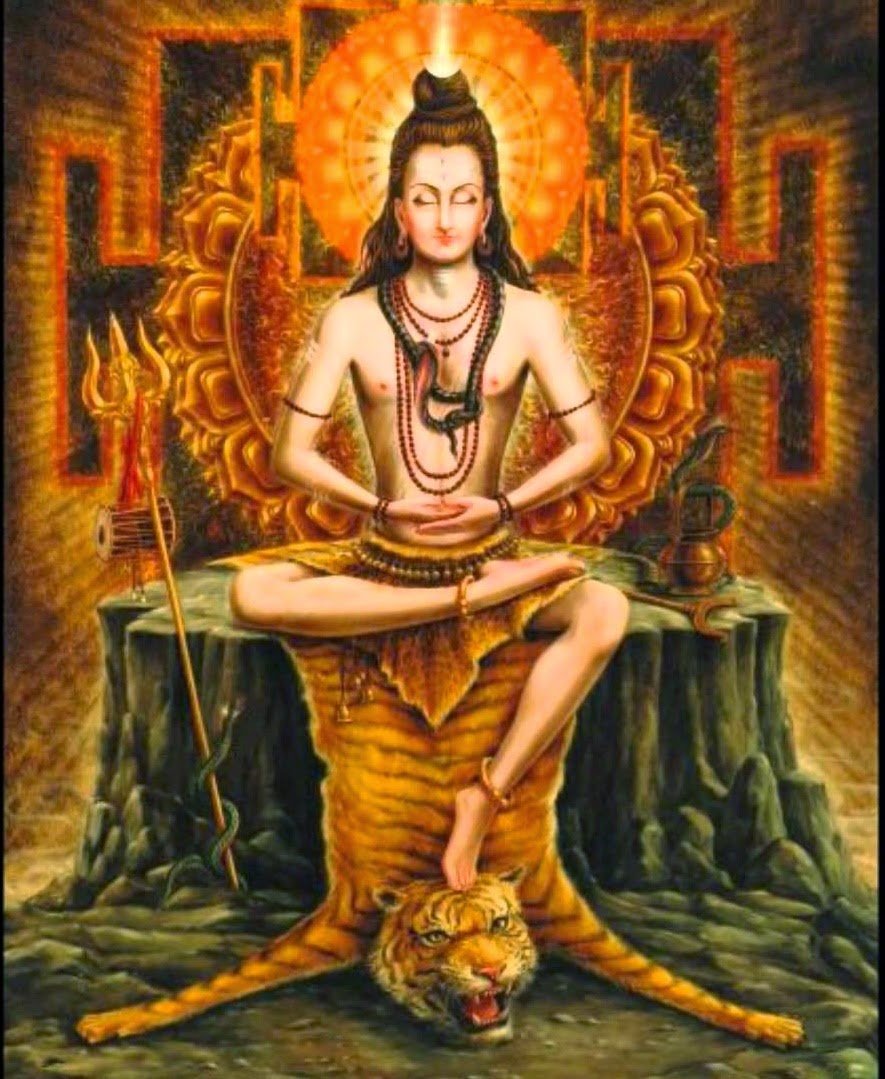
1. Etymology of the YOGA
The term Yoga has its verbal root (Yuj) in Sanskrit. Yuj means joining. Yoga is that which joins.
What are the entities that are joined?
It is the joining of the individual SELF with the universal SELF. It is an expansion of the narrow constricted egoistic personality to an all-pervasive, eternal and blissful state of REALITY.
युज्यते अनेना
इति योगः
Meaning: One that combines is called Yoga.
The term Yoga has its verbal root (Yuj) in Sanskrit. Yuj means joining. Yoga is that which joins.
What are the entities that are joined?
It is the joining of the individual SELF with the universal SELF. It is an expansion of the narrow constricted egoistic personality to an all-pervasive, eternal and blissful state of REALITY.
युज्यते अनेना
इति योगः
Meaning: One that combines is called Yoga.
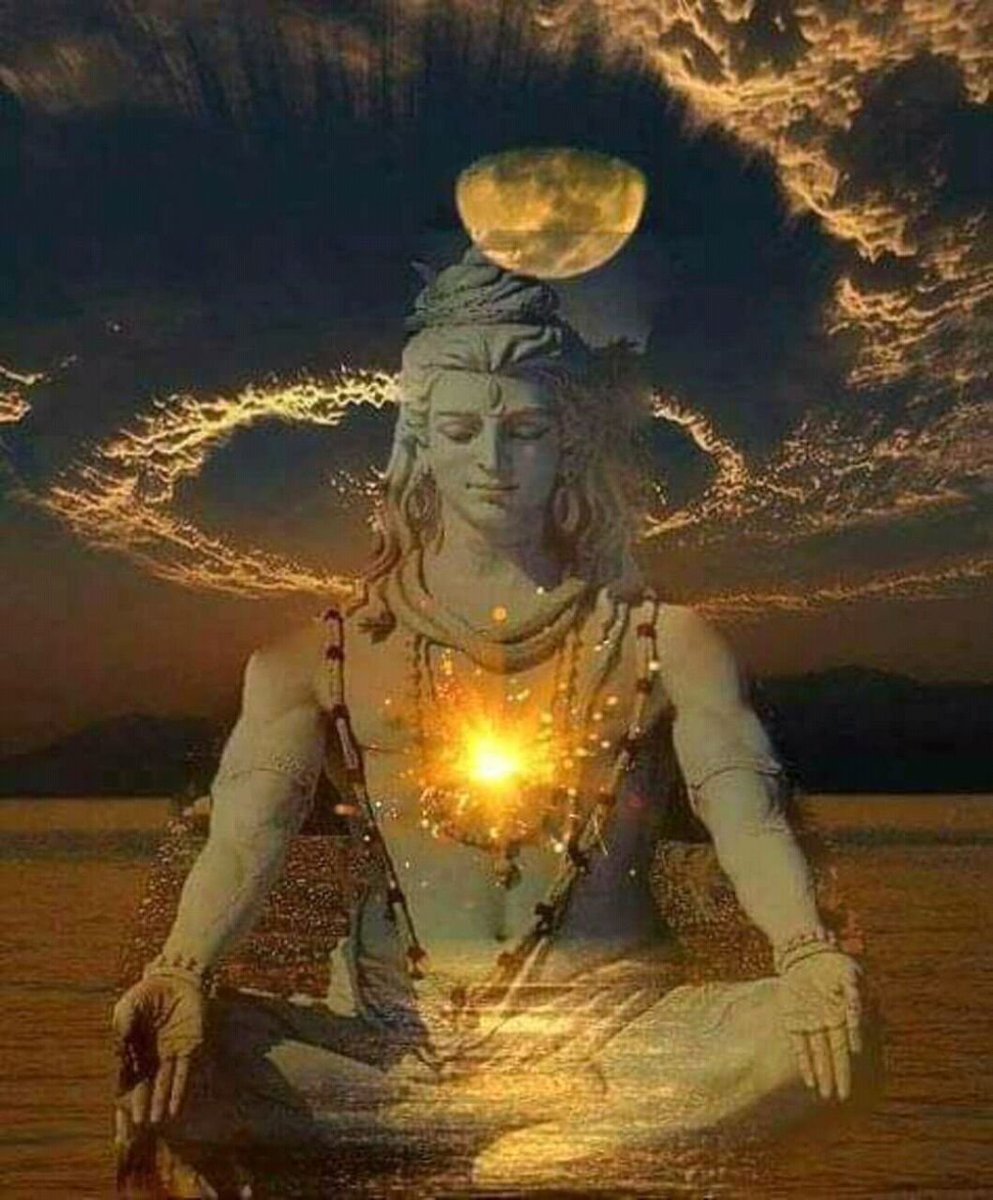
2. Origin of the Yoga - Vedic Yoga
Three Basic Types of Vedic Yoga:
Mantra Yoga – Speech – Rig Veda – Earth
Prana Yoga – Prana – Yajur Veda – Atmosphere
Dhyana Yoga – Mind – Sama Veda – Heaven
Three Types of Manifestations of the Vedic Yoga:
Waking State – Agni or Fire – Brahma, Creator
Dream – Indra or Lightning – Shiva, Transformer
Deep Sleep – Surya or the Sun – Vishnu, Preserver
Mantra Yoga involves developing Mantra Shakti, the power of mantra, through which the mantra becomes alive as a tool of transformation of the mind. From this arises Mantra Sphota, mantric insight, through which the inner meaning of the mantra can be grasped, linking us up with Aadi Shakti and ShaktiMaan.
Prana Yoga involves developing Prana or Vidyut Shakti (lightning or electrical force), and Pranic insight (lightning perception). This allows us to work with our vital energy as a manifestation of the energy of consciousness. The mantra becomes Prana as Prana (breath) itself is an unmanifest sound. This Prana provides the impetus and vitality for the awakening of the inner self.
Dhyana Yoga, or the Yoga of meditation, involves developing Buddhi or awakened intelligence, called Dhi in the Vedas, and its power of truth perception. This allows us to understand the universe and the human being as integral extension of Aadi Shakti and the ShaktiMaan himself. This higher intelligence arises through the energization of speech and Prana and brings an exceptional transformative power into the deepest level of the mind. In Dhyana Yoga the light of truth floods the mind and we come to know the unified nature of the Aadi Shakti and Shakti Mann.
The Three Yogas relate to our three basic faculties of speech, Prana and intelligence dominated mind (Buddhi/ Manas). These are our ability to develop the Divine Word, the Divine Life and the Divine Mind within us. They relate to the three bodies, the physical, astral (Pranic) and causal (soul or deeper mind).
The Three Vedas correspond to these three Yogas. The Rig Veda, the Veda of mantra, sets forth the basic mantras or seeds of cosmic knowledge. The Yajur Veda, the Veda of sacrifice, shows their application through ritual, which is both external and internal (yogic). The internal ritual is Pranayama. The Sama Veda, the Vedas of unification, shows their realization through ecstasy and insight.
The three main Vedic Deities or Devatas correspond to the three types of light. Agni is fire, which is heat or thermogenic light that burns up all negativity and reformulates our nature on a Cosmic level. Indra is lightning, which is light energy or electrical force through which we can ascend and move on a higher level of being. Surya is the Sun, which is pure light or magnetic force that draws us into the omnipresent infinite.
These three forces operate in our three states of waking, dream and deep sleep, and can transform them into states of cosmic waking or perception, Cosmic dream or creation, and Cosmic rest or peace. These are the three worlds of Earth, Atmosphere and Heaven, not as external but as internal realities, through which we can grasp all the worlds as formations of our own mind.
This allows us to understand the universe and the human being as integral unfoldment of Aadi Shakti and the ShaktiMaan himself. This higher intelligence arises through the energization of speech and Prana and brings an transformative power into the deepest level of the mind. In Dhyana Yoga the light of truth floods the mind and we come to know the unified nature of all reality.
For details on Mantra Yoga and its Human body biology, please refer to this thread:
(
Three Basic Types of Vedic Yoga:
Mantra Yoga – Speech – Rig Veda – Earth
Prana Yoga – Prana – Yajur Veda – Atmosphere
Dhyana Yoga – Mind – Sama Veda – Heaven
Three Types of Manifestations of the Vedic Yoga:
Waking State – Agni or Fire – Brahma, Creator
Dream – Indra or Lightning – Shiva, Transformer
Deep Sleep – Surya or the Sun – Vishnu, Preserver
Mantra Yoga involves developing Mantra Shakti, the power of mantra, through which the mantra becomes alive as a tool of transformation of the mind. From this arises Mantra Sphota, mantric insight, through which the inner meaning of the mantra can be grasped, linking us up with Aadi Shakti and ShaktiMaan.
Prana Yoga involves developing Prana or Vidyut Shakti (lightning or electrical force), and Pranic insight (lightning perception). This allows us to work with our vital energy as a manifestation of the energy of consciousness. The mantra becomes Prana as Prana (breath) itself is an unmanifest sound. This Prana provides the impetus and vitality for the awakening of the inner self.
Dhyana Yoga, or the Yoga of meditation, involves developing Buddhi or awakened intelligence, called Dhi in the Vedas, and its power of truth perception. This allows us to understand the universe and the human being as integral extension of Aadi Shakti and the ShaktiMaan himself. This higher intelligence arises through the energization of speech and Prana and brings an exceptional transformative power into the deepest level of the mind. In Dhyana Yoga the light of truth floods the mind and we come to know the unified nature of the Aadi Shakti and Shakti Mann.
The Three Yogas relate to our three basic faculties of speech, Prana and intelligence dominated mind (Buddhi/ Manas). These are our ability to develop the Divine Word, the Divine Life and the Divine Mind within us. They relate to the three bodies, the physical, astral (Pranic) and causal (soul or deeper mind).
The Three Vedas correspond to these three Yogas. The Rig Veda, the Veda of mantra, sets forth the basic mantras or seeds of cosmic knowledge. The Yajur Veda, the Veda of sacrifice, shows their application through ritual, which is both external and internal (yogic). The internal ritual is Pranayama. The Sama Veda, the Vedas of unification, shows their realization through ecstasy and insight.
The three main Vedic Deities or Devatas correspond to the three types of light. Agni is fire, which is heat or thermogenic light that burns up all negativity and reformulates our nature on a Cosmic level. Indra is lightning, which is light energy or electrical force through which we can ascend and move on a higher level of being. Surya is the Sun, which is pure light or magnetic force that draws us into the omnipresent infinite.
These three forces operate in our three states of waking, dream and deep sleep, and can transform them into states of cosmic waking or perception, Cosmic dream or creation, and Cosmic rest or peace. These are the three worlds of Earth, Atmosphere and Heaven, not as external but as internal realities, through which we can grasp all the worlds as formations of our own mind.
This allows us to understand the universe and the human being as integral unfoldment of Aadi Shakti and the ShaktiMaan himself. This higher intelligence arises through the energization of speech and Prana and brings an transformative power into the deepest level of the mind. In Dhyana Yoga the light of truth floods the mind and we come to know the unified nature of all reality.
For details on Mantra Yoga and its Human body biology, please refer to this thread:
(
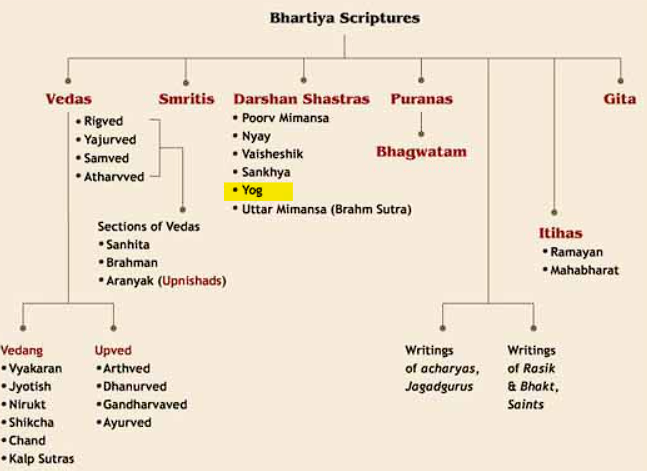
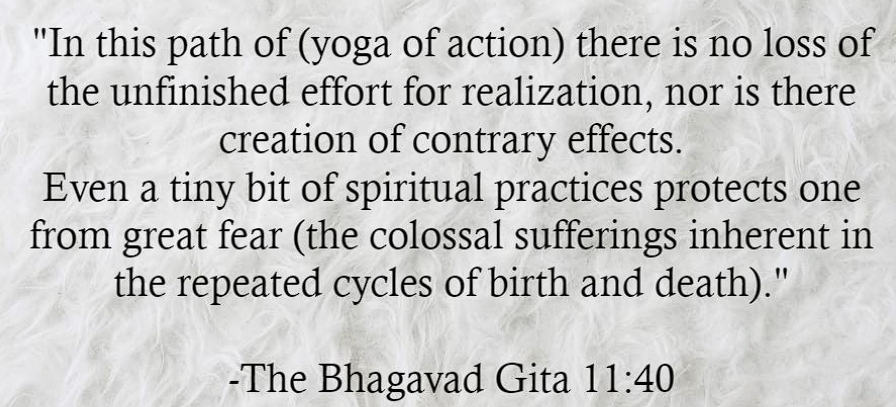
3. The Bhagwat Gita and Yoga
Shri Krishna explained three types of Yoga in the Bhagwat Geeta:
1. Bhakti Yoga
It is pure yoga of the devotion to the Param Atma creating bliss and a sense of salvation in the heart of the one who practices Bhakti Yoga.
2. Jnana Yoga
It is also known as the yoga of the intellect and consciousness through the learning of the scriptures and attaining a higher state of consciousness through the knowledge acquired about the self and the cosmos.
3. Karma Yoga
This is what Shri Krishna termed as NISHKAM KARMA. This type of yoga requires one to be selfless in the service of human beings and the Parm Atma the divine Shri Krishna Himself.
Shri Krishna explained three types of Yoga in the Bhagwat Geeta:
1. Bhakti Yoga
It is pure yoga of the devotion to the Param Atma creating bliss and a sense of salvation in the heart of the one who practices Bhakti Yoga.
2. Jnana Yoga
It is also known as the yoga of the intellect and consciousness through the learning of the scriptures and attaining a higher state of consciousness through the knowledge acquired about the self and the cosmos.
3. Karma Yoga
This is what Shri Krishna termed as NISHKAM KARMA. This type of yoga requires one to be selfless in the service of human beings and the Parm Atma the divine Shri Krishna Himself.
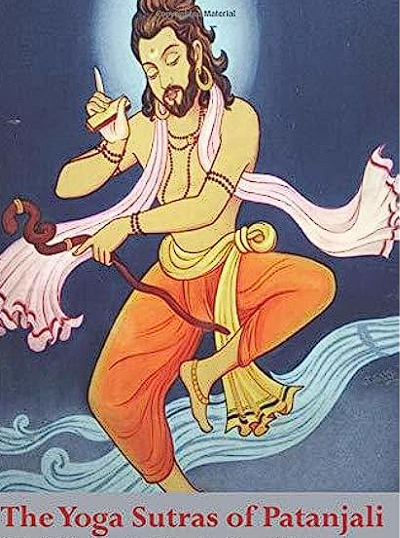
4. Origin of the Ashtang Yoga - Rishi Patanjali
Rishi Patanjali organized the practice of yoga into an eight-limbed path known as Ashtanga Yoga, which consisted of steps and stages toward enlightenment. Patanjali’s Yoga Sutras are the first systematic presentation of the practice. For this reason, Patanjali is known as the Father of Yoga.
Eight Limbs/ Parts of the Ashtanga Yoga:
The eight limbs of yoga are:
1. First limb (Yama) – attitudes toward our environment. It consists of five Yamas: Ahimsa (non-violence), Satya (honesty and truthfulness), Asteya (non-stealing), Brahmacharya (right use of energy, marital fidelity/sexual restraint), Aparigraha (non-greed, non-coveting).
2. Second limb (Niyama) – positive duties. It consists of five Niyamas: Saucha (cleanliness/ purity of the mind and body), Santosha (contentment, acceptance), Tapas (discipline), Svadhyaya (study, self-reflection), Isvara Pranidhana (contemplation of the divine).
3. Third limb (Asana) – posture
4. Fourth limb (Pranayama) – breathing techniques
5. Fifth limb (Pratyahara) – withdrawal of the senses
6. Sixth limb (Dharana) – focused attention on a single thing
7. Seventh limb (Dhyana) – meditation
8. Eight limb (Samadhi) – bliss or enlightenment
Rishi Patanjali wrote 195 sutras in his compendium on the practices of the Ashtanga Yoga and till date this called the origin of the Yoga. Actually Vedic Yoga is generally refered to as Pran Yoga (Yoga for the mind and the Spirit) and Yoga postulated by the Patanjali is called Raj Yoga (Yoga for the Body).
Rishi Patanjali organized the practice of yoga into an eight-limbed path known as Ashtanga Yoga, which consisted of steps and stages toward enlightenment. Patanjali’s Yoga Sutras are the first systematic presentation of the practice. For this reason, Patanjali is known as the Father of Yoga.
Eight Limbs/ Parts of the Ashtanga Yoga:
The eight limbs of yoga are:
1. First limb (Yama) – attitudes toward our environment. It consists of five Yamas: Ahimsa (non-violence), Satya (honesty and truthfulness), Asteya (non-stealing), Brahmacharya (right use of energy, marital fidelity/sexual restraint), Aparigraha (non-greed, non-coveting).
2. Second limb (Niyama) – positive duties. It consists of five Niyamas: Saucha (cleanliness/ purity of the mind and body), Santosha (contentment, acceptance), Tapas (discipline), Svadhyaya (study, self-reflection), Isvara Pranidhana (contemplation of the divine).
3. Third limb (Asana) – posture
4. Fourth limb (Pranayama) – breathing techniques
5. Fifth limb (Pratyahara) – withdrawal of the senses
6. Sixth limb (Dharana) – focused attention on a single thing
7. Seventh limb (Dhyana) – meditation
8. Eight limb (Samadhi) – bliss or enlightenment
Rishi Patanjali wrote 195 sutras in his compendium on the practices of the Ashtanga Yoga and till date this called the origin of the Yoga. Actually Vedic Yoga is generally refered to as Pran Yoga (Yoga for the mind and the Spirit) and Yoga postulated by the Patanjali is called Raj Yoga (Yoga for the Body).
5. Asana in Yoga
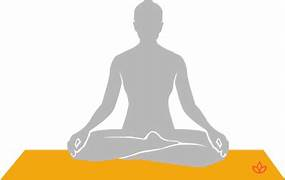
An āsana (Sanskrit: आसन) is a body posture, originally and still a general term for a sitting meditation pose, and later extended in hatha yoga and modern yoga as exercise, to any type of position, adding reclining, standing, inverted, twisting, and balancing poses. The Yoga Sutras of Patanjali define "asana" as a position that is steady and comfortable. Patanjali mentions the ability to sit for extended periods as one of the eight limbs of his system. Asanas are also called yoga poses or yoga postures in English.
In Vedic Yoga Asana means the ability to sit and in metaphysical terms, Asana is a limb, a way to enter the body of the YOGA, the union with Cosmic energy by keeping the body in asana or a posture for a certain period of time. The first description of the ASANA is found in the Shiva Samhita dedicated to the Aadi Yogi or first Yohi of the Universe the ShaktiMaan the Shiva himself, where we found more than 84 Lakh Asana performed by the Bhagwan Shiva himself and all other yoga asanas are presumed to be originated from those Asanas of the Aadi Yogi himself.
An āsana (Sanskrit: आसन) is a body posture, originally and still a general term for a sitting meditation pose, and later extended in hatha yoga and modern yoga as exercise, to any type of position, adding reclining, standing, inverted, twisting, and balancing poses. The Yoga Sutras of Patanjali define "asana" as a position that is steady and comfortable. Patanjali mentions the ability to sit for extended periods as one of the eight limbs of his system. Asanas are also called yoga poses or yoga postures in English.
In Vedic Yoga Asana means the ability to sit and in metaphysical terms, Asana is a limb, a way to enter the body of the YOGA, the union with Cosmic energy by keeping the body in asana or a posture for a certain period of time. The first description of the ASANA is found in the Shiva Samhita dedicated to the Aadi Yogi or first Yohi of the Universe the ShaktiMaan the Shiva himself, where we found more than 84 Lakh Asana performed by the Bhagwan Shiva himself and all other yoga asanas are presumed to be originated from those Asanas of the Aadi Yogi himself.
6. Five Main Principals of the Yoga Practice
1. Ujjayi Pranayam:
This is the basic breathing technique during the asana of Yoga to invoke the prana shakti of the human body.
2. Drishti
Creation of the point of the focus to remain mediated to the Asana of the Yoga to invoke the cosmic union of the prana and Shakti.
3. Vinyasa
This involves the synchronization of breathing with yoga asana and movements.
4. Bandha
Locking the body in a particular posture of the Asana for a particular time span to increase the level of the union of prana with Shakti the cosmic energy.
5. Abhyasa
It is a regular practice of the Asana to increase the level of the union of the prana and the Shakti the cosmic energy to attain the level of enlightenment.
स्थिरसुखमासनम्
Asana means a steady and comfortable posture.
Patanjali Yoga Sutras 2:46
1. Ujjayi Pranayam:
This is the basic breathing technique during the asana of Yoga to invoke the prana shakti of the human body.
2. Drishti
Creation of the point of the focus to remain mediated to the Asana of the Yoga to invoke the cosmic union of the prana and Shakti.
3. Vinyasa
This involves the synchronization of breathing with yoga asana and movements.
4. Bandha
Locking the body in a particular posture of the Asana for a particular time span to increase the level of the union of prana with Shakti the cosmic energy.
5. Abhyasa
It is a regular practice of the Asana to increase the level of the union of the prana and the Shakti the cosmic energy to attain the level of enlightenment.
स्थिरसुखमासनम्
Asana means a steady and comfortable posture.
Patanjali Yoga Sutras 2:46
7. Shiva Samhita and Yoga:
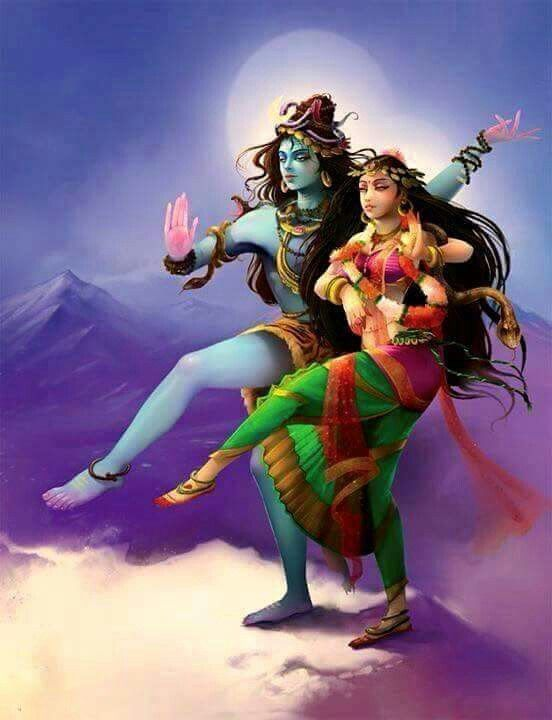
The “Shiva Samhita” is written as the conversation between the Shaktimaan, The Shiva Himself, and the AadiShakti, the consort of Shaktimaan, Mata Parvati. It is one of the oldest surviving texts based on Hatha yoga and Raja Yoga. It is regarded as being the most complete set of Yoga philosophy and Metaphysics.
Shiva is the symbolic representation of the creative and destructive power of the divine masculine. His consort, Parvati, represents the gentle feminine creative power of the universe. The Shiva Samhita discusses many of the esoteric details of the practice of Yoga.
ASPECTS OF THE PRACTICE OF YOGA IN SAMHITA
The chapters of the Shiva Samhita cover various aspects of the practice of Yoga. The word “Yoga” means the union of a human soul with the divine. Shiva Samhita mentions several methods of liberation, different asanas, the structure of our 72,864 nadis, types of prana, and the awakening of the Kundalini Shakti energy. The Shiva Samhita outlines the importance of having a true Guru who can awaken the Kundalini energy safely, as well as describing the subtle body and the movement of prana.
The “Shiva Samhita” is written as the conversation between the Shaktimaan, The Shiva Himself, and the AadiShakti, the consort of Shaktimaan, Mata Parvati. It is one of the oldest surviving texts based on Hatha yoga and Raja Yoga. It is regarded as being the most complete set of Yoga philosophy and Metaphysics.
Shiva is the symbolic representation of the creative and destructive power of the divine masculine. His consort, Parvati, represents the gentle feminine creative power of the universe. The Shiva Samhita discusses many of the esoteric details of the practice of Yoga.
ASPECTS OF THE PRACTICE OF YOGA IN SAMHITA
The chapters of the Shiva Samhita cover various aspects of the practice of Yoga. The word “Yoga” means the union of a human soul with the divine. Shiva Samhita mentions several methods of liberation, different asanas, the structure of our 72,864 nadis, types of prana, and the awakening of the Kundalini Shakti energy. The Shiva Samhita outlines the importance of having a true Guru who can awaken the Kundalini energy safely, as well as describing the subtle body and the movement of prana.
8. Hatha Yoga - The divine consciousness of the Tantra Yoga
Hatha Yoga originated from Tantra Yoga which is related to the conversations of the Aadishakti and the Shaktimaan The Shiva himself is mentioned in various Agama scriptures and in Shiv Samhita also. It is an integral part of Tantra Yoga and its two major sub-parts Mantra Yoga and Yantra Yoga.
For Tantra Yoga deyails. please refer to the below thread.
(
Hatha Yoga originated from Tantra Yoga which is related to the conversations of the Aadishakti and the Shaktimaan The Shiva himself is mentioned in various Agama scriptures and in Shiv Samhita also. It is an integral part of Tantra Yoga and its two major sub-parts Mantra Yoga and Yantra Yoga.
For Tantra Yoga deyails. please refer to the below thread.
(
9. What is Hatha
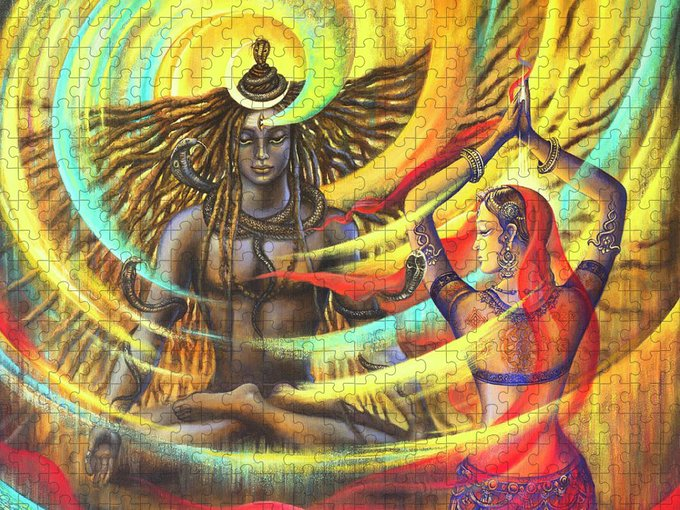
Sun and Moon Energy of the Kundalini of the Human Body
Ha – Sun
Tha – Moon
Hatha yoga is a process or set of processes, to bring a balance of the two energies inside you, Sun and moon.
The sun is the Agni, the fiery masculine aspect of you, and the moon is the water, the cooling feminine aspect of you. We need to balance out these internal forces to bring our energy to the center and allow it to flow freely.
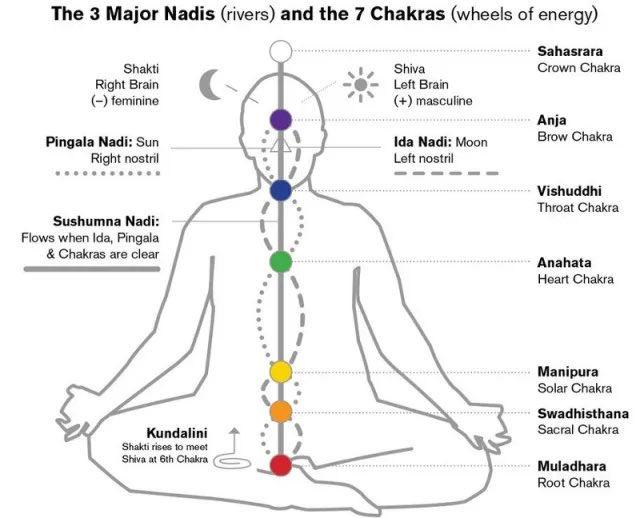
The Sun is associated with the Pingala nadi and the right nostril, and the Moon is associated with the Ida nadi and the left nostril. You can become aware of which is more active by observing through which nostril the air passes most easily. When balance is achieved, you will feel equal amounts of air flowing through each nostril. When you can retain this state of balance you will be more easily able to fall into meditation and the state of Samadhi which is called Samadhi Yoga the ultimate state of the Yoga in Tantra Yoga.
For more details on Nadis and Kundalini, please refer to this thread:
(
Sun and Moon Energy of the Kundalini of the Human Body
Ha – Sun
Tha – Moon
Hatha yoga is a process or set of processes, to bring a balance of the two energies inside you, Sun and moon.
The sun is the Agni, the fiery masculine aspect of you, and the moon is the water, the cooling feminine aspect of you. We need to balance out these internal forces to bring our energy to the center and allow it to flow freely.
The Sun is associated with the Pingala nadi and the right nostril, and the Moon is associated with the Ida nadi and the left nostril. You can become aware of which is more active by observing through which nostril the air passes most easily. When balance is achieved, you will feel equal amounts of air flowing through each nostril. When you can retain this state of balance you will be more easily able to fall into meditation and the state of Samadhi which is called Samadhi Yoga the ultimate state of the Yoga in Tantra Yoga.
For more details on Nadis and Kundalini, please refer to this thread:
(
10. 6 steps of Hatha Yoga and its Purpose
The meaning of the word hatha makes it clear that anyone who wants to take this path will be practicing a forceful or effortful purification of the self. The path is well laid out with techniques to remove various levels of blockages and bring the body to its natural state of health so that prana can flow freely through the kundalini, and the sense of ego and self can be dropped.
The 6 techniques of Hatha yoga are:
Asana Postures and moves of the physical body
Shat Kriya 6 Cleansing Techniques
Mudra Seals made with the hands and body
Bandha Locks (muscular contractions to redirect prana in the body)
Dharana Concentration techniques leading to meditation
Mantra Chanting with intention
Pranayama Using the breath to control and direct prana
The meaning of the word hatha makes it clear that anyone who wants to take this path will be practicing a forceful or effortful purification of the self. The path is well laid out with techniques to remove various levels of blockages and bring the body to its natural state of health so that prana can flow freely through the kundalini, and the sense of ego and self can be dropped.
The 6 techniques of Hatha yoga are:
Asana Postures and moves of the physical body
Shat Kriya 6 Cleansing Techniques
Mudra Seals made with the hands and body
Bandha Locks (muscular contractions to redirect prana in the body)
Dharana Concentration techniques leading to meditation
Mantra Chanting with intention
Pranayama Using the breath to control and direct prana
11. Hath Yoga and the Concept of the Prana
PRANA Originates from Sanskrit word praṇa- which means "breath, exhalation, breath of life," derived from the base of praṇiti which means "(she/he) breathes, draws in breath," from pra- "before, forward" + aniti "(she/he) breathes".
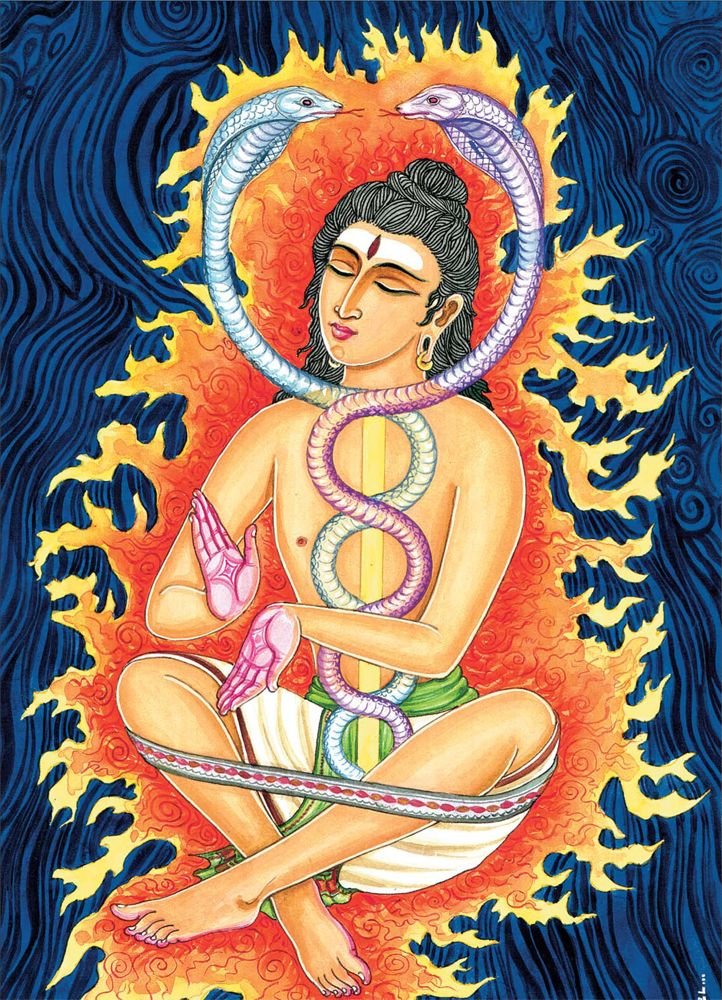
Hath yoga in simplest form is the management of the Prana in the human body. Prana controls the movement of the energy in our body through nadis, from one chakra oof the kundalini to another chakra, thus ensuring the sublime expansion of the energy in the body to make it functional both biologically as well as spiritually.
PRANA Originates from Sanskrit word praṇa- which means "breath, exhalation, breath of life," derived from the base of praṇiti which means "(she/he) breathes, draws in breath," from pra- "before, forward" + aniti "(she/he) breathes".
Hath yoga in simplest form is the management of the Prana in the human body. Prana controls the movement of the energy in our body through nadis, from one chakra oof the kundalini to another chakra, thus ensuring the sublime expansion of the energy in the body to make it functional both biologically as well as spiritually.
12. Flow of Prana in the Human Body
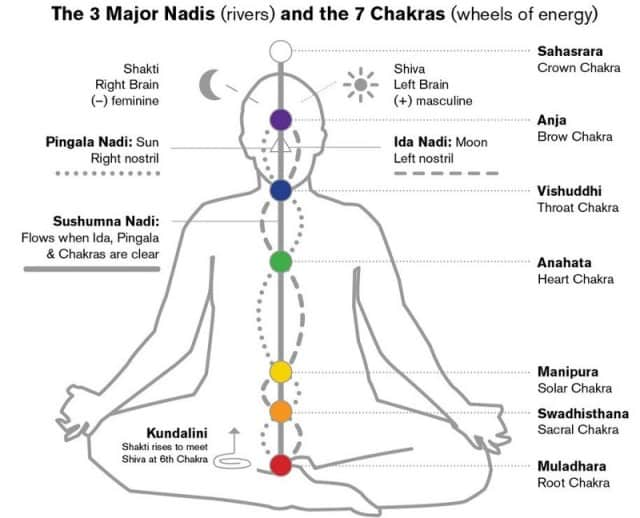
In Yoga the goal is to merge the 5 Vayus (5 Parts of the Prana), Kundalini, and Shakti (CAosmic energy) into one. This Brings in the manifestation of true yoga as one which combines mortal with the immortal.
PRANA vayu is responsible for the INTAKE of the body. It moves downward and inward, providing the basic energy that drives us in life. It is primarily located in the head, lungs and heart. Imbalances in Prana flow can show up as anxiety, fear, anger (head); breathlessness, asthma, sleep apnea (lungs); heart palpitations or stroke (heart).
In Yoga the goal is to merge the 5 Vayus (5 Parts of the Prana), Kundalini, and Shakti (CAosmic energy) into one. This Brings in the manifestation of true yoga as one which combines mortal with the immortal.
PRANA vayu is responsible for the INTAKE of the body. It moves downward and inward, providing the basic energy that drives us in life. It is primarily located in the head, lungs and heart. Imbalances in Prana flow can show up as anxiety, fear, anger (head); breathlessness, asthma, sleep apnea (lungs); heart palpitations or stroke (heart).
13. Pran Vayus and their function
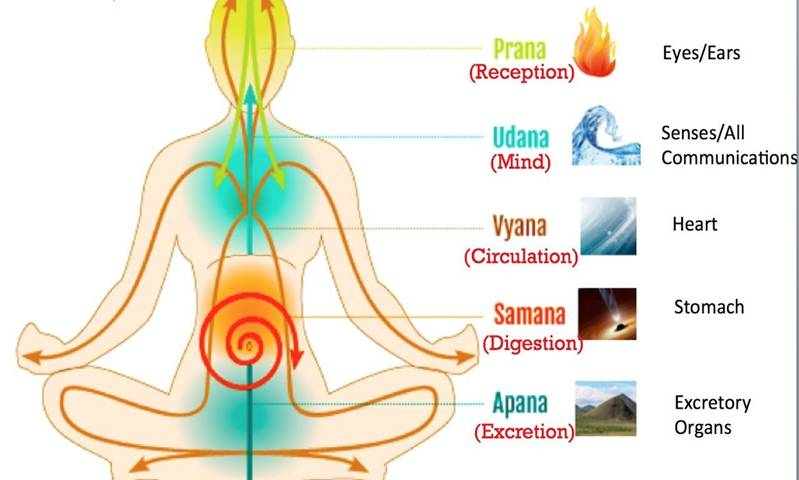
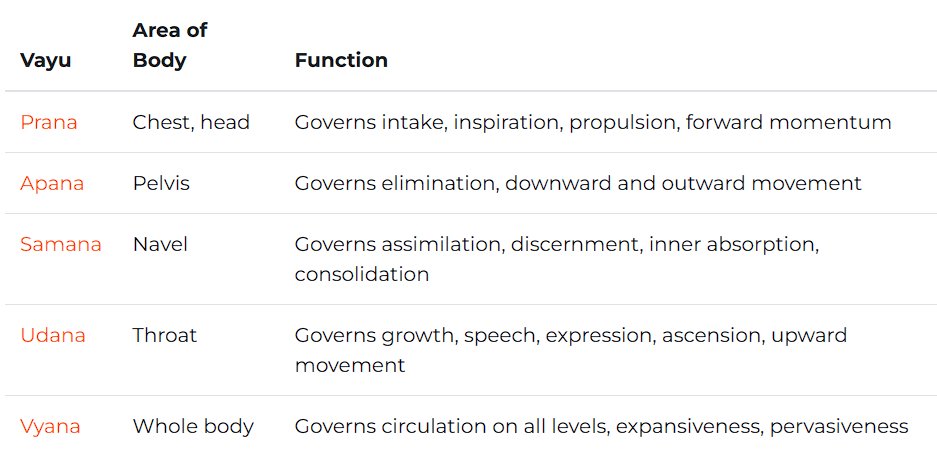
1. Aapana vayu is responsible for elimination. It moves down and out and also helps retain things in. It is primarily located in the lower abdomen and is associated with functions of elimination, reproduction and bone health (regulating the absorption and retaining of minerals). Imbalances in Apana flow can show up as constipation/diarrhea, IBS; menstrual problems, sexual issues; bone density issues.
Vedas say: “Mortals eat food with Apana, while the gods eat food with Prana” (mortals are the physical tissues; the immortals are the senses that receive nourishment directly through the sense openings in the head). While the right food sustains Apana, the right impressions are required to feed Prana. As we grow spiritually, we must learn to take in more prana to feed the spiritual powers within us. We need to control Apana, particularly the sexual function, not to drain vital energy downward.
2. Samana vayu is responsible for processing things and moves toward the center in a churning motion. It is concentrated around the navel. It is responsible for digestion on all levels, including the mind. It is associated with processes of digestion, absorption and assimilation. Imbalances in Samana vayu function include metabolism issues, poor digestion, bloating, and loss of appetite.
3. Vyana Vayu is responsible for distribution. It moves outward in a circular, pulsating motion. It is located in the heart and lungs and is involved in cardiac activity, circulation and the voluntary nervous system. Imbalances may show up as poor circulation, blocked arteries, heart attack, edema; peripheral neuropathy, symptoms of MS. Vyana and Samana vayus are opposite as forces of expansion and contraction. Vyana allows for differentiation of elements and grants each their separate sphere of activity. Samana brings about the integration of the elements and keeps them connected. Samana regulates agni (digestive fire) with fuel, which must burn evenly. Vyana governs the movement of prana through the nadis, keeping them open, clear, clean and even in their functioning.
4. Udana vayu is responsible for growth. It moves upward and is a result of other vayus working properly. It governs our ability to stand, our speech, effort, enthusiasm and will. It is concentrated near the diaphragm and throat and is responsible for certain respiratory functions, speech and mental functioning (by supporting the blood movement to the brain). Imbalances in Udana vayu functioning include asthma, emphysema; stuttering, voice hoarseness; depression, poor memory, lack of creativity, direction or goals.
5. Prana vayu is responsible for the INTAKE of the body. It moves downward and inward, providing the basic energy that drives us in life. It is primarily located in the head, lungs and heart. Imbalances in Prana flow can show up as anxiety, fear, anger (head); breathlessness, asthma, sleep apnea (lungs); heart palpitations or stroke (heart).
1. Aapana vayu is responsible for elimination. It moves down and out and also helps retain things in. It is primarily located in the lower abdomen and is associated with functions of elimination, reproduction and bone health (regulating the absorption and retaining of minerals). Imbalances in Apana flow can show up as constipation/diarrhea, IBS; menstrual problems, sexual issues; bone density issues.
Vedas say: “Mortals eat food with Apana, while the gods eat food with Prana” (mortals are the physical tissues; the immortals are the senses that receive nourishment directly through the sense openings in the head). While the right food sustains Apana, the right impressions are required to feed Prana. As we grow spiritually, we must learn to take in more prana to feed the spiritual powers within us. We need to control Apana, particularly the sexual function, not to drain vital energy downward.
2. Samana vayu is responsible for processing things and moves toward the center in a churning motion. It is concentrated around the navel. It is responsible for digestion on all levels, including the mind. It is associated with processes of digestion, absorption and assimilation. Imbalances in Samana vayu function include metabolism issues, poor digestion, bloating, and loss of appetite.
3. Vyana Vayu is responsible for distribution. It moves outward in a circular, pulsating motion. It is located in the heart and lungs and is involved in cardiac activity, circulation and the voluntary nervous system. Imbalances may show up as poor circulation, blocked arteries, heart attack, edema; peripheral neuropathy, symptoms of MS. Vyana and Samana vayus are opposite as forces of expansion and contraction. Vyana allows for differentiation of elements and grants each their separate sphere of activity. Samana brings about the integration of the elements and keeps them connected. Samana regulates agni (digestive fire) with fuel, which must burn evenly. Vyana governs the movement of prana through the nadis, keeping them open, clear, clean and even in their functioning.
4. Udana vayu is responsible for growth. It moves upward and is a result of other vayus working properly. It governs our ability to stand, our speech, effort, enthusiasm and will. It is concentrated near the diaphragm and throat and is responsible for certain respiratory functions, speech and mental functioning (by supporting the blood movement to the brain). Imbalances in Udana vayu functioning include asthma, emphysema; stuttering, voice hoarseness; depression, poor memory, lack of creativity, direction or goals.
5. Prana vayu is responsible for the INTAKE of the body. It moves downward and inward, providing the basic energy that drives us in life. It is primarily located in the head, lungs and heart. Imbalances in Prana flow can show up as anxiety, fear, anger (head); breathlessness, asthma, sleep apnea (lungs); heart palpitations or stroke (heart).
14. Hatha Yoga vs Ashtanga Yoga: Which one shall you practice?
With Hatha you can simply perform one asana at a time, but Ashtanga practice won’t let you stop before completing a series of asanas in a flow. This is Vinyasa. To flow from one asana to the next makes the whole practice more vigorous, consequently, a greater heat generation within. Ashtanga is thus good for fast calorie burning and dynamic strength building. With the motion slow and focused, you can utilize Ashtanga to the potential of cardiovascular exercise as well. Hatha is more effective as a warm-up, restorative workout, and relaxant. While Hatha lets you focus deeply on the bends and flexes in each asana, in Ashtanga, it all passes in a blur. Ashtanga gets a little more complex when the Guru brings your attention to the synergy of movement and breath. Not only you must set your movements in a rhythm while Ashtanga vinyasa, but your breath must also fall in curves too. To master synchronized breath-intensified asana movement, it is highly recommended to start your journey in yoga with Hatha first. After you have followed through with the nuances of yoga breath and the importance of synchronizing yoga movement with pranayama yoga breath in singular Hatha exercises, move to the more complex system of Ashtanga yoga.
With Hatha you can simply perform one asana at a time, but Ashtanga practice won’t let you stop before completing a series of asanas in a flow. This is Vinyasa. To flow from one asana to the next makes the whole practice more vigorous, consequently, a greater heat generation within. Ashtanga is thus good for fast calorie burning and dynamic strength building. With the motion slow and focused, you can utilize Ashtanga to the potential of cardiovascular exercise as well. Hatha is more effective as a warm-up, restorative workout, and relaxant. While Hatha lets you focus deeply on the bends and flexes in each asana, in Ashtanga, it all passes in a blur. Ashtanga gets a little more complex when the Guru brings your attention to the synergy of movement and breath. Not only you must set your movements in a rhythm while Ashtanga vinyasa, but your breath must also fall in curves too. To master synchronized breath-intensified asana movement, it is highly recommended to start your journey in yoga with Hatha first. After you have followed through with the nuances of yoga breath and the importance of synchronizing yoga movement with pranayama yoga breath in singular Hatha exercises, move to the more complex system of Ashtanga yoga.
15. Bhagwan Shiva as the 1st Yogi
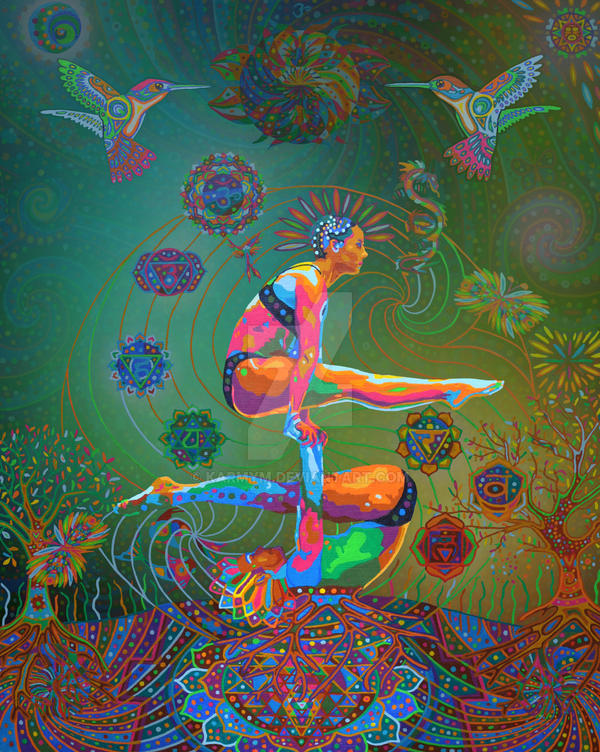
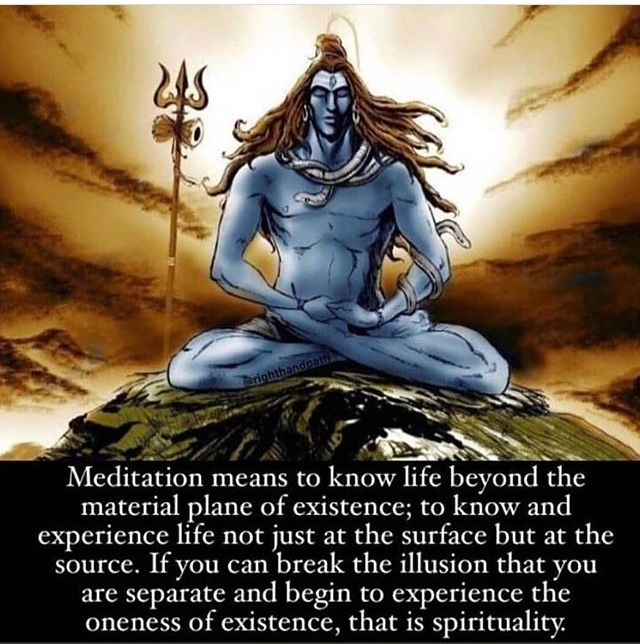
Bhagwan Shiva is known as Yogeshvara, the great custodian of Yoga, Adi Natha, Adi Yogi, and Mahayogi, he rules over all aspects of Yoga relative to body, mind, and consciousness. Shiva is the lord of asana practice with 84 lakhs of asanas said to have derived from his movements. This shows Shiva’s connections with the numerous Yoga asanas known and unknown. Shiva is most famous as having three eyes or Tryambakam. The third eye of Shiva is the inner eye of unitary awareness and higher perception beyond all duality. Shiva as the lord of the mountain, the Himalayas in general and Mount Kailas in particular, represents the mountain of meditation which also the mountain of the spine and the subtle body, the great cosmic mountain.
The river Ganga that flows down on Shiva’s head represents the immortal stream of higher yogic awareness from planes and lokas beyond this material world. The Shiva Linga, his upward focused energy, represents the ascending power of Yoga, the silent mind of Samadhi and the yogic state of transcendence, the pillar that supports the entire universe.
Shiva’s consort as Devi or Shakti, the Divine Mother, is the Yoga Shakti, the power of yoga is always honored along with him, seen as the left half of his own body. From the Kundalini Shakti in the human being to the power of consciousness (Chit-shakti) at a cosmic level, she mirrors his magnificence and allows us to experience it. Shakti possesses beauty and embodies a fluid and adaptable nature, embracing reality as a dance. Her energy is sensual, expressive, and present in all living beings, while Shiva’s energy remains formless.
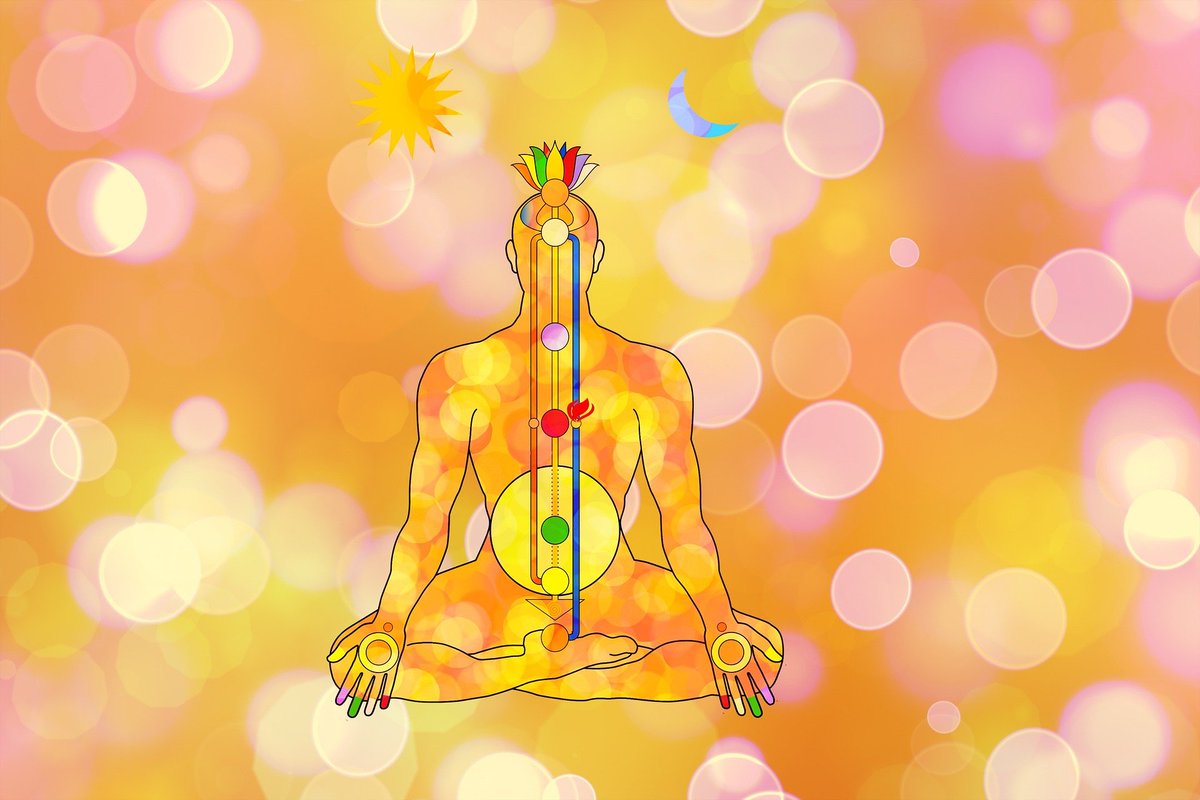
Shakti energy manifests as prana, the life force that flows through nadis, our subtle energy channels.
It can also manifest as kundalini energy, which awakens and moves through our central channel (sushumna nadi), where your seven chakras reside, facilitating your cleansing and transformation.
By becoming the witness of Shakti, we connect with our Shiva energy. Through meditation and presence, we embrace our inner Shiva nature. Shiva provides direction to Shakti’s energetic flow, holding space for her movements.
Bhagwan Shiva is known as Yogeshvara, the great custodian of Yoga, Adi Natha, Adi Yogi, and Mahayogi, he rules over all aspects of Yoga relative to body, mind, and consciousness. Shiva is the lord of asana practice with 84 lakhs of asanas said to have derived from his movements. This shows Shiva’s connections with the numerous Yoga asanas known and unknown. Shiva is most famous as having three eyes or Tryambakam. The third eye of Shiva is the inner eye of unitary awareness and higher perception beyond all duality. Shiva as the lord of the mountain, the Himalayas in general and Mount Kailas in particular, represents the mountain of meditation which also the mountain of the spine and the subtle body, the great cosmic mountain.
The river Ganga that flows down on Shiva’s head represents the immortal stream of higher yogic awareness from planes and lokas beyond this material world. The Shiva Linga, his upward focused energy, represents the ascending power of Yoga, the silent mind of Samadhi and the yogic state of transcendence, the pillar that supports the entire universe.
Shiva’s consort as Devi or Shakti, the Divine Mother, is the Yoga Shakti, the power of yoga is always honored along with him, seen as the left half of his own body. From the Kundalini Shakti in the human being to the power of consciousness (Chit-shakti) at a cosmic level, she mirrors his magnificence and allows us to experience it. Shakti possesses beauty and embodies a fluid and adaptable nature, embracing reality as a dance. Her energy is sensual, expressive, and present in all living beings, while Shiva’s energy remains formless.
Shakti energy manifests as prana, the life force that flows through nadis, our subtle energy channels.
It can also manifest as kundalini energy, which awakens and moves through our central channel (sushumna nadi), where your seven chakras reside, facilitating your cleansing and transformation.
By becoming the witness of Shakti, we connect with our Shiva energy. Through meditation and presence, we embrace our inner Shiva nature. Shiva provides direction to Shakti’s energetic flow, holding space for her movements.
16. Shiva and Shakti as symbols of the Yoga
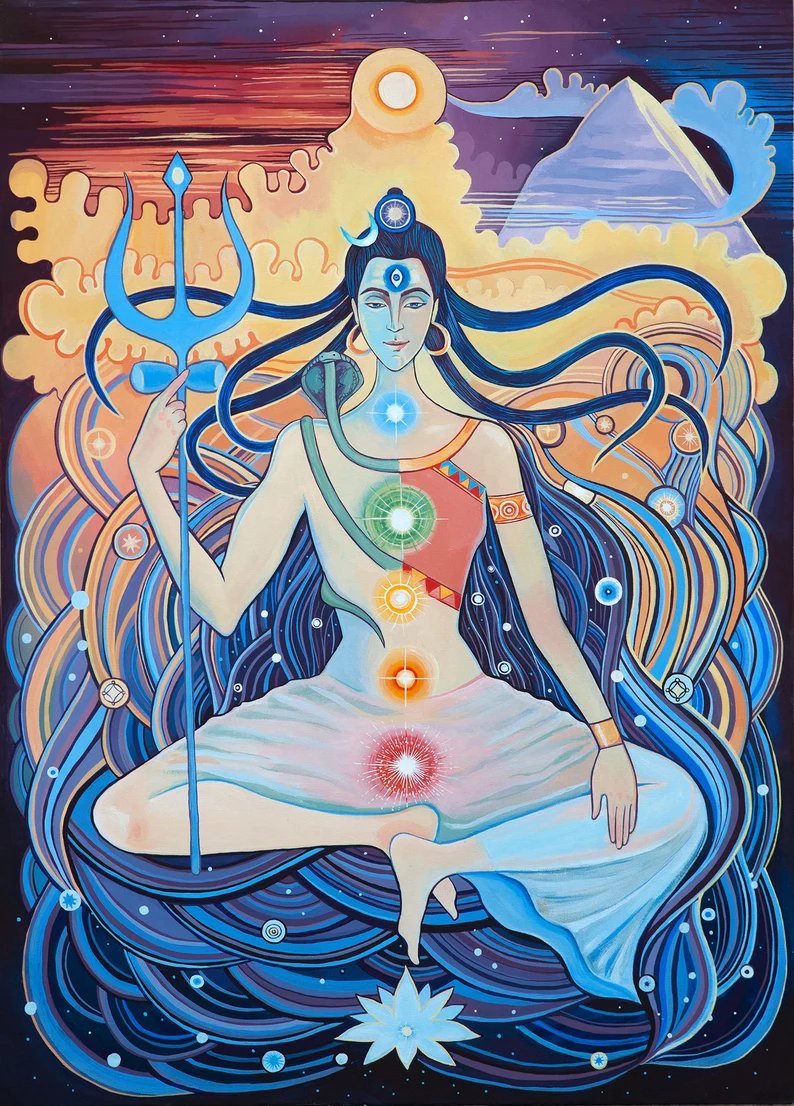
In the practice of yoga, Shiva and Shakti are associated with the two main channels of energy in the body, known as the ida and pingala nadis.
The Ida nadi is associated with the feminine energy of Shakti, and it is said to govern the lunar, or cooling, aspects of the body and mind.
The Pingala nadi, on the other hand, is associated with the masculine energy of Shiva, and it is said to govern the solar, or heating, aspects of the body and mind.
When these two energies are balanced, the Yoga practitioner is said to experience a state of bliss or enlightenment. However, when one energy is dominant over the other, the practitioner may experience imbalance or discomfort.
In the practice of yoga, Shiva and Shakti are associated with the two main channels of energy in the body, known as the ida and pingala nadis.
The Ida nadi is associated with the feminine energy of Shakti, and it is said to govern the lunar, or cooling, aspects of the body and mind.
The Pingala nadi, on the other hand, is associated with the masculine energy of Shiva, and it is said to govern the solar, or heating, aspects of the body and mind.
When these two energies are balanced, the Yoga practitioner is said to experience a state of bliss or enlightenment. However, when one energy is dominant over the other, the practitioner may experience imbalance or discomfort.
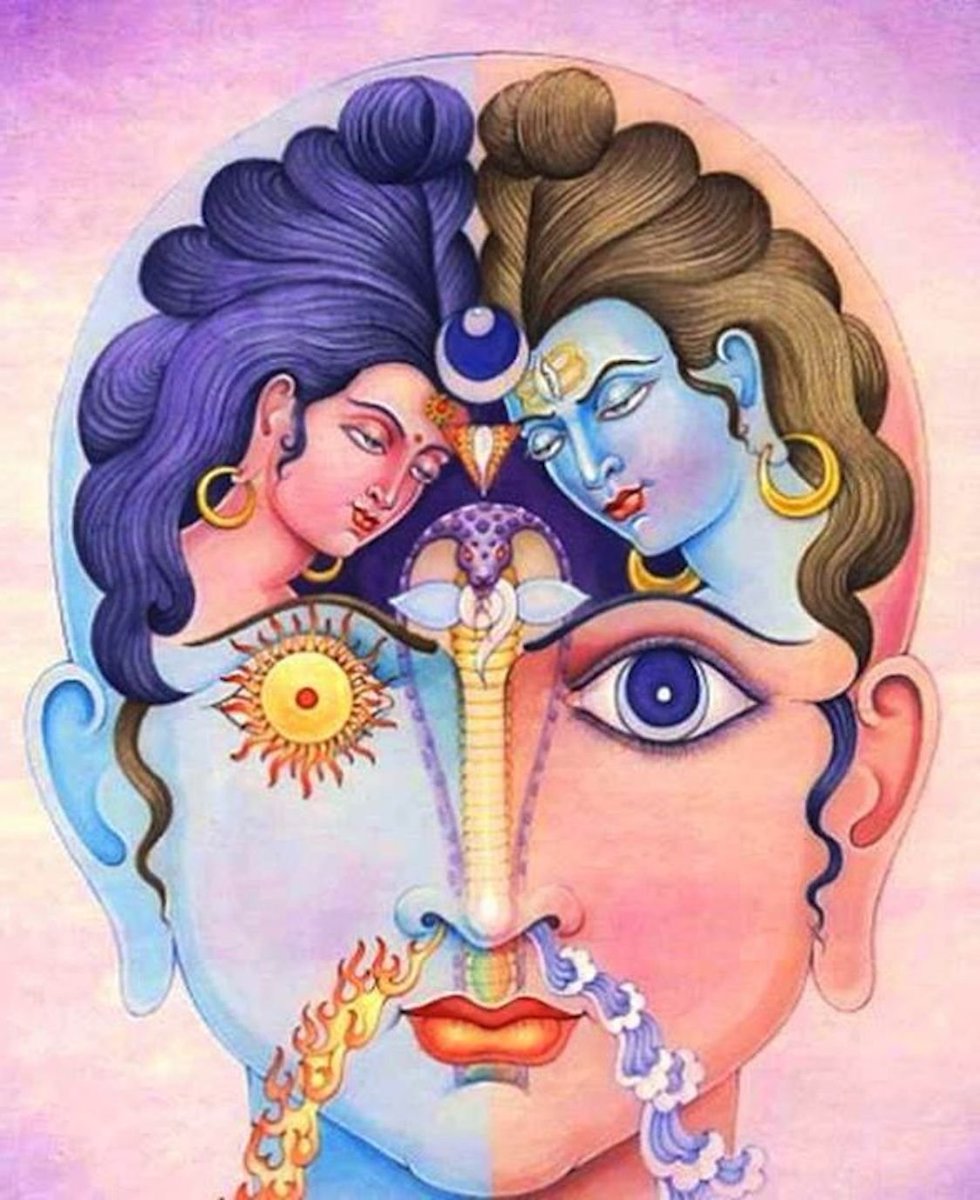
17. Vasishta Yoga Samhita - The forgotten treatise of Yoga
Vasishta Yoga Samhita (योगवासिष्ठम्) is also known as Maha-Ramayana, Arsha Ramayana, Vasiṣṭha Ramayana, Yogavasistha-Ramayana and Jnanavasistha. It is attributed to Maharishi Valmiki. The complete text contains over 29,000 verses. The short version of the text is called Laghu yogavāsiṣṭham and contains 6,000 verses.
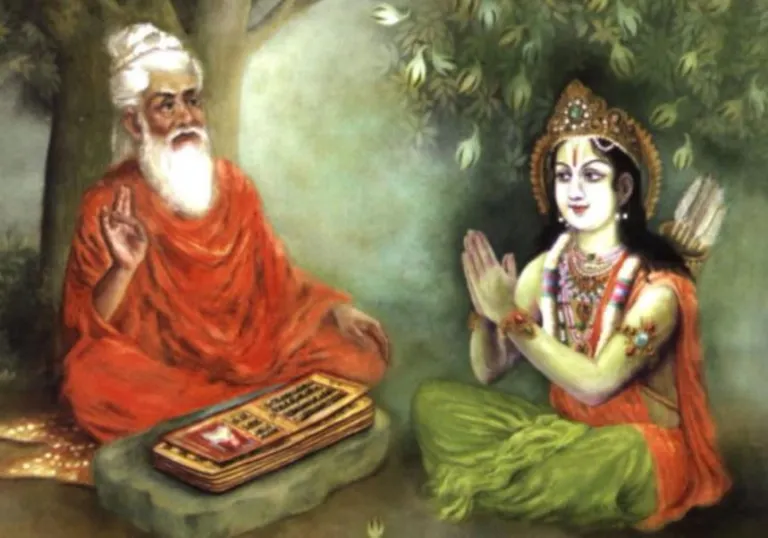
The text is named after sage Vasistha who is mentioned in the seventh book of the Rigveda, and who was called the first sage by Adi Shankara. The text is structured as a discourse of sage Vasistha to Shri Rama.
The text consists of six books. The first book presents Rama's frustration with the nature of life, human suffering, and disdain for the world. The second Book describes, through the character of Rama, the desire for liberation and the nature of those who seek such liberation. The third and fourth books assert that liberation comes through a spiritual life, one that requires self-effort, and present cosmology and metaphysical theories of existence embedded in stories. These two books are known for emphasizing free will and human creative power. The fifth book discusses meditation and its powers in liberating the individual, while the 6th book describes the state of an enlightened and blissful Rama.
Vasishta Yoga Samhita (योगवासिष्ठम्) is also known as Maha-Ramayana, Arsha Ramayana, Vasiṣṭha Ramayana, Yogavasistha-Ramayana and Jnanavasistha. It is attributed to Maharishi Valmiki. The complete text contains over 29,000 verses. The short version of the text is called Laghu yogavāsiṣṭham and contains 6,000 verses.
The text is named after sage Vasistha who is mentioned in the seventh book of the Rigveda, and who was called the first sage by Adi Shankara. The text is structured as a discourse of sage Vasistha to Shri Rama.
The text consists of six books. The first book presents Rama's frustration with the nature of life, human suffering, and disdain for the world. The second Book describes, through the character of Rama, the desire for liberation and the nature of those who seek such liberation. The third and fourth books assert that liberation comes through a spiritual life, one that requires self-effort, and present cosmology and metaphysical theories of existence embedded in stories. These two books are known for emphasizing free will and human creative power. The fifth book discusses meditation and its powers in liberating the individual, while the 6th book describes the state of an enlightened and blissful Rama.
18. How scriptures have defined Yoga
1. Vaisheshika Sutra / Kanad Sutra - Composed by Rishi Kanada
"Pleasure and suffering arise as a result of the drawing together of the sense organs, the mind and objects. When that does not happen because the mind is in the self, there is no pleasure or suffering for one who is embodied. That is yoga"
2. Katha Upanishad
"When the five senses, along with the mind, remain still and the intellect is not active, that is known as the highest state. They consider yoga to be firm restraint of the senses. Then one becomes un-distracted for yoga is the arising and the passing away"
3. Bhagavad Gita
"Be equal-minded in both success and failure. Such equanimity is called Yoga"
"Yoga is a skill in action", "Know that which is called yoga to be separation from contact with suffering"
4. Yoga Sutras of Patanjali
a) yogas chitta vritti nirodhah - "Yoga is the calming down the fluctuations/patterns of mind"
b) Then the Seer is established in his own essential and fundamental nature.
c) In other states, there is assimilation (of the Seer) with the modifications (of the mind)
5. Linga Purana
"By the word 'yoga' is meant nirvana, the condition of Shiva."
1. Vaisheshika Sutra / Kanad Sutra - Composed by Rishi Kanada
"Pleasure and suffering arise as a result of the drawing together of the sense organs, the mind and objects. When that does not happen because the mind is in the self, there is no pleasure or suffering for one who is embodied. That is yoga"
2. Katha Upanishad
"When the five senses, along with the mind, remain still and the intellect is not active, that is known as the highest state. They consider yoga to be firm restraint of the senses. Then one becomes un-distracted for yoga is the arising and the passing away"
3. Bhagavad Gita
"Be equal-minded in both success and failure. Such equanimity is called Yoga"
"Yoga is a skill in action", "Know that which is called yoga to be separation from contact with suffering"
4. Yoga Sutras of Patanjali
a) yogas chitta vritti nirodhah - "Yoga is the calming down the fluctuations/patterns of mind"
b) Then the Seer is established in his own essential and fundamental nature.
c) In other states, there is assimilation (of the Seer) with the modifications (of the mind)
5. Linga Purana
"By the word 'yoga' is meant nirvana, the condition of Shiva."
19 True meaning of the Yoga
As the Pantanjali Yoga Sutra says
योगस्य शक्तिः अधुना अस्ति
Power of the yoga is "Now".
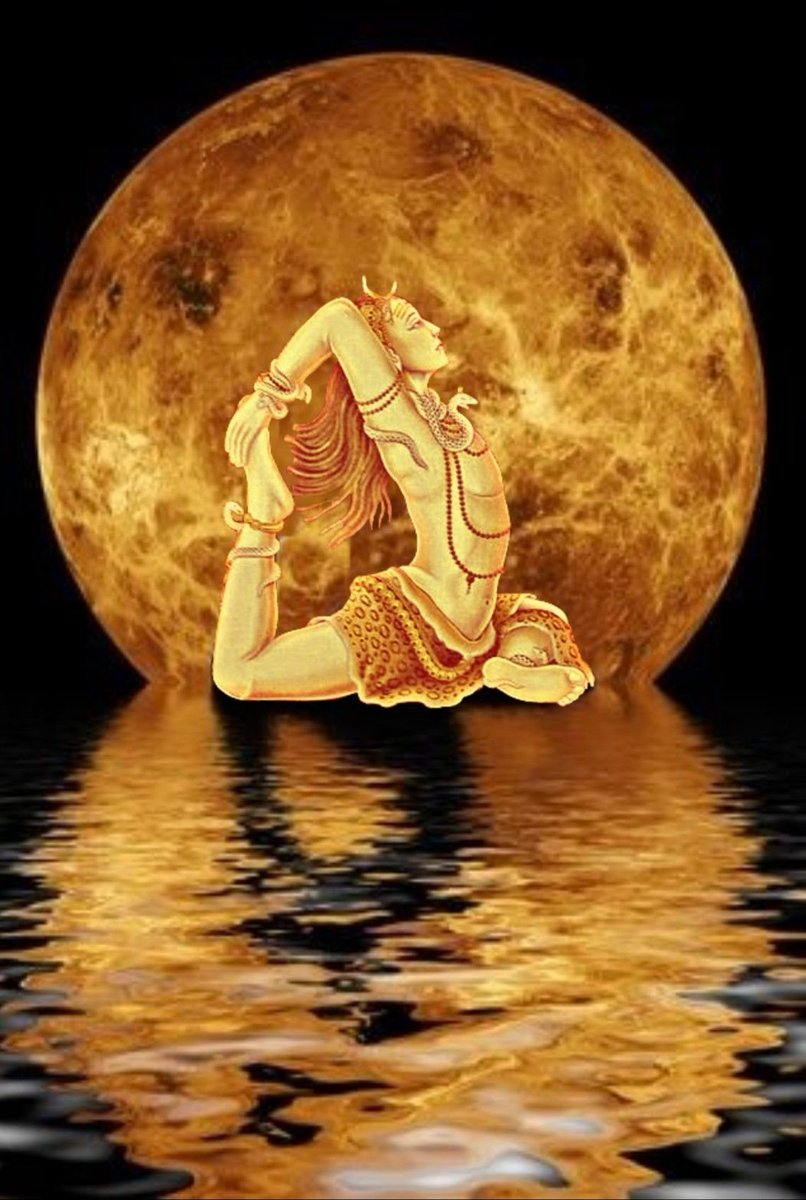
So You have to start the process of yogic salvation "Now". That is the first step towards merging your body with Cosmic energy of the Shakti and the Shaktimaan.
As the Pantanjali Yoga Sutra says
योगस्य शक्तिः अधुना अस्ति
Power of the yoga is "Now".
So You have to start the process of yogic salvation "Now". That is the first step towards merging your body with Cosmic energy of the Shakti and the Shaktimaan.
21. Be very proud of your Santana Lineage.
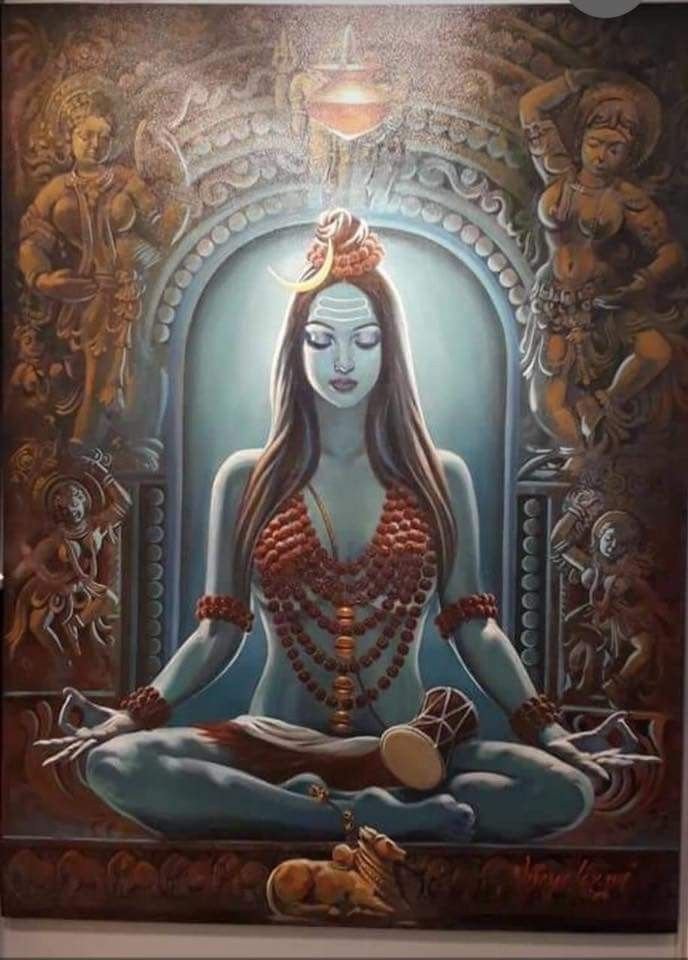
Sanatan is the light and Dharma is the Path.
Please share it with everyone around and help me spread the light of the Sanatana.
Radhe Radhe
Blessings of the Shri Krishna
Sanatan is the light and Dharma is the Path.
Please share it with everyone around and help me spread the light of the Sanatana.
Radhe Radhe
Blessings of the Shri Krishna
Loading suggestions...