

Modular Blockchains Could Solve the Blockchain Trilemma.
#Binance has just released their Report.
Here is ALL you need to know (+ 4 promising projects) 🧵👇
#Binance has just released their Report.
Here is ALL you need to know (+ 4 promising projects) 🧵👇

First things first, bookmark this thread for later reference.
There's a lot of info to digest here!
There's a lot of info to digest here!
Let's start with a brief overview of the differences between modular and monolithic blockchains.
To be considered an immutable ledger of transactions, a blockchain must perform four key functions:
• Consensus
• Data Availability
• Execution
• Settlement
To be considered an immutable ledger of transactions, a blockchain must perform four key functions:
• Consensus
• Data Availability
• Execution
• Settlement
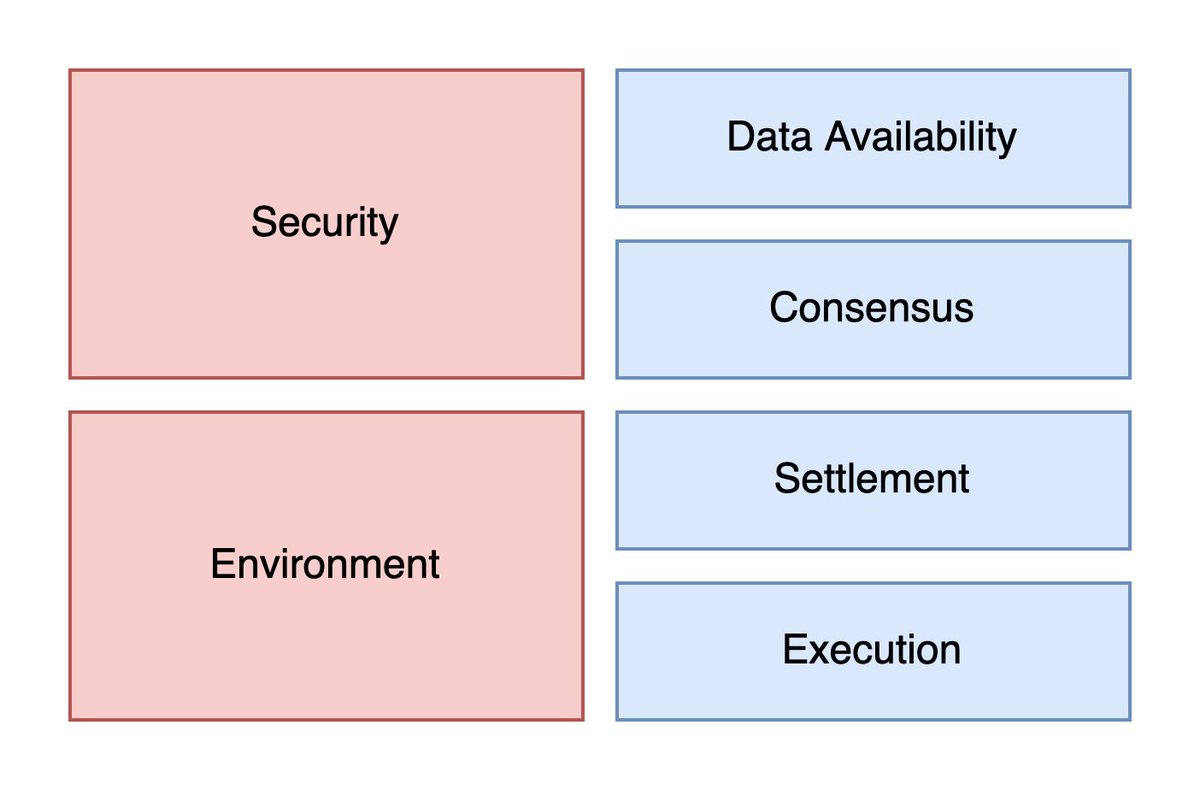
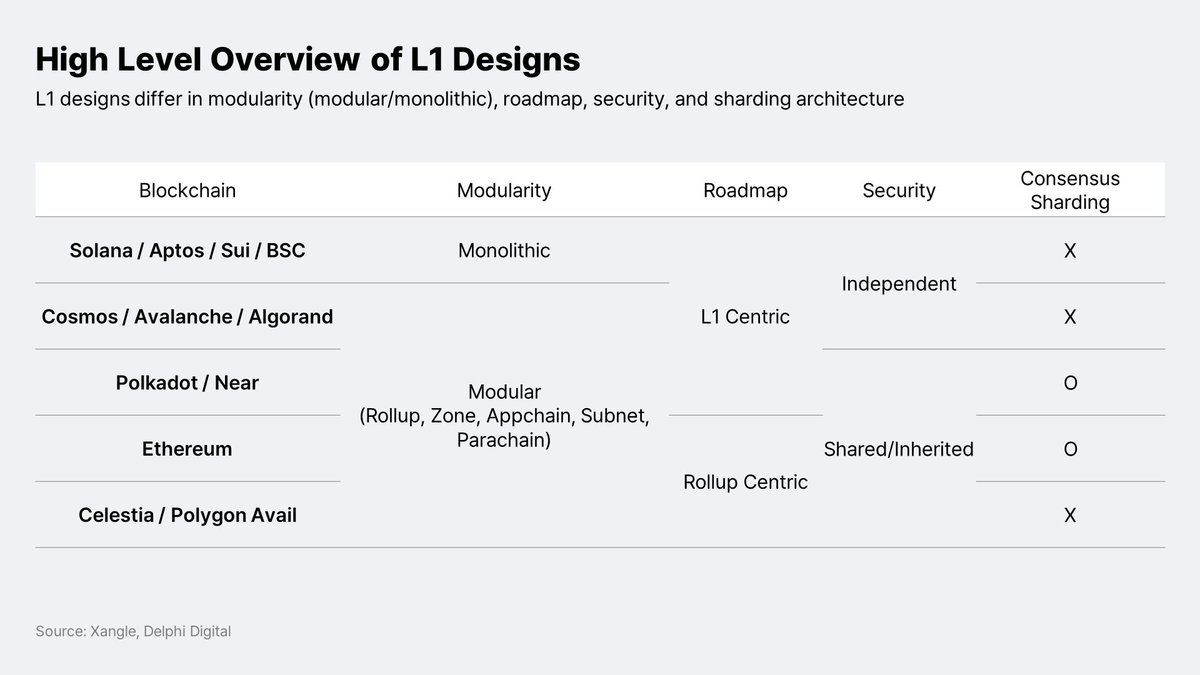
The majority of blockchains are monolithic.
Monolithic blockchains, like Bitcoin and Ethereum, perform these four functions on the same layer.
Modular blockchains, on the other hand, seek to separate these functions across multiple different chains.
Monolithic blockchains, like Bitcoin and Ethereum, perform these four functions on the same layer.
Modular blockchains, on the other hand, seek to separate these functions across multiple different chains.
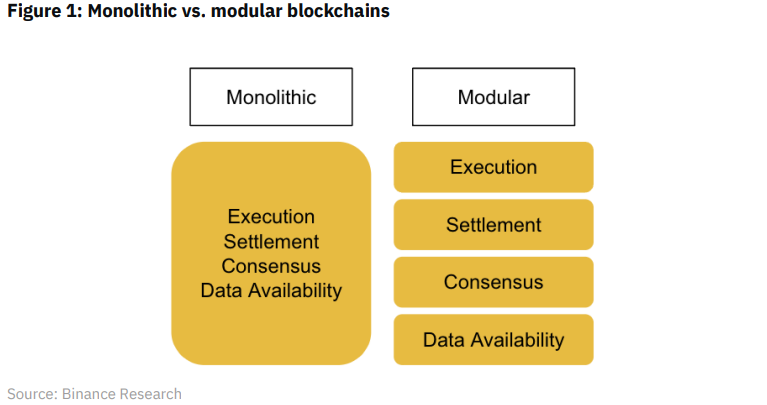
A modular approach uses different blockchains specialized in different stack parts, providing customized solutions for different user needs.
How big is this?
Through modular blockchains, we could finally solve the Blockchain Trilemma!
Let's go more in-depth👇
How big is this?
Through modular blockchains, we could finally solve the Blockchain Trilemma!
Let's go more in-depth👇
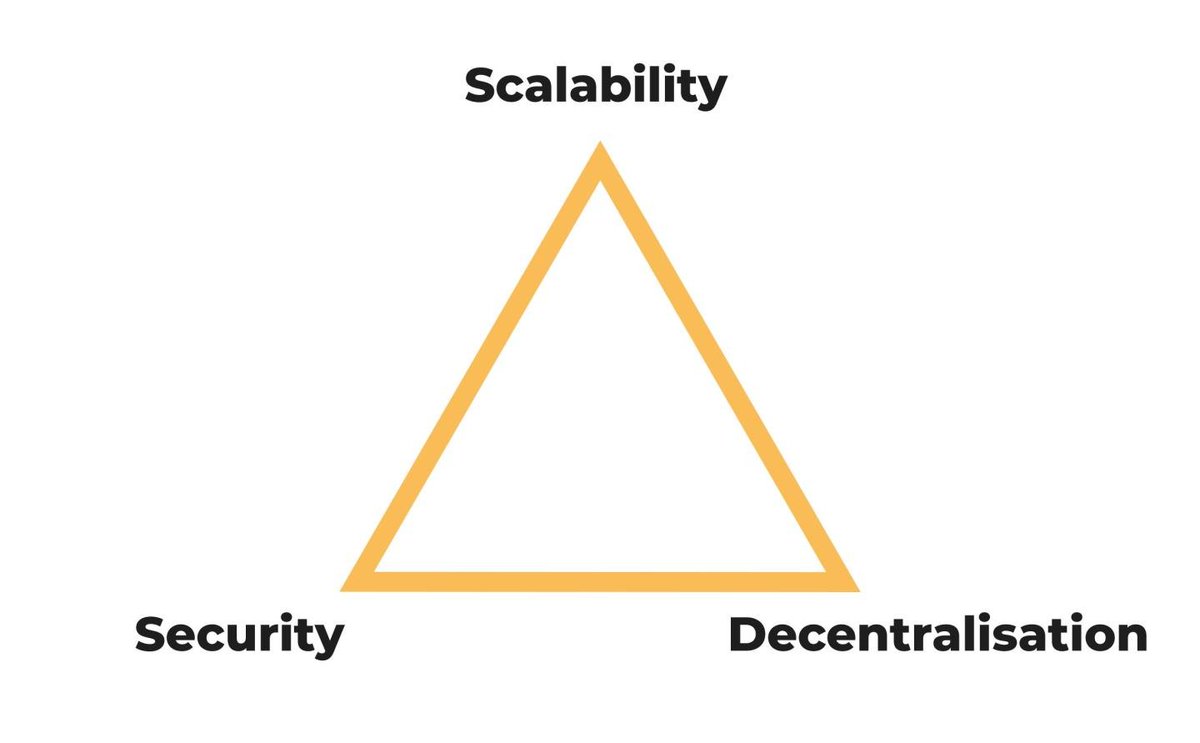
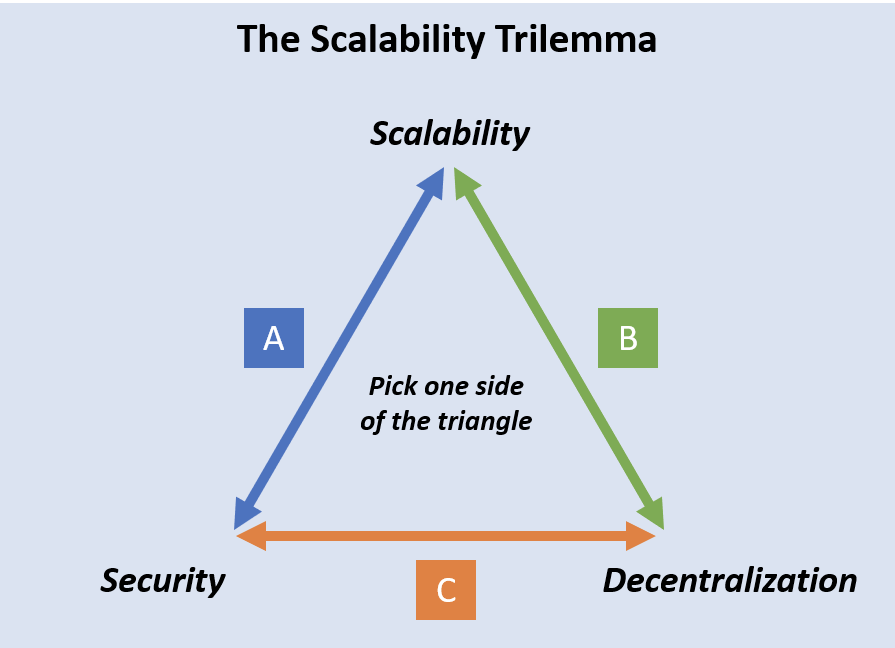
Blockchain Trilemma = The idea that a blockchain faces a tradeoff as it can only optimize for two out of three features:
• Scalability
• Decentralization
• Security
• Scalability
• Decentralization
• Security
1/3 - Scalability
"The ability to increase the number of transactions being processed (throughput), without increasing the cost of those transactions".
Throughput can be increased in two ways.
"The ability to increase the number of transactions being processed (throughput), without increasing the cost of those transactions".
Throughput can be increased in two ways.
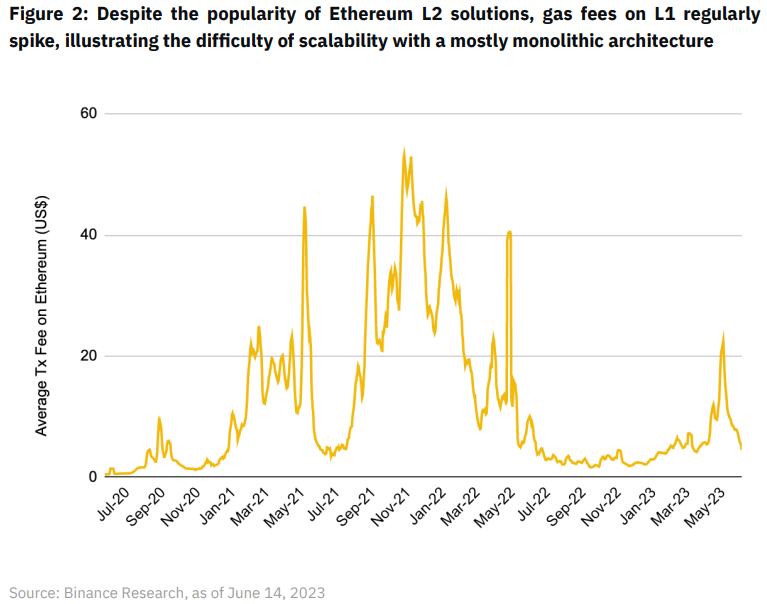
1.) Increasing block sizes (number of tx into each block).
However, this will require better hardware, increasing the costs of running a node and thus harming decentralization.
2.) The second method would be a modular approach, moving the execution onto other chains.
However, this will require better hardware, increasing the costs of running a node and thus harming decentralization.
2.) The second method would be a modular approach, moving the execution onto other chains.

We have seen this solution within the Ethereum ecosystem, where L2 solutions like Optimism and Arbitrum execute transactions and then verify them on the L1.
This is essentially the “modularization” of Ethereum.
This is essentially the “modularization” of Ethereum.
2/3 - Decentralization
"We can consider decentralization in the context of the hardware requirements for running a full node. The lower the hardware requirements, the more users will be encouraged to do so, thus furthering the decentralization of the network".
"We can consider decentralization in the context of the hardware requirements for running a full node. The lower the hardware requirements, the more users will be encouraged to do so, thus furthering the decentralization of the network".
Blockchains rely on two entities to perform.
Block producers - execute and bundle transactions.
Validators - verify the accuracy of each block.
Generally, monolithic blockchains use the same set of validators to perform BOTH functions.
(Less Decentralized)
Block producers - execute and bundle transactions.
Validators - verify the accuracy of each block.
Generally, monolithic blockchains use the same set of validators to perform BOTH functions.
(Less Decentralized)
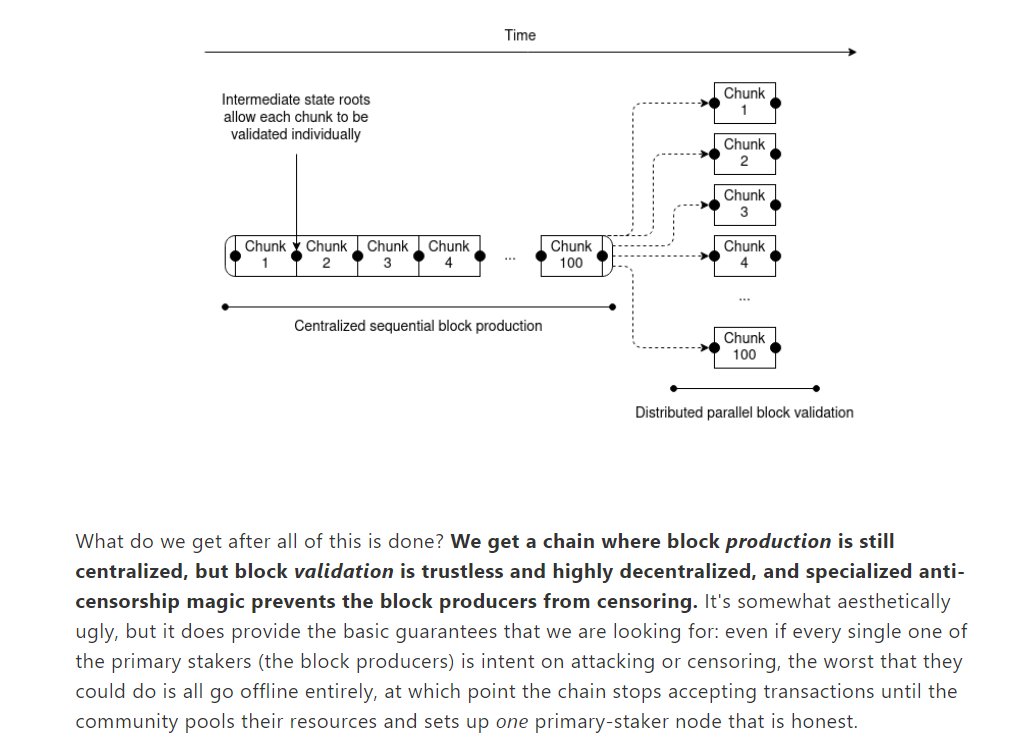
In a modular blockchain system, the execution layer will be responsible for block production, while a separate layer can be responsible for
verification.
Below is a piece of "Endgame", an article by Vitalik Buterin, discussing this topic.
verification.
Below is a piece of "Endgame", an article by Vitalik Buterin, discussing this topic.
3/3 - Security
We can consider blockchain security from two different perspectives:
• Consensus
• Validity
We can consider blockchain security from two different perspectives:
• Consensus
• Validity
Consensus
“Once a transaction is sent and included in a block, how costly is it to maliciously remove that transaction from the chain?”
In Pos or PoW networks, an attacker would have to gain control of a majority of hasing power/staked tokens (51%) to do such things.
“Once a transaction is sent and included in a block, how costly is it to maliciously remove that transaction from the chain?”
In Pos or PoW networks, an attacker would have to gain control of a majority of hasing power/staked tokens (51%) to do such things.
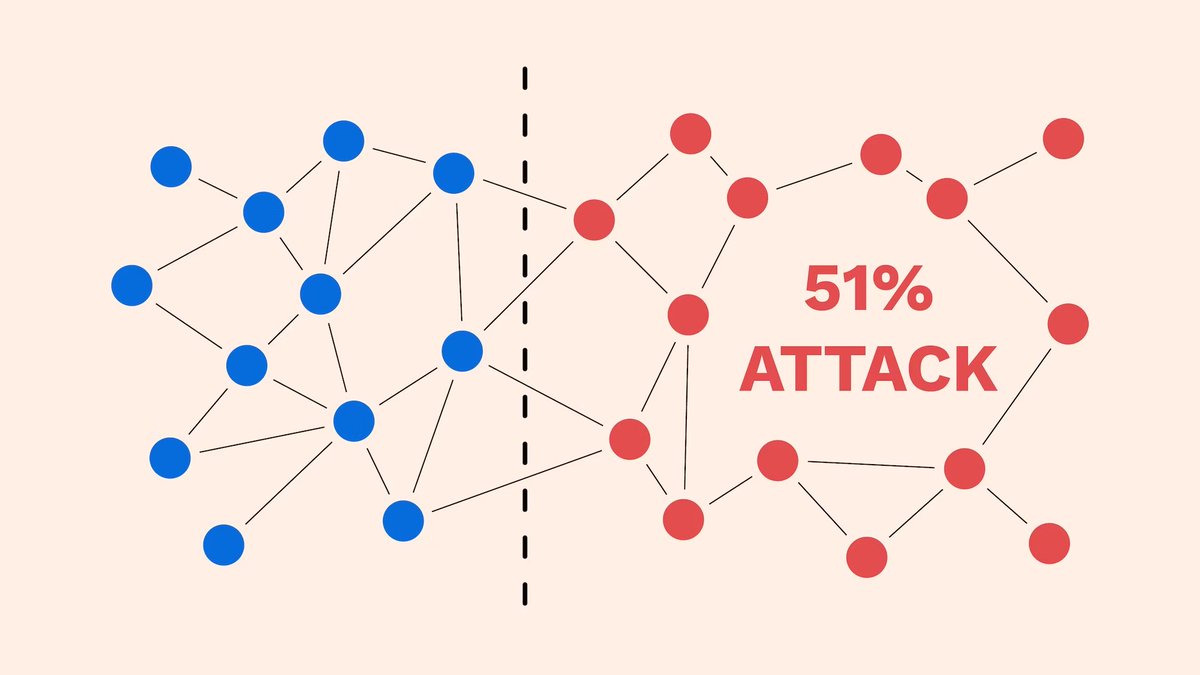
For PoS chains like Ethereum, the likelihood of this attack depends on the value of $ETH and the value staked on the network.
The greater the amount for both numbers, the more costly it is for someone to attempt an attack.
The greater the amount for both numbers, the more costly it is for someone to attempt an attack.
Validity
This type of security is concerned with the rules set out in a blockchain and whether any given block is valid according to those
rules.
Validity security is independent of consensus security or token value and depends on people running full nodes.
This type of security is concerned with the rules set out in a blockchain and whether any given block is valid according to those
rules.
Validity security is independent of consensus security or token value and depends on people running full nodes.
In this case, the more participants run a full node, the better the validity security.
A modular approach, which divides the roles of block producers and verifiers, would ensure a sufficient level of verifiers to keep a decentralised and secure chain.
A modular approach, which divides the roles of block producers and verifiers, would ensure a sufficient level of verifiers to keep a decentralised and secure chain.
The overall point to take away from this is that a modular approach can target all three key factors within the Blockchain Trilemma and might provide a more customizable solution optimized for both developers and users.
Where do Layer-2 rollups fit into this?
L2 are significantly cheaper than Ethereum L1 to conduct activity on.
Consequently, they can attract users and developers onto their platform.
L2 are significantly cheaper than Ethereum L1 to conduct activity on.
Consequently, they can attract users and developers onto their platform.
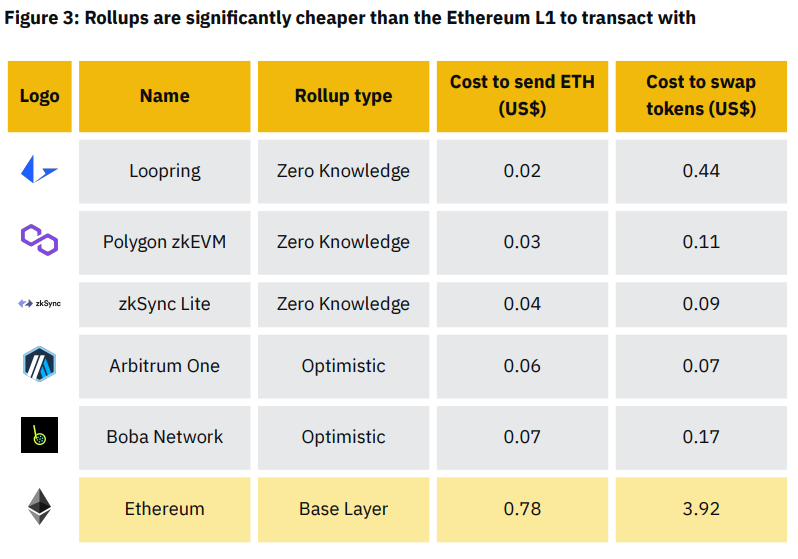
L2 perform transaction execution outside of the L1 and then post the data on the L1, where consensus and settlement occur.
In this way, they benefit from the security of Ethereum as an attacker would need to gain majority control of Ethereum to remove transactions maliciously.
In this way, they benefit from the security of Ethereum as an attacker would need to gain majority control of Ethereum to remove transactions maliciously.
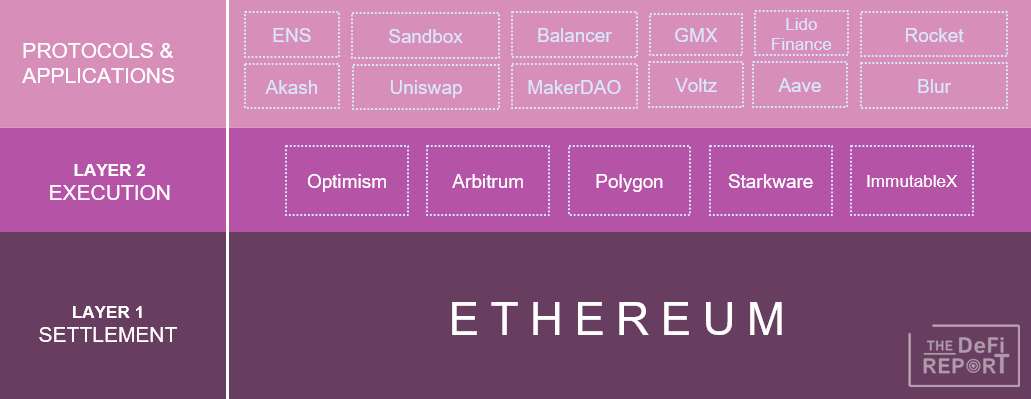
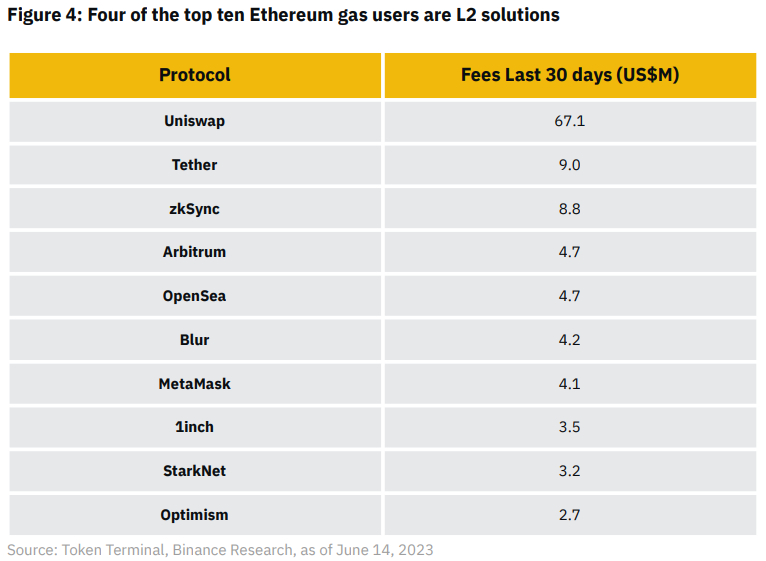
The main take from this is that posting transaction data to the Ethereum L1 incurs a cost, which we can refer to as publishing fees.
In this way, Ethereum has created a new revenue source.
Rollups are secured by Ethereum's security, and they pay fees for this privilege.
In this way, Ethereum has created a new revenue source.
Rollups are secured by Ethereum's security, and they pay fees for this privilege.
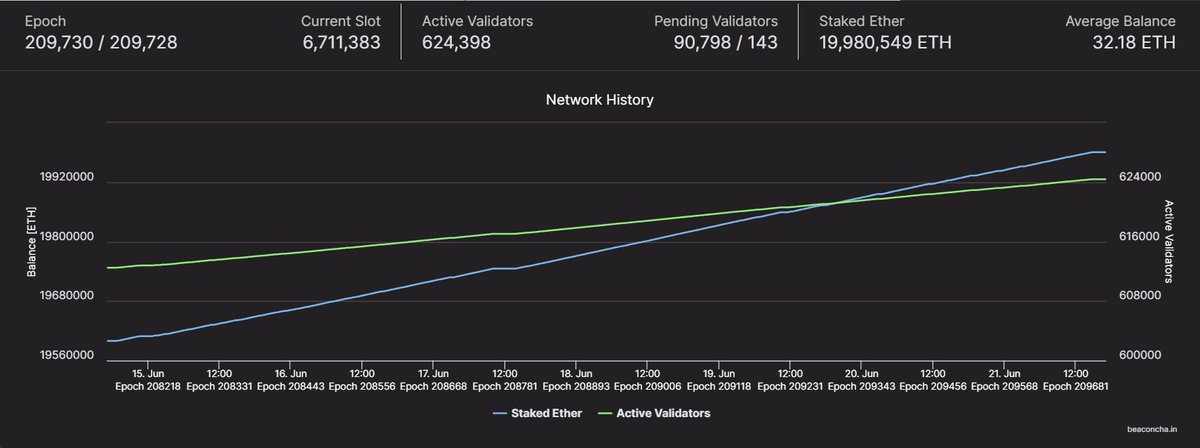
Ethereum boasts the highest security budget of all PoS chains, with over 19M $ETH staked, amounting to $34B+ of value securing the chain.
An attacker would have to control at least $17B to gain control of the chain.
An attacker would have to control at least $17B to gain control of the chain.
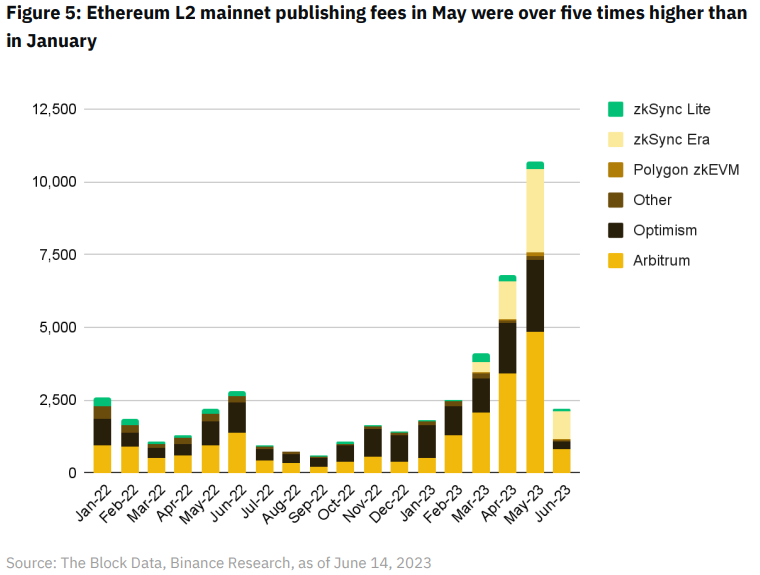
This high security allowed L2 rollups to grow exponentially in the last months.
In fact, mainnet publishing fees have been rising this year, and fees reached an all-time high in May.
In fact, mainnet publishing fees have been rising this year, and fees reached an all-time high in May.
Selling security to other applications can be a meaningful value accrual and revenue generation mechanism for L1s.
A different but similar method of borrowing Ethereum's security has been trending lately.
Restaking.
Restaking seeks to solve fragmented blockchain security.
A different but similar method of borrowing Ethereum's security has been trending lately.
Restaking.
Restaking seeks to solve fragmented blockchain security.
Many projects, which don't need to issue a token, are forced to do it in order to establish their security mechanism, knowing they will never overcome Ethereum's security.
Restaking solves this by pooling Ethereum's security and making it available for everyone to utilize it.
Restaking solves this by pooling Ethereum's security and making it available for everyone to utilize it.
Here enters @eigenlayer
EigenLayer calls itself a “restaking collection for Ethereum” and aims to create a marketplace for decentralized trust.
It allows Ethereum stakers to repurpose their staked $ETH to secure other applications built on the network.
EigenLayer calls itself a “restaking collection for Ethereum” and aims to create a marketplace for decentralized trust.
It allows Ethereum stakers to repurpose their staked $ETH to secure other applications built on the network.
I'm writing a deep dive on EigenLayer and will post it tomorrow (June 22).
They just launched on mainnet after closing $64.5M of funds from Top-Tier VCs.
It will likely be one of the biggest protocols in the next bull run.
They just launched on mainnet after closing $64.5M of funds from Top-Tier VCs.
It will likely be one of the biggest protocols in the next bull run.

Three other projects aim to provide a similar solution to EigenLayer that is worth mentioning.
• @Neutron_org
• @osmosiszone
• @babylon_chain
• @Neutron_org
• @osmosiszone
• @babylon_chain
Closing Thoughts
The launch and success of Ethereum L2s have shown two main things:
• The modular approach is the way to go for the future.
• Selling security can become a top revenue source for L1s.
What's the main take from this?
The launch and success of Ethereum L2s have shown two main things:
• The modular approach is the way to go for the future.
• Selling security can become a top revenue source for L1s.
What's the main take from this?
The largest blockchains will be the most difficult to attack and the fastest to grow.
Higher demand for a blockchain to provide security will increase the value of its native token, further drawing in validators to help maintain the network and get a share of its fees.
Higher demand for a blockchain to provide security will increase the value of its native token, further drawing in validators to help maintain the network and get a share of its fees.
Tagging some giga brains who might be interested
@Louround_
@CryptoKoryo
@IamZeroIka
@arndxt_xo
@rektdiomedes
@thehiddenmaze
@defi_mochi
@0xCrypto_doctor
@DeFi_Finest
@belizardd
@defiprincess_
@splinter0n
@Defi0xJeff
@nobrainflip
@francescoweb3
@Slappjakke
@the_smart_ape
@Louround_
@CryptoKoryo
@IamZeroIka
@arndxt_xo
@rektdiomedes
@thehiddenmaze
@defi_mochi
@0xCrypto_doctor
@DeFi_Finest
@belizardd
@defiprincess_
@splinter0n
@Defi0xJeff
@nobrainflip
@francescoweb3
@Slappjakke
@the_smart_ape
@WinterSoldierxz @0xSalazar @0xsurferboy @CryptoStreamHub @karl_0x @DefiIgnas @rektdiomedes @CryptoShiro_ @crypto_linn @ardizor @Defi_Maestro @LouisCooper_ @defi_mochi @crypthoem @TheDeFISaint @0xTindorr @DeFiMinty @0x_gremlin @wacy_time1 @leshka_eth That's a wrap!
If you enjoyed this thread:
1. Follow me @Moomsxxx for more of these
2. RT the tweet below to share this thread with your chads
If you enjoyed this thread:
1. Follow me @Moomsxxx for more of these
2. RT the tweet below to share this thread with your chads
Loading suggestions...