

The L2 wars are heating up.
Optimism → Superchains
Arbitrum → Arbitrum Orbit (L3)
zkSync → Hyperchains
StarkWare → Fractal Scaling
Polygon → Value Layer
Want to ride this trend?
Dive into the cutting-edge world of L2 developments in one thread.
🧵 1/
Optimism → Superchains
Arbitrum → Arbitrum Orbit (L3)
zkSync → Hyperchains
StarkWare → Fractal Scaling
Polygon → Value Layer
Want to ride this trend?
Dive into the cutting-edge world of L2 developments in one thread.
🧵 1/

The future of Ethereum scaling is expected to revolve around the development of L3s, Superchains, and Hyperchains.
Why? While Ethereum operates as an L1, it must be able to operate on the same scale as the Internet. Today, no single L2 chain possesses this capability.
🧵 2/
Why? While Ethereum operates as an L1, it must be able to operate on the same scale as the Internet. Today, no single L2 chain possesses this capability.
🧵 2/
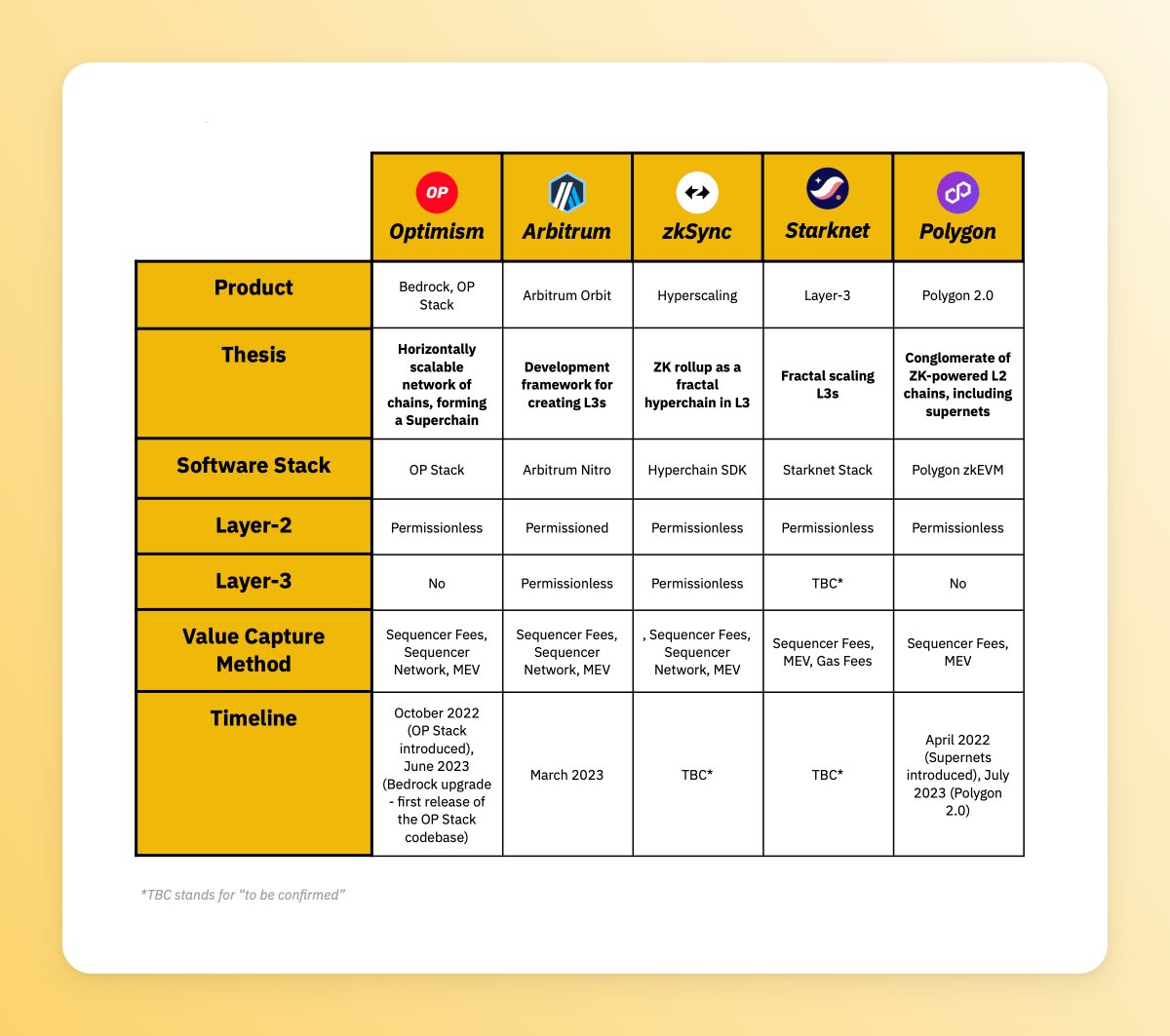
At a high level, Web3 devs currently have three options:
• Deploy on Ethereum, sacrificing scalability.
• Opt for an L2 solution, risking dependency on that specific ecosystem.
• Deploy and maintain their own chain, which could result in liquidity fragmentation.
🧵 3/
• Deploy on Ethereum, sacrificing scalability.
• Opt for an L2 solution, risking dependency on that specific ecosystem.
• Deploy and maintain their own chain, which could result in liquidity fragmentation.
🧵 3/
Moreover, achieving interoperability has presented a significant challenge.
Our efforts to tackle this challenge using cross-chain bridges have proven to be fragile and consistently targeted by malicious actors.
New challenges call for innovative solutions.
🧵 4/
Our efforts to tackle this challenge using cross-chain bridges have proven to be fragile and consistently targeted by malicious actors.
New challenges call for innovative solutions.
🧵 4/
The next wave of rollups, such as OP Chains on Optimism, L3s on Arbitrum Orbit, or hyperchains on zkSync, will empower various entities with different goals to create their own customized environments.
Think of it as deploying a new rollup chain = creating a new webpage.
🧵 5/
Think of it as deploying a new rollup chain = creating a new webpage.
🧵 5/
Let's take a closer look at the solutions provided by the core scaling actors.
🧵 6/
🧵 6/
OPTIMISM & OP STACK
In Oct 2022, @optimismFND introduced:
• OP Stack – a modular and open-source blueprint for creating scalable and interoperable blockchains of all types
• Superchain – a collection of tightly integrated and unified L2s built on top of the OP Stack.
🧵 7/
In Oct 2022, @optimismFND introduced:
• OP Stack – a modular and open-source blueprint for creating scalable and interoperable blockchains of all types
• Superchain – a collection of tightly integrated and unified L2s built on top of the OP Stack.
🧵 7/
In simplified terms, the OP Stack can be seen as a "build-an-L2" supermarket. It offers different layers (modules) that can be easily customized to meet the specific needs of a project.
By utilizing this approach, they can unlock the potential for a Superchain future.
🧵 8/
By utilizing this approach, they can unlock the potential for a Superchain future.
🧵 8/
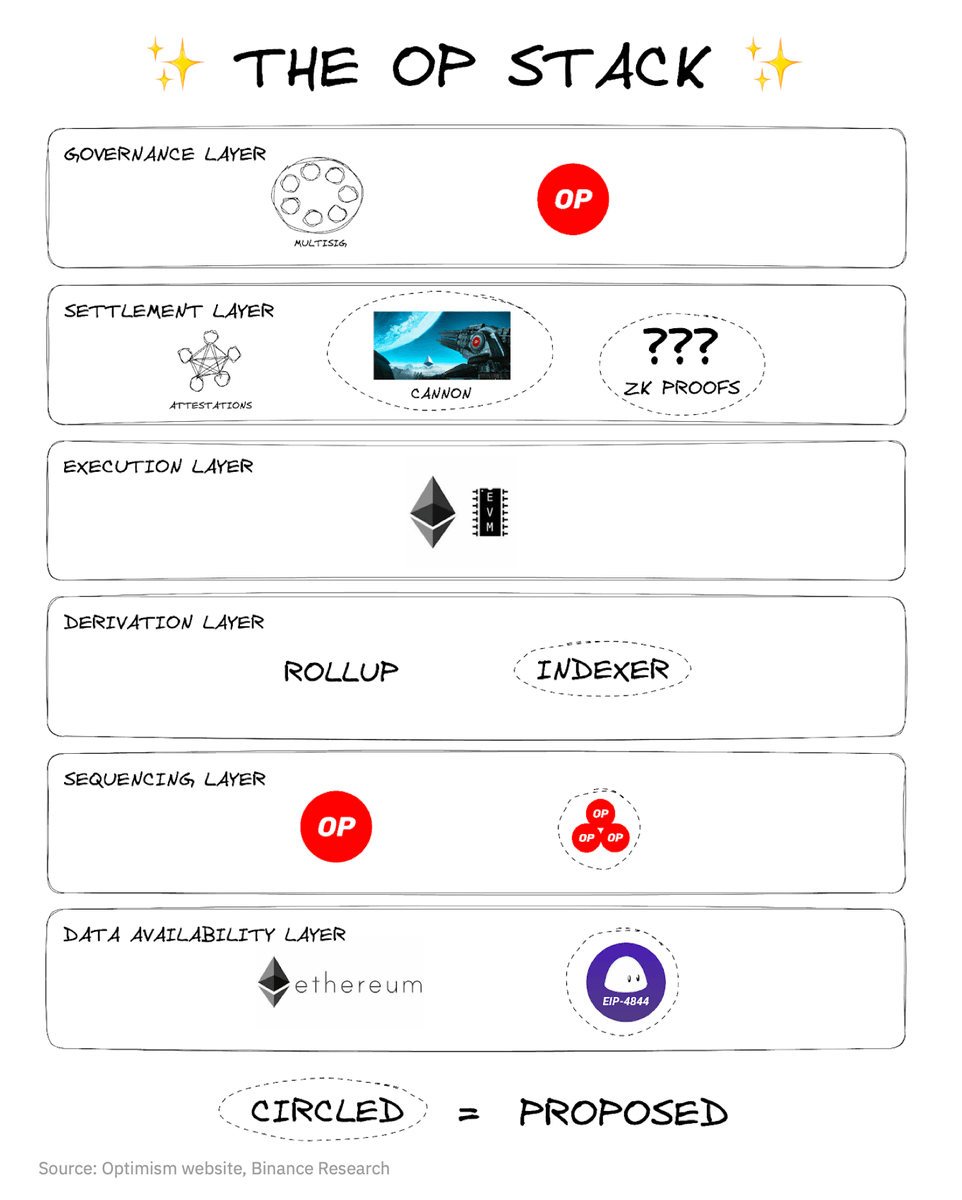
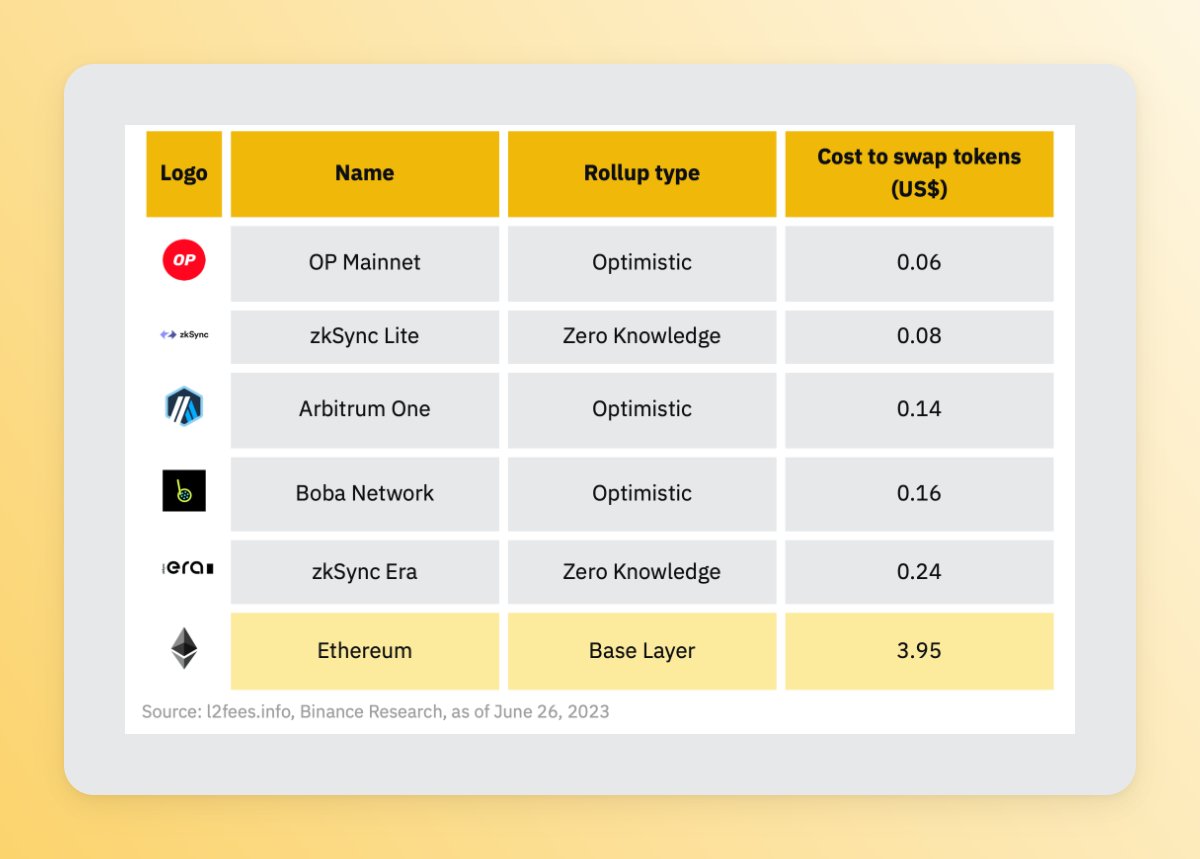
In early June, Optimism made an announcement about migrating their flagship L2 rollup to Bedrock.
This release represents the first official launch of the OP Stack, making the OP mainnet the most cost-effective Ethereum L2 rollup for token swapping.
🧵 9/
This release represents the first official launch of the OP Stack, making the OP mainnet the most cost-effective Ethereum L2 rollup for token swapping.
🧵 9/
In addition, Bedrock offers the following benefits:
• Reduces deposit time from 10 min to 3 min.
• Enhances proof modularity by supporting both fault proofs and ZK-proofs.
• Enables the execution of multiple transactions within a single rollup "block".
🧵 10/
• Reduces deposit time from 10 min to 3 min.
• Enhances proof modularity by supporting both fault proofs and ZK-proofs.
• Enables the execution of multiple transactions within a single rollup "block".
🧵 10/
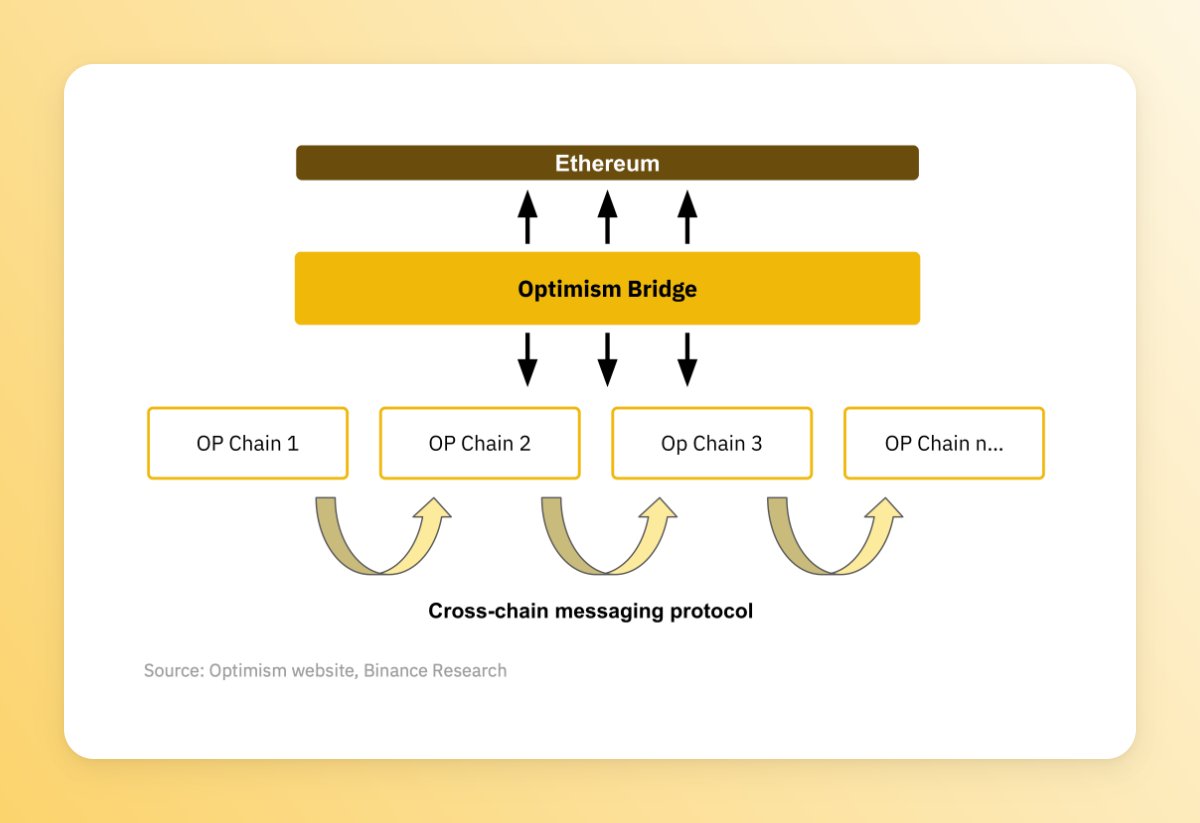
Following the Bedrock upgrade, Optimism's next step is to transition to the Superchain.
The Superchain is a decentralized network composed of L2s (OP Chains) that will share security, a communication layer, and an open-source technology stack (OP Stack).
🧵 11/
The Superchain is a decentralized network composed of L2s (OP Chains) that will share security, a communication layer, and an open-source technology stack (OP Stack).
🧵 11/
What's next?
The alpha part starts here.
• Optimism's L2 rollup chain - the 1st member of the Superchain.
• Coinbase's upcoming Base L2 - the 2nd member, with a mainnet announcement expected this year.
• @worldcoin has also committed to building on the OP Stack.
🧵 12/
The alpha part starts here.
• Optimism's L2 rollup chain - the 1st member of the Superchain.
• Coinbase's upcoming Base L2 - the 2nd member, with a mainnet announcement expected this year.
• @worldcoin has also committed to building on the OP Stack.
🧵 12/
• @aevoxyz, a decentralized options exchange, has recently launched its OP Stack-based rollup in collaboration with @conduitxyz.
• opBNB on the BNB Chain also utilizes the OP Stack.
• The Zora Network, developed by @ourZORA, is an L2 solution built on the OP Stack.
🧵 13/
• opBNB on the BNB Chain also utilizes the OP Stack.
• The Zora Network, developed by @ourZORA, is an L2 solution built on the OP Stack.
🧵 13/
ARBITRUM ORBIT
@arbitrum currently holds the title of the largest and most dominant L2 network in terms of TVL, with an impressive total of over $5.9B. To put this into perspective, Arbitrum commands a market share of over 60%.
🧵 14/
@arbitrum currently holds the title of the largest and most dominant L2 network in terms of TVL, with an impressive total of over $5.9B. To put this into perspective, Arbitrum commands a market share of over 60%.
🧵 14/
Arbitrum offers 4 core products:
1. Arbitrum One: This is the first and mainnet rollup of the Arbitrum ecosystem.
2. Arbitrum Nova: An AnyTrust solution, designed for projects with cost-sensitive and high transaction volume expectations.
🧵 15/
1. Arbitrum One: This is the first and mainnet rollup of the Arbitrum ecosystem.
2. Arbitrum Nova: An AnyTrust solution, designed for projects with cost-sensitive and high transaction volume expectations.
🧵 15/
3. Arbitrum Nitro: This technical software stack powers Arbitrum L2, making the rollup faster, cheaper, and more EVM-compatible.
4. Arbitrum Orbit: This development framework allows for the creation and deployment of L3s on top of the Arbitrum mainnet.
🧵 16/
4. Arbitrum Orbit: This development framework allows for the creation and deployment of L3s on top of the Arbitrum mainnet.
🧵 16/
L3 rollups, also known as app-chains, play a crucial role in settling transactions to Arbitrum's chains. They are fundamental to the next phase of Arbitrum's scaling journey and serve as the solution to realizing their vision.
🧵 17/
🧵 17/
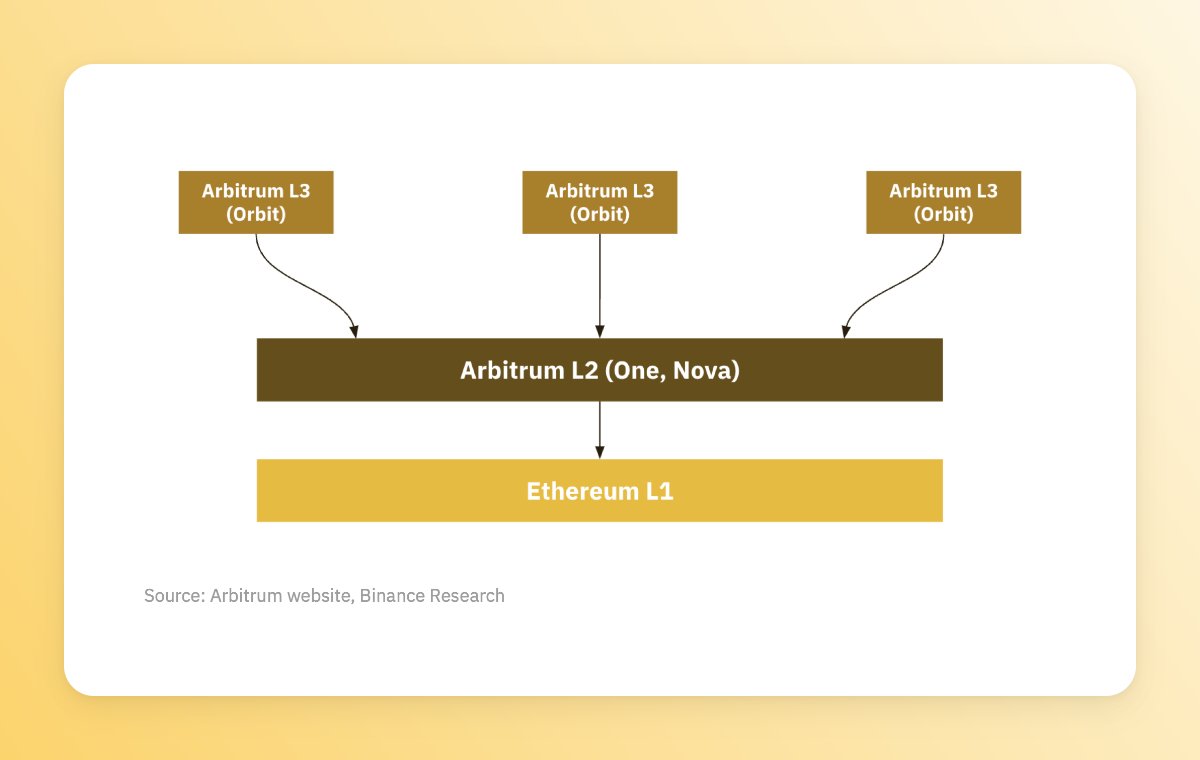
Arbitrum places great emphasis on customizability.
Orbit is designed to be compatible with the upcoming Arbitrum Stylus upgrade. This compatibility opens up possibilities for devs to build dApps using C, C++, and Rust and expands the versatility and reach of Arbitrum.
🧵 18/
Orbit is designed to be compatible with the upcoming Arbitrum Stylus upgrade. This compatibility opens up possibilities for devs to build dApps using C, C++, and Rust and expands the versatility and reach of Arbitrum.
🧵 18/
ZKSYNC & HYPERCHAINS
Now, let's move on to zkSync and its vision of the future of Ethereum scaling.
Hyperchains are zkSync’s vision of an L3, conceived as an extensive ecosystem of trustless and customizable linked blockchains.
🧵 19/
Now, let's move on to zkSync and its vision of the future of Ethereum scaling.
Hyperchains are zkSync’s vision of an L3, conceived as an extensive ecosystem of trustless and customizable linked blockchains.
🧵 19/

To put it simply, hyperchains refer to independent ZK-chains on Ethereum.
These chains are interconnected through a network of customizable and fully trustless hyper-bridges. This approach helps overcome vulnerabilities typically associated with non-native bridges.
🧵 20/
These chains are interconnected through a network of customizable and fully trustless hyper-bridges. This approach helps overcome vulnerabilities typically associated with non-native bridges.
🧵 20/
STARKWARE & FRACTAL SCALING
In theory, the system could have an infinite number of hyperchains to represent its entirety. This is where @StarkWareLtd comes in as a pioneer in the concept of fractal scaling.
🧵 21/
In theory, the system could have an infinite number of hyperchains to represent its entirety. This is where @StarkWareLtd comes in as a pioneer in the concept of fractal scaling.
🧵 21/
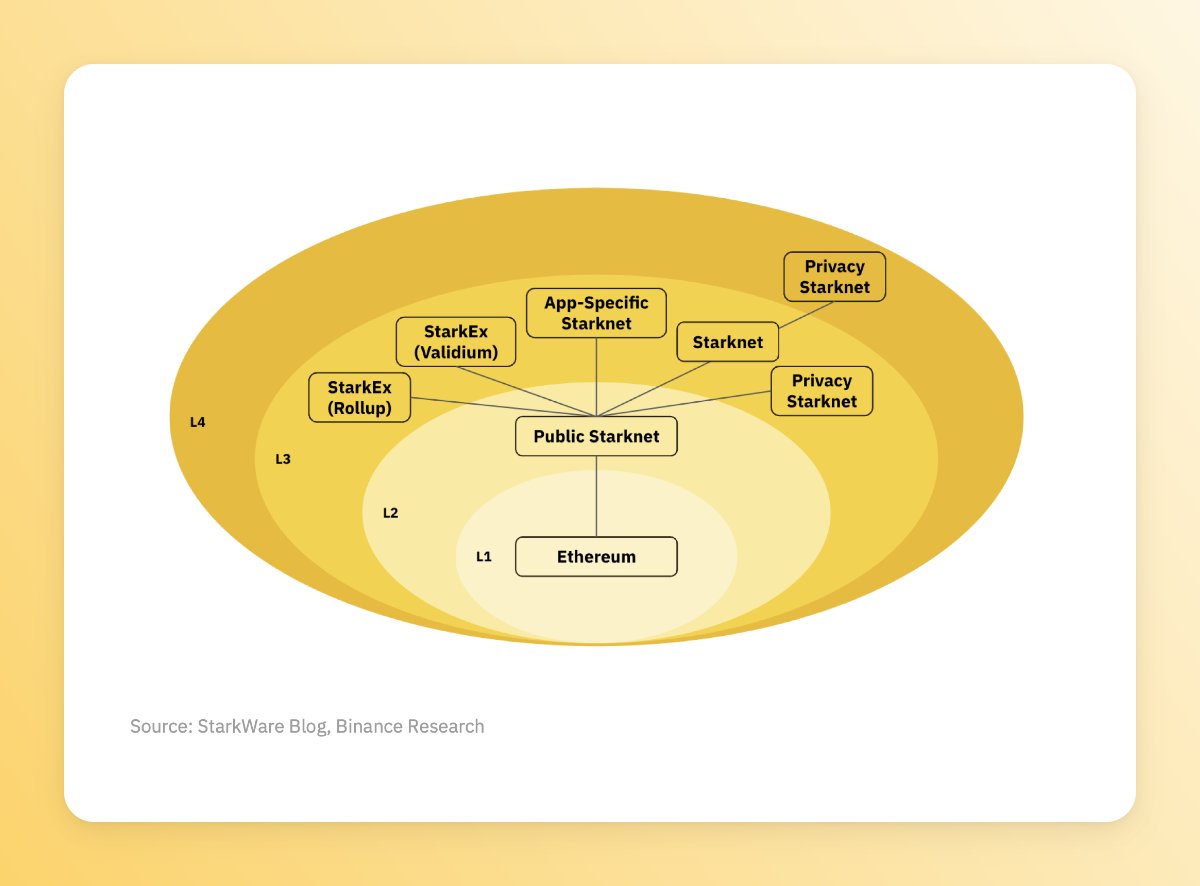
In summary, StarkWare's multi-layer network thesis proposes that L2s are designed for general-purpose scaling, while L3 should be utilized for customized scaling.
However, StarkWare has not made any further announcements beyond the initial publication of this thesis.
🧵 22/
However, StarkWare has not made any further announcements beyond the initial publication of this thesis.
🧵 22/
POLYGON 2.0
Polygon’s latest announcement about the next phase of their L2 journey was released during the early part of June. Polygon 2.0 was announced with the vision of creating the “Value Layer of the Internet”.
🧵 23/
Polygon’s latest announcement about the next phase of their L2 journey was released during the early part of June. Polygon 2.0 was announced with the vision of creating the “Value Layer of the Internet”.
🧵 23/
This solution aims to enhance interoperability among Polygon zkEVM, PoS, and Supernets through a series of upgrades.
By combining zero-knowledge technology with their existing PoS mechanism, Polygon seeks to strengthen security and privacy.
🧵 24/
By combining zero-knowledge technology with their existing PoS mechanism, Polygon seeks to strengthen security and privacy.
🧵 24/
In Polygon 2.0, they aim to combine the strengths of both technologies.
A recent announcement from the Polygon team reveals their plan to transition Polygon PoS to a zkEVM validium by the end of Q1 2024.
polygon.technology
🧵 25/
A recent announcement from the Polygon team reveals their plan to transition Polygon PoS to a zkEVM validium by the end of Q1 2024.
polygon.technology
🧵 25/
This threads summarizes the deep L2 research by @BinanceResearch written by Moulik Nagesh and Shivam Sharma. If you want to dive into the topic deeper, I recommend that you read the original paper ↓
research.binance.com
🧵 26/
research.binance.com
🧵 26/

The evolution of Ethereum scaling solutions is a topic worth closely monitoring in the coming months. I hope that my thread has helped you gain a better understanding of the subject.
If it did, pls show your support by following me, liking and RTing this thread <3
🧵 27/
If it did, pls show your support by following me, liking and RTing this thread <3
🧵 27/
Last but not least, I recommend that you follow the mega researchers below:
• @DefiIgnas
• @Hercules_Defi
• @0xSalazar
• @crypthoem
• @Louround_
• @poopmandefi
• @0xMughal
• @francescoweb3
• @Dynamo_Patrick
• @defi_mochi
• @0xsurferboy
• @redphonecrypto
<3
• @DefiIgnas
• @Hercules_Defi
• @0xSalazar
• @crypthoem
• @Louround_
• @poopmandefi
• @0xMughal
• @francescoweb3
• @Dynamo_Patrick
• @defi_mochi
• @0xsurferboy
• @redphonecrypto
<3
Thank you 😊
Loading suggestions...