

Secularity and Experience:🧵
Ref: Taylor, A Secular Age 📚
Secularity, as understood by Taylor, is of 3 kinds. In whatever sense or meaning secularity is defined here, it is in contrast to our past experience as human societies, where religion was of central importance.
Ref: Taylor, A Secular Age 📚
Secularity, as understood by Taylor, is of 3 kinds. In whatever sense or meaning secularity is defined here, it is in contrast to our past experience as human societies, where religion was of central importance.
1. In the first sense, it is in relation to the public sphere. In today's "secular age," religion has faded away from politics, economics, education, etc.
"They have been allegedly emptied of God or any reference to ultimate reality. Or taken from another side, as we function within various spheres of activity - economic, political, cultural, educational, professional, recreational - the norms and principles we follow,...

...the deliberations we engage in, generally, don't refer us to God or to any religious beliefs;" (p.2)
This secular age is new & contrary to our past, where societies used to be completely religious (opposite of secularity in the first sense i.e. religion was present in public).
This secular age is new & contrary to our past, where societies used to be completely religious (opposite of secularity in the first sense i.e. religion was present in public).
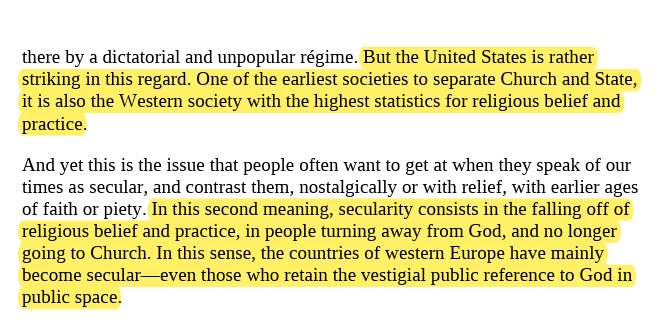
2. In the second sense, secularity means the decline in the belief in God or any supernatural power.
"In this second meaning, secularity consists in the falling off of religious belief and practice, in people turning away from God," (p.2)
"In this second meaning, secularity consists in the falling off of religious belief and practice, in people turning away from God," (p.2)
3. In the 3rd sense, secularity refers to the age of "plurality," the age where:
i) religion has become a choice,
ii) and it is not central to our life or worldview
This, again, is totally contrary to our past, where religion & religious understanding of the world was central.
i) religion has become a choice,
ii) and it is not central to our life or worldview
This, again, is totally contrary to our past, where religion & religious understanding of the world was central.
"The shift to secularity in this sense consists, among other things, of a move from a society where belief in God is unchallenged and indeed, unproblematic, to one in which it is understood to be one option among others," (p.3)
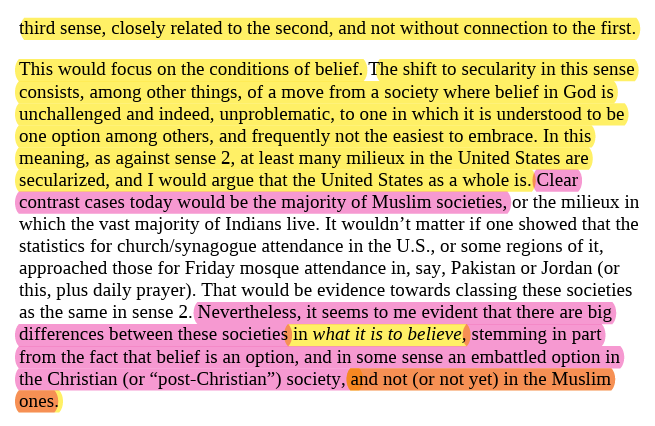
Secularity, in this sense, is the idea that being "a staunch believer in God is just another possibility," (p.3) as opposed to the pre-secular age where not believing in God was virtually impossible.
The Muslim world is still excluded from this "secular age," in the sense that I have described secularity. In a Muslim country, for example, you are still supposed to believe in Allah. The idea of considering this as a choice has still not grounded itself within the Muslim world.
EXPERIENCE:
Let's explore our human experience by focusing on the third sense of secularity.
Secularity in this sense is about the whole context of understanding in which our moral, spiritual, or religious experience search takes place. It is about belief/unbelief as experience.
Let's explore our human experience by focusing on the third sense of secularity.
Secularity in this sense is about the whole context of understanding in which our moral, spiritual, or religious experience search takes place. It is about belief/unbelief as experience.
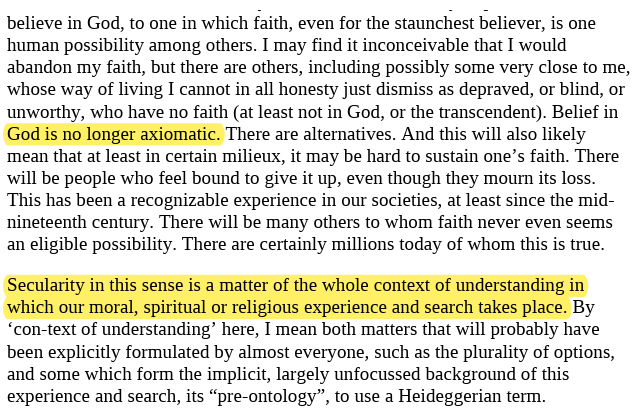
(see p. 5-12)
In order to explore this notion of belief and unbelief as lived experience (as opposed to mere concepts/theories), Taylor draws a structure of this moral/spritiual dimension or space.
"Somewhere is some activity, or condition, lies a fullness, a richness; that is,
In order to explore this notion of belief and unbelief as lived experience (as opposed to mere concepts/theories), Taylor draws a structure of this moral/spritiual dimension or space.
"Somewhere is some activity, or condition, lies a fullness, a richness; that is,
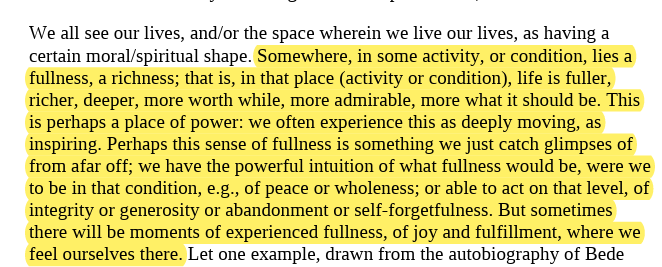
in that place, life is fuller, richer deeper, more worthwhile, more admirable, more what it should be." (p.5)
This experience of "fullness" is where we feel spiritually at home with who we are & what we do. We perceive reality outside of the ordinary that suddenly dawns upon us.
This experience of "fullness" is where we feel spiritually at home with who we are & what we do. We perceive reality outside of the ordinary that suddenly dawns upon us.
Sometimes we feel this sense of transcendence, rich in experience, when, for instance, we suddenly become aware of the singing of birds in the evening, the sunset, the utter silence of our minds, the shock and surprise of how this ordinary world can be so profound.
We feel as if another reality broke through the mundane life.
There are different ways of experiencing this fullness. However, they can be divided into two types.
1) Religious
2) Irreligious
There are different ways of experiencing this fullness. However, they can be divided into two types.
1) Religious
2) Irreligious
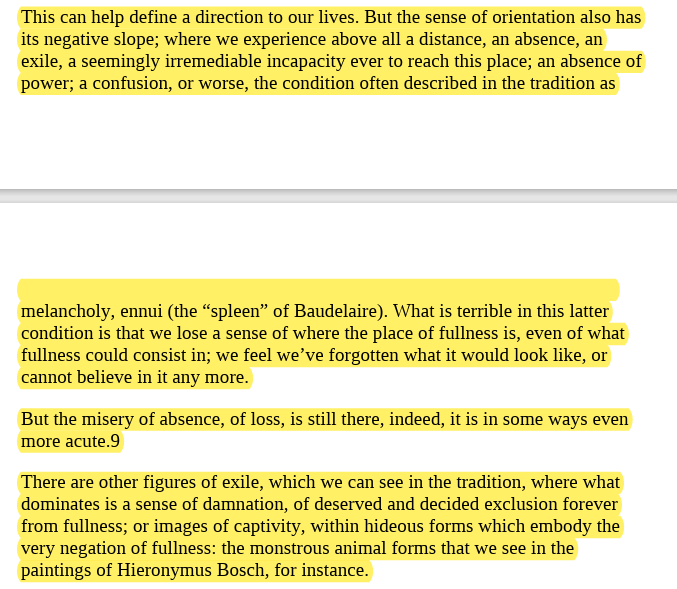
1)Religious:
The way a religious person navigates this moral/spiritual dimension is in the following order:
Fullness
------
Sense of abandonment
------
Middle Condition
-----
Exile/ennui/melancholy
The way a religious person navigates this moral/spiritual dimension is in the following order:
Fullness
------
Sense of abandonment
------
Middle Condition
-----
Exile/ennui/melancholy
I already briefly describe what or how fullness feels like. The rest of the states of being, if you will, are in a way states that are distant from the state of fullness.
The sense of abandonment and loss refers to the state where one cannot experience fullness.
The sense of abandonment and loss refers to the state where one cannot experience fullness.
It seems as if he has lost the way.
The middle condition is between the fullness and the state of exile or "ennui".
This is where most people will find themselves in. It is a state where we surround ourselves with a certain routine, a structure of our lives that keeps us away
The middle condition is between the fullness and the state of exile or "ennui".
This is where most people will find themselves in. It is a state where we surround ourselves with a certain routine, a structure of our lives that keeps us away
this state of exile and melancholy, and at the same time it is in constant contact with the state of fullness. Oftentimes, we reach this state of fullness through the daily routine that we have set for ourselves.
For instance, talking to your daughter, hugging your parents,
For instance, talking to your daughter, hugging your parents,
taking care of someone you love, being charitable, etc.
The state that Taylor calls melancholy or ennui or this feeling of exile is where we are completely detached from the sense of wholeness, richness and fullness.
We feel in a crisis. We can't centralize our energies.
The state that Taylor calls melancholy or ennui or this feeling of exile is where we are completely detached from the sense of wholeness, richness and fullness.
We feel in a crisis. We can't centralize our energies.
Loading suggestions...