

“Islam was thus central to the tolerationist debate in England in the late 17th century (...) it was generally understood that force was not used by Muslims and that they allowed Xians within their domains. This understanding was correct: in Smyrna in the second half of the 17th
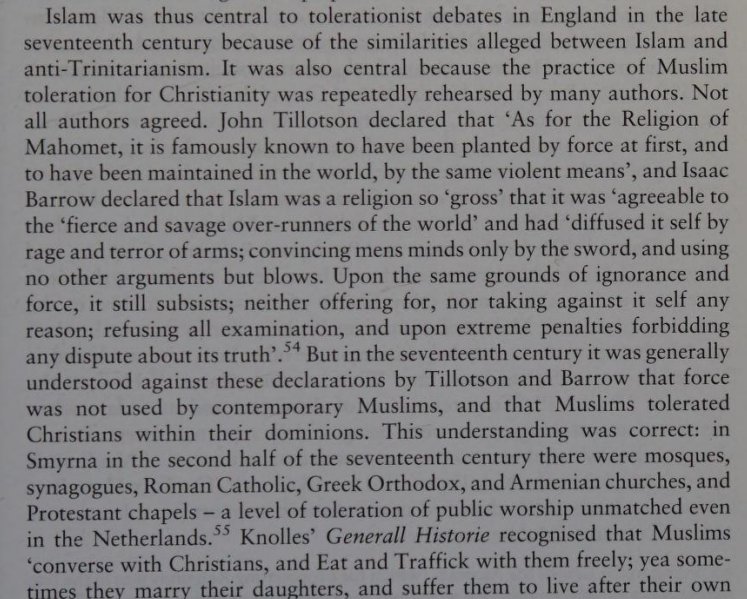
century, there were mosques, synagogues, Roman Catholic, Greek Orthodox, and Armenian churches, and Protestant chapels—a level of toleration of public worship unmatched even in the Netherlands." (p. 393)
Edward Kellet noted that converts to Islam from Christianity yielded to allurement and not to violence. Blount noted that ‘the Turke puts none to death for Religion’. George Sandys says that “they compel no man.”[..]
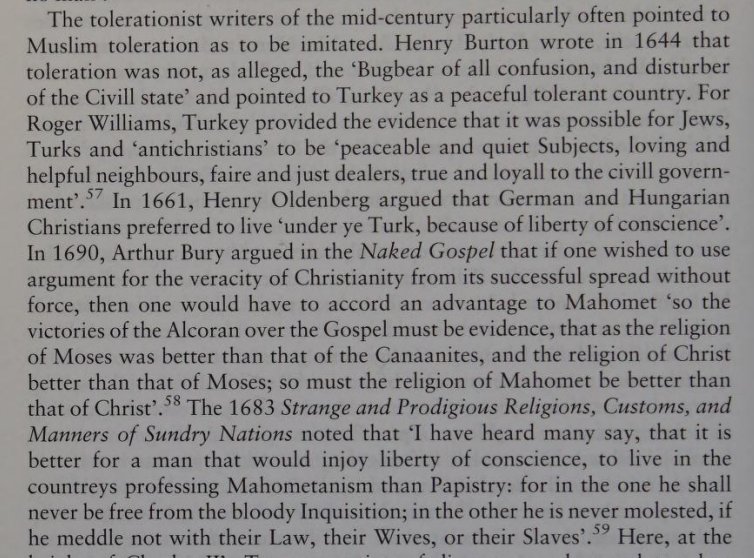
The tolerationists of the mid-century particularly often pointed to Muslim toleration as to be “imitated”. Henry Burton wrote in 1644 [..] pointed to Turkey as a peaceful, tolerant country. For Roger Williams, Turkey provided the evidence that it is possible for Jews, Turks,
and ‘antichristians’ to be “peaceable and quiet Subjects, loving and helpful neighbours, fair and just dealers, true and loyal to the civil governments.”In 1661, Henry Oldenberg argues that German and Hungarian Christians preferred to live “under ye Turks for liberty and
conscience.”[..] The Tory Heraclitus Ridens in March 1681 identified nonconformist support for toleration as that of “Protestant Mahometans” who, according to the law of Alcoran [Quran], are zealous for Toleration of all Jews, Turks, pagans, and Infidels: If they have but a
conscience, it is no matter what colour or size it is. It must have Liberty.” (p. 394)
John Marshall “John Locke, Toleration and Early Enlightenment Culture” [p. 393-4]
![John Marshall “John Locke, Toleration and Early Enlightenment Culture” [p. 393-4] https://t.co/pmtCF...](https://pbs.twimg.com/media/Fz4crXSagAUGQ8g.jpg)
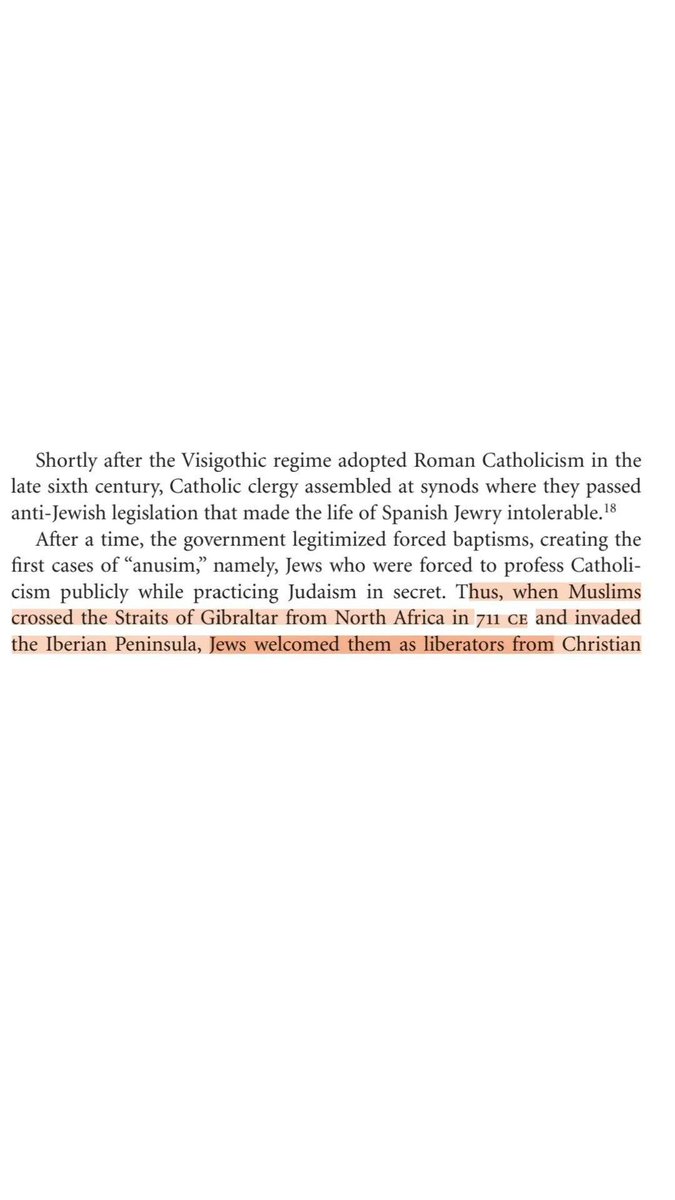
When Muslims invaded their neighbouring empires, Jews welcomed Muslims as their liberators in Spain as well as in Egypt and Syria. (Zion)

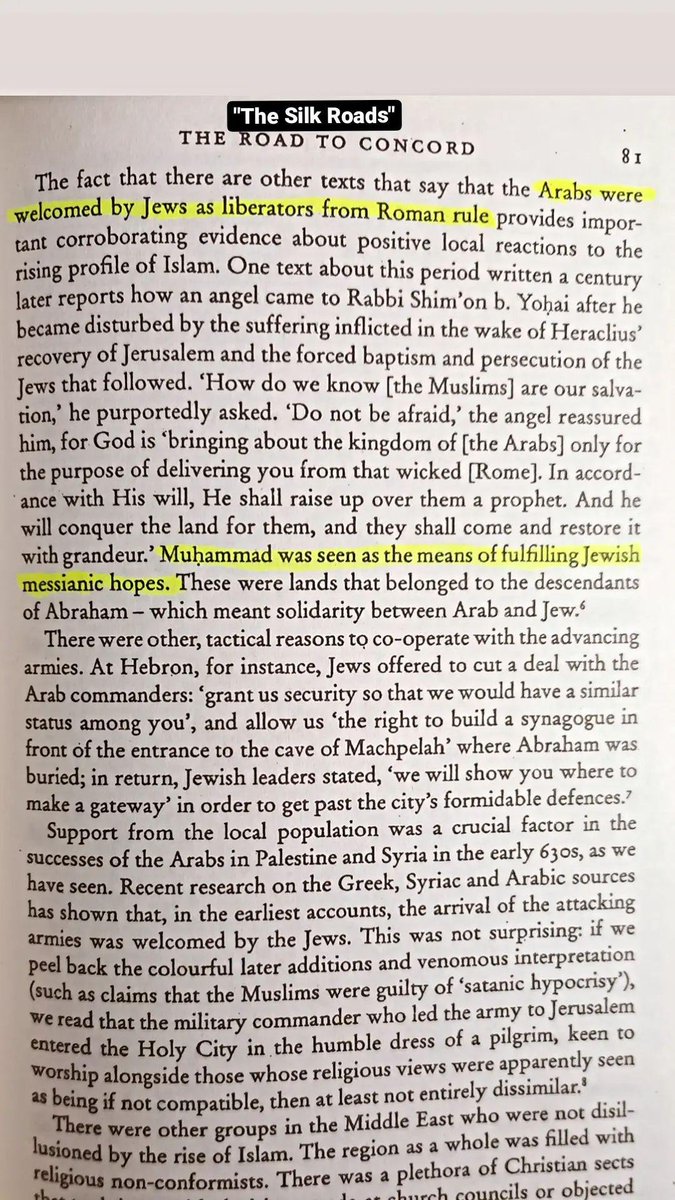
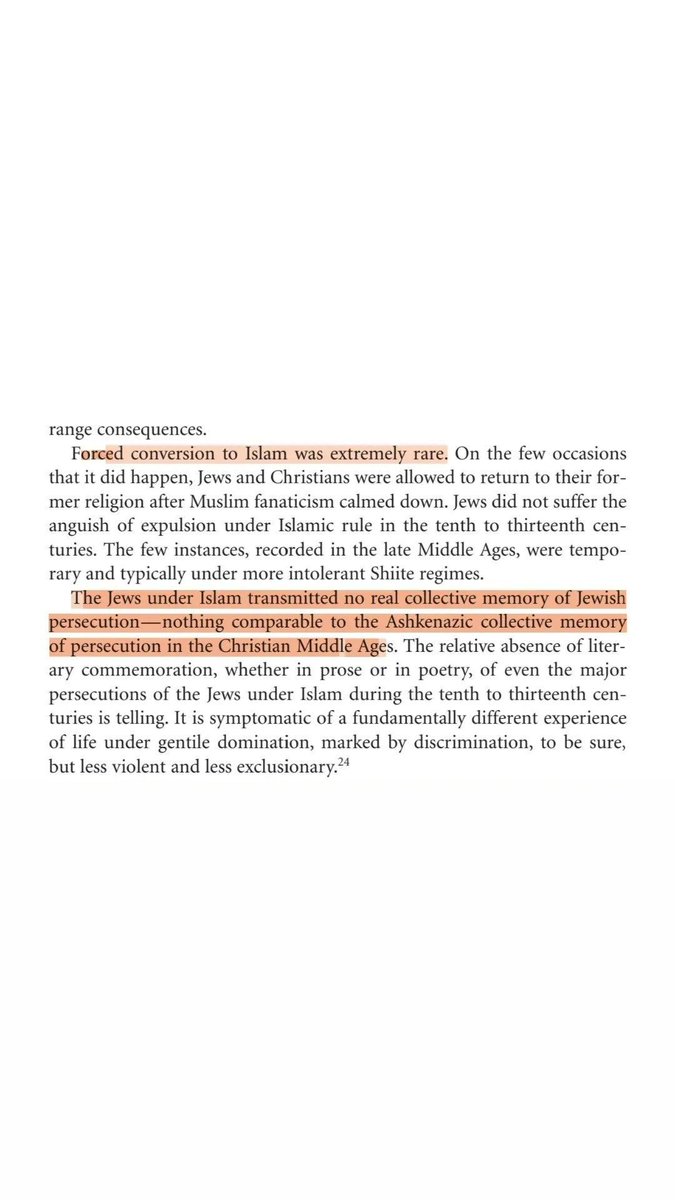
"Forced conversion was extremely rare." (Cohen)
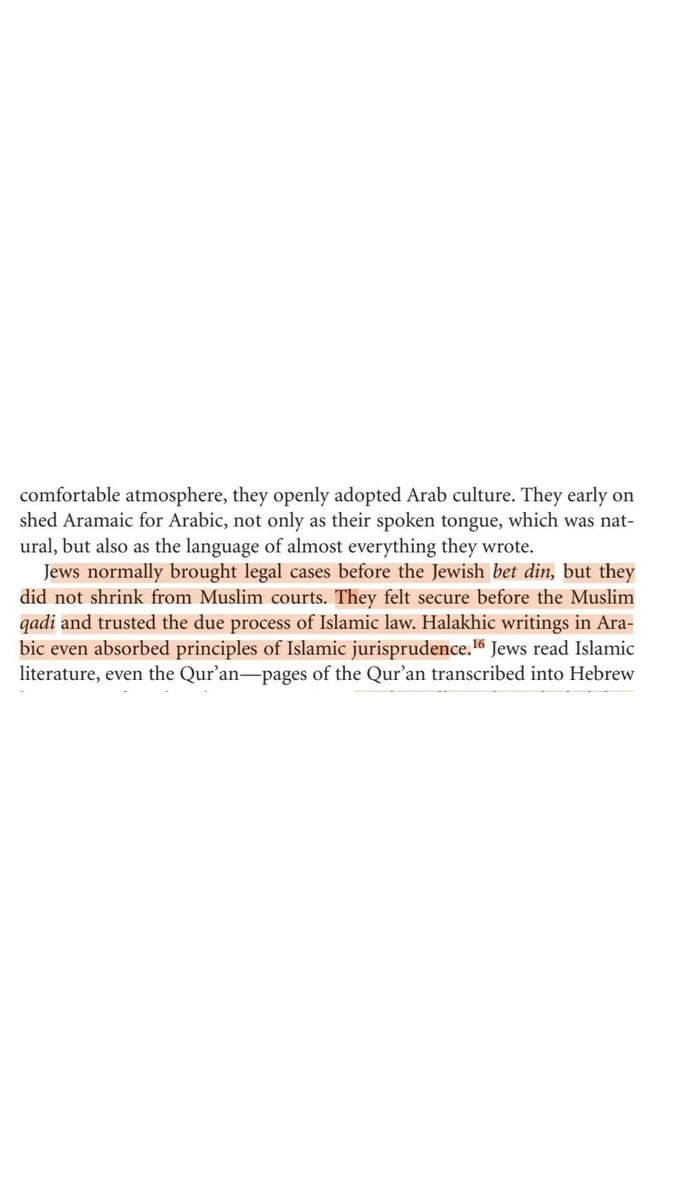
Jews had their own court system in the Islamic Caliphate (bet din) they were also not afraid to go to Islamic courts to get justice. (In Andalusia). (Cohen)
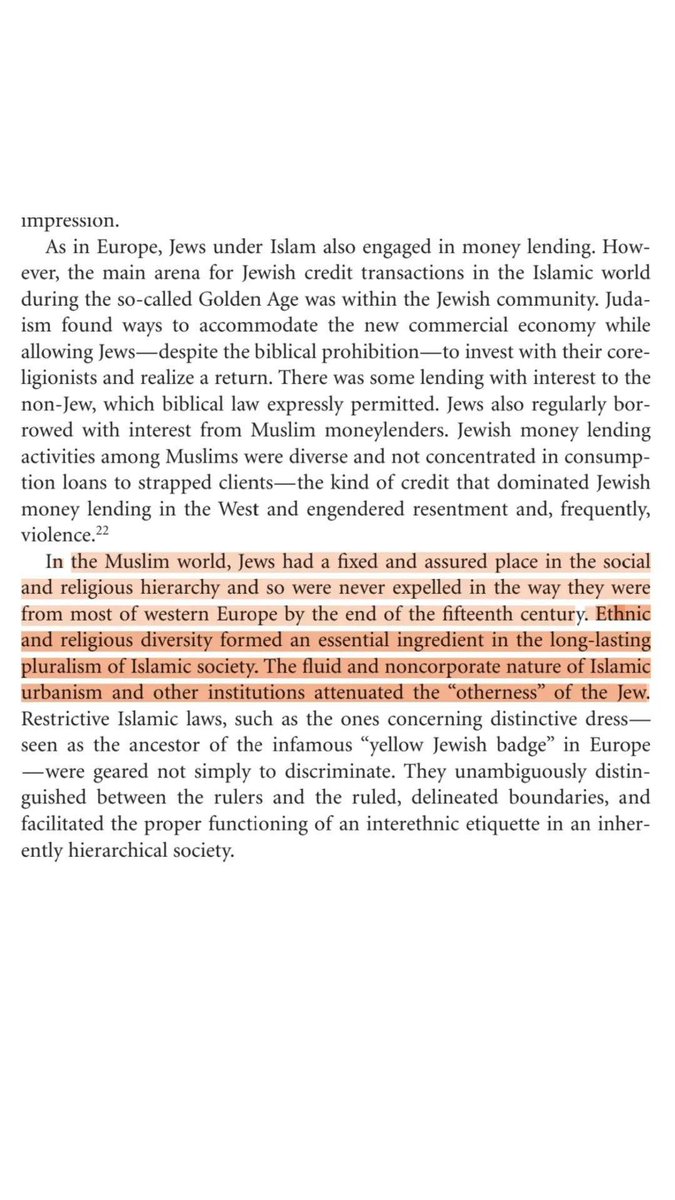
"Ethnic and religious diversity formed an essential ingredient in the long-lasting pluralism of Islamic society." (Cohen)
Reference:
Sephardic and Mizrahi Jewry, (introduction [Zohar], ch.2 [Cohen] are quoted above)
The authors deny the utopian image of Andalusia but argue that it was far better than any place for Jews in the Middle Ages.
Sephardic and Mizrahi Jewry, (introduction [Zohar], ch.2 [Cohen] are quoted above)
The authors deny the utopian image of Andalusia but argue that it was far better than any place for Jews in the Middle Ages.
![Reference:
Sephardic and Mizrahi Jewry, (introduction [Zohar], ch.2 [Cohen] are quoted above)
The a...](https://pbs.twimg.com/media/Fz4cvQyaAAELN8B.jpg)
Loading suggestions...