

To become a better macro investor it's important to understand the crucial role the US Dollar plays in our monetary system.
Once you understand that, it also becomes clear that an orderly de-dollarization is just a fairytale.
Let's see why.
1/
Once you understand that, it also becomes clear that an orderly de-dollarization is just a fairytale.
Let's see why.
1/
In a globalized economic system you want to trade with as many partners as possible in a seamless way.
When Brazil exports its commodities to China or Japan and the trade happens in USD, Brazil accumulates US Dollars.
2/
When Brazil exports its commodities to China or Japan and the trade happens in USD, Brazil accumulates US Dollars.
2/
In other words, today the US Dollar is the Global (Reserve) Currency of choice: over 80% of global FX transactions and 50%+ of global trades and payments happen in US Dollar.
More importantly, in the last 30 years competitors could not alter this massive USD dominance: why?
3/
More importantly, in the last 30 years competitors could not alter this massive USD dominance: why?
3/

Well, it’s because being the US Dollar seems fun and an ''exorbitant privilege'' from the outside.
But fulfilling the role of Global Reserve Currency ain’t easy.
Let’s start from the asset side.
4/
But fulfilling the role of Global Reserve Currency ain’t easy.
Let’s start from the asset side.
4/
When Brazil exports commodities in USD more than spends USD to import stuff from the outside, the country accumulates USD foreign exchange reserves.
These USDs enter the domestic banking system, and ultimately the local Central Bank is responsible...
5/
These USDs enter the domestic banking system, and ultimately the local Central Bank is responsible...
5/
...for managing this FX reserve buffer – that means keeping these US Dollars safe and liquid.
In our monetary system, keeping money ‘’safe and liquid’’ means avoiding credit risk and investing in deep and liquid markets that guarantee a painless turnover if necessary.
7/
In our monetary system, keeping money ‘’safe and liquid’’ means avoiding credit risk and investing in deep and liquid markets that guarantee a painless turnover if necessary.
7/
The US Treasury market stands out as the global leader in this field: as big as 20+ trillion in size, liquid and underpinned by a deep repo ecosystem it ticks all boxes.
No capital controls, democratic roots and the rule of law reinforce the case.
8/
No capital controls, democratic roots and the rule of law reinforce the case.
8/
Most importantly, an ample supply of US Treasuries (read: deficits) provide to the rest of the world what they need: a safe and liquid asset where to recycle the USD proceeds from their global trades.
As global trades increase, the world needs more Treasuries.
9/
As global trades increase, the world needs more Treasuries.
9/
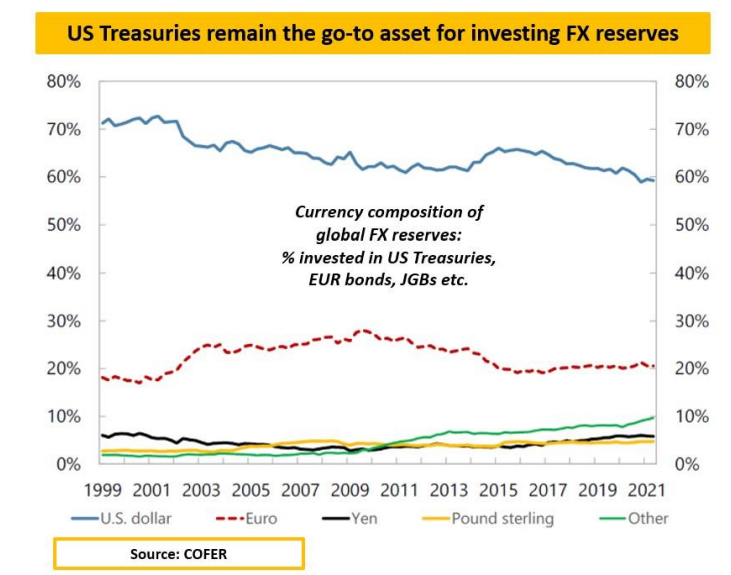
What's the potential alternative to the USD and Treasuries?
Japan?
Its government bond market is 60%+ absorbed by the BoJ, and there have been multiple days in a row (!) where no trade happened in the JGBs – how can you store your FX reserves in such an illiquid market?
10/
Japan?
Its government bond market is 60%+ absorbed by the BoJ, and there have been multiple days in a row (!) where no trade happened in the JGBs – how can you store your FX reserves in such an illiquid market?
10/
Europe?
With such a fragile monetary but non-fiscal union, and the only AAA countries potentially able to provide the world with safe collateral (German Bunds) instead sticking to austerity for decades?
11/
With such a fragile monetary but non-fiscal union, and the only AAA countries potentially able to provide the world with safe collateral (German Bunds) instead sticking to austerity for decades?
11/
China? Brazil? Russia?
You are facing a combination of capital controls (China), lack of democracy/rule of law (Russia), corruption and frequent episodes of double-digit inflation (Brazil)...
12/
You are facing a combination of capital controls (China), lack of democracy/rule of law (Russia), corruption and frequent episodes of double-digit inflation (Brazil)...
12/
...do you want to take these risks when storing your hard-earned FX reserves accumulated from selling your goods and services abroad?
The truth is that US Treasuries don’t have a valid competitor as a global vehicle where to invest FX reserves.
13/
The truth is that US Treasuries don’t have a valid competitor as a global vehicle where to invest FX reserves.
13/
Being the USD is not easy: you must provide an ever growing and liquid asset where foreign currency can recycle their FX reserves!
And this is also true for the other side of the coin: debt.
Foreign countries will want to borrow in your currency, too.
14/
And this is also true for the other side of the coin: debt.
Foreign countries will want to borrow in your currency, too.
14/
USD-denominated foreign debt is huge, and it makes an orderly De-Dollarization not more than a fairytale
Entities outside the US have accumulated $12 trn of USD-denominated debt: this is because to finance global businesses that sell stuff in USD…well, you need USD debt
15/
Entities outside the US have accumulated $12 trn of USD-denominated debt: this is because to finance global businesses that sell stuff in USD…well, you need USD debt
15/
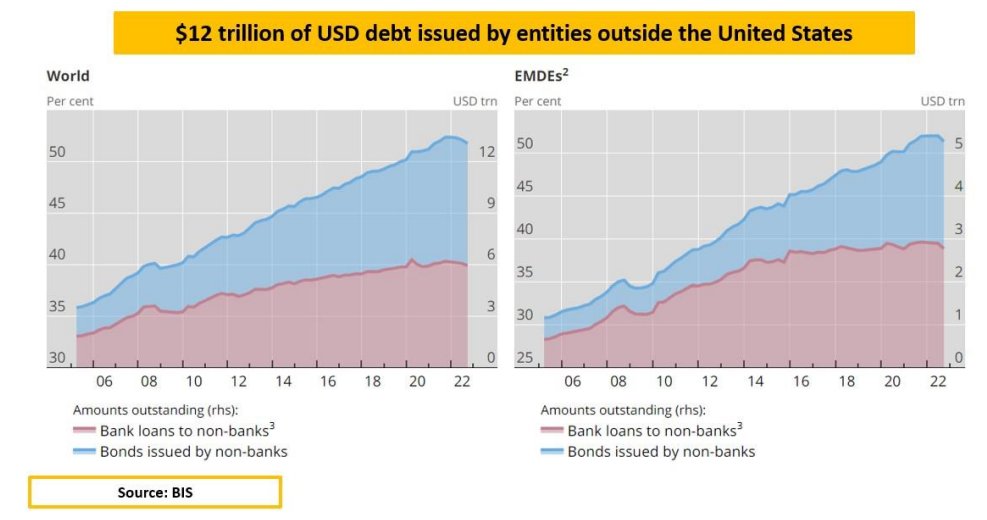
I can’t stress how important it is to understand this concept: if you want to break this system and ‘’De-Dollarize’’, you need to deleverage a $12 trillion debt system.
Let's say Brazil wants to walk away from the USD global system tomorrow.
16/
Let's say Brazil wants to walk away from the USD global system tomorrow.
16/
Brazil walking away from USD-denominated trades would hamper its organic inflows of USD, & Brazilian corporates would be choked under USD scarcity as they need to repay and refinance their USD debt
If they don't sell stuff in USD, where are they getting their Dollars from?
17/
If they don't sell stuff in USD, where are they getting their Dollars from?
17/
You see, when you de-leverage a debt-based system you are either bidding up the debt denominator (the USD) or you are witnessing tectonic geopolitical events (e.g. wars) where the world order is at stake.
In the case above, either Brazilian corporates would be forced to...
18/
In the case above, either Brazilian corporates would be forced to...
18/
...bid for cash USD to try and keep up with servicing their Dollar debt or they would have to default on it hence losing any credibility and access to international credit markets!
An orderly unwind of the US Dollar is a fairytale.
19/
An orderly unwind of the US Dollar is a fairytale.
19/
A true de-dollarization of our system can and will happen over time, but it won't be orderly. I
t will come with tectonic geopolitical events and the transition to another system will be very painful.
This is why you keep hearing about it, but it never happens.
20/
t will come with tectonic geopolitical events and the transition to another system will be very painful.
This is why you keep hearing about it, but it never happens.
20/
If you are an institutional investor and want to get access to my research and exclusive live BBG chat with me, feel free to DM here or ping me there (Alfonso Peccatiello)
21/
21/

Loading suggestions...