

The High Ticket eCom niche selection framework that you can use to pick niches that can scale to over $100,000/month in the next 16 weeks.
Here's how it works....
// THREAD // 🧵
Here's how it works....
// THREAD // 🧵
The high-ticket eCom model is deceptively simple.
1. Set up a nice store.
2. Market research on niches
3. Close high-end suppliers
4. Onboard suppliers
5. Run low-funnel ads to high-end suppliers
6. Build a team
7. Focus on SEO/CRO
8. Scale - ie. automate 3-6
1. Set up a nice store.
2. Market research on niches
3. Close high-end suppliers
4. Onboard suppliers
5. Run low-funnel ads to high-end suppliers
6. Build a team
7. Focus on SEO/CRO
8. Scale - ie. automate 3-6
Every business is like a machine.
Every part feeds into the next.
If one element breaks down, it affects the entire structure.
Every part feeds into the next.
If one element breaks down, it affects the entire structure.
If followed correctly, I’m convinced over time, you could have a successful store in nearly any niche.
But picking an excellent niche will make your life 100x easier.
So….how do you choose a niche?
But picking an excellent niche will make your life 100x easier.
So….how do you choose a niche?
Simple....
You sell people what they are already looking to buy.
How do you know what people are looking to buy?
Follow this process:
You sell people what they are already looking to buy.
How do you know what people are looking to buy?
Follow this process:
// STEP 1: Brainstorm potential product types over $1,000.
Don’t be picky.
Think of anything:
3D printers, canoes, music festival equipment, and watch cases.
Anything works; the more unique, the better.
Don’t be picky.
Think of anything:
3D printers, canoes, music festival equipment, and watch cases.
Anything works; the more unique, the better.
// STEP 2: Now, your job is to build your store around a specific AVATAR.
For example - if you had “canoes” on your list.
Visualize, in detail, who your ideal customer would be.
For example - if you had “canoes” on your list.
Visualize, in detail, who your ideal customer would be.
I’m thinking of a:
👉 35-65-year-old
👉 Male
👉 Does not live in big cities,
👉 Top 50% of income bracket
👉 Loves the outdoors
👉 Lots of free time.
Now, ask yourself what other products this avatar may like:
👉 35-65-year-old
👉 Male
👉 Does not live in big cities,
👉 Top 50% of income bracket
👉 Loves the outdoors
👉 Lots of free time.
Now, ask yourself what other products this avatar may like:
Here's my list:
👉 Kayaks
👉 Camping gear
👉 Boat trailers
👉 Paddle boat
👉 Gun cases
👉 Rock climbing equipment
👉 Survival gear
You want to find 10+ products for this avatar.
👉 Kayaks
👉 Camping gear
👉 Boat trailers
👉 Paddle boat
👉 Gun cases
👉 Rock climbing equipment
👉 Survival gear
You want to find 10+ products for this avatar.
Now you have your avatar-focused store.
An Outdoor store - like Bass Pro Shops, but online.
An Outdoor store - like Bass Pro Shops, but online.
This next step is essential:
Remember the 8 part framework I laid out above?
If you get the niche wrong at the start, it clogs up the rest.
Remember the 8 part framework I laid out above?
If you get the niche wrong at the start, it clogs up the rest.
// STEP 3: Keyword Research
Go to a keyword research tool like Ahrefs, Semrush, or Moz.
Some of these have free trials.
1. Go to the keyword section
2. Set location to the US
3. Analyze the # of search volume for each of your product types
4. Analyze the seasonality of each
Go to a keyword research tool like Ahrefs, Semrush, or Moz.
Some of these have free trials.
1. Go to the keyword section
2. Set location to the US
3. Analyze the # of search volume for each of your product types
4. Analyze the seasonality of each
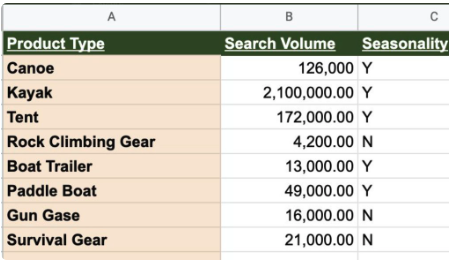
Ideally, we want to find 10+ product types with a search volume over 20,000-30,000/month.
Seasonality is not a concern.
Why?
If you notice over 50% of the items have seasonality, your job is to think of what your avatar wants in the opposite months.
Seasonality is not a concern.
Why?
If you notice over 50% of the items have seasonality, your job is to think of what your avatar wants in the opposite months.
For example - if canoes are seasonal in the summer, that’s fine.
What does your avatar want in the winter?
I’d guess snow shoes or snowmobile equipment.
Add those to the list.
What does your avatar want in the winter?
I’d guess snow shoes or snowmobile equipment.
Add those to the list.
While these are also seasonal, they are inversely correlated with the summer items, therefore balancing each other out.
In conclusion - do not build a store around what YOU want.
In conclusion - do not build a store around what YOU want.
Instead, pick an avatar (ideally one with lots of $$), and build a store around what they want and are already searching for.
“But, why wouldn’t this person just buy on Amazon?”
Have you ever tried to contact a customer service rep on Amazon from the product page?
You haven't.
“But, why wouldn’t this person just buy on Amazon?”
Have you ever tried to contact a customer service rep on Amazon from the product page?
You haven't.
Your advantage is that your customer can speak directly to you/your team at a moment's notice.
You can give them all of the information that they need to make an informed buying decision.
You can give them all of the information that they need to make an informed buying decision.
// STEP 4: Find Suppliers
Now your job is to find suppliers in other stores similar to yours and compile them into a list.
👉 To do so
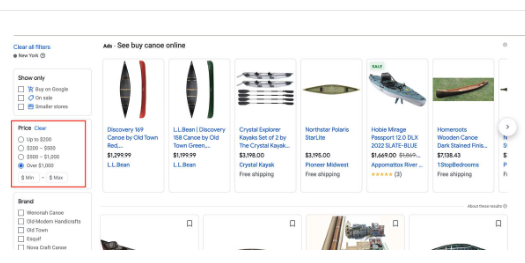
1. Type in "buy [product type]"
2. Go to Google Shopping.
3. Filter by product over $1,000
Now your job is to find suppliers in other stores similar to yours and compile them into a list.
👉 To do so
1. Type in "buy [product type]"
2. Go to Google Shopping.
3. Filter by product over $1,000
// STEP 5:
Next, we need to find high-ticket eCom stores that sell these products.
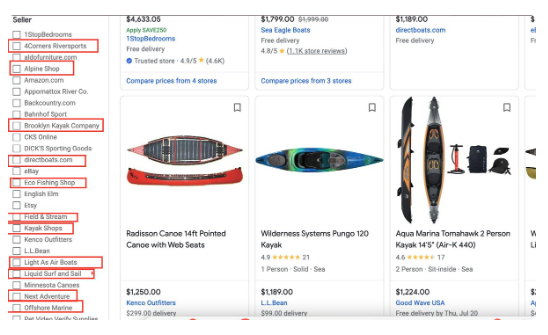
👉 Scroll to the bottom left of Google Shopping where "Sellers" are.
I can't describe how I "know" a store is a dropshipping store.
These would be my best guesses based on the names:
Next, we need to find high-ticket eCom stores that sell these products.
👉 Scroll to the bottom left of Google Shopping where "Sellers" are.
I can't describe how I "know" a store is a dropshipping store.
These would be my best guesses based on the names:
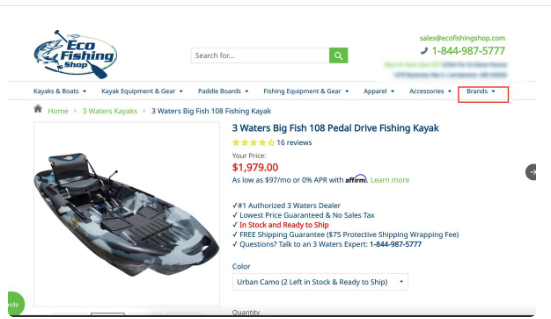
// STEP 6: Visit Competitors Stores
Go to these stores.
Find a tab that says "Vendors" or "Brands" in the top menu.
Now, put all of these brands into a spreadsheet (from all of the stores).
It should be hundreds of brands long.
Go to these stores.
Find a tab that says "Vendors" or "Brands" in the top menu.
Now, put all of these brands into a spreadsheet (from all of the stores).
It should be hundreds of brands long.
// STEP 7: Supplier Research
The character traits of a good supplier are as follows:
1. Enforce MAP:
2. Low Competition
3. Branded search Traffic
4. High quality products
Let's dive into each
The character traits of a good supplier are as follows:
1. Enforce MAP:
2. Low Competition
3. Branded search Traffic
4. High quality products
Let's dive into each
👉 Part 1. Minimum advertised price.
This saves your margin and prevents your competitors from undercutting you.
This removes the ability to compete on price.
This saves your margin and prevents your competitors from undercutting you.
This removes the ability to compete on price.
To check, go to Google Shopping and search for one of their products.
"[brand name] [product type they sell]
If they enforce MAP, when you press “Compare stores” at the bottom of the page, the pricing of items should look something like this.
"[brand name] [product type they sell]
If they enforce MAP, when you press “Compare stores” at the bottom of the page, the pricing of items should look something like this.
![To check, go to Google Shopping and search for one of their products.
"[brand name] [product type...](https://pbs.twimg.com/media/F1PZAw-XgAEp1Je.png)
👉 Part 2: Competition
On the same tab as above - count the # of stores selling that brands products.
- Under 10: non-competitive
- 10-30: Reasonably competitive
- Over 30: Extremely competitive
On the same tab as above - count the # of stores selling that brands products.
- Under 10: non-competitive
- 10-30: Reasonably competitive
- Over 30: Extremely competitive
🧐 Caveat
If there are 200 canoe brands in 150 canoe stores you may think it is competitive.
BUT
If 3 of those brands are only on 4 stores.
You can face almost 0 competition in an otherwise very competitive niche.
Your job is to find and close those 3 suppliers.
If there are 200 canoe brands in 150 canoe stores you may think it is competitive.
BUT
If 3 of those brands are only on 4 stores.
You can face almost 0 competition in an otherwise very competitive niche.
Your job is to find and close those 3 suppliers.
👉 Step 3: Branded Search Traffic
Next, go back to the keyword research tool and type in the BRAND name.
On your sheet, fill in the # searches per month for that brand.
More = better.
Best case: Under 10 stores selling AND high branded search volume
Next, go back to the keyword research tool and type in the BRAND name.
On your sheet, fill in the # searches per month for that brand.
More = better.
Best case: Under 10 stores selling AND high branded search volume
👉 Step 4: High-quality products
Search [brand name] [reviews] on Google.
Check out the reviews to make sure customers using the products are satisfied and they are of high quality.
What you sell will reflect on you/your brand, so choose your suppliers wisely.
Search [brand name] [reviews] on Google.
Check out the reviews to make sure customers using the products are satisfied and they are of high quality.
What you sell will reflect on you/your brand, so choose your suppliers wisely.
If you find a niche that meets all of the above criteria, you've got a solid foundation for a $1,000,000 store.
TO SUM UP 🧵
What is a good supplier?
1. Enforces MAP
2. Low competitoin
3. Branded search traffic
4. Excellent product reviews
What is a good supplier?
1. Enforces MAP
2. Low competitoin
3. Branded search traffic
4. Excellent product reviews
How to pick a niche 🎯
1. Brainstorm product ideas over $1,000.
2. Pick an avatar
3. Find 10+ product types for your specific avatar.
4. Find existing stores in the space
5. List their suppliers
6. Check if they meet certain the 4 criteria above.
1. Brainstorm product ideas over $1,000.
2. Pick an avatar
3. Find 10+ product types for your specific avatar.
4. Find existing stores in the space
5. List their suppliers
6. Check if they meet certain the 4 criteria above.
Now it's time for you to close them.
Then execute the remainder of the framework:
3. Close high-end suppliers
4. Onboard suppliers
5. Run low-funnel ads to high-end suppliers
6. Build a team
7. Focus on SEO/CRO
8. Scale - ie. automate 3-6
Then execute the remainder of the framework:
3. Close high-end suppliers
4. Onboard suppliers
5. Run low-funnel ads to high-end suppliers
6. Build a team
7. Focus on SEO/CRO
8. Scale - ie. automate 3-6
If you took ANY value from this tweet:
1. Like and retweet the first tweet to share with your audience.
2. Follow me @ecomwithbrook for more ecom related content.
1. Like and retweet the first tweet to share with your audience.
2. Follow me @ecomwithbrook for more ecom related content.
If you want to build a High Ticket eCom store working directly with me and my team....
Check it out if you want to build a store to over $10K/month profit - CLICK LINK IN MY BIO
Check it out if you want to build a store to over $10K/month profit - CLICK LINK IN MY BIO
Loading suggestions...