

It’s hard being a CEO.
Every decision impacts financial health, employee morale, and stakeholder satisfaction.
To succeed, you’ll need a good CFO.
And you’ll need to Master Strategic Management.
Every decision impacts financial health, employee morale, and stakeholder satisfaction.
To succeed, you’ll need a good CFO.
And you’ll need to Master Strategic Management.
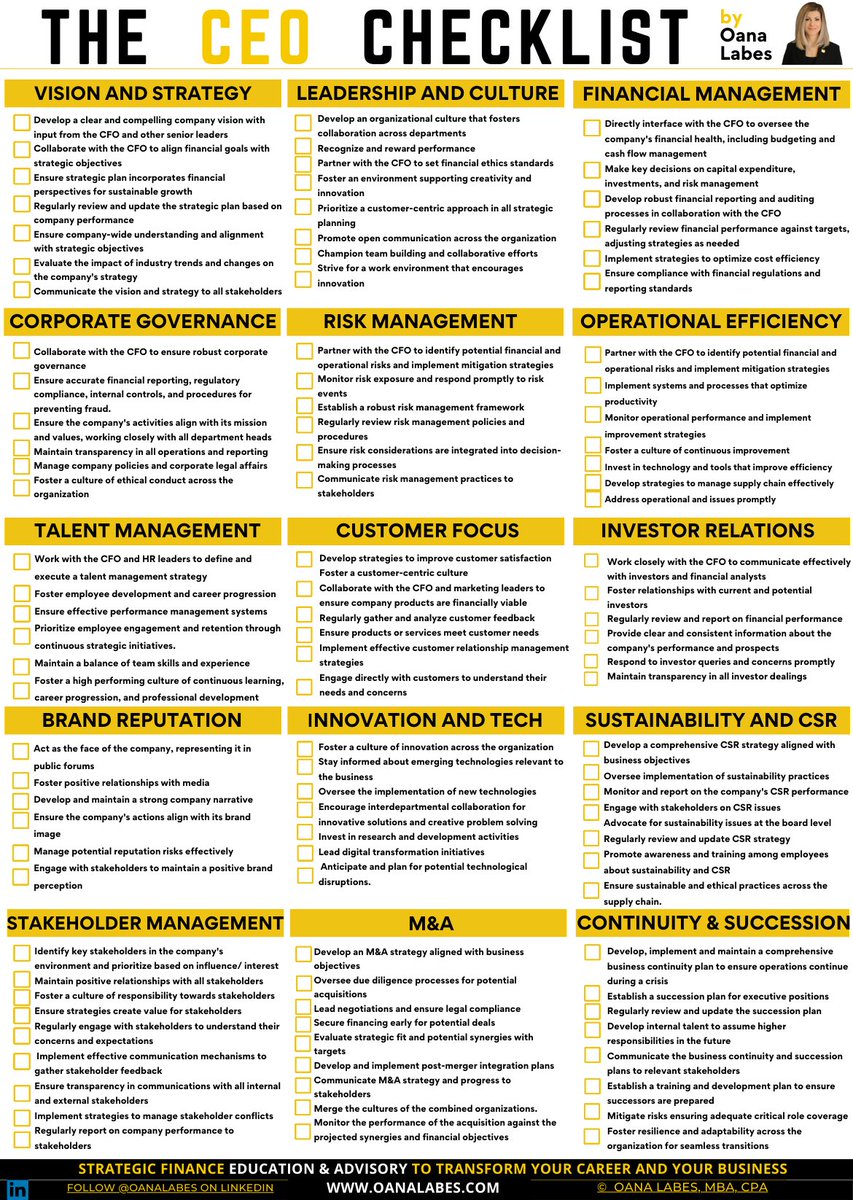
Here are 15 key areas that a CEO should focus on, to help you track your learning, your progress or your performance:
1.Vision and Strategy Development: map the company’s future, ensure alignment with strategic vision, and develop long-term goals and strategies to overcome challenges.
2.Leadership and Organizational Culture: create a positive and productive organizational culture, leading by example to inspire teams and uphold company values.
3.Financial Management: oversee the company's financial health
3.Financial Management: oversee the company's financial health
4. Corporate Governance: work with the board of directors to ensure adherence to the highest standards of governance, ethical conduct, and regulatory compliance
5.Risk Management: identify potential risks to the company and ensure it has systems in place to mitigate them
5.Risk Management: identify potential risks to the company and ensure it has systems in place to mitigate them
6. Operational Efficiency: streamline operations, improve productivity, and promote innovation
7. Talent Management: hire and develop key executives, ensuring the right people are in the right roles to effectively drive the strategic plan
7. Talent Management: hire and develop key executives, ensuring the right people are in the right roles to effectively drive the strategic plan
8. Customer Focus: foster a customer-centric approach across all department, to understand and meet customer needs
9. Investor Relations: maintain strong relationships with investors, shareholders, and financial analysts to secure capital, support growth, and maintain market confidence
10. Brand Reputation and Image: act as the face of the company, and ensure their actions reflect positively on the brand
11. Innovation and Technology: foster a culture of innovation to gain and retain competitive advantages
11. Innovation and Technology: foster a culture of innovation to gain and retain competitive advantages
12. Sustainability and Corporate Social Responsibility: balance the drive for profit with the need for ethical and sustainable operations
13. Stakeholder Management: manage relationships with various stakeholders, including employees, customers, suppliers, local communities, and regulatory bodies.
14. Mergers and Acquisitions: evaluate opportunities for growth via mergers, acquisitions, partnerships, or joint ventures, and oversee their successful execution.
15. Business Continuity and Succession Planning: develop and implement a comprehensive business continuity plan, to ensure operations continue during a crisis as well as after they change positions and are no longer CEOs.
What would you add?
If you enjoyed this thread:
1. Follow me @IAmOanaLabes for more of these
2. Sign up for my free newsletter. and join 30,000 subscribers: the-finance-gem.beehiiv.com
3. RT the tweet below to share the knowledge:
If you enjoyed this thread:
1. Follow me @IAmOanaLabes for more of these
2. Sign up for my free newsletter. and join 30,000 subscribers: the-finance-gem.beehiiv.com
3. RT the tweet below to share the knowledge:

Join 30,000 subscribers and enjoy my finance gems every Saturday in your inbox: the-finance-gem.beehiiv.com
Loading suggestions...