

Product Managers->
Don't suck at decision-making process.
Get well-rounded with financial performance knowledge.
Here are 10 financial metrics that Product Managers should know (with formulas):
Don't suck at decision-making process.
Get well-rounded with financial performance knowledge.
Here are 10 financial metrics that Product Managers should know (with formulas):
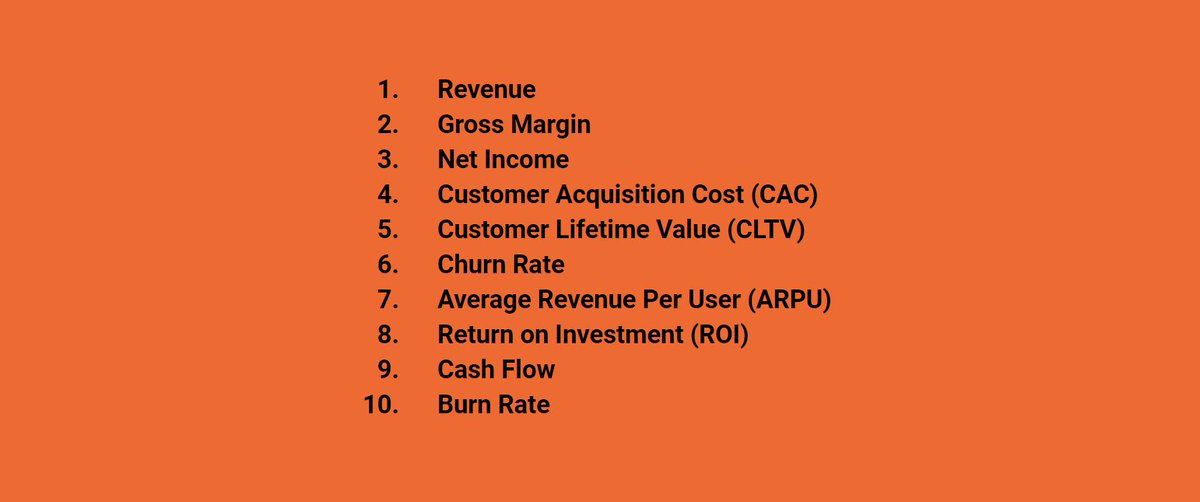
1. Revenue: The total amount of money generated from product sales or services.
Monitoring revenue trends over time helps Product Managers assess the growth or decline in customer demand for their product.
Monitoring revenue trends over time helps Product Managers assess the growth or decline in customer demand for their product.
2. Gross Margin: The difference between revenue and the cost of goods sold, expressed as a percentage. It indicates the profitability of each unit sold.
Gross Margin = (Revenue - Cost of Goods Sold) / Revenue
Gross Margin = (Revenue - Cost of Goods Sold) / Revenue
3. Net Income: The total earnings after deducting all expenses, including taxes and operating costs.
NI = Total Revenue - Total Expenses
By monitoring NI, you can assess the efficiency of cost structures, identify where expenses can be optimized, and improve profitability.
NI = Total Revenue - Total Expenses
By monitoring NI, you can assess the efficiency of cost structures, identify where expenses can be optimized, and improve profitability.
4. Customer Acquisition Cost (CAC): The average cost incurred to acquire a new customer. It includes marketing and sales expenses.
CAC = Total Sales and Marketing Expenses / Number of New Customers Acquired
CAC = Total Sales and Marketing Expenses / Number of New Customers Acquired
5. Customer Lifetime Value (CLTV): The total value a customer brings to the business over their entire relationship. It helps evaluate the long-term profitability of acquiring and retaining customers.
CLTV = Average Revenue per Customer × Average Customer Lifespan
CLTV = Average Revenue per Customer × Average Customer Lifespan
6. Churn Rate: The percentage of customers who stop using or cancel a subscription to your product or service over a given period. High churn rates can indicate customer dissatisfaction or product-market fit issues.
7. Average Revenue Per User (ARPU): The average amount of revenue generated per user or customer. It helps assess the effectiveness of monetization strategies.
8. Return on Investment (ROI): The ratio of the net profit gained from an investment to the cost of the investment. It measures the profitability of a specific initiative or project.
ROI = (Net Profit or Gain from Investment / Initial Investment Cost) × 100
ROI = (Net Profit or Gain from Investment / Initial Investment Cost) × 100
9. Cash Flow: The net amount of cash and cash equivalents flowing in and out of a business during a specific period. Positive cash flow is crucial for maintaining financial stability.
Cash Flow = Net Income + Non-cash Expenses - Changes in Working Capital
Cash Flow = Net Income + Non-cash Expenses - Changes in Working Capital
10. Burn Rate: The rate at which a company is spending its cash reserves. It helps evaluate how long a company can operate before running out of funds.
Burn Rate = (Beginning Cash Balance - Ending Cash Balance) / Time Period
Burn Rate = (Beginning Cash Balance - Ending Cash Balance) / Time Period
Liked the thread?
But you're missing out on lot more.
Join nearly 20,000 subscribers to Productify who get product deep dives, tips and growth articles in their inbox.
Go to Productify[dot]substack[dot]com
or go to my bio @bandanjot to find the link to subscribe.
But you're missing out on lot more.
Join nearly 20,000 subscribers to Productify who get product deep dives, tips and growth articles in their inbox.
Go to Productify[dot]substack[dot]com
or go to my bio @bandanjot to find the link to subscribe.

Loading suggestions...