

Four of the most striking aspects of the SC’s very problematic judgment that strikes down Supreme Court (Review of Judgements and Orders) Act, 2023, in its entirety for being ultra vires the Constitution:
1. SC fails to acknowledge how its own expansive interpretation of Art 184(3) has disturbed our constitutional scheme
Where is “express authorization” to allows SC to assume jurisdiction “suo motu”? Fix prices? Declare parliamentarians are not honest/truthful? Create dam funds?
Where is “express authorization” to allows SC to assume jurisdiction “suo motu”? Fix prices? Declare parliamentarians are not honest/truthful? Create dam funds?
SC over the years read these powers in its original jurisdiction, undeterred by the absence of “express authorisation” and their adverse impact on separation of powers
Yet, it cynically uses these arguments to deny aggrieved parties a meaningful opportunity of redress
Yet, it cynically uses these arguments to deny aggrieved parties a meaningful opportunity of redress
2. SC says “it goes without saying” SC rules rest on a higher pedestal than ordinary legislation
The judgment it (wrongly) quotes as authority says rules made by SC under Art 188 are on a higher pedestal than *statutory rules* made by *executive*
Two entirely different things
The judgment it (wrongly) quotes as authority says rules made by SC under Art 188 are on a higher pedestal than *statutory rules* made by *executive*
Two entirely different things

3. It gets worse:
Judgment also says legislation that is incompatible with SC’s *interpretation* of rules that declares CJP is the sole authority through whom SC’s 184(3) jurisdiction can be invoked (rules say nothing of this sort) violates the Constitution
Absurd!
Judgment also says legislation that is incompatible with SC’s *interpretation* of rules that declares CJP is the sole authority through whom SC’s 184(3) jurisdiction can be invoked (rules say nothing of this sort) violates the Constitution
Absurd!
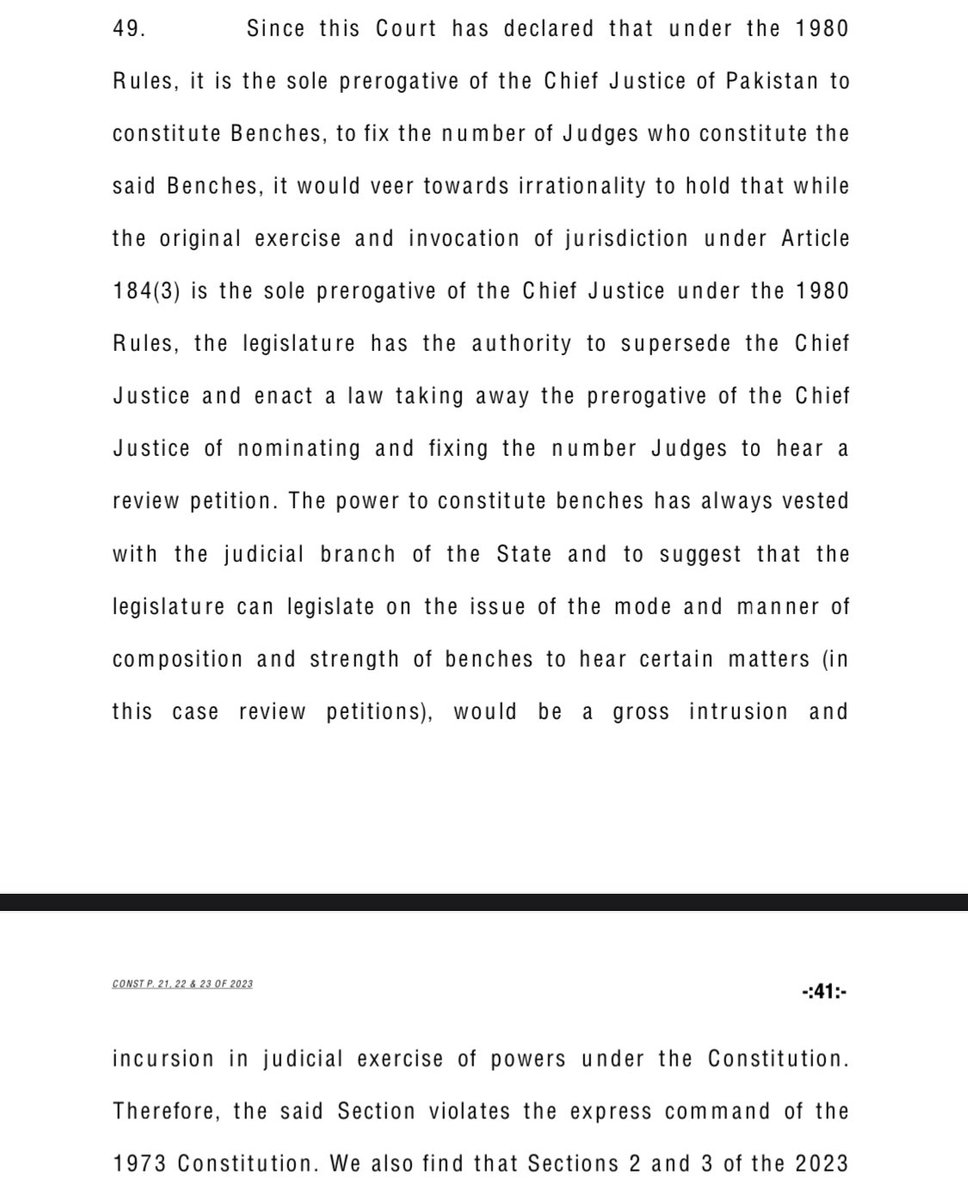
This reasoning also clearly indicates how this bench will decide petitions challenging SC (Practice and Procedure) Act, 2023, since that law changes how benches are constituted and Art 184(3) jurisdiction invoked, giving the power to the 3 most senior judges instead of CJ alone
4. Finally, recall how last year the same three judges held speaker must discard votes cast against party line, even though this interpretation was against express provisions of the Constitution
It also did not matter to them that their rewriting would make VONC nearly redundant
It also did not matter to them that their rewriting would make VONC nearly redundant
Oddly, here even clear text of Art 188 isn’t “express” enough!
Inconsistencies in their own reasoning show these judges are not guided by any theory of constitutional interpretation
Instead, how they read the Constitution depends solely on the outcome they want in a given case
Inconsistencies in their own reasoning show these judges are not guided by any theory of constitutional interpretation
Instead, how they read the Constitution depends solely on the outcome they want in a given case
In short, SC fails to acknowledge problems caused by its overreach, expansive use of 184(3)/ “suo motu” powers, and concentration of powers in CJP’s hands
It refuses to revise SC rules to bring about reform. And it refuses to allow parliament to do so through legislation either
It refuses to revise SC rules to bring about reform. And it refuses to allow parliament to do so through legislation either
Loading suggestions...