

Last Sunday, during @toyinomotoso's AMA Spaces, someone asked how to do research before selling a product online.
Now what I'm about to share with you isn't exhaustive, but it's the exact research process I used to come up with a solid copy in 2021 for an IELTS guide that has made around 15 million Naira in sales.
Even though I've written copy that has done 10X that, it's still one of my sweetest copywriting wins as:
1. IELTS isn't exactly a sexy product
2. It allowed my client to quit his job and also move his family to a different city.
So, here it goes...
1. IELTS isn't exactly a sexy product
2. It allowed my client to quit his job and also move his family to a different city.
So, here it goes...
When I'm writing copy, my research process is 3 parts:
1. Customer/Audience
2. Product
3. Industry/Niche
1. Customer/Audience
2. Product
3. Industry/Niche
For customer/audience research, I follow copywriting legend, Robert Collier's advice:
“Always enter the conversation already occurring in the prospect's mind.”
“Always enter the conversation already occurring in the prospect's mind.”
To do this effectively, it's important you know what people are saying or what people think about that product or what it solves.
In essence, hear people's opinions.
In essence, hear people's opinions.
My favourite places to scour for people's opinions are forums - Nairaland, Reddit, Pinterest, etc.
I had to go through over 60 pages on Nairaland for this one in particular.
By the time I was done, I even knew how much IELTS was 10 years ago 😆
I had to go through over 60 pages on Nairaland for this one in particular.
By the time I was done, I even knew how much IELTS was 10 years ago 😆
This also helped me know what people's pain points concerning IELTS were.
And it wasn't just about difficulty in writing and passing the exam. Other pain points included:
And it wasn't just about difficulty in writing and passing the exam. Other pain points included:
1. Time
Most people sitting for IELTS were either busy 9-5 workers (some were doctors, nurses, medical personnel), business people, stay at home moms, etc.
So they couldn't afford to spend a lot of time preparing - somewhere around 1 hour a day was what they could manage.
Most people sitting for IELTS were either busy 9-5 workers (some were doctors, nurses, medical personnel), business people, stay at home moms, etc.
So they couldn't afford to spend a lot of time preparing - somewhere around 1 hour a day was what they could manage.
2. Fear
People are afraid of sitting for IELTS as aside from the fact they'd be spending N83,000 on registration alone. If they don't hit their required band score, they'd have to sit for it again.
So, in essence, it's a make or break for their immigration plans.
People are afraid of sitting for IELTS as aside from the fact they'd be spending N83,000 on registration alone. If they don't hit their required band score, they'd have to sit for it again.
So, in essence, it's a make or break for their immigration plans.
3. Immigration chances
Before now, lots of schools in the UK and Canada demanded IELTS.
Some schools even tell you the specific band score you need to hit.
It was/is an admission criteria.
A high IELTS score increases your immigration chances to Canada.
Before now, lots of schools in the UK and Canada demanded IELTS.
Some schools even tell you the specific band score you need to hit.
It was/is an admission criteria.
A high IELTS score increases your immigration chances to Canada.
For doctors, nurses, and medical personnel moving to the UK, I think it's compulsory.
So, you see?
This wasn't something to be taken lightly.
So, you see?
This wasn't something to be taken lightly.
But forums aren't the only places to see people's views on the topic.
One of my favourite places to check out is Twitter.
Just go to the search button & play with a bunch of keywords related to the topic.
That's how I was able to see this particular complaint from this lady:
One of my favourite places to check out is Twitter.
Just go to the search button & play with a bunch of keywords related to the topic.
That's how I was able to see this particular complaint from this lady:
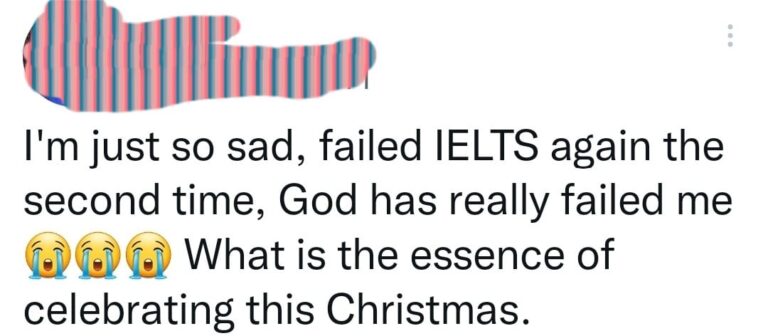
It was from this and the opinions on Nairaland that I discovered people wrote IELTS 2, 3, 4, 5, 6, and even 7 times.
I was shocked 😲
I was shocked 😲
4. Too little or too much information
Some people are scared they don't have enough information.
Some others are scared they have too much information (had no idea this was a thing), and so they get overwhelmed.
This is why you need to know what people are thinking.
Some people are scared they don't have enough information.
Some others are scared they have too much information (had no idea this was a thing), and so they get overwhelmed.
This is why you need to know what people are thinking.
5. Low self-esteem and personal expectations
"My English isn't good enough."
"I've seen better people fail IELTS. What's the hope for me?"
Some other people had specific parts of IELTS like reading or writing that was giving them issues.
"My English isn't good enough."
"I've seen better people fail IELTS. What's the hope for me?"
Some other people had specific parts of IELTS like reading or writing that was giving them issues.
But there's no way to know these things if you don't dig.
That's why research is referred to as digging for gold.
That's why research is referred to as digging for gold.
The next step is product research.
Clients who want copy written for them typically give me access to their product.
My job is to go through it over and over again with a fine comb (sometimes for weeks) to see if there are unique angles I could come up with.
Clients who want copy written for them typically give me access to their product.
My job is to go through it over and over again with a fine comb (sometimes for weeks) to see if there are unique angles I could come up with.
And I have to do this because if the research isn't thorough, then the copy will be bland.
For affiliates who promote products on @expertnaire, they mostly do research by studying the sales page or VSLs of the product.
Though I'd advise it's better to get the product as you can find unique promotional angles that someone who only reads the sales page might not see.
The biggest affiliates on @expertnaire are mostly people who've used that particular product and gotten results from it.
When you've used a product, your testimonial & personal experience also serve as research fodder.
Plus, you're getting it at a discount, so it makes sense.
When you've used a product, your testimonial & personal experience also serve as research fodder.
Plus, you're getting it at a discount, so it makes sense.
I test almost every product I'm trying to create a marketing campaign for.
The 3rd step is the Industry/Niche research.
This is where Google, Bing, and all the search engines come in.
Search engine results from Google and AnswerThePublic also give you a clue about what people are searching in relation to that product or industry.
This is where Google, Bing, and all the search engines come in.
Search engine results from Google and AnswerThePublic also give you a clue about what people are searching in relation to that product or industry.
For example, if you type "Affiliate Marketing" on Google, aside from the search results you'll get, you'd also get related search enquiries like this 👇🏿
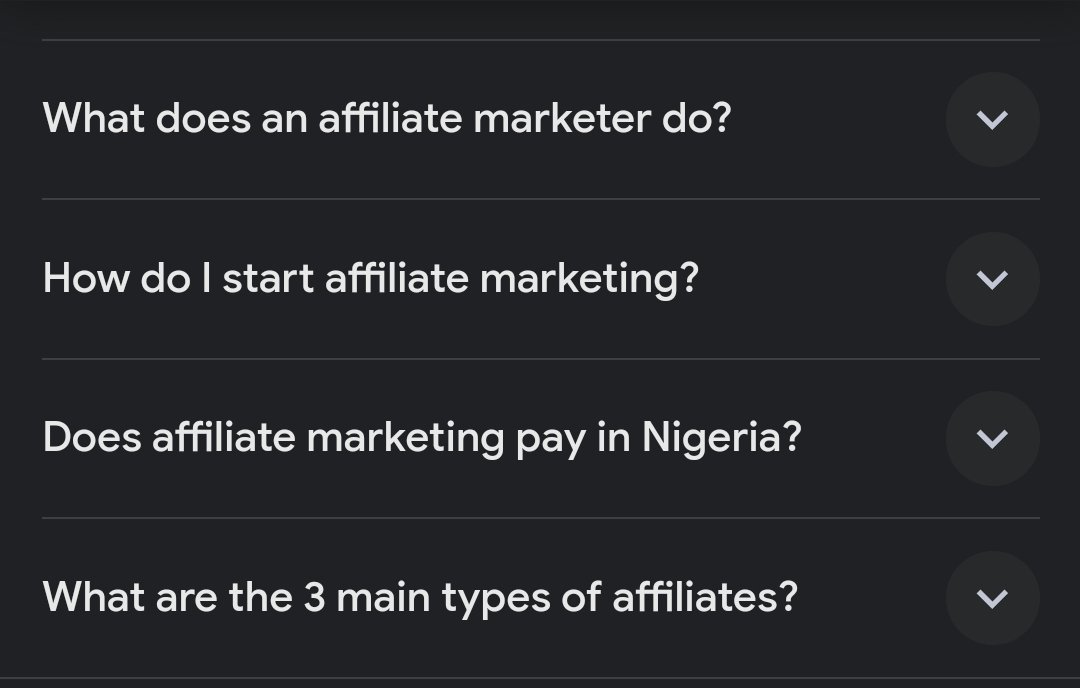
You'll find something similar on Google Trends and AnswerThePublic with their heatmaps and search frequencies.
Next thing I do is check out similar products - competitors and past promotions.
If they have email lists, enter there.
Check out their funnels.
Old VSLs or sales copies? Go through them.
I look at my swipe file or check out swiped.co for this.
If they have email lists, enter there.
Check out their funnels.
Old VSLs or sales copies? Go through them.
I look at my swipe file or check out swiped.co for this.
Questions like:
What did they say?
What are they saying?
How did they say it?
...will help you get a feel of what's going on in that industry.
All of these falls in line with Robert Collier's advice on staying in the conversation going on in the prospect's head.
What did they say?
What are they saying?
How did they say it?
...will help you get a feel of what's going on in that industry.
All of these falls in line with Robert Collier's advice on staying in the conversation going on in the prospect's head.
You can even speak to people too.
But like I said at the beginning of this thread, none of this is exhaustive.
But this is the process that usually works for me.
But like I said at the beginning of this thread, none of this is exhaustive.
But this is the process that usually works for me.
Research isn't sexy at all.
But there's no way you're going to hit the BIG IDEA if you don't do it and do it well.
You also can't rush it.
One of my favourite hip-hop lyrics of all time is from Loose Kaynon, where he says:
"The thing about the grind is, we treat it like the…
But there's no way you're going to hit the BIG IDEA if you don't do it and do it well.
You also can't rush it.
One of my favourite hip-hop lyrics of all time is from Loose Kaynon, where he says:
"The thing about the grind is, we treat it like the…
And that's the same approach I take towards research.
You just need to find that one thing.
One unique mechanism.
One unique pain point.
One powerful testimonial.
That one unique thing.
You just need to find that one thing.
One unique mechanism.
One unique pain point.
One powerful testimonial.
That one unique thing.
That one unique thing can be the difference between a copy doing six figures and it doing seven and even eight or nine figures.
So you have to find it.
But how do I know when I've found it?
So you have to find it.
But how do I know when I've found it?
Maybe it's instinct...
Maybe it's telepathy...
Or maybe it's inspiration from Lolita, the goddess of writing...
But you'll know when you find it.
I hope this helps you.
Cheers,
Uche.
Maybe it's telepathy...
Or maybe it's inspiration from Lolita, the goddess of writing...
But you'll know when you find it.
I hope this helps you.
Cheers,
Uche.
PS: Those asking for copywriting courses, there's just four Nigerians who teach powerful copy I can vouch for:
1. @toyinomotoso
Words can not describe 😁
No copywriting course, but buy everything he releases.
Get on his email list.
Read his tweets.
Words can not describe 😁
No copywriting course, but buy everything he releases.
Get on his email list.
Read his tweets.
@toyinomotoso 2. @ronaldnzimora
Might be the best storyteller from this side of the world.
Read a copy he wrote for a promotion for @akinalabi, and I couldn't get it out of my head.
That piece of copy was the bedrock for one of my biggest copywriting wins.
Might be the best storyteller from this side of the world.
Read a copy he wrote for a promotion for @akinalabi, and I couldn't get it out of my head.
That piece of copy was the bedrock for one of my biggest copywriting wins.
@toyinomotoso @ronaldnzimora @akinalabi Not sure he has a course right now, but he does cohorts from time to time.
If and whenever he does, please pay whatever he charges and join in.
If it's coming from him, it's definitely halal.
If and whenever he does, please pay whatever he charges and join in.
If it's coming from him, it's definitely halal.
@toyinomotoso @ronaldnzimora @akinalabi 3. @tonyfotizo
But he isn't a copywriter.
He's a psychologist and mindhacker.
If you want to learn copy psychology, he's your guy.
He's also a bloody good storyteller.
His Bloodsucking Copywriting program is solid.
But he isn't a copywriter.
He's a psychologist and mindhacker.
If you want to learn copy psychology, he's your guy.
He's also a bloody good storyteller.
His Bloodsucking Copywriting program is solid.
@toyinomotoso @ronaldnzimora @akinalabi @TonyFotizo 4. @andymukolo
Helped me a lot at the beginning of my journey.
His biggest attributes are his work ethic and willingness to help.
Top guy fr.
Helped me a lot at the beginning of my journey.
His biggest attributes are his work ethic and willingness to help.
Top guy fr.
@toyinomotoso @ronaldnzimora @akinalabi @TonyFotizo @Andymukolo His Project Frankenstein course helps you get foreign copywriting clients all the way from Nigeria (or wherever you are).
Get it here 👇🏿
expertnaire.com
Get it here 👇🏿
expertnaire.com

For foreign coaches, @StefanGeorgi's RMBC is really good, especially with teaching research.
@daviddeutsh's A-Level Copywriting Program is incredible too.
Hope this helps.
@daviddeutsh's A-Level Copywriting Program is incredible too.
Hope this helps.
Loading suggestions...