

Backend engineers don't play with Servers.
It's vital to building scalable backend systems.
Let me break it down for you.
What is a Server?
A thread
It's vital to building scalable backend systems.
Let me break it down for you.
What is a Server?
A thread
What is a Server?
Servers are the bedrock of backend engineering hence the name Server-Side Development.
A server is an application or hardware that receives and processes requests transmitted over the network, providing appropriate responses.
Servers are the bedrock of backend engineering hence the name Server-Side Development.
A server is an application or hardware that receives and processes requests transmitted over the network, providing appropriate responses.
What are they used for?
Servers are used for numerous things, and especially, they are used to manage network resources.
You can set up a server to receive and send emails, respond to HTTP requests, manage print jobs, or host a website.
Servers are used for numerous things, and especially, they are used to manage network resources.
You can set up a server to receive and send emails, respond to HTTP requests, manage print jobs, or host a website.
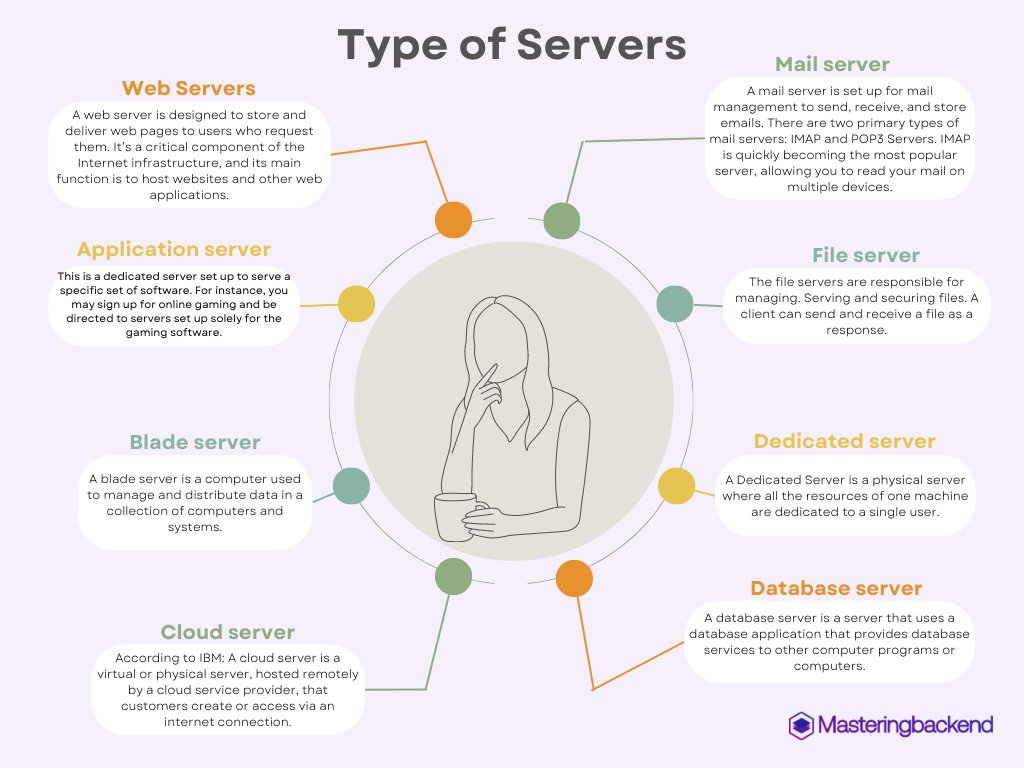
Type of Servers
1. Application server —> This is a dedicated server set up to serve a specific set of software. For instance, you may sign up for online gaming and be directed to servers set up solely for the gaming software.
1. Application server —> This is a dedicated server set up to serve a specific set of software. For instance, you may sign up for online gaming and be directed to servers set up solely for the gaming software.
2. Blade server: A blade server is a computing device for data management and distribution across interconnected computers and systems
3. Cloud server: A cloud server is a server, either virtual or physical, that is hosted remotely by a cloud service provider, and customers can access it through an internet connection.
4. Database server: A database server is equipped with a database application, offering database services to other computer programs or computers.
5. Dedicated server —> A Dedicated Server is a physical server where all the computing resources are exclusively allocated to a single user.
6. File server —> The file servers manage, serve, and secure files. A client can send and receive a file as a response.
6. File server —> The file servers manage, serve, and secure files. A client can send and receive a file as a response.
7. Mail server —> A mail server is set up for mail management to send, receive, and store emails. There are two primary types of mail servers: IMAP and POP3 Servers. IMAP is quickly becoming the most popular server, allowing you to read your mail on multiple devices.
8. Proxy server —> A proxy server mediates between server-to-filter user requests and a client program. So, it allows the management of emails and shared connections.
9. Web server —> A web server is specifically designed to store and deliver web pages to users who request them. As a crucial element of the Internet infrastructure, its primary purpose is to host websites and various web applications.
That's all for this thread.
If you enjoy this:
Like
Retweet
Reply
You can enjoy the full article here.
masteringbackend.com
If you enjoy this:
Like
Retweet
Reply
You can enjoy the full article here.
masteringbackend.com

Loading suggestions...