

1
Arab civilization “borrowed” so much scientific & mathematical knowledge from Hindus, that they named the discipline “Hindisa” referring to its Indic origin. A mathematician or engineer in Arabic was called a “Muhandis” one who is an expert in Hindisa or Hindu mathematics.
Arab civilization “borrowed” so much scientific & mathematical knowledge from Hindus, that they named the discipline “Hindisa” referring to its Indic origin. A mathematician or engineer in Arabic was called a “Muhandis” one who is an expert in Hindisa or Hindu mathematics.


2
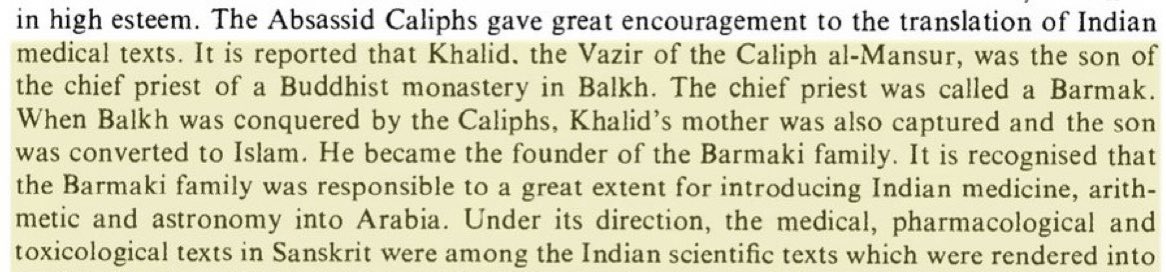
In 8th c., Caliph Al Mansur enslaved the head of Buddhist Nava Vihara monastery in Balkh forcibly converting him to Islam. He founded the famous Barmaki (fr. Pramukh) family of Arabia who translated Sanskrit works on medicine, astronomy, & mathematics for the Arabs.
In 8th c., Caliph Al Mansur enslaved the head of Buddhist Nava Vihara monastery in Balkh forcibly converting him to Islam. He founded the famous Barmaki (fr. Pramukh) family of Arabia who translated Sanskrit works on medicine, astronomy, & mathematics for the Arabs.

3
In the 9th c. physician Al Razi/ Rhazes incorporated that knowledge of Hindu medicine in his comprehensive book Kitab Al Hawi which became a standard medical reference in Europe after it was translated to Latin (Liber Continens) by Faraj Ibn Salim (Moses Farachi) in 1279 AD.
In the 9th c. physician Al Razi/ Rhazes incorporated that knowledge of Hindu medicine in his comprehensive book Kitab Al Hawi which became a standard medical reference in Europe after it was translated to Latin (Liber Continens) by Faraj Ibn Salim (Moses Farachi) in 1279 AD.

4
In 8th c. CE, Arabs translated many important Sanskrit treatises about numerals, Zero, decimal system, irrational numbers, algebra & trigonometry which revolutionized mathematics. In 12th c. CE Europeans translated them into Latin & credited Arabs for the basis of modern math.
In 8th c. CE, Arabs translated many important Sanskrit treatises about numerals, Zero, decimal system, irrational numbers, algebra & trigonometry which revolutionized mathematics. In 12th c. CE Europeans translated them into Latin & credited Arabs for the basis of modern math.

5
As far back as 772 CE, Khalid & other forcibly converted scholars at Baghdad court of Al-Mansur shared astronomy & math formulas from the Brahma-Sphuta-Siddhanta of Brahmagupta(~628 CE). Famous astronomer Al-Fazari translated it - in a book called “Al-Sindhind al-Kabir”
As far back as 772 CE, Khalid & other forcibly converted scholars at Baghdad court of Al-Mansur shared astronomy & math formulas from the Brahma-Sphuta-Siddhanta of Brahmagupta(~628 CE). Famous astronomer Al-Fazari translated it - in a book called “Al-Sindhind al-Kabir”


6
Concepts from Brâhma-Sphuta-Siddhânta of Brahmagupta & Sûrya-Siddhânta, were translated from Persian into Arabic in a book called Al-Sindhind al-Kabir” referring to Al-Kabîr (great) & "sindhind" as “centuries of centuries”. The astronomical tables were called "zij as- Shah"
Concepts from Brâhma-Sphuta-Siddhânta of Brahmagupta & Sûrya-Siddhânta, were translated from Persian into Arabic in a book called Al-Sindhind al-Kabir” referring to Al-Kabîr (great) & "sindhind" as “centuries of centuries”. The astronomical tables were called "zij as- Shah"


7
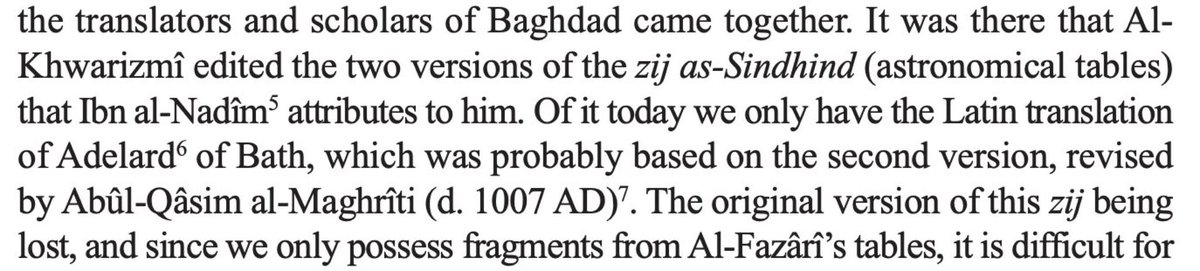
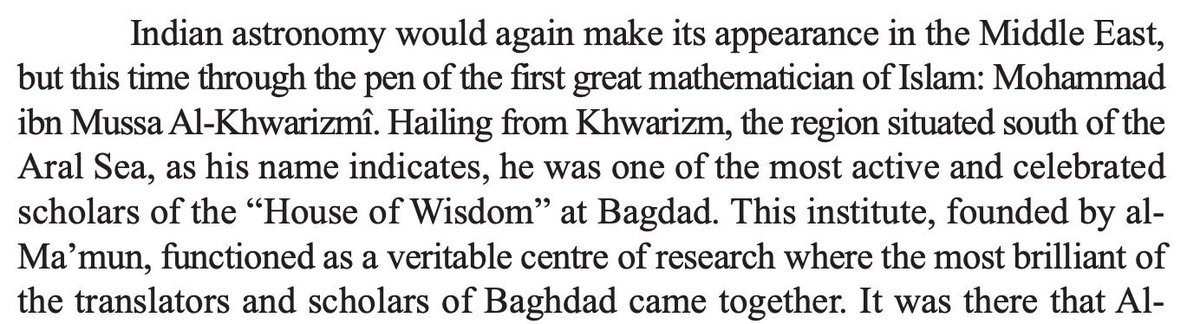
One of the Arab world’s most famous mathematicians from the “House of Wisdom” at Baghdad, Al-Khwārizmī (780-850 CE) edited 2 versions of the zij as-Sindhind (astronomical tables) from these translations of Hindu works - which formed the basis of his mathematical knowledge.
One of the Arab world’s most famous mathematicians from the “House of Wisdom” at Baghdad, Al-Khwārizmī (780-850 CE) edited 2 versions of the zij as-Sindhind (astronomical tables) from these translations of Hindu works - which formed the basis of his mathematical knowledge.
8
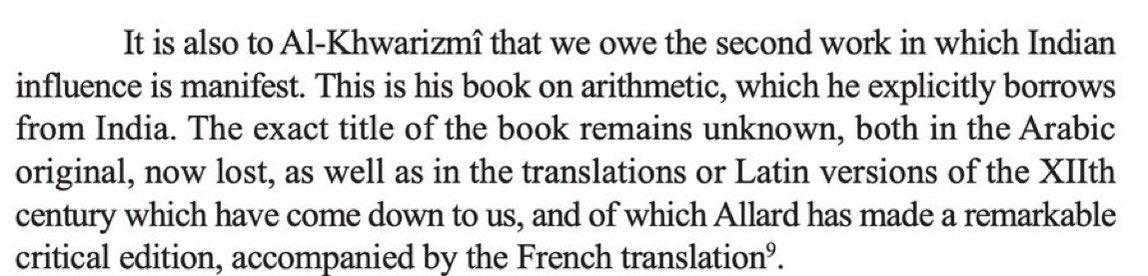
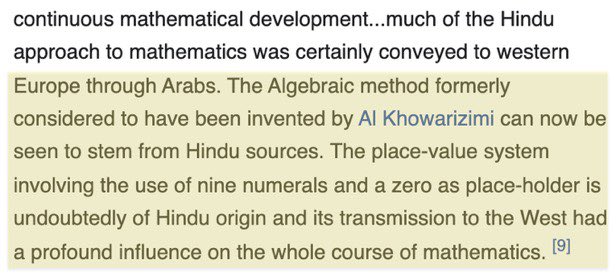
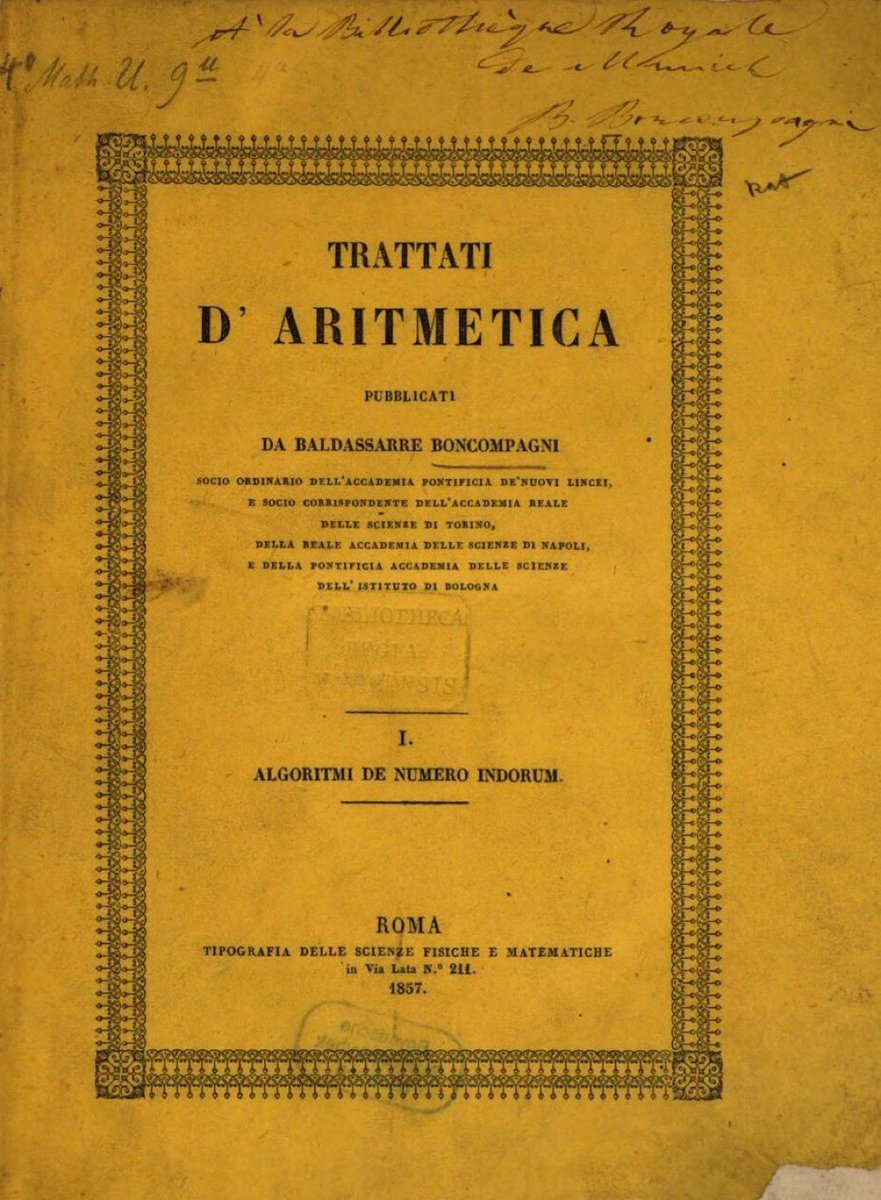
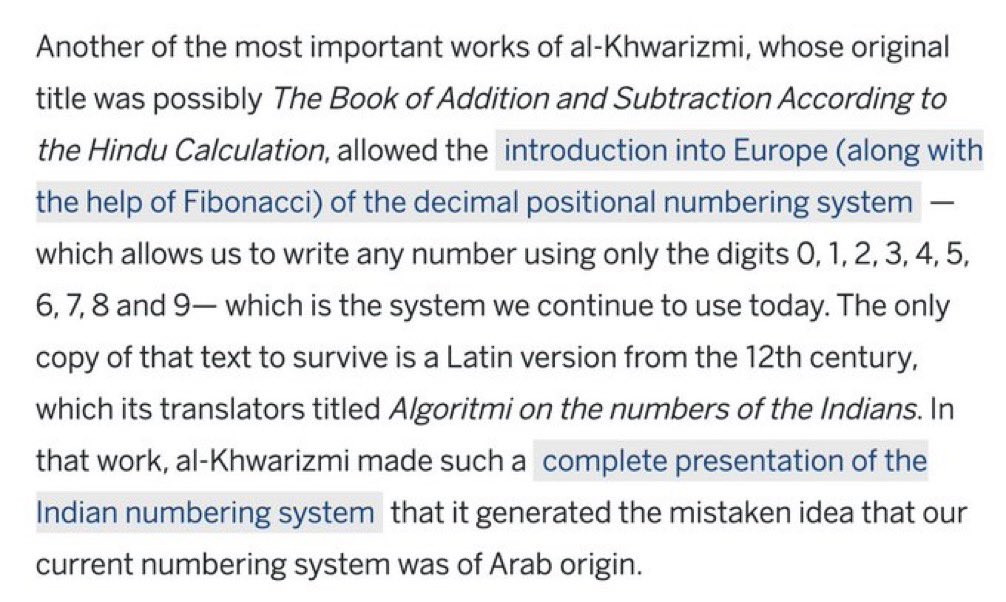
Al-Khwārizmī is so famous that the Latin versions of his name & book are considered to be the origin of the terms "algorithm" & "algebra". Al-Khwarizmî’s most famous book is on the topic of arithmetic formulas, most of which he explicitly borrowed from India.
Al-Khwārizmī is so famous that the Latin versions of his name & book are considered to be the origin of the terms "algorithm" & "algebra". Al-Khwarizmî’s most famous book is on the topic of arithmetic formulas, most of which he explicitly borrowed from India.
9
Muhammad Ibn-i-Jubair Al-Battani (10th c.) translated the Indian use of ratios from Aryabhatta's treatise & introduced it to Arabs. Scholars like Al-khwarizmi, Ibn-Washiya and Abu Mash’ar, incorporated advanced algebra & other branches of Indian mathematics into Arab sciences.
Muhammad Ibn-i-Jubair Al-Battani (10th c.) translated the Indian use of ratios from Aryabhatta's treatise & introduced it to Arabs. Scholars like Al-khwarizmi, Ibn-Washiya and Abu Mash’ar, incorporated advanced algebra & other branches of Indian mathematics into Arab sciences.


10
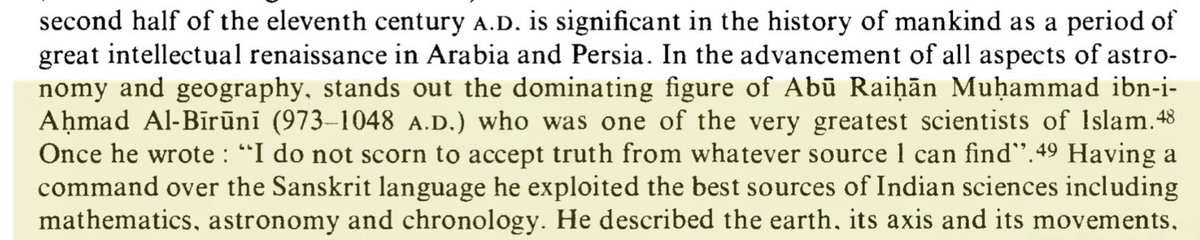
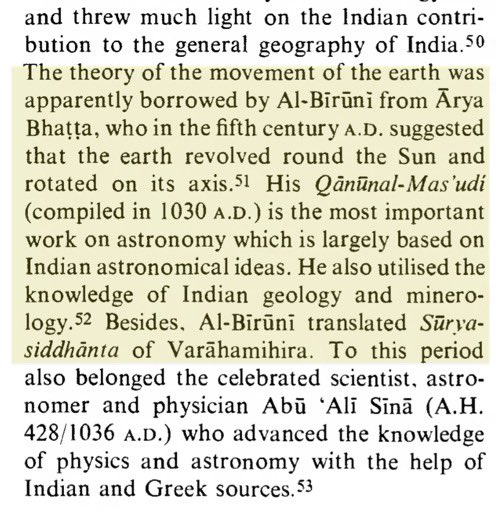
Al-Biruni (11th c.) the Arab mathematician & scientist learnt Sanskrit primarily to exploit Hindu ideas. He “borrowed” many theories regarding earth, its axis & movement of the earth around the Sun from Aryabhatta (5th. c.). He also translated the Surya Siddhanta into Arabic.
Al-Biruni (11th c.) the Arab mathematician & scientist learnt Sanskrit primarily to exploit Hindu ideas. He “borrowed” many theories regarding earth, its axis & movement of the earth around the Sun from Aryabhatta (5th. c.). He also translated the Surya Siddhanta into Arabic.
11
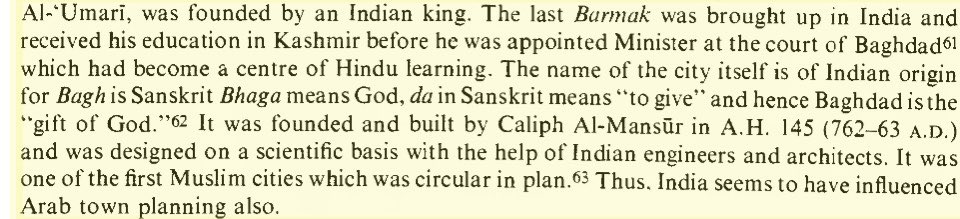
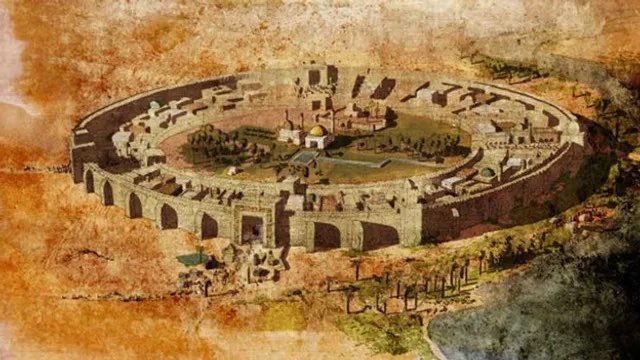
Baghdad, the center of Islamic knowledge was named after Sanskrit Bhaga & da meaning “gift of god”. Designed with the help of Indian engineers & architects, it was one of the 1st Islamic cities built on a circular plan. Converted Indian Barmaks made it the center of knowledge
Baghdad, the center of Islamic knowledge was named after Sanskrit Bhaga & da meaning “gift of god”. Designed with the help of Indian engineers & architects, it was one of the 1st Islamic cities built on a circular plan. Converted Indian Barmaks made it the center of knowledge
12
Mayurpankhi’s imaginary “caste based Brahmanical hegemony over knowledge” in India clearly was no impediment to innovation. Evidence shows how prolifically Arabs “borrowed” from India. Sanskrit texts formed the foundation of Arab mathematical, medical & astronomical knowledge.
Mayurpankhi’s imaginary “caste based Brahmanical hegemony over knowledge” in India clearly was no impediment to innovation. Evidence shows how prolifically Arabs “borrowed” from India. Sanskrit texts formed the foundation of Arab mathematical, medical & astronomical knowledge.
13
When such half baked drivel by incompetent propagandists masquerading as historians is featured regularly by The Print, it becomes clear that the agenda is to falsify history, glorify Mughals & deliberately misinform readers to erase the scientific contributions of Hindus.
When such half baked drivel by incompetent propagandists masquerading as historians is featured regularly by The Print, it becomes clear that the agenda is to falsify history, glorify Mughals & deliberately misinform readers to erase the scientific contributions of Hindus.
14
Loading suggestions...