

1/n An important thread to understand the root behind “Dravidian Separatism” (in my opinion).
@Udhaystalin didn’t called #SanatanDharma as disease at his own. The understanding has long history.
“Christianity is from God, and a remedy for the spiritual diseases of the Hindus, as well as of all other races of men.”
— These are the words of 19th century Evangelist Bishop Robert Caldwell who popularised myth of “Dravidian Race” with clear notion to convert more Hindus to Christianity.
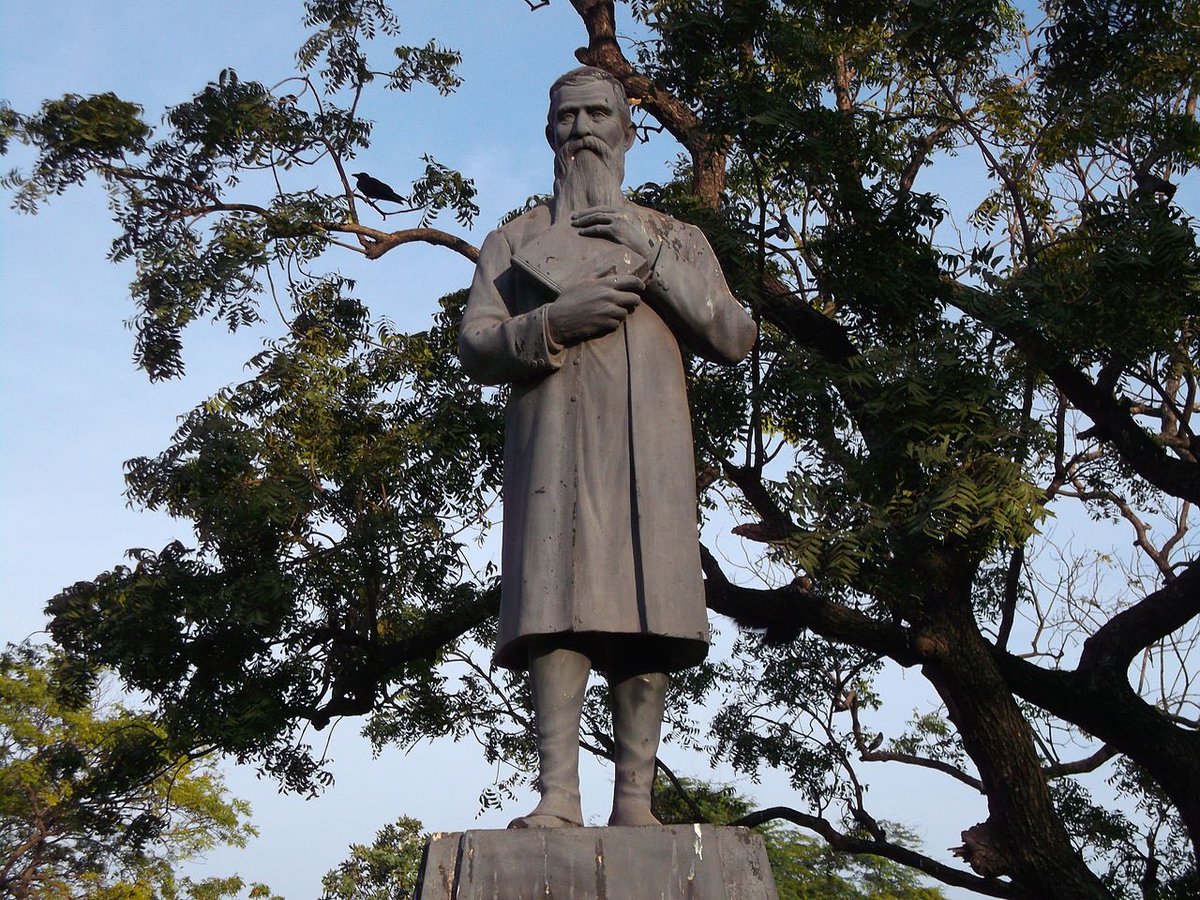
I am currently reading “Bishop Robert Caldwell” again, whose works can be held main reason behind separatist Dravidian Movement.
This thread is around the book “Lectures on the Tinnevelly missions, descriptive of the field, the work, and the results: with an introductory lecture on the progress of Christianity in India.”
Wherein I’ll put across relevant snippets and relative facts in order of chapters.
Last I had read his works around “Comparative Grammar” during my architecture school days which had made me firmly believe in legitimacy of “Dravidian Race.” But, when I superimpose those notions again along with other facts from various studies of science and humanities, they appear to be hardcore church propaganda.
The ideas were merely to expand Christianity, which surely was at the cost of erasing of Santan Dharm. One can’t understand so if they haven’t learn about Caldwell’s work.
So let’s begin with “Lecture-III: Results.”
Here he talks about results of his missionary work in “Tinnevelly” which we know as “Tirunelveli” of Tamil Nadu.
He writes:
“(…) it is an ungentlemanly thing for a man to change his religion. This is a notion which high-caste heathens take much care to encourage. Their own religion makes no proselytes, and accepts none; consequently, they regard those who have
adopted a foreign religion, especially if they are guilty of the additional crime of being of lower caste than themselves, as the filth of the world and the off-scouring of all things;’ and hence, Europeans who occupy official positions in India, who are surrounded by high-caste subordinates, and breathe every day of their lives
an atmosphere of high-caste blandishments, too often mistake the prejudices instilled into their minds by Brahmans for results of their own observation. (…)
It sometimes seems to be supposed that all our converts must have been converted not only from idolatry to Christianity, but from sin to God ; that they must all have been renewed in the spirit of their minds, and become real, spiritual Christians. (…)
The fact is, that the work of God in heathen lands does not differ essentially from the same work at home. In Tinnevelly as in England good has to struggle with evil, truth with error, light with darkness : nowhere on earth shall we find the characteristics of heaven. They are in error
who dwell upon the dark side of the picture, and ignore the bright side ; and they are equally, though more amiably, in
error, who fix their eyes exclusively upon the bright side, and ignore the dark.
The work of Misions in Tinnevelly is a real work, with real difficulties and real encouragements, and it only claims to be judged by the principles on which every similar work is estimated in Christian countries.
In endeavouring to form a fair estimate of the results which have really been accomplished, we are sometimes met at the outset by the statement that all our native Christians belong to low and degraded castes. The great majority of Hindu converts belong undoubtedly to the lower classes of society : in the country
they are small farmers and farm labourers, not unfrequently slaves ; in the cities they are mostly domestic servants of Europeans. But though this is the case of the majority, it is not the case with all ; and even if it were, what then ? It would only follow that in India, as in ancient Greece, not many wise, not many noble, not many mighty are called, but that God had chosen the poor of this world to be rich in faith.”
@Udhaystalin didn’t called #SanatanDharma as disease at his own. The understanding has long history.
“Christianity is from God, and a remedy for the spiritual diseases of the Hindus, as well as of all other races of men.”
— These are the words of 19th century Evangelist Bishop Robert Caldwell who popularised myth of “Dravidian Race” with clear notion to convert more Hindus to Christianity.
I am currently reading “Bishop Robert Caldwell” again, whose works can be held main reason behind separatist Dravidian Movement.
This thread is around the book “Lectures on the Tinnevelly missions, descriptive of the field, the work, and the results: with an introductory lecture on the progress of Christianity in India.”
Wherein I’ll put across relevant snippets and relative facts in order of chapters.
Last I had read his works around “Comparative Grammar” during my architecture school days which had made me firmly believe in legitimacy of “Dravidian Race.” But, when I superimpose those notions again along with other facts from various studies of science and humanities, they appear to be hardcore church propaganda.
The ideas were merely to expand Christianity, which surely was at the cost of erasing of Santan Dharm. One can’t understand so if they haven’t learn about Caldwell’s work.
So let’s begin with “Lecture-III: Results.”
Here he talks about results of his missionary work in “Tinnevelly” which we know as “Tirunelveli” of Tamil Nadu.
He writes:
“(…) it is an ungentlemanly thing for a man to change his religion. This is a notion which high-caste heathens take much care to encourage. Their own religion makes no proselytes, and accepts none; consequently, they regard those who have
adopted a foreign religion, especially if they are guilty of the additional crime of being of lower caste than themselves, as the filth of the world and the off-scouring of all things;’ and hence, Europeans who occupy official positions in India, who are surrounded by high-caste subordinates, and breathe every day of their lives
an atmosphere of high-caste blandishments, too often mistake the prejudices instilled into their minds by Brahmans for results of their own observation. (…)
It sometimes seems to be supposed that all our converts must have been converted not only from idolatry to Christianity, but from sin to God ; that they must all have been renewed in the spirit of their minds, and become real, spiritual Christians. (…)
The fact is, that the work of God in heathen lands does not differ essentially from the same work at home. In Tinnevelly as in England good has to struggle with evil, truth with error, light with darkness : nowhere on earth shall we find the characteristics of heaven. They are in error
who dwell upon the dark side of the picture, and ignore the bright side ; and they are equally, though more amiably, in
error, who fix their eyes exclusively upon the bright side, and ignore the dark.
The work of Misions in Tinnevelly is a real work, with real difficulties and real encouragements, and it only claims to be judged by the principles on which every similar work is estimated in Christian countries.
In endeavouring to form a fair estimate of the results which have really been accomplished, we are sometimes met at the outset by the statement that all our native Christians belong to low and degraded castes. The great majority of Hindu converts belong undoubtedly to the lower classes of society : in the country
they are small farmers and farm labourers, not unfrequently slaves ; in the cities they are mostly domestic servants of Europeans. But though this is the case of the majority, it is not the case with all ; and even if it were, what then ? It would only follow that in India, as in ancient Greece, not many wise, not many noble, not many mighty are called, but that God had chosen the poor of this world to be rich in faith.”
2/n He goes on to write:
“The domestic servants of Europeans in the Madras Presidency generally belong to the caste of Pariars a caste which has been degraded by long continued oppression, and which is one of the few castes that are accustomed to use intoxicating liquors. (…)
It should be remembered, on the other hand, that nineteen-twentieths of the native Christians in the Madras Presidency belong to classes considerably higher than the Pariars
in the social scale ; they reside in the rural districts, and never come in contact with Europeans at all, either as domestic servants, or in any other capacity. (…)”
Caldwell goes on write as below for the converts being of lower caste:
“If it is to be regretted that the majority of our native Christians belong to the lower circle of castes, it is for a reason that lies deeper than anything yet mentioned.
If a man gives up anything for Christ, he receives from Christ sevenfold more in spiritual gifts and graces; he rises rapidly to the stature of a perfect man in Christ. On the contrary, if he is
so situated that -he is called upon to give up little, either because he has little to give up, or because he meets with little opposition, and more especially, if he gains, on the whole, in a temporal point of view, by becoming a Christian not indeed in a pecuniary sense, for that can rarely happen, but as regards protection from oppression, or any similar advantage the probability is that he will acquire little elevation of spirit, or enlargement of
heart, and little experience of the power of faith. Individuals may, indeed, be met with, even under such circumstances, who will rise to Christian eminence ; but if there be a community in this position, like the bulk of our native community in Tinnevelly, in the first ages at least of its Christianity, that community may be expected to exemplify the truth of this statement. On the other hand, there is nothing new in this in the
history of the Christian Church, for it has ever been a characteristic of Christianity, that it has delighted to preach the Gospel to the poor ; and it has ever been another of its characteristics, that it has elevated the temporal as well as the spiritual condition of those who have embraced it.
It is also necessary to bear in mind, that though the majority of our native Christians belong to the poorer classes, all do not. There is a small, but steadily-increasing portion of the native Christian community in India, consisting chiefly of the high caste youth converted to Christianity in connexion with the educational department of Missions, who may be regarded as Hindu Christian gentlemen. The social rank of some members of this class is as respectable as their attainments in English scholarship ; and as they have invariably renounced caste and kindred for Christ's sake,- they have attained thereby to ‘great boldness in the faith’ and ‘a good degree’ in Christ's school. Such persons bear the same relation to the less educated, less distinguished majority, that the ornamented capital of a column does to the simple, solid shaft ; and not only do they furnish a reply to the objection that our native Christians belong to the lower castes alone, but they tend to raise the tone of character and feeling throughout the entire body. They are
the ‘first fruits unto Christ’ from the higher classes of the Hindus, and they lead us to expect in due time a rich harvest of accessions from those classes to the Christian cause.”
He then begins to talk about results of his evangelical activities.
He writes:
“In proceeding to furnish an estimate of the results of missionary labours in Tinnevelly, I begin with temporal results, such results being the first that strike the eye of persons visiting our stations. (…)
“The domestic servants of Europeans in the Madras Presidency generally belong to the caste of Pariars a caste which has been degraded by long continued oppression, and which is one of the few castes that are accustomed to use intoxicating liquors. (…)
It should be remembered, on the other hand, that nineteen-twentieths of the native Christians in the Madras Presidency belong to classes considerably higher than the Pariars
in the social scale ; they reside in the rural districts, and never come in contact with Europeans at all, either as domestic servants, or in any other capacity. (…)”
Caldwell goes on write as below for the converts being of lower caste:
“If it is to be regretted that the majority of our native Christians belong to the lower circle of castes, it is for a reason that lies deeper than anything yet mentioned.
If a man gives up anything for Christ, he receives from Christ sevenfold more in spiritual gifts and graces; he rises rapidly to the stature of a perfect man in Christ. On the contrary, if he is
so situated that -he is called upon to give up little, either because he has little to give up, or because he meets with little opposition, and more especially, if he gains, on the whole, in a temporal point of view, by becoming a Christian not indeed in a pecuniary sense, for that can rarely happen, but as regards protection from oppression, or any similar advantage the probability is that he will acquire little elevation of spirit, or enlargement of
heart, and little experience of the power of faith. Individuals may, indeed, be met with, even under such circumstances, who will rise to Christian eminence ; but if there be a community in this position, like the bulk of our native community in Tinnevelly, in the first ages at least of its Christianity, that community may be expected to exemplify the truth of this statement. On the other hand, there is nothing new in this in the
history of the Christian Church, for it has ever been a characteristic of Christianity, that it has delighted to preach the Gospel to the poor ; and it has ever been another of its characteristics, that it has elevated the temporal as well as the spiritual condition of those who have embraced it.
It is also necessary to bear in mind, that though the majority of our native Christians belong to the poorer classes, all do not. There is a small, but steadily-increasing portion of the native Christian community in India, consisting chiefly of the high caste youth converted to Christianity in connexion with the educational department of Missions, who may be regarded as Hindu Christian gentlemen. The social rank of some members of this class is as respectable as their attainments in English scholarship ; and as they have invariably renounced caste and kindred for Christ's sake,- they have attained thereby to ‘great boldness in the faith’ and ‘a good degree’ in Christ's school. Such persons bear the same relation to the less educated, less distinguished majority, that the ornamented capital of a column does to the simple, solid shaft ; and not only do they furnish a reply to the objection that our native Christians belong to the lower castes alone, but they tend to raise the tone of character and feeling throughout the entire body. They are
the ‘first fruits unto Christ’ from the higher classes of the Hindus, and they lead us to expect in due time a rich harvest of accessions from those classes to the Christian cause.”
He then begins to talk about results of his evangelical activities.
He writes:
“In proceeding to furnish an estimate of the results of missionary labours in Tinnevelly, I begin with temporal results, such results being the first that strike the eye of persons visiting our stations. (…)
3/n (…) The whole of the civilization of Northern Europe being due to Christianity, we cannot doubt the power of the Gospel to civilize a community ; it is evident too, on comparing Protestant communities with Roman Catholic, that the civilizing power of the Gospel is in proportion to its freedom from corruption. On turning to Tinnevelly, and comparing the temporal condition of the native Christians with that of the heathens, we cannot but be struck with the visible improvement which the Gospel has effected.”
Caldwell seems to be quite proud of his evangelical achievements. He writes as below:
“In passing from village to village you can tell, without asking a question, which village is Christian, and which is heathen. You can distinguish the Christian village by such signs as these
the straightness and regularity of the streets, the superior construction and neatness and cleanness of the cottages, the double row of tulip-trees or cocoa-nut palms, planted along each street for ornament as well as for shade, and the air of humble respectability which everywhere meets your view all so different from the filth and indecency, the disorder and neglect, which assure the visitor that a village is heathen. You notice also, as you pass through, a marked difference in the people themselves especially in the women. The Christian women are more decently attired, and more intelligent-looking than their heathen sisters ; and instead of hiding themselves on the approach of an European stranger, they come out and give him, as he passes, the Christian salutation.”
One can clearly see his contempt for the Hindus and the belief of white Christian’s burden.
He goes on to write:
“In every case with which I am acquainted, villages which have held fast and valued the Christianity they received, have risen, sometimes in the first generation, always in the second, to the enjoyment of greater prosperity and comfort, and to a higher position in the social scale, than any heathen village of the same caste.
My own village of Edeyenkoody furnishes an illustration of this. For some years after my arrival the houses of the people continued to be, as all Shanar houses had always been, unfit for civilized human beings to live in : in the course of time, however, one of the villagers resolved to build a better house for himself, and gradually the movement extended and became fashionable, until at length almost every person in the village, from the richest to the poorest, has built for himself a new house ; and the new houses the people have thus built for themselves are twice or thrice as large as the houses they were content to live in before, besides being much loftier, airier, and more respectable-looking, with little verandahs in front, and various other arrangements which used to be seen only in the houses of high-caste people in the towns. There is still undoubtedly room both for architectural improvement and for sanitary improvement ; nevertheless, the changes that have already taken place are a good omen for the future, especially seeing that they have been carried into effect by the people themselves, of their own accord, and at their own expense, and are directly the results of Christian influences.
Christianity has given the people higher ideas of their capabilities and duties, even with respect to their present life ; it has taught them self-respect, and some degree of self reliance : it has not made them, perhaps, more industrious, for in their own quiet, apathetic way, almost all Hindus are tolerably industrious already ; but it has made them more enterprising, more energetic ; it has knocked off the fetters wherewith their intellects were bound, and bid them go forth free; and this it has opened before them an unlimited prospect of progress and improvement.”
Remember EVR (wrongly called #Periyar ) wanted English to replace Tamil?
Caldwell seems to be quite proud of his evangelical achievements. He writes as below:
“In passing from village to village you can tell, without asking a question, which village is Christian, and which is heathen. You can distinguish the Christian village by such signs as these
the straightness and regularity of the streets, the superior construction and neatness and cleanness of the cottages, the double row of tulip-trees or cocoa-nut palms, planted along each street for ornament as well as for shade, and the air of humble respectability which everywhere meets your view all so different from the filth and indecency, the disorder and neglect, which assure the visitor that a village is heathen. You notice also, as you pass through, a marked difference in the people themselves especially in the women. The Christian women are more decently attired, and more intelligent-looking than their heathen sisters ; and instead of hiding themselves on the approach of an European stranger, they come out and give him, as he passes, the Christian salutation.”
One can clearly see his contempt for the Hindus and the belief of white Christian’s burden.
He goes on to write:
“In every case with which I am acquainted, villages which have held fast and valued the Christianity they received, have risen, sometimes in the first generation, always in the second, to the enjoyment of greater prosperity and comfort, and to a higher position in the social scale, than any heathen village of the same caste.
My own village of Edeyenkoody furnishes an illustration of this. For some years after my arrival the houses of the people continued to be, as all Shanar houses had always been, unfit for civilized human beings to live in : in the course of time, however, one of the villagers resolved to build a better house for himself, and gradually the movement extended and became fashionable, until at length almost every person in the village, from the richest to the poorest, has built for himself a new house ; and the new houses the people have thus built for themselves are twice or thrice as large as the houses they were content to live in before, besides being much loftier, airier, and more respectable-looking, with little verandahs in front, and various other arrangements which used to be seen only in the houses of high-caste people in the towns. There is still undoubtedly room both for architectural improvement and for sanitary improvement ; nevertheless, the changes that have already taken place are a good omen for the future, especially seeing that they have been carried into effect by the people themselves, of their own accord, and at their own expense, and are directly the results of Christian influences.
Christianity has given the people higher ideas of their capabilities and duties, even with respect to their present life ; it has taught them self-respect, and some degree of self reliance : it has not made them, perhaps, more industrious, for in their own quiet, apathetic way, almost all Hindus are tolerably industrious already ; but it has made them more enterprising, more energetic ; it has knocked off the fetters wherewith their intellects were bound, and bid them go forth free; and this it has opened before them an unlimited prospect of progress and improvement.”
Remember EVR (wrongly called #Periyar ) wanted English to replace Tamil?
Loading suggestions...