

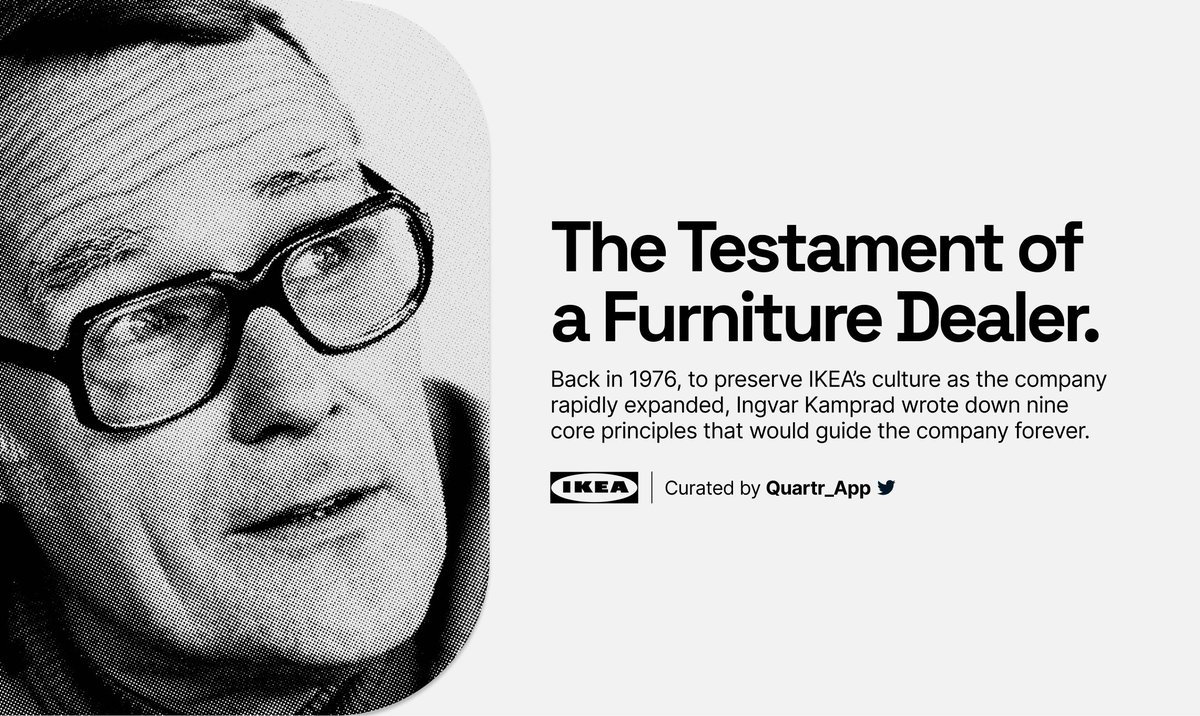
Decades before corporate culture became a "thing", Ingvar Kamprad, the founder of IKEA, wrote The Testament of a Furniture Dealer (1976).
This letter, based on 9 core principles, has served as a corporate bible for IKEA ever since.
Let's take a deep dive into each principle 🧵
This letter, based on 9 core principles, has served as a corporate bible for IKEA ever since.
Let's take a deep dive into each principle 🧵
Just like what Jeff Bezos would start fixating on ~20 years later, Kamprad concluded early on that what is good for IKEA's customers is also, in the long run, good for the business.
Introduction Pt. I:
Introduction Pt. I:
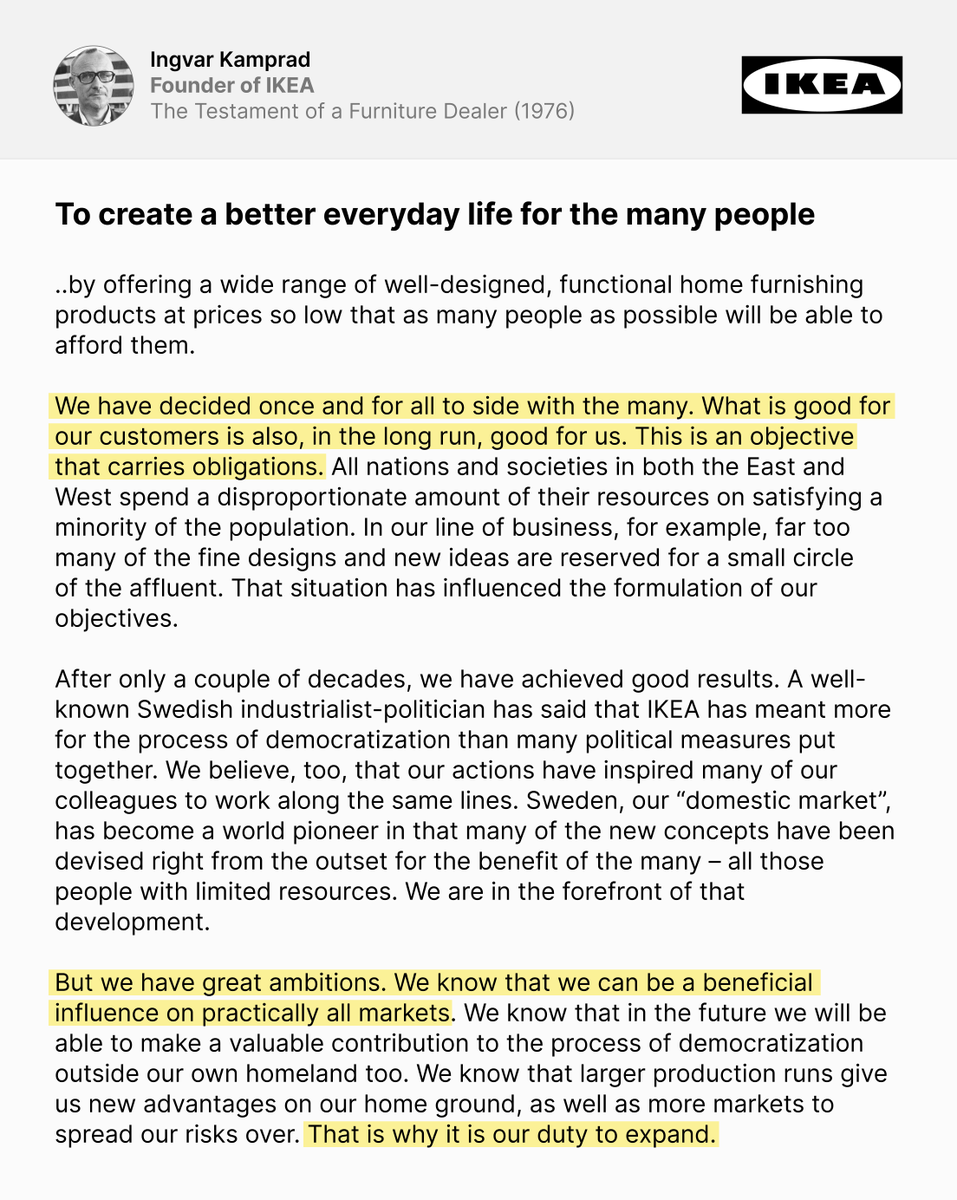
"The product range and [lowest] price philosophy [...] are the essence of our work"
Introduction Pt. II:
Introduction Pt. II:
!["The product range and [lowest] price philosophy [...] are the essence of our work"
Introduction Pt...](https://pbs.twimg.com/media/F7mXChuW8AAB0NJ.png)
1. The Product Range
Kamprad's obsession with a wide product range came early on. He understood the importance of differentiation, and how hard it would be to compete with a company of his envisioned scale:
Kamprad's obsession with a wide product range came early on. He understood the importance of differentiation, and how hard it would be to compete with a company of his envisioned scale:
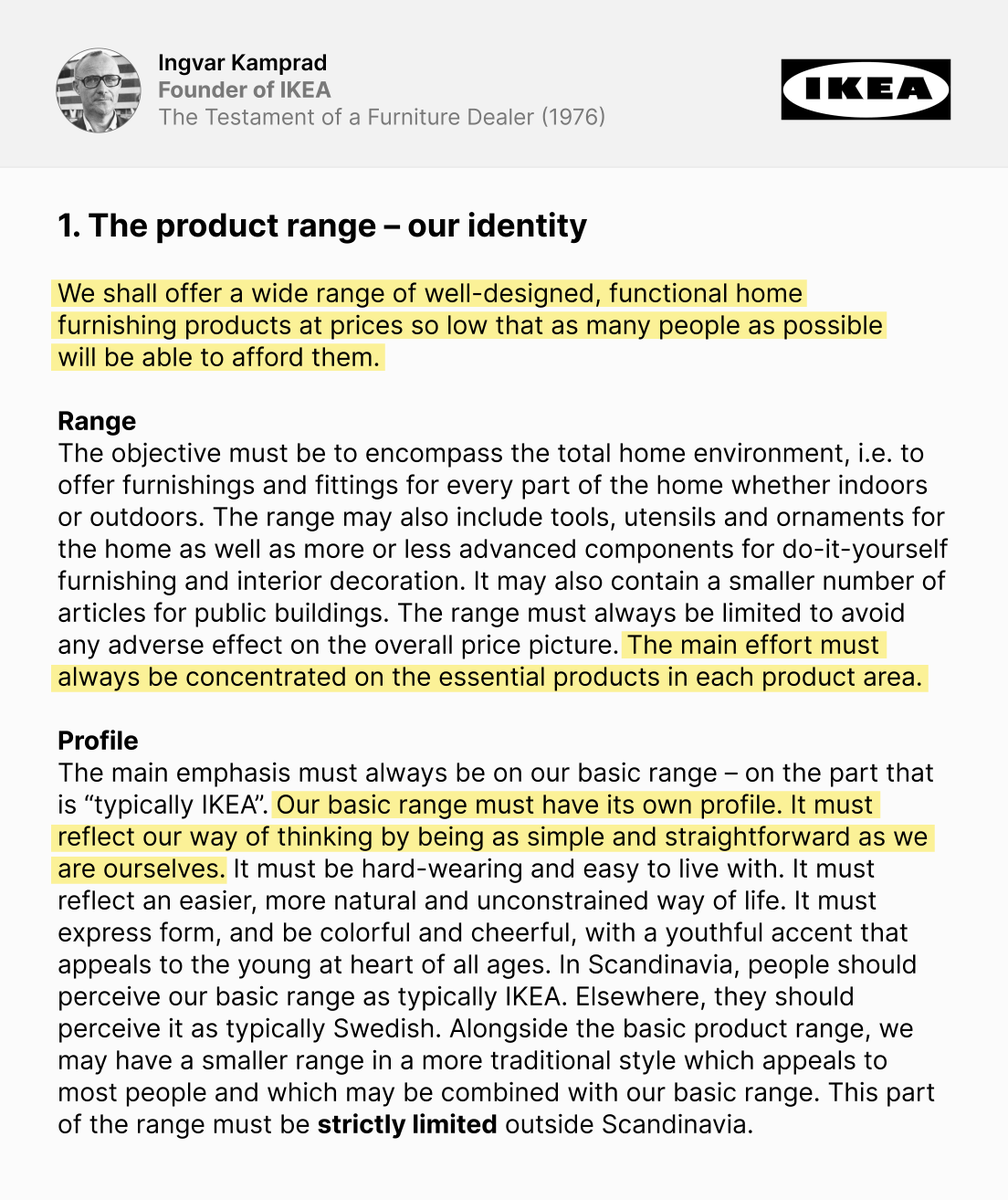
"Our basic policy of serving the many people can *never* be changed"
Although range was truly important, it could never be at the expense of quality and customer availability:
Although range was truly important, it could never be at the expense of quality and customer availability:
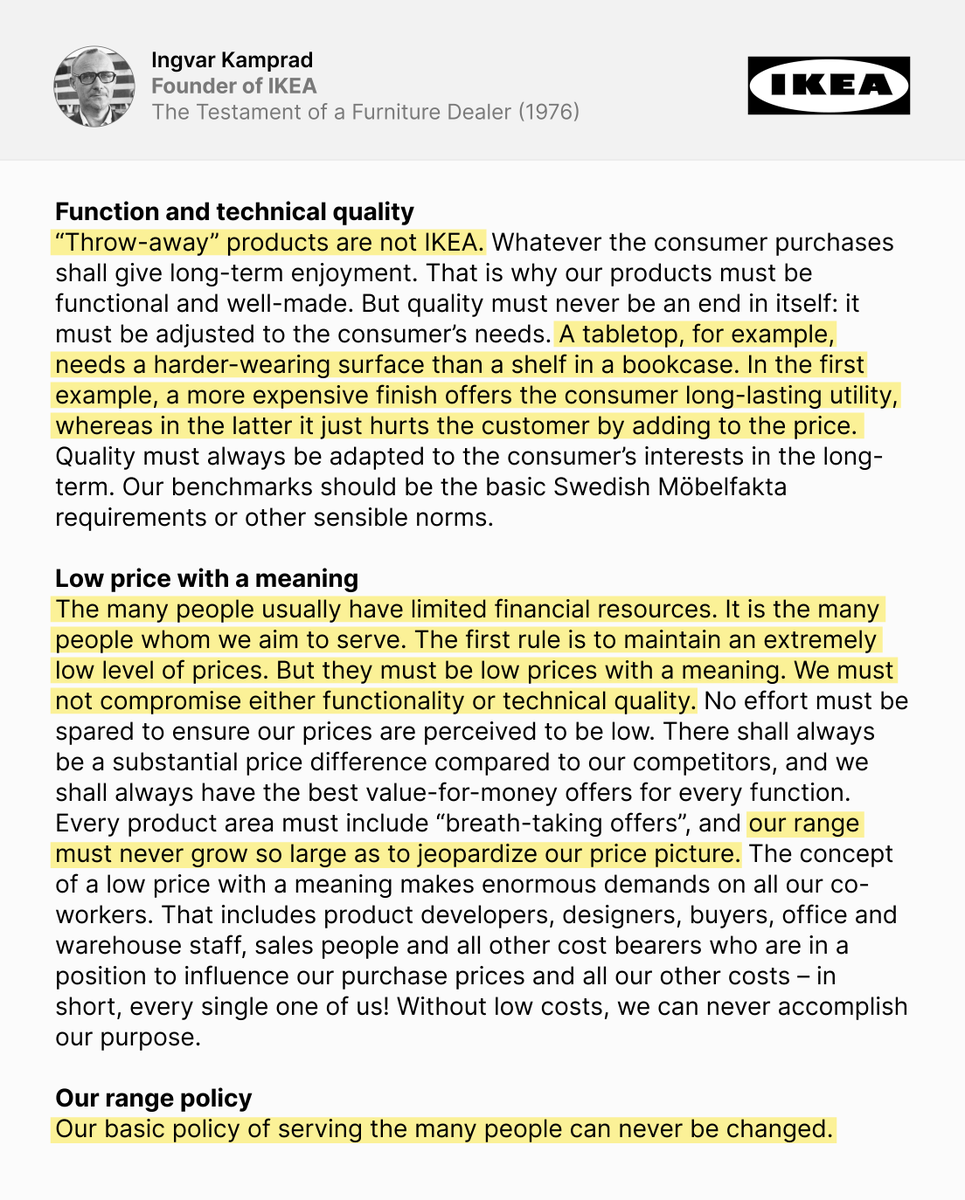
2. The IKEA Spirit
This is why Kamprad felt the need to write this letter. He was afraid that the original IKEA culture would disappear as the company grew:
This is why Kamprad felt the need to write this letter. He was afraid that the original IKEA culture would disappear as the company grew:
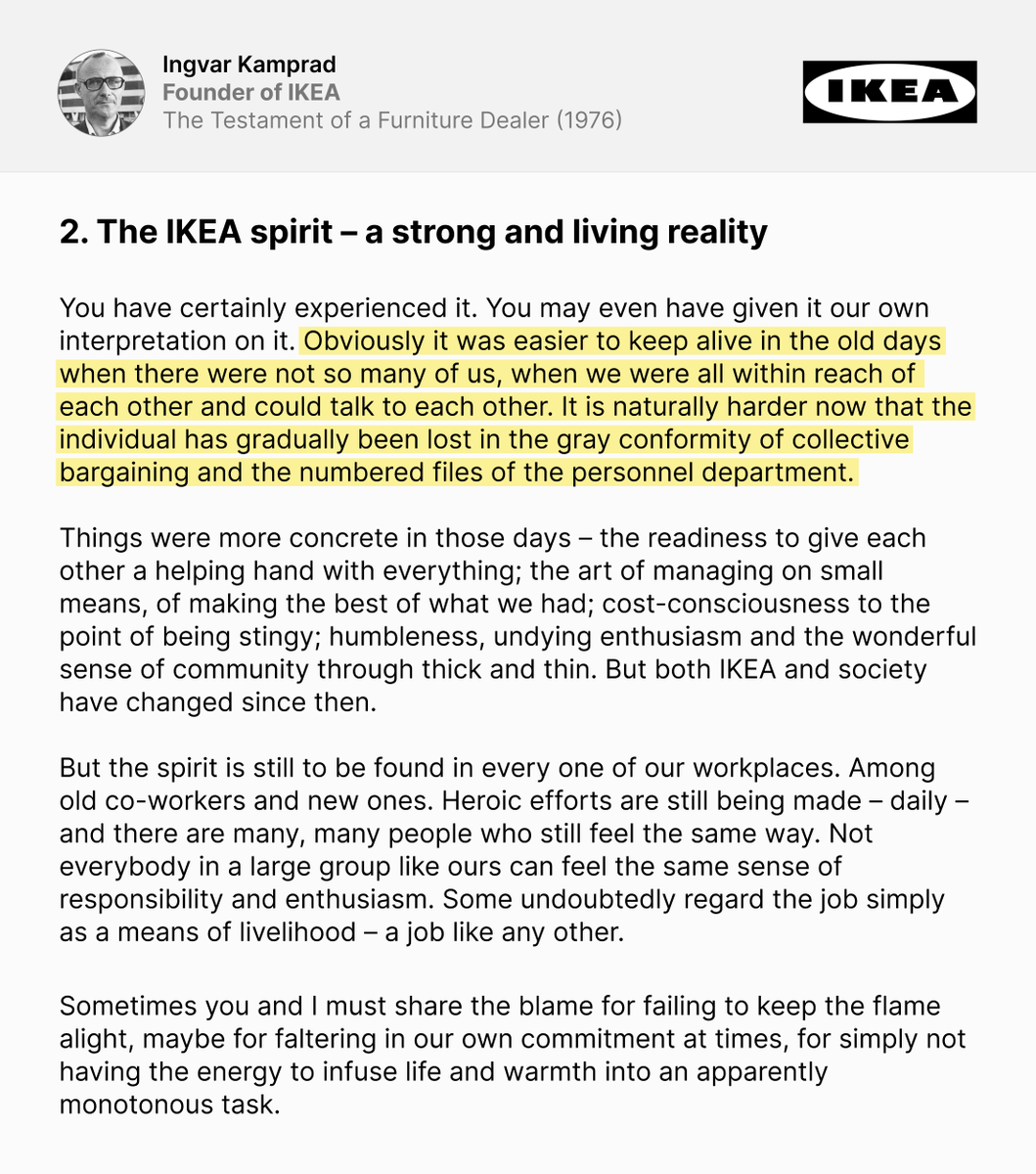
"A job must never be just a livelihood. If you are not enthusiastic with your job, a third of your life goes to waste"
Kamprad defines the IKEA spirit and concludes that it must be cultivated and developed over time:
Kamprad defines the IKEA spirit and concludes that it must be cultivated and developed over time:
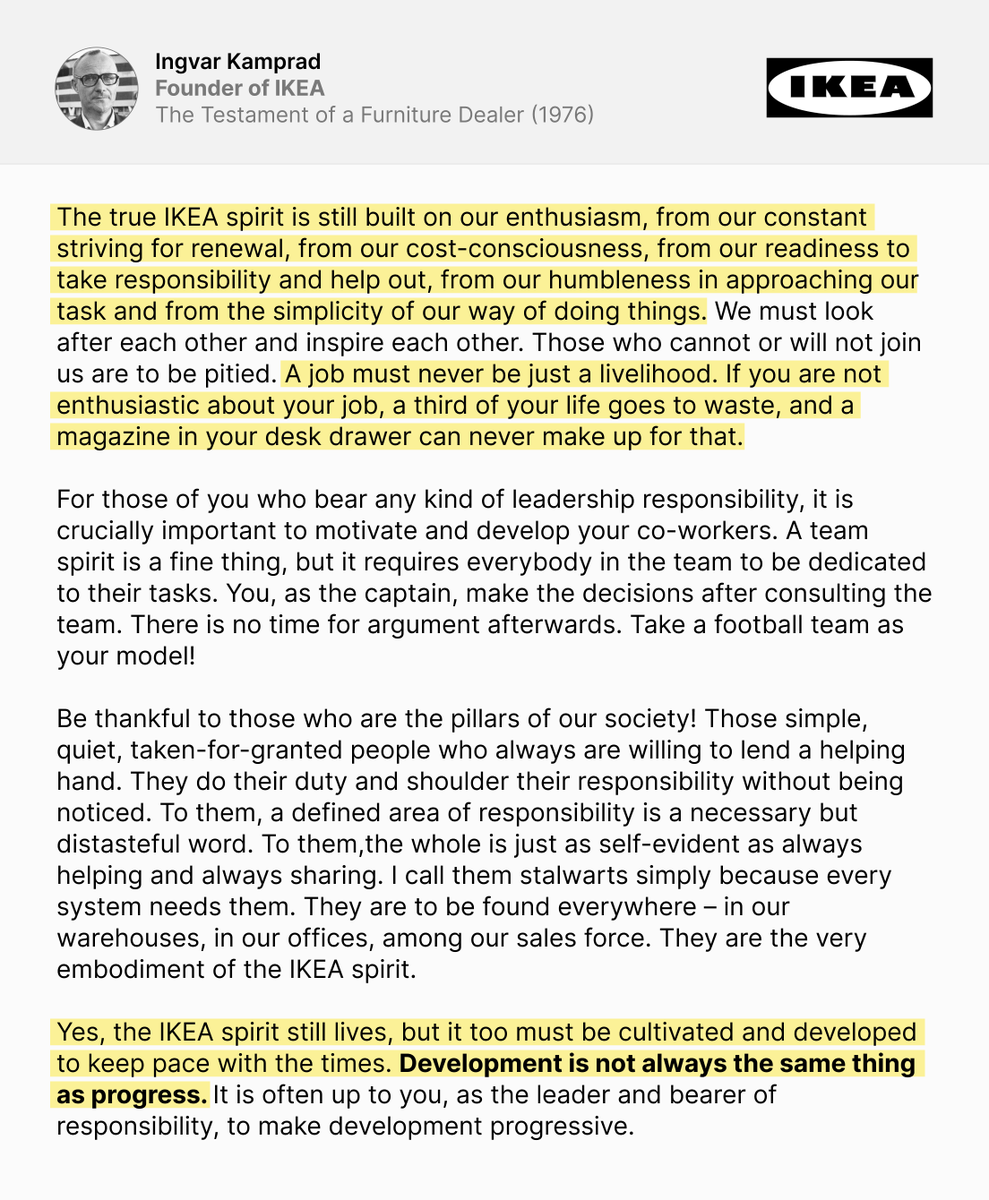
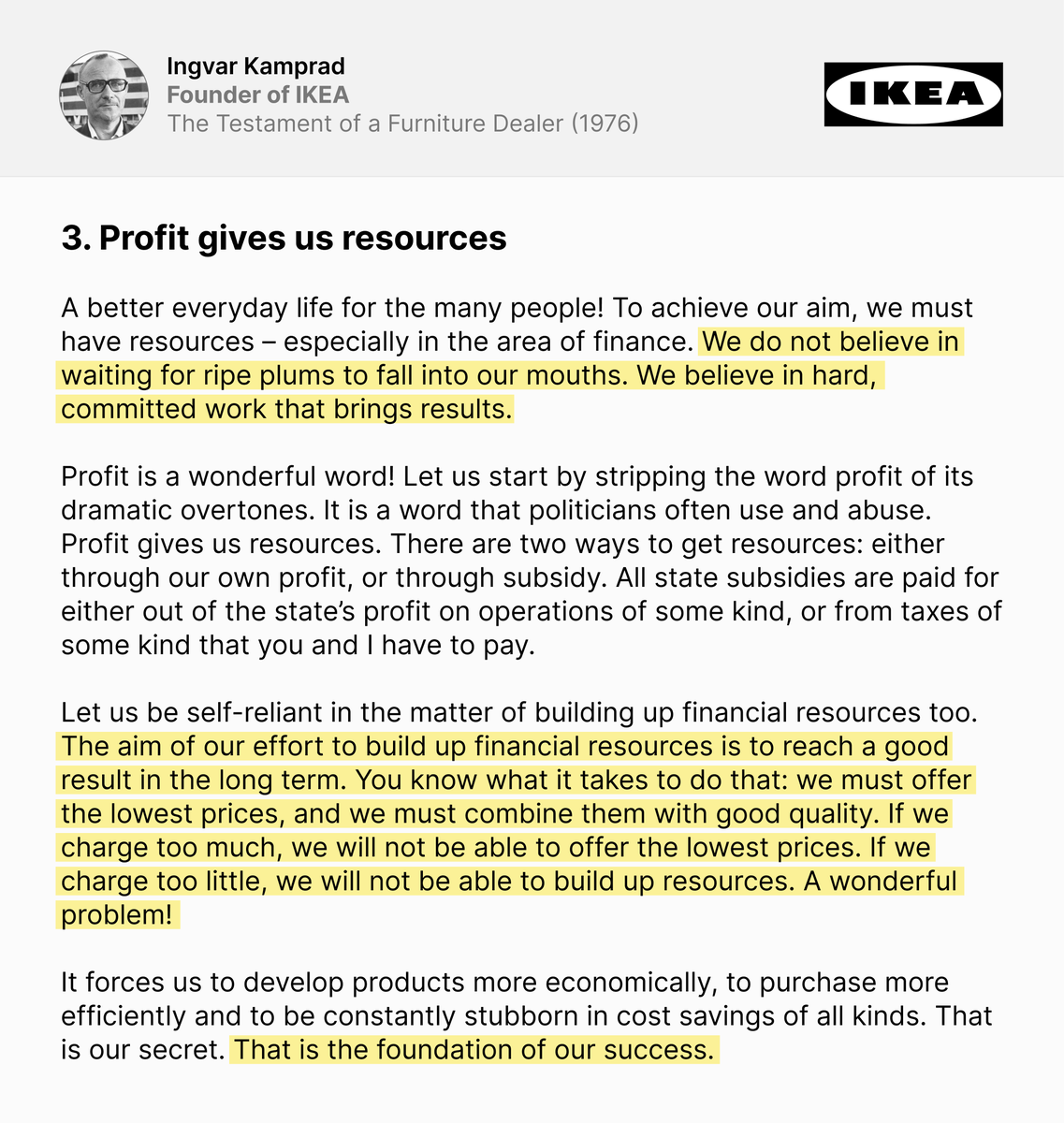
3. Profit Gives Us Resources
Kamprad describing IKEA's low-price high-quality "flywheel", and how it in the long-run would help them reach economies of scale:
Kamprad describing IKEA's low-price high-quality "flywheel", and how it in the long-run would help them reach economies of scale:
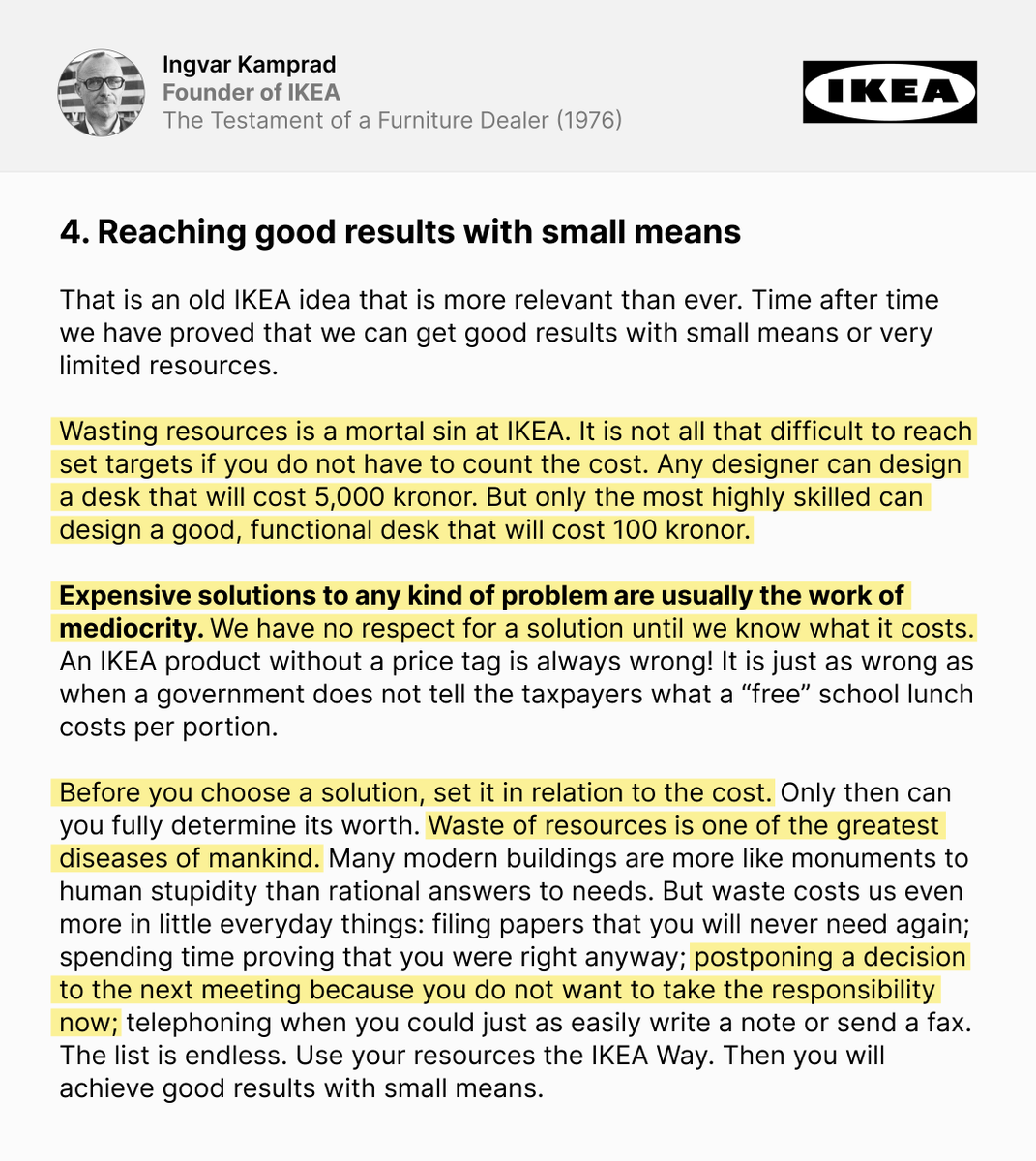
4. Reaching Good Results With Small Means
"It is not difficult to reach set targets if you do not have to count in the cost"
Kamprad personal obsessive frugality has been talked about a lot over the years. It was simply the way he was wired, and he ran IKEA the same way:
"It is not difficult to reach set targets if you do not have to count in the cost"
Kamprad personal obsessive frugality has been talked about a lot over the years. It was simply the way he was wired, and he ran IKEA the same way:
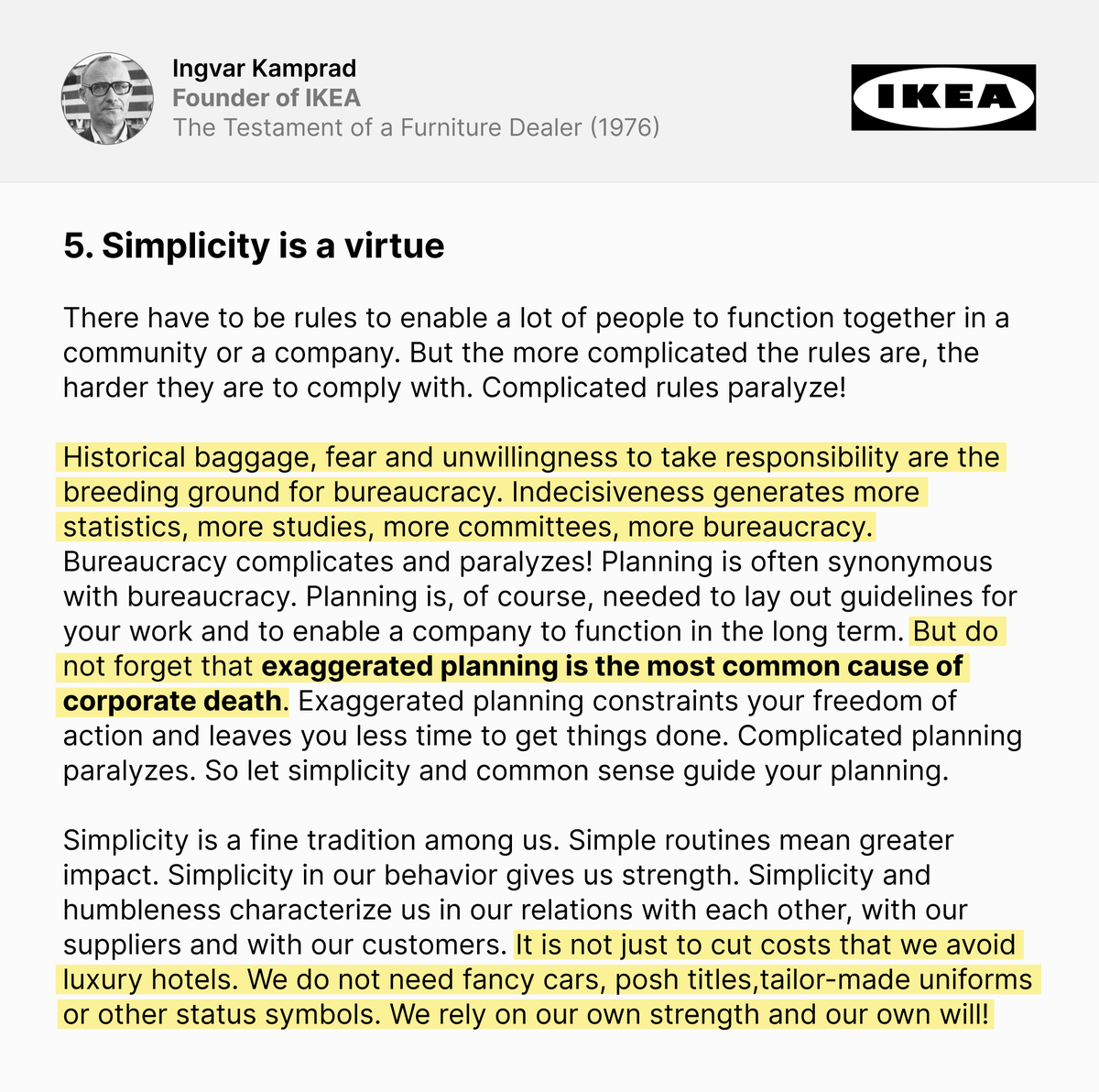
5. Simplicity Is A Virtue
"Exaggerated planning is the most common cause of corporate death"
Kamprad was very much against complex corporate hierarchies, with lots of meetings, bosses, and unnecessary rules. He preferred everything to be kept simple:
"Exaggerated planning is the most common cause of corporate death"
Kamprad was very much against complex corporate hierarchies, with lots of meetings, bosses, and unnecessary rules. He preferred everything to be kept simple:
6. Doing It A Different Way
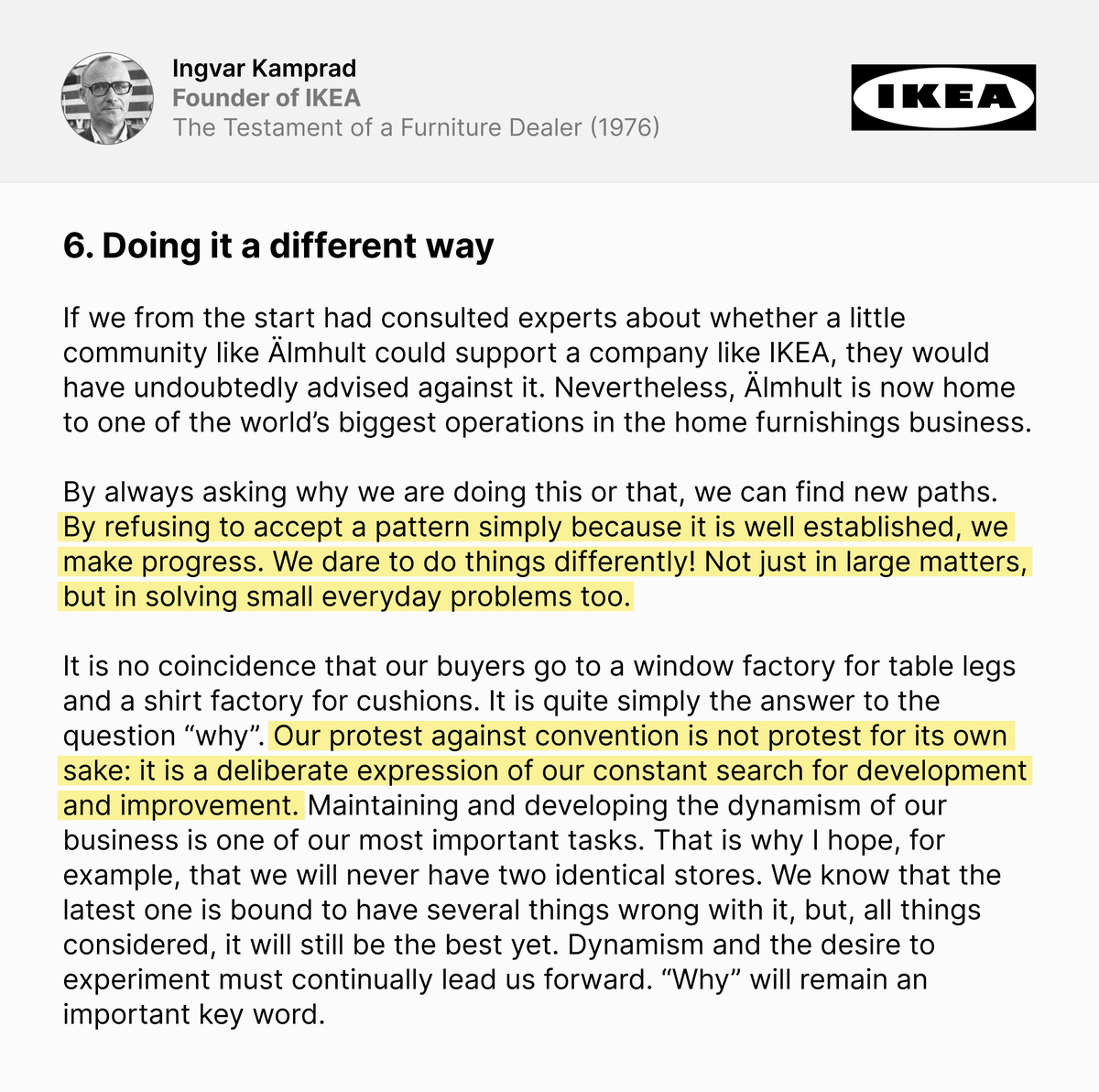
"By refusing to accept a pattern simply because it is well established, we make progress"
Kamprad was not afraid to try new methods, and instilled in IKEA's DNA to constantly find new ways of doing things:
"By refusing to accept a pattern simply because it is well established, we make progress"
Kamprad was not afraid to try new methods, and instilled in IKEA's DNA to constantly find new ways of doing things:
7. Concentration
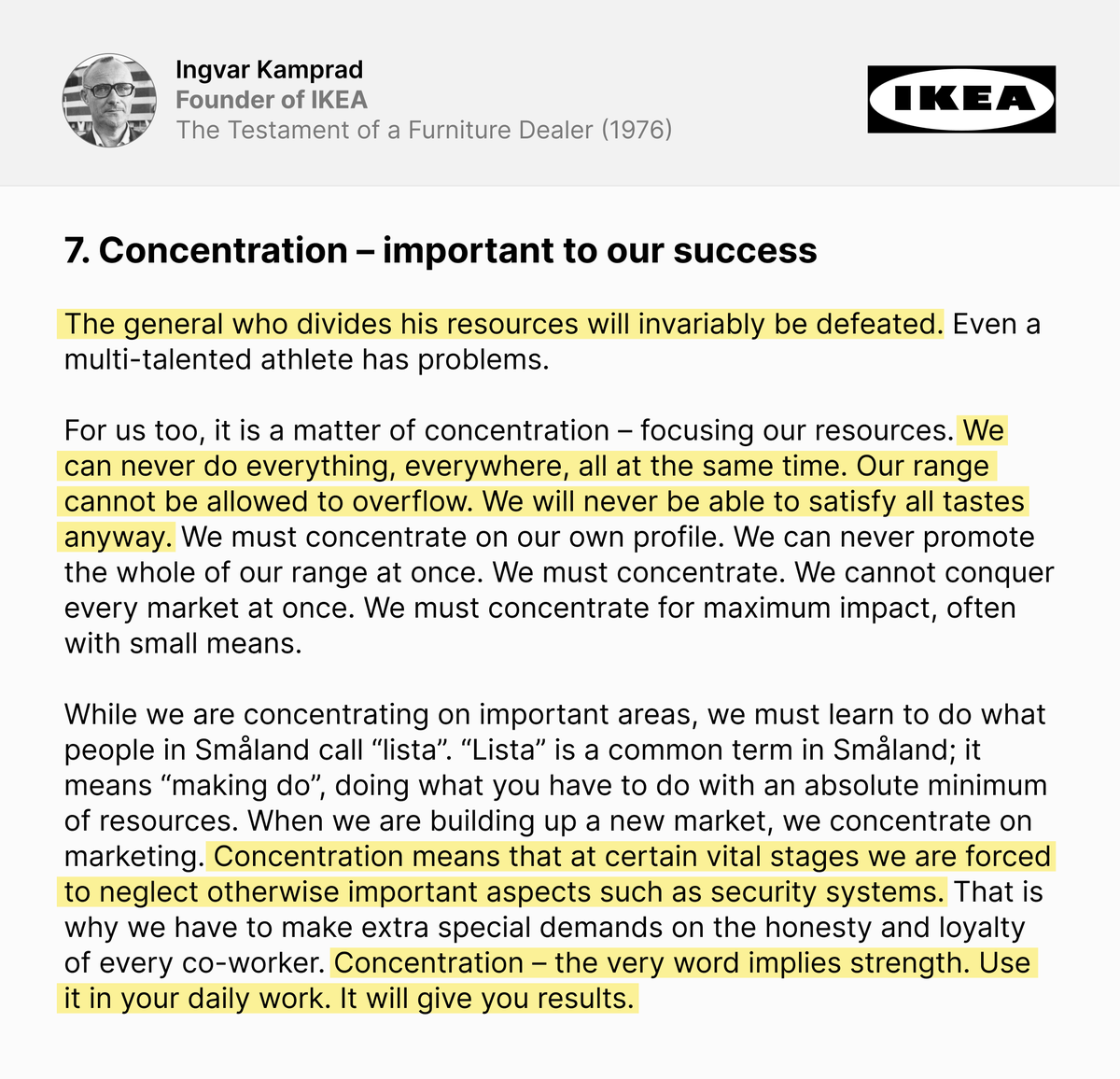
"The general who divides his resources will invariably be defeated"
Kamprad, despite his obsession with a wide ranging product catalog, understod the important of focus:
"The general who divides his resources will invariably be defeated"
Kamprad, despite his obsession with a wide ranging product catalog, understod the important of focus:
8. Taking Responsibility
"The fewer such responsibility-takers a company [...] has, the more bureaucratic it is"
This goes hand in hand with what Kamprad wrote previously on corporate simplicity. The more responsibility-takers in a company, the less bosses/hierarchy you need:
"The fewer such responsibility-takers a company [...] has, the more bureaucratic it is"
This goes hand in hand with what Kamprad wrote previously on corporate simplicity. The more responsibility-takers in a company, the less bosses/hierarchy you need:
![8. Taking Responsibility
"The fewer such responsibility-takers a company [...] has, the more bureau...](https://pbs.twimg.com/media/F7mXh28XUAAU7uc.png)
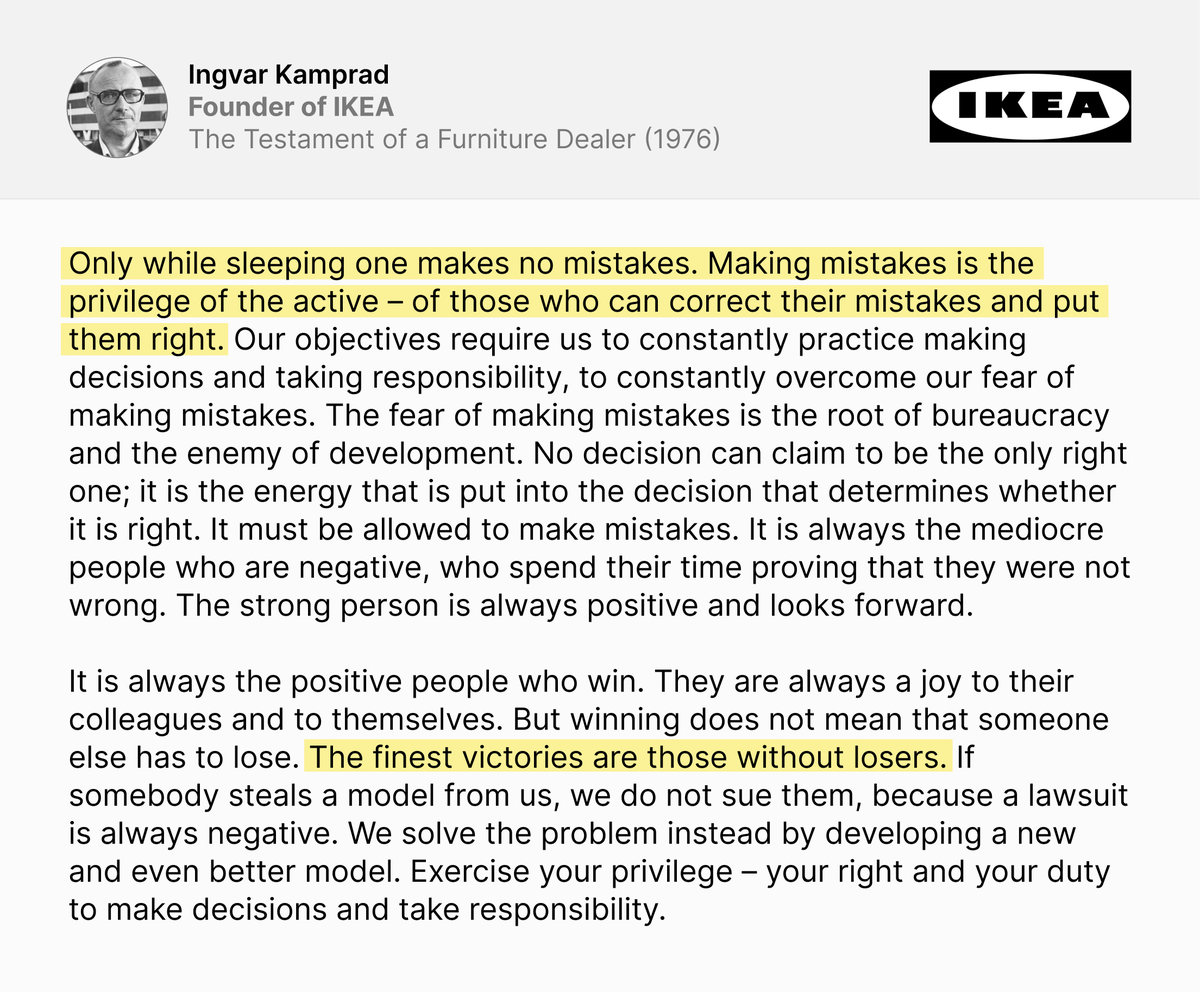
"Only while sleeping one makes no mistakes"
You have to accept mistakes if you are going to take on responsibility:
You have to accept mistakes if you are going to take on responsibility:
9. Most Things Still Remain To Be Done
"Experience is a word to be handled carefully"
Kamprad was terrified that IKEA would stagnate, and often preached about the glorious future of things that remained to be done:
"Experience is a word to be handled carefully"
Kamprad was terrified that IKEA would stagnate, and often preached about the glorious future of things that remained to be done:
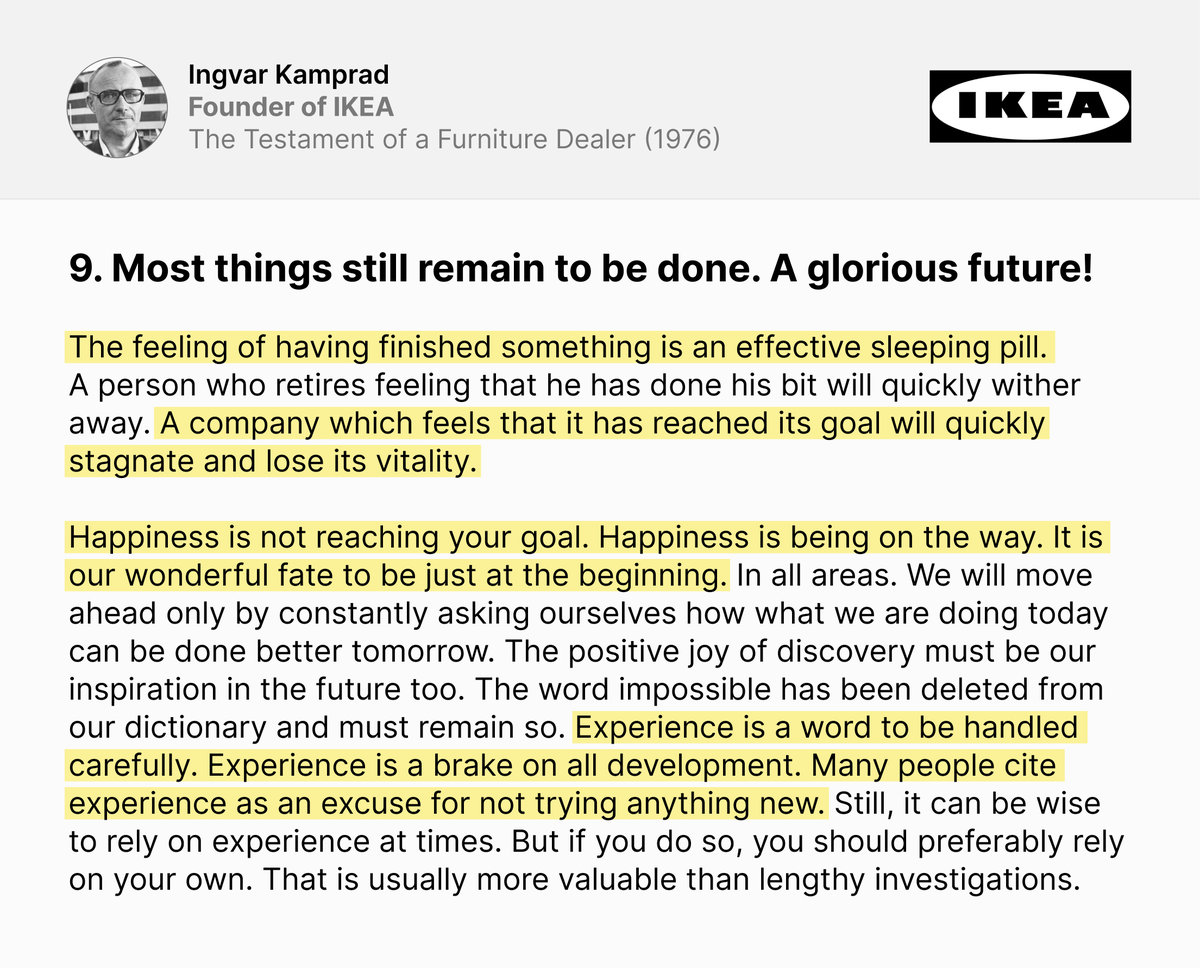
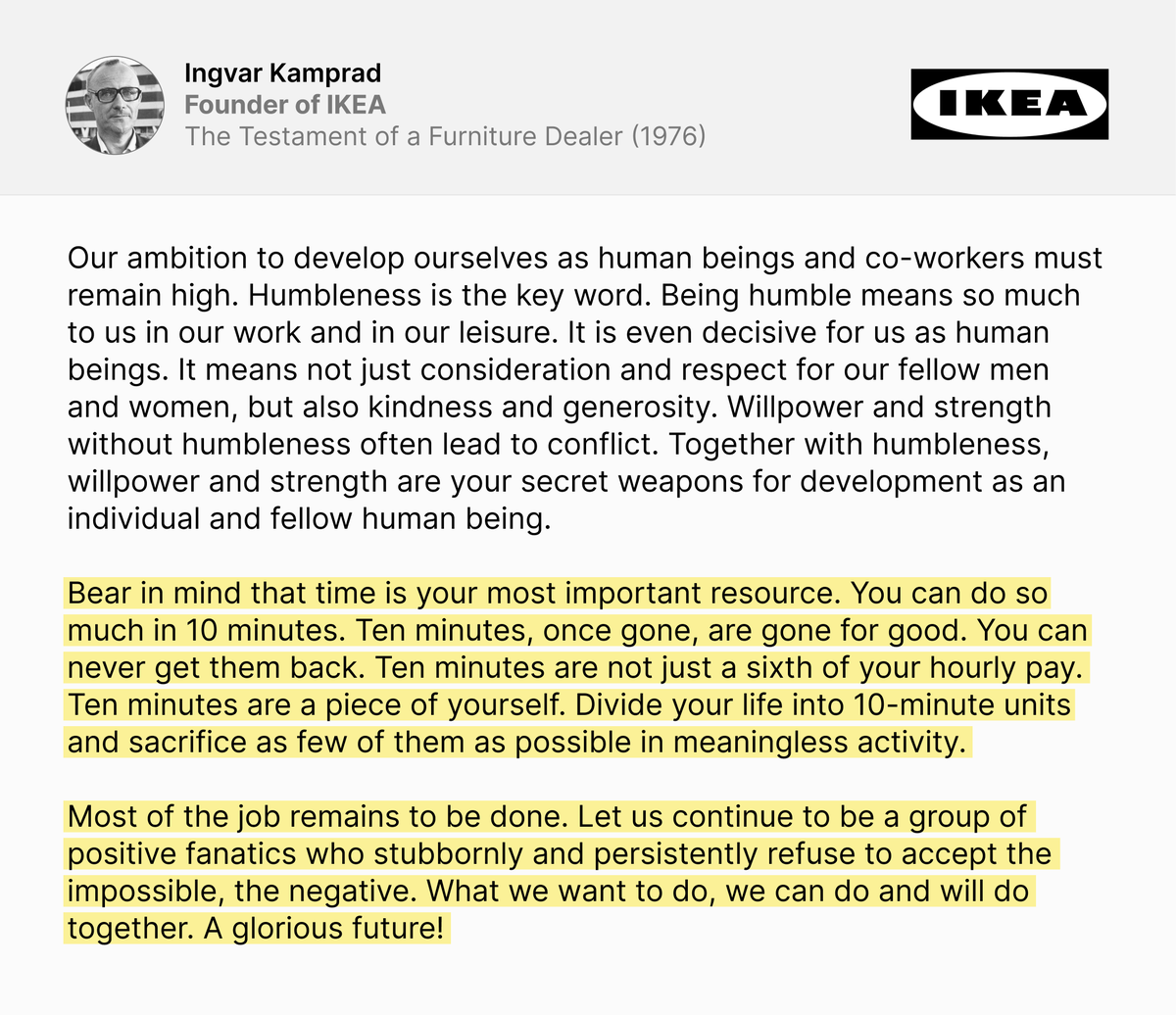
"Let us continue to be a group of positive fanatics who stubbornly and persistently refuse to accept the impossible, the negative"
Kamprad finishes the letter with a lesson on time management. Every 10-minute unit of your life is incredibly important:
Kamprad finishes the letter with a lesson on time management. Every 10-minute unit of your life is incredibly important:
Loading suggestions...