

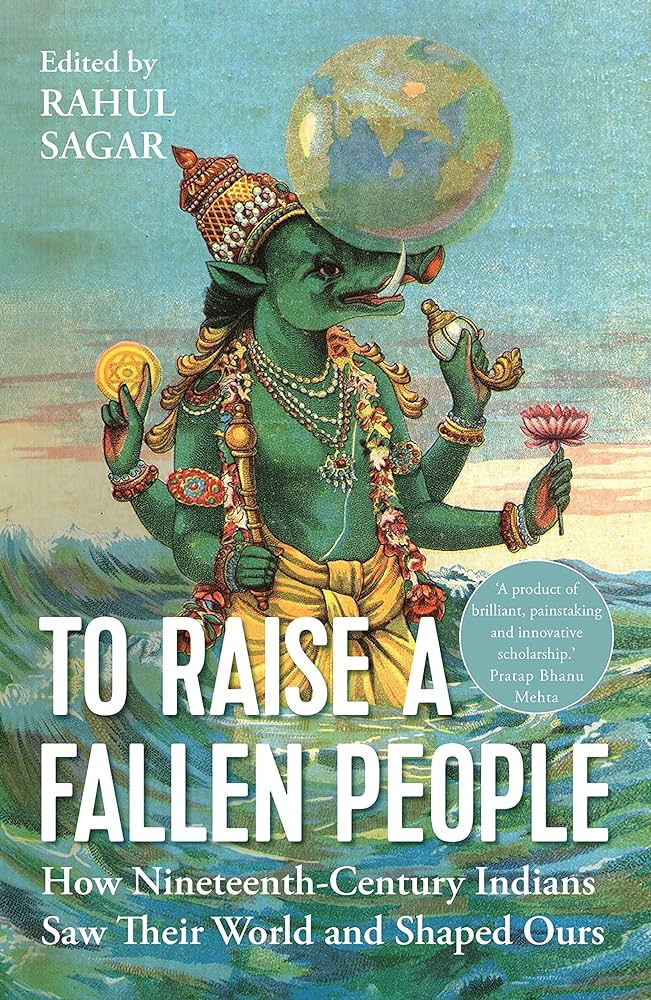
'To Raise A Fallen People' edited by @rahulsagar contains some excellently discovered works of Indians writing in the 19th century on various topics- sometimes about a very different India, & other times about how inhabitants of this great civilisation imagined their future. 1/12
Some of the best excerpts from the intro:
“It reminds contemporary observers that India has long been home to vigorous debate about ends and means in international politics. As such, it disproves the notion that there is a singular, traditional “Indian” view of the world.” 2/12
“It reminds contemporary observers that India has long been home to vigorous debate about ends and means in international politics. As such, it disproves the notion that there is a singular, traditional “Indian” view of the world.” 2/12
Instead, we witness deep disagreement with views ranging from pacific cosmopolitanism to militant nationalism. Notice what this implies. It has become commonplace to depict contemporary India as being in the midst of an intellectual revolution, as an erstwhile saintliness is..
"cast aside in favor of a new, unbecoming muscularity. The essays recovered here cast doubt on this narrative by showing that ‘New India’, as it has come to be termed, has deeper foundations than is commonly acknowledged. Muscularity may be more advertised today, but its.." 4/12
"importance has long been admitted in modern India. Consider.. this salutary warning in Bankim Chandra Chatterjee’s masterpiece Dharmatattva (1888):
"The people who are strong will rob the weaker people. I am not speaking of the barbarians: this is the custom of civilized.."
"The people who are strong will rob the weaker people. I am not speaking of the barbarians: this is the custom of civilized.."
"Europe. Today France is robbing Germany, next day Germany is robbing 🇫🇷… as dogs in the rural markets snatch morsels from one another, peoples whether they are civilized or not are despoiling one another’s property. A strong people is always ready to fall upon the weaker ones.”
“Indians were not the primitive and disorganized peoples that the Romans or the Arabs had conquered in their day. Even English-educated Indians felt that Hindu society had withstood the test of time because its mores & laws had much to comment in them. As Dar reminded his peers:"
An Englishman thinks of his ancestors as barbarians, rude, illiterate, & the like… and has no particular reason to be proud of being a descendant of Hengist and Horsa, or William the Conqueror. In fact, he considers the progress of European society to be hampered to a great..
"extent by the customs and traditions of feudalism surviving up to this day. But can an Indian contemplate the course of Indian history with the same feeling? No. That there once existed a mighty civilization in India, nobody can deny; and though in a great many respects.." 9/12
"respects it is not suited to the present age, yet it developed to their full extent certain qualities and faculties of the human mind, without which there can be no completeness in our progress, and which it will be ill for us to lose." 10/12
"As Vivekananda recounted in 1897 before the Triplicane Literary Society in Madras:
"I was asked by a young lady in London, “What have you Hindus done? You have never even conquered a single nation.” That is true from the point of view of the Englishman, the brave, the heroic.."
"I was asked by a young lady in London, “What have you Hindus done? You have never even conquered a single nation.” That is true from the point of view of the Englishman, the brave, the heroic.."
conquest is the greatest glory that one man can have over another. That is true from his point of view, but from ours it is quite the opposite. If I ask myself what has been the cause of India’s greatness, I answer, “The cause is that we have never conquered.” That is our glory
Loading suggestions...