

Object Oriented Programming
Object-oriented programming (OOP) is a programming paradigm or methodology that organizes and structures code by modelling real-world entities and their interactions using objects. In OOP, an "object" is a self-contained unit that represents a combination of data (attributes or properties) and the methods (functions or procedures) that operate on that data. These objects can be used to create complex systems by defining relationships and interactions between them.
Object-oriented programming (OOP) is a way of writing computer programs that mimics the way we think about and interact with real-world objects. In OOP, we use "objects" to represent things, and these objects can have both data (like characteristics) and actions (like behaviors). We create these objects from "classes," which are like templates for objects with predefined properties and behaviors.
Imagine a car as an object in OOP. The car object would have data (attributes) like its color, make, and model. It would also have actions (methods) like starting the engine, accelerating, and braking. OOP helps us organize our code by breaking it down into these object-oriented structures, making it easier to understand and manage.
Key concepts of object-oriented programming:
- Classes: Think of classes as blueprints for creating objects. They define what an object will look like and what it can do.
- Objects: Objects are instances created from these blueprints (classes). They have characteristics (data) and behaviors (actions).
- Encapsulation: This is like putting a protective layer around an object. It hides the complicated stuff inside and provides a clean way to interact with it from the outside.
- Inheritance: Inheritance is like passing down traits from parents to children. In OOP, it allows one class to inherit features from another class, making code reuse easy.
- Polymorphism: This is the ability for different objects to respond to the same request in their unique way. It makes your code more flexible.
- Abstraction: Abstraction simplifies complex things by focusing on the important parts and hiding the less important details. It's like using a TV remote without needing to know how it works inside.
Object-oriented programming (OOP) is a programming paradigm or methodology that organizes and structures code by modelling real-world entities and their interactions using objects. In OOP, an "object" is a self-contained unit that represents a combination of data (attributes or properties) and the methods (functions or procedures) that operate on that data. These objects can be used to create complex systems by defining relationships and interactions between them.
Object-oriented programming (OOP) is a way of writing computer programs that mimics the way we think about and interact with real-world objects. In OOP, we use "objects" to represent things, and these objects can have both data (like characteristics) and actions (like behaviors). We create these objects from "classes," which are like templates for objects with predefined properties and behaviors.
Imagine a car as an object in OOP. The car object would have data (attributes) like its color, make, and model. It would also have actions (methods) like starting the engine, accelerating, and braking. OOP helps us organize our code by breaking it down into these object-oriented structures, making it easier to understand and manage.
Key concepts of object-oriented programming:
- Classes: Think of classes as blueprints for creating objects. They define what an object will look like and what it can do.
- Objects: Objects are instances created from these blueprints (classes). They have characteristics (data) and behaviors (actions).
- Encapsulation: This is like putting a protective layer around an object. It hides the complicated stuff inside and provides a clean way to interact with it from the outside.
- Inheritance: Inheritance is like passing down traits from parents to children. In OOP, it allows one class to inherit features from another class, making code reuse easy.
- Polymorphism: This is the ability for different objects to respond to the same request in their unique way. It makes your code more flexible.
- Abstraction: Abstraction simplifies complex things by focusing on the important parts and hiding the less important details. It's like using a TV remote without needing to know how it works inside.
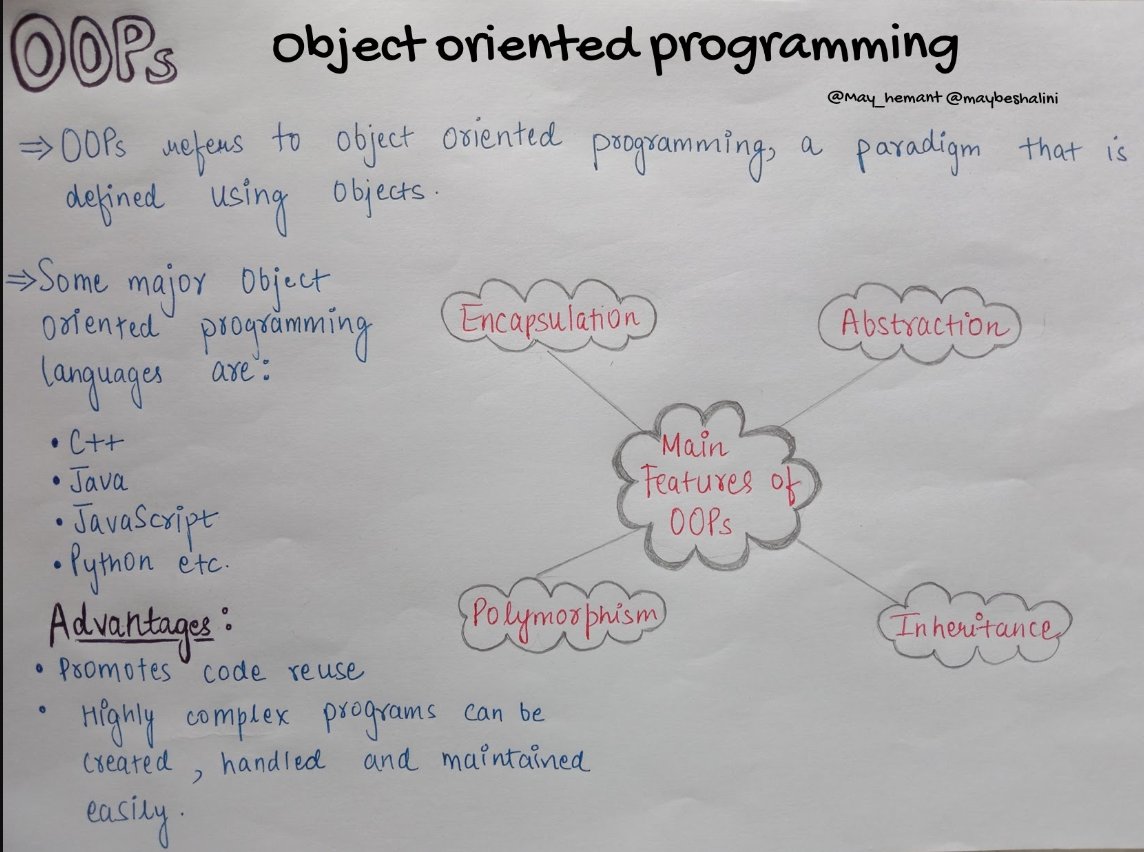
Starting tomorrow, we will explore the pillars of OOP.
Loading suggestions...