

I was teaching third year medical students about acute kidney injury and the lecture begins with a brief history of extracorporeal dialysis for AKI. I asked a student what extracorporeal dialysis was, and he correctly identified it as “dialysis outside the body”
#Tweetorial 1/16
#Tweetorial 1/16
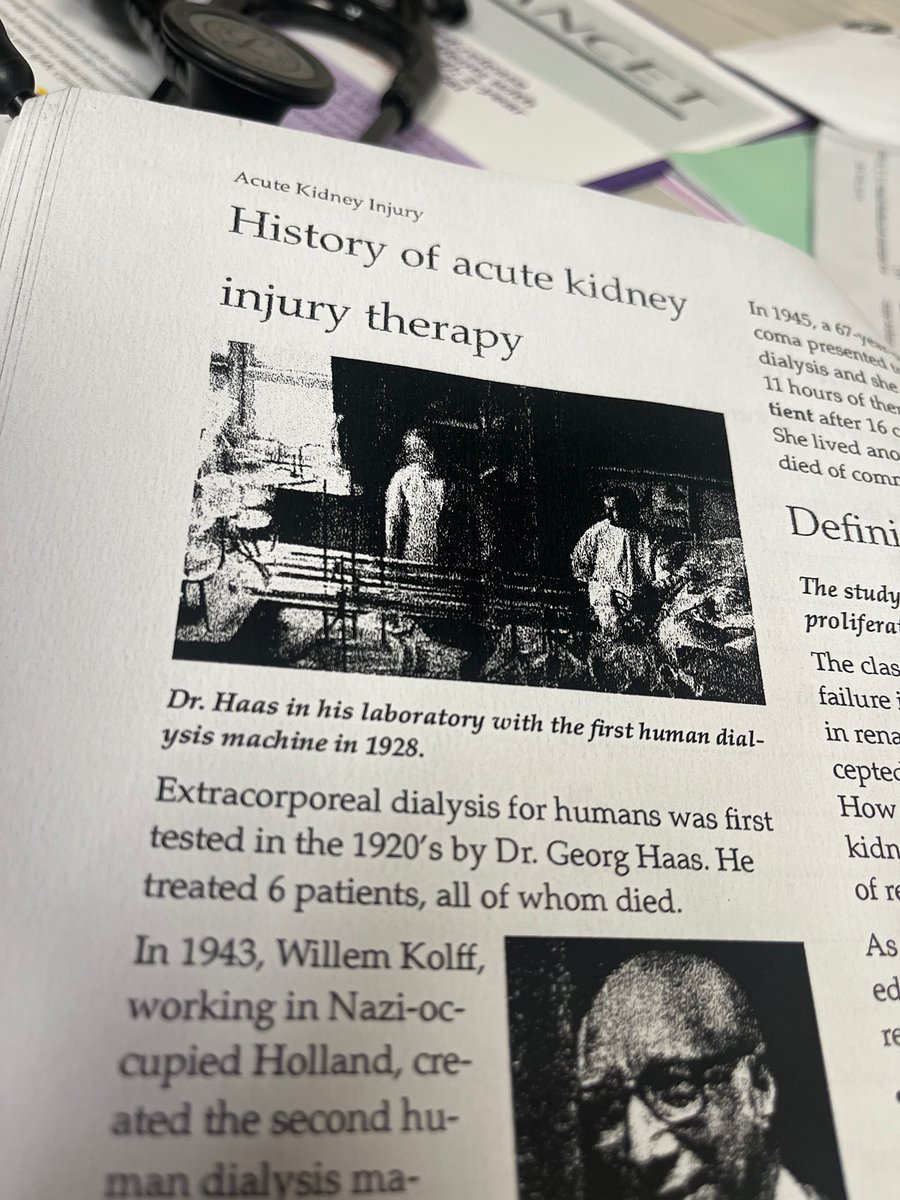
Since the ironclad law of the Socratic Method is that every correct answer is rewarded with another, harder, question, I replied, “Can you think of any example of intracorporeal dialysis?” The right answer is peritoneal dialysis, but he said , “The kidney?”
2/16
2/16

And off on a tangent we went...
Does the kidney even do dialysis? No. The kidney does not use diffusion to clean the blood. Clearance is provided by convection at the glomerulus.
3/16
Does the kidney even do dialysis? No. The kidney does not use diffusion to clean the blood. Clearance is provided by convection at the glomerulus.
3/16
Let's review renal clearance
Plasma is squeezed through the slit diaphragms of the podocytes in the glomerulus but besides the lack of protein, the solute composition on both sides of that membrane is essentially identical.
4/16
Plasma is squeezed through the slit diaphragms of the podocytes in the glomerulus but besides the lack of protein, the solute composition on both sides of that membrane is essentially identical.
4/16
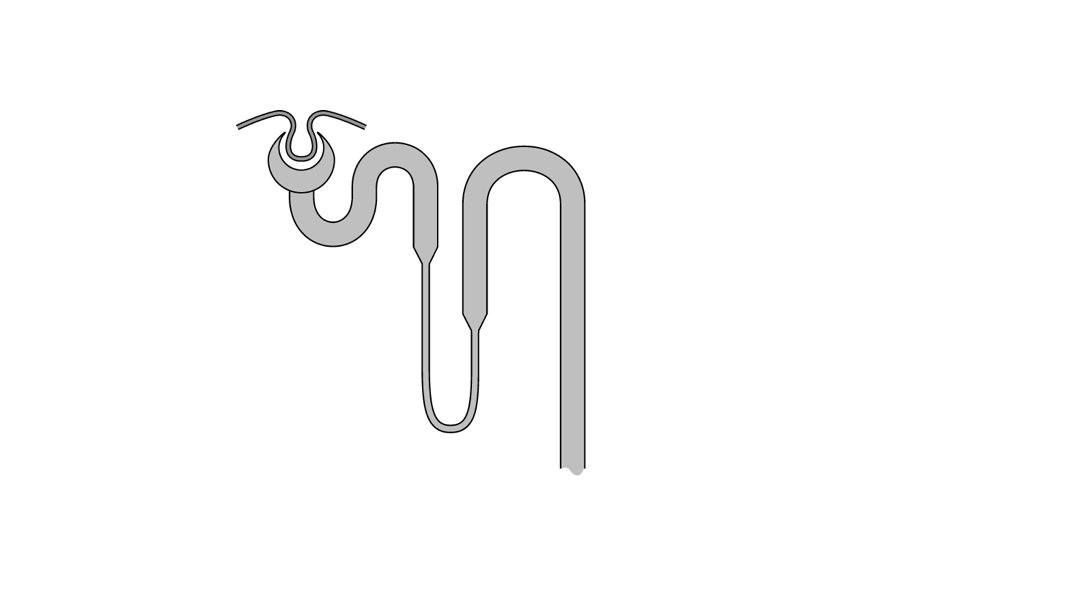
The kidney does not clear the blood by diffusion, the defining characteristic of dialysis, but rather by convection.
How does that work? Glad you asked. Take Creatinine. The creatinine on both sides of the podocyte is the same, 4.4 mg/dL in this example. 5/16
How does that work? Glad you asked. Take Creatinine. The creatinine on both sides of the podocyte is the same, 4.4 mg/dL in this example. 5/16
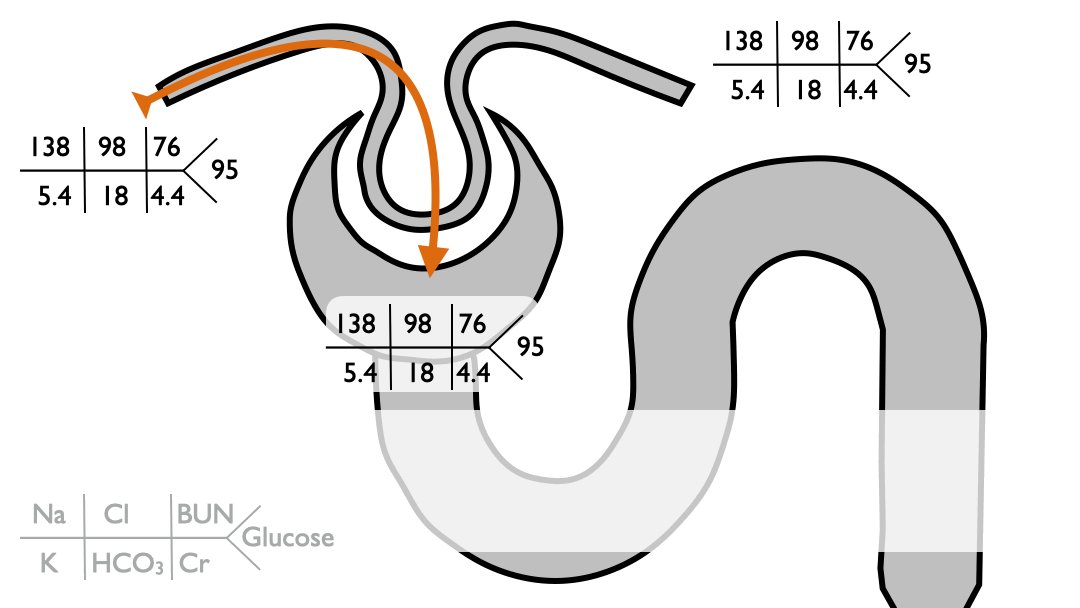
4.4 mg per dL x GFR of 25 mL/min x 1440 min/day divided my 100 mL pre dL = 1584 mg of creatinine filtered.
That is about the amount of creatinine produced daily.
So diffusive clearance can clear all of the creatinine. And additional Cr is secreted in the proximal tubule. 6/16
That is about the amount of creatinine produced daily.
So diffusive clearance can clear all of the creatinine. And additional Cr is secreted in the proximal tubule. 6/16

What about sodium?
138 mEq/L x GFR 25 mL/min x 1440 min/day divided by 1000 mL/liter = 4968 mEq of Na filtered.
PROBLEM: We only consume 100-200 mEq of Na per day. This is why we have tubules, to reabsorb all the excess filtered Na to keep us from peeing ourselves to death. 7/16
138 mEq/L x GFR 25 mL/min x 1440 min/day divided by 1000 mL/liter = 4968 mEq of Na filtered.
PROBLEM: We only consume 100-200 mEq of Na per day. This is why we have tubules, to reabsorb all the excess filtered Na to keep us from peeing ourselves to death. 7/16

This demonstrates a critical concept of convective clearance: it is better for clearing things at a high concentration than a low concentration. A GFR of 1 ml/min is adequate to clear the daily Na load
138 x 1 ml/min x 1440 min/day divided by 1000 ml/L = 198 mEq/day
7/16
138 x 1 ml/min x 1440 min/day divided by 1000 ml/L = 198 mEq/day
7/16
But that same GFR of 1 would only clear
4.4 mg dL Cr x 1 ml/min x 1440 divided by 100 ml/dL = 63 mg of creatinine, or only about 4% of the daily creatinine load*
8/16
4.4 mg dL Cr x 1 ml/min x 1440 divided by 100 ml/dL = 63 mg of creatinine, or only about 4% of the daily creatinine load*
8/16
*This calculation is highly dependant on the serum Cr, which would be a lot higher than 4.4 if the GFR was 1, but since a GFR of 1 in incompatible with life, the patient would also be getting renal replacement therapy, so it is hard to know where the serum Cr would actually be.
So after explaining that the kidney didn’t actually do dialysis, or anything remotely close to dialysis. I asked if there was an organ that did do dialysis? Or, more specifically, used diffusion for clearance.
Liver > nope
Spleen > nope
Skin > nope
And finally, Lung? Yup.
9/16
Liver > nope
Spleen > nope
Skin > nope
And finally, Lung? Yup.
9/16

The lung clears carbon dioxide from the body and absorbs oxygen by creating a setting where the gasses move down their respective concentration gradients across a semipermeable membrane. You know, like dialysis.
10/16
10/16
A ventilator is not really artificial lung, in the way a dialysis machine replaces the core function of a kidney. It provides flow, but no clearance. We still are dependent on the alveolar membrane for oxygen absorption and carbon dioxide clearance.
11/16
11/16
But ECMO is an artificial lung and fully replaces the alveoli and uses the principles of dialysis to clear carbon dioxide and move oxygen into the blood. So at some level, ECMO is philosophically closer to the lung than dialysis is to the kidney
12/16
12/16
One final note on this thread is in regards to dialysis and convection. The kidneys work by convective clearance but our primary means of replacing them is by diffusive clearance.
13/16
13/16
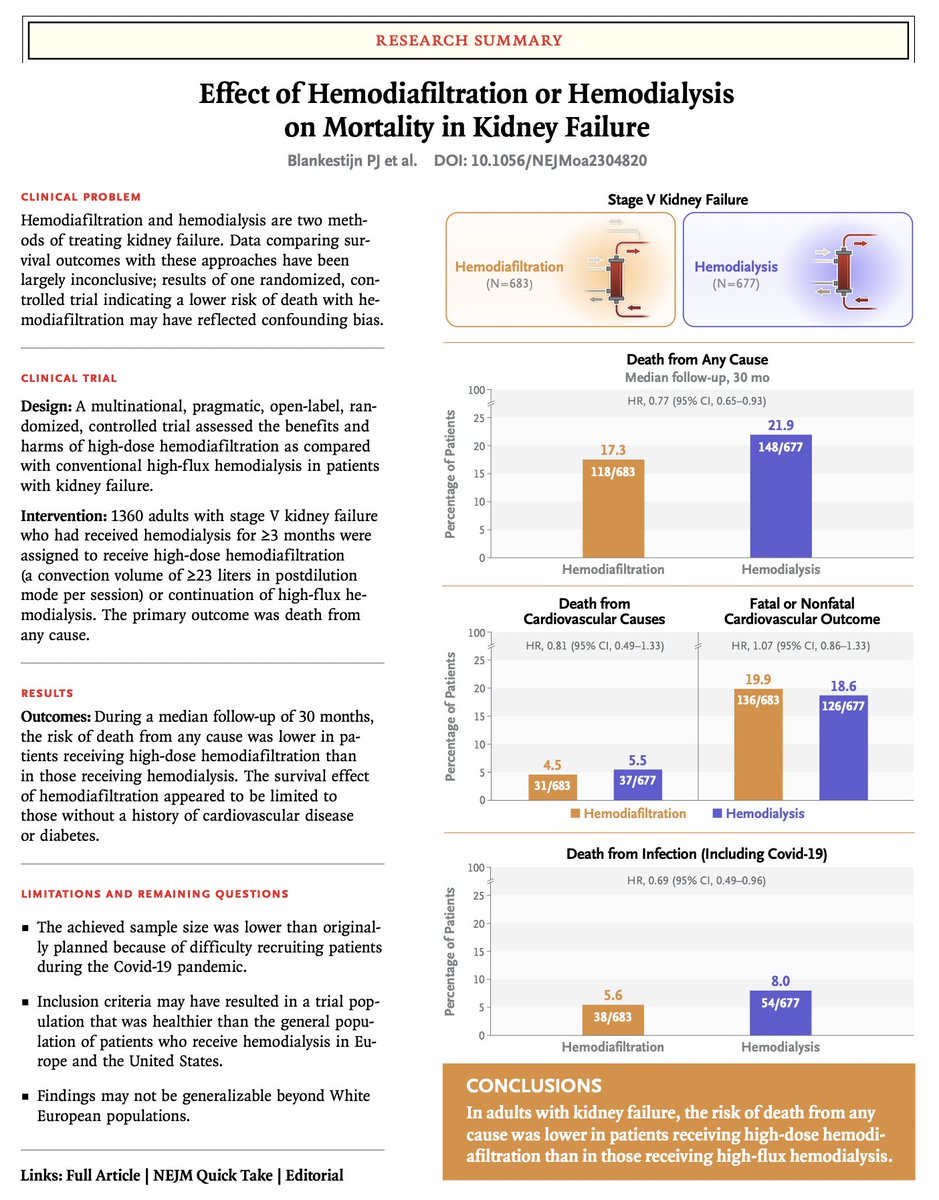
This summer, we saw a randomized controlled trial of modifying dialysis to use convection rather than diffusion…and the result? Significant reduction in total mortality.
14/16
nejm.org
14/16
nejm.org

We don’t get a lot of wins in dialysis, so when we get one, we pay attention.
Hat tip to @NephRodby for inspiring this tweetorial
16/16
Hat tip to @NephRodby for inspiring this tweetorial
16/16
Loading suggestions...