

🚨NEW ARTICLE ALERT🚨
Did Proto-Indo-European borrow words from Proto-Semitic?
Short answer: No
Long answer: vr-elibrary.de
Medium length answer: thread 🧵👇
Did Proto-Indo-European borrow words from Proto-Semitic?
Short answer: No
Long answer: vr-elibrary.de
Medium length answer: thread 🧵👇
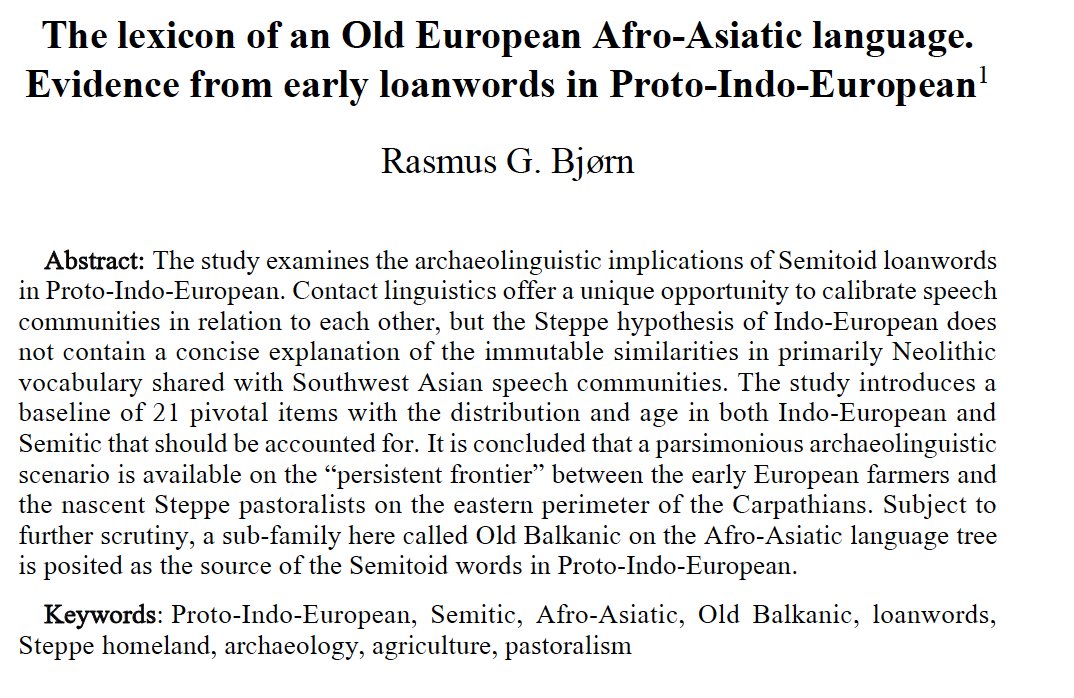
Loanwords are telltale signs of contacts between different speech communities. Why does Proto-Uralic have early Indo-European words? (
But there are similar immutable similarities with Semitic and wider Afro-Asiatic that have played a lesser role.
But there are similar immutable similarities with Semitic and wider Afro-Asiatic that have played a lesser role.
In this new article, I show that there is some correlation between the archaeological record and the items denoted in the purported shared vocabulary between PIE and languages of the Southwest Asian (including Egyptian and Berber) Neolithic speech communities.
Gamkrelidze-Ivanov and Dolgopolsky famously provided lists to support a SW Asian homeland of Proto-Indo-European. The hypothesis is not favored among IE linguists, although non-experts appear swayed by arguments based on genetics and Bayesian analyses (
(If you nonetheless find this hypothesis intriguing, I invite anyone to explore the following data in the context of a SW Asian homeland – as I proposed to one of the PI’s of the Heggart et al. paper; he was not interested!).
Method: piecing new insights from research together with the established or majority views. Mostly consensus views, but with the prehistoric contact perspective, including folk etymologies and tentatively accepting minor mismatches through lost intermediaries.
There are similarities between any two languages. If there is a demonstrable regular correspondence, we can make inferences on the linguistic material alone. Yet prehistory is generally not too happy to give up linguistic data, so we have to work with what we’ve got.
In my new article in Historische Sprachforschung, I provide the following new perspectives to the debate:
1. IE Stratigraphy - some are PIE with regular developments into all branches, others not
2. Contextualization of Semitic evidence - is it found elsewhere?
...
1. IE Stratigraphy - some are PIE with regular developments into all branches, others not
2. Contextualization of Semitic evidence - is it found elsewhere?
...
...
3. Archaeolinguistic analysis - how does the chronology of the loanwords fit the chronology of the archaeological record into the Steppe Zone
4. Recognition of the cultural impact of the Neolithic cultures of Old Europe
3. Archaeolinguistic analysis - how does the chronology of the loanwords fit the chronology of the archaeological record into the Steppe Zone
4. Recognition of the cultural impact of the Neolithic cultures of Old Europe
The article discusses 21 lexical items ordered in chronological order from the IE perspective. This order is subject to discussion. I’d be happy to discuss any particular word, a subset, or the list in its entirety. This is just an introduction.
Here's the list with examples
Here's the list with examples
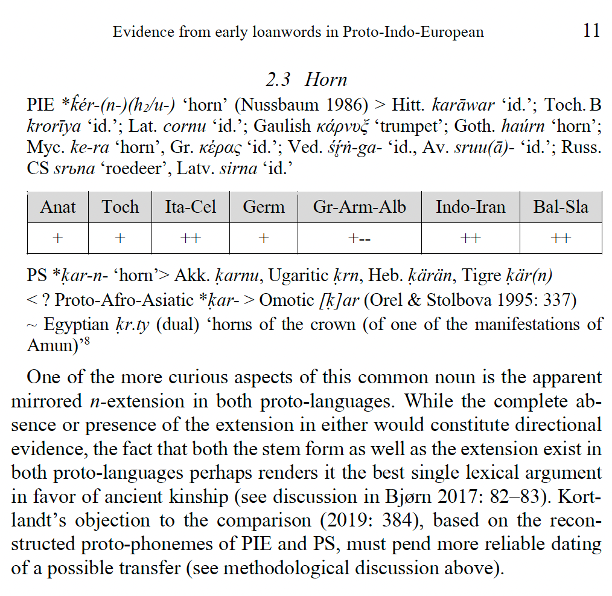
Tantalizing, but no obvious transfer event:
🤘Horn PIE *k̂ér-(n-)(h2/u-) ~ PS *ḳar-n- (<? PAA *ḳar-)
🌟Star PIE *h2ster- ~ PS *ʕaθtar- ‘deified morning star’
🦅 Eagle PIE *h3or-(n-) ~ PS *ɣVrVn ‘eagle’ ~ Sumerian erin, (ḫ)u₁₁-rí-in ‘eagle, standard’
🤘Horn PIE *k̂ér-(n-)(h2/u-) ~ PS *ḳar-n- (<? PAA *ḳar-)
🌟Star PIE *h2ster- ~ PS *ʕaθtar- ‘deified morning star’
🦅 Eagle PIE *h3or-(n-) ~ PS *ɣVrVn ‘eagle’ ~ Sumerian erin, (ḫ)u₁₁-rí-in ‘eagle, standard’
Early contacts, trade
6⃣ PIE *(s)wek̑s ~ Kartv. *ekws~ Hurrian šeše ~ PS *šidt ~ Eg. śrś.w ~ Berber *sdis ~ NWC *(s)əxwə ~
7⃣ PIE *septm ~ PS *t͡sabʕa-t ~ Eg. śfḫ ~ Berb *sa ~ Kartv. *šwid- ~ Hur. *šindi- ~ U. *ćäjć(ć)imä, Turk. *sjeti, O.Chin. *tshit, Basque zazpi, Etr. semph
.
6⃣ PIE *(s)wek̑s ~ Kartv. *ekws~ Hurrian šeše ~ PS *šidt ~ Eg. śrś.w ~ Berber *sdis ~ NWC *(s)əxwə ~
7⃣ PIE *septm ~ PS *t͡sabʕa-t ~ Eg. śfḫ ~ Berb *sa ~ Kartv. *šwid- ~ Hur. *šindi- ~ U. *ćäjć(ć)imä, Turk. *sjeti, O.Chin. *tshit, Basque zazpi, Etr. semph
.
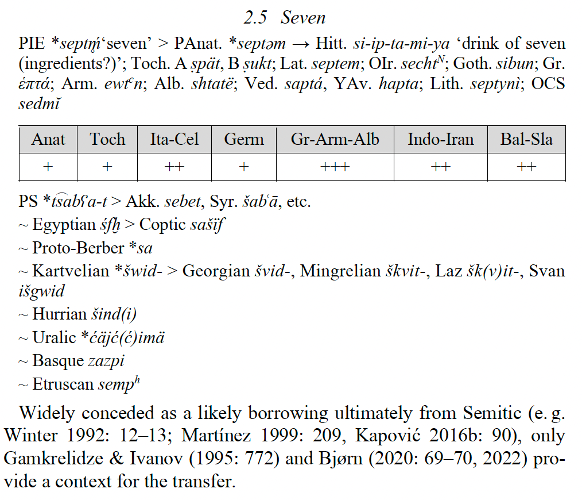
8⃣ PIE *(H)ok̑toH ~ Berber *okkuz‘four’ ~ Kartv. *otxo ’four’
🤝PIE *kwrei(h2)- 'to pay, exchange' ~ PS *krj- 'to trade'
🤝PIE *kwrei(h2)- 'to pay, exchange' ~ PS *krj- 'to trade'
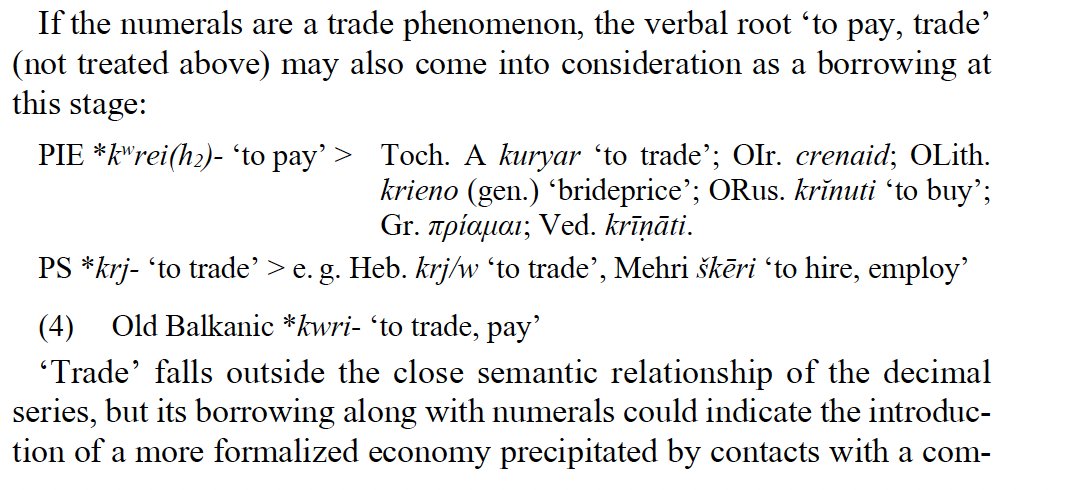
early contacts, first agropastoral adoptions – likely closely associated with the above
🐄 Cow PIE *gwṓu– ~ Egyptian gw‘bull’ ~ Sumerian gu4 ~ gud ‘bull’ NWC, NEC
🐑 Sheep (see the article for all forms)
🌾 Grain
🍖 Feast
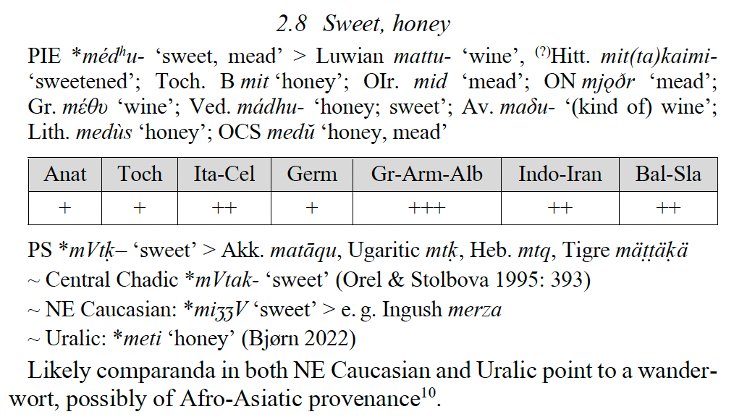
🍯 Honey
🥌 millstone
🔒 Lock
🚜 Field
🤠 To drive cattle
🐄 Cow PIE *gwṓu– ~ Egyptian gw‘bull’ ~ Sumerian gu4 ~ gud ‘bull’ NWC, NEC
🐑 Sheep (see the article for all forms)
🌾 Grain
🍖 Feast
🍯 Honey
🥌 millstone
🔒 Lock
🚜 Field
🤠 To drive cattle
Later, but still early borrowings in the European branches
🌱 Barley
🐄 Cattle (aleph)
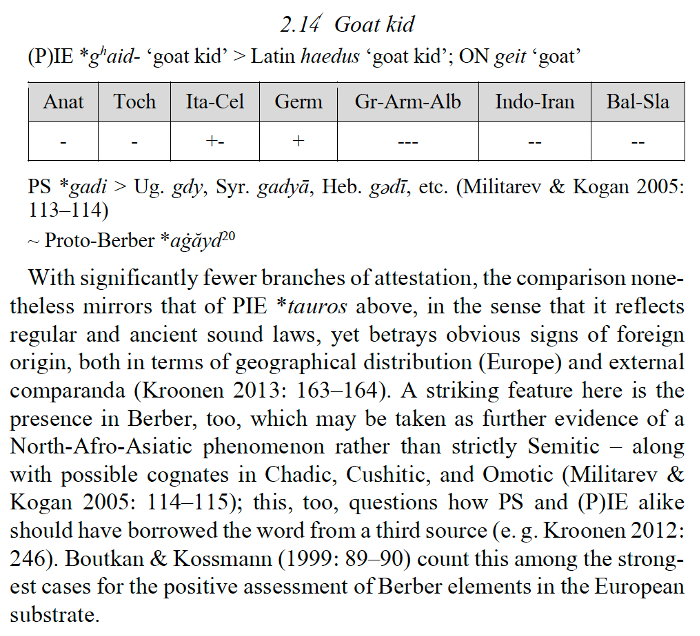
🐐 Goat
🐂 Bull
💁♀️ Sister-in-law
🌱 Barley
🐄 Cattle (aleph)
🐐 Goat
🐂 Bull
💁♀️ Sister-in-law
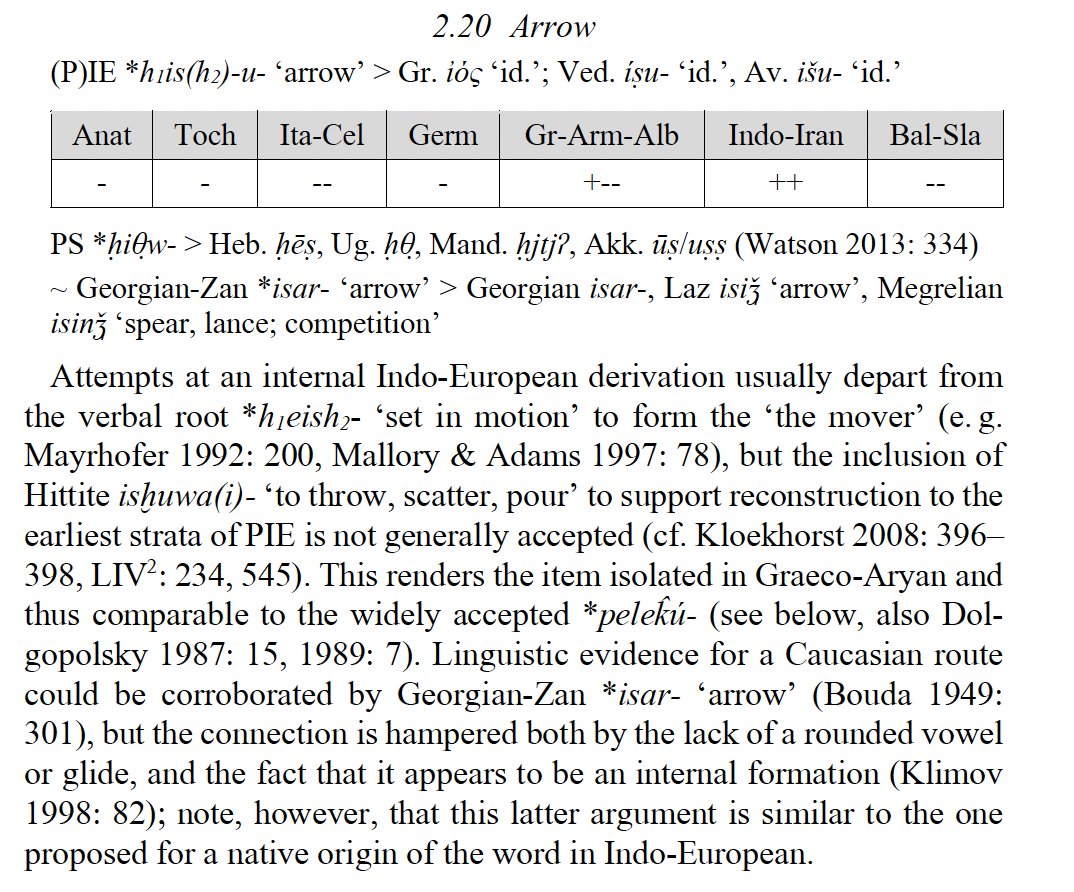
The Greco-Aryan armory words – a later and truly Semitic impulse?
🏹 Arrow
🪓 Axe
🏹 Arrow
🪓 Axe
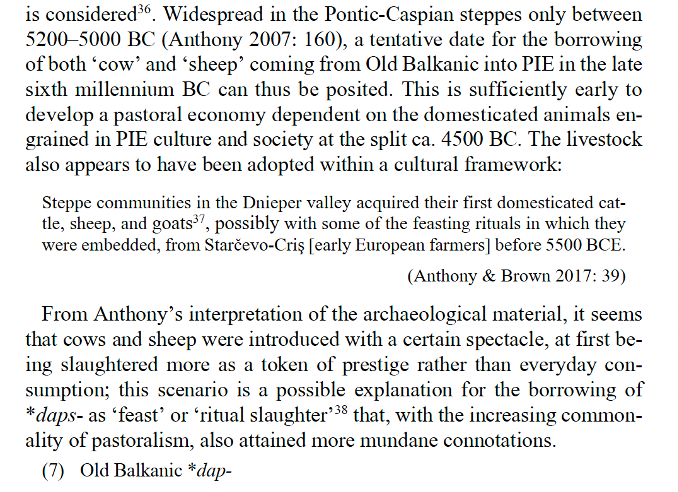
I go on to argue that the linguistic stratigraphy generally matches that of the archaeological record and the expected order of borrowings into a hunter-gatherer society that first fully incorporates pastoralism and only marginally adopts agricultural practices (an example):
This contextualization naturally comes with some implications for Proto-Indo-European and Afro-Asiatic
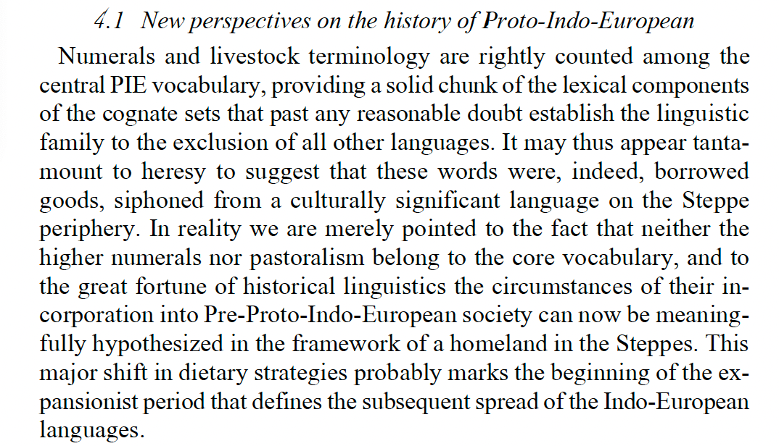
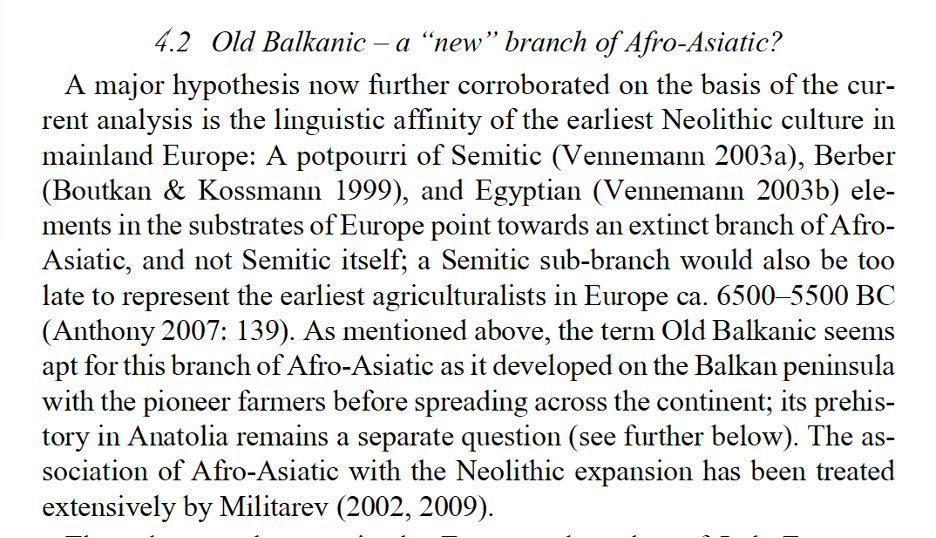
This is not proof. It is a (re)contextualization of salient linguistic data. It is also a limited archaeological appraisal. Further studies should scrutinize both the linguistic and archaeological data points. It’s just easier to scrutinize a concrete hypothesis!
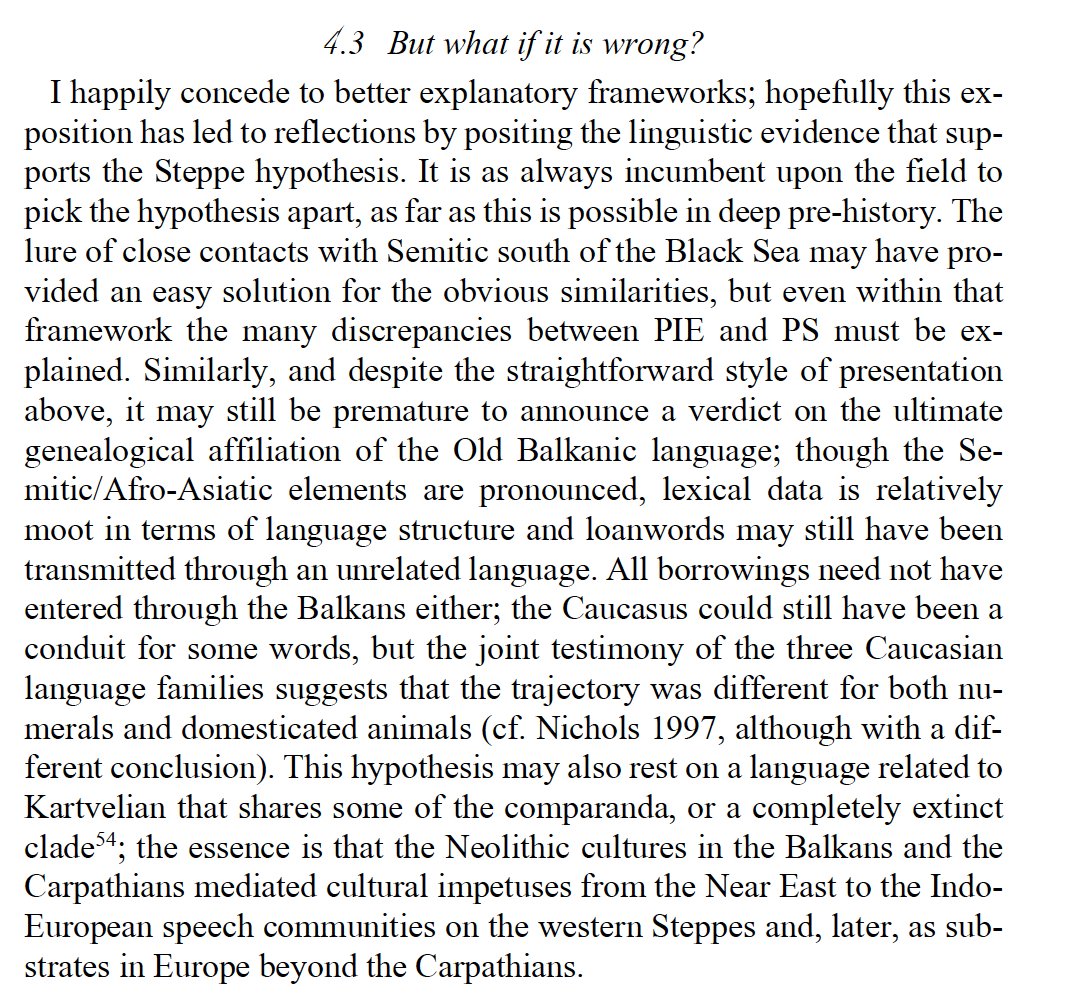
Note that recent archaeogenetic studies support the persistent cultural exchange frontier, here (Peske et al. 2023). nature.com
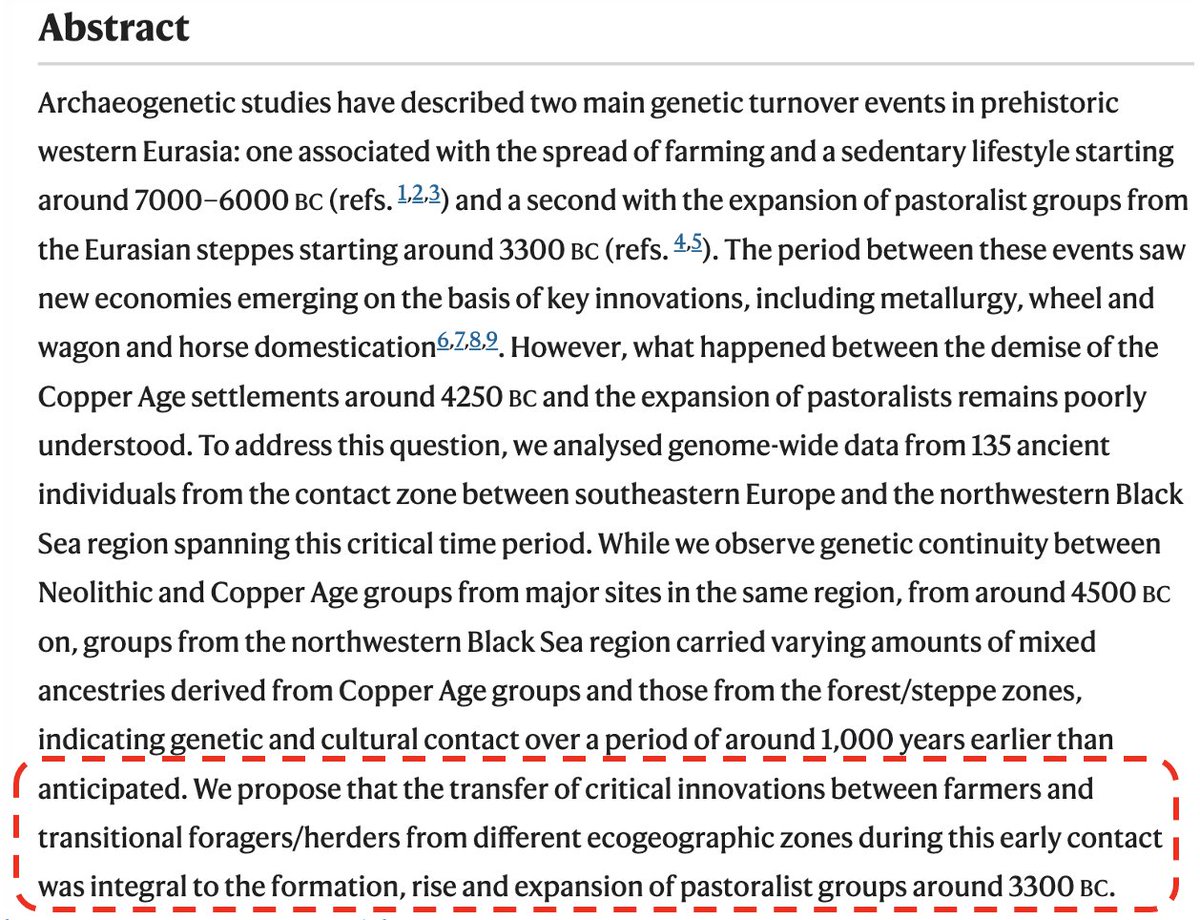

Major take-aways, as summarized in the conclusion
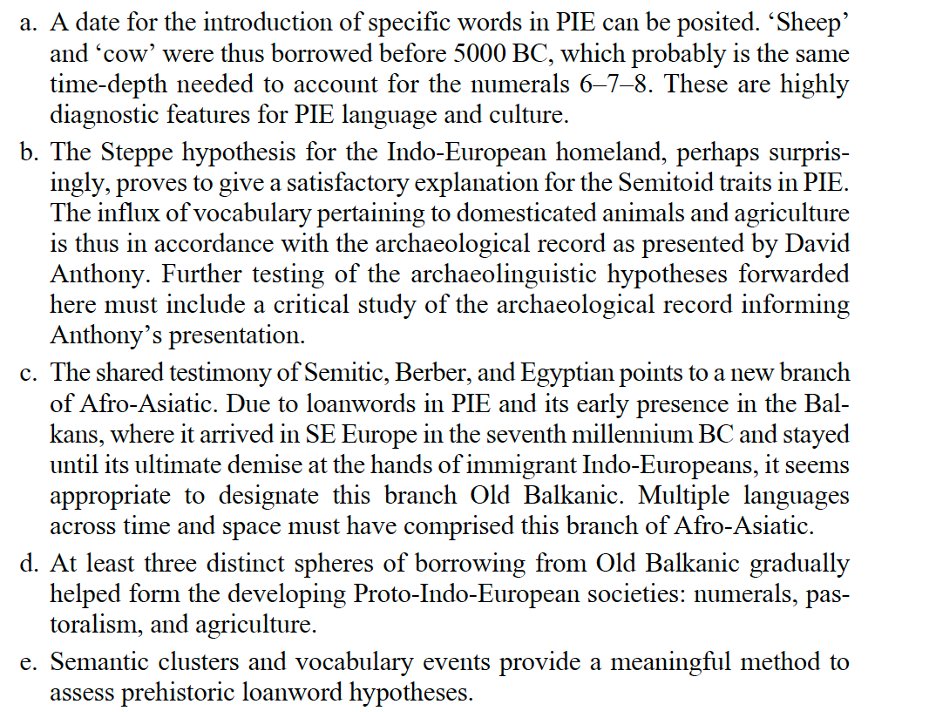
This is a good-faith argument, that alone proves nothing. But the argument starts and finishes with the linguistic material. Other interpretations are more than welcome. Can we remove/add some words - how? What about the Caucasus? ...
...Some data points are shared with parts of the Caucasian families, others not. Continued study of the internal relations of NWC and NEC will shed further light on this interface. For all it’s worth, the above is a recontextualization of similarities that won't go away.
Thanks for tuning in - I look forward to continuing the discussion

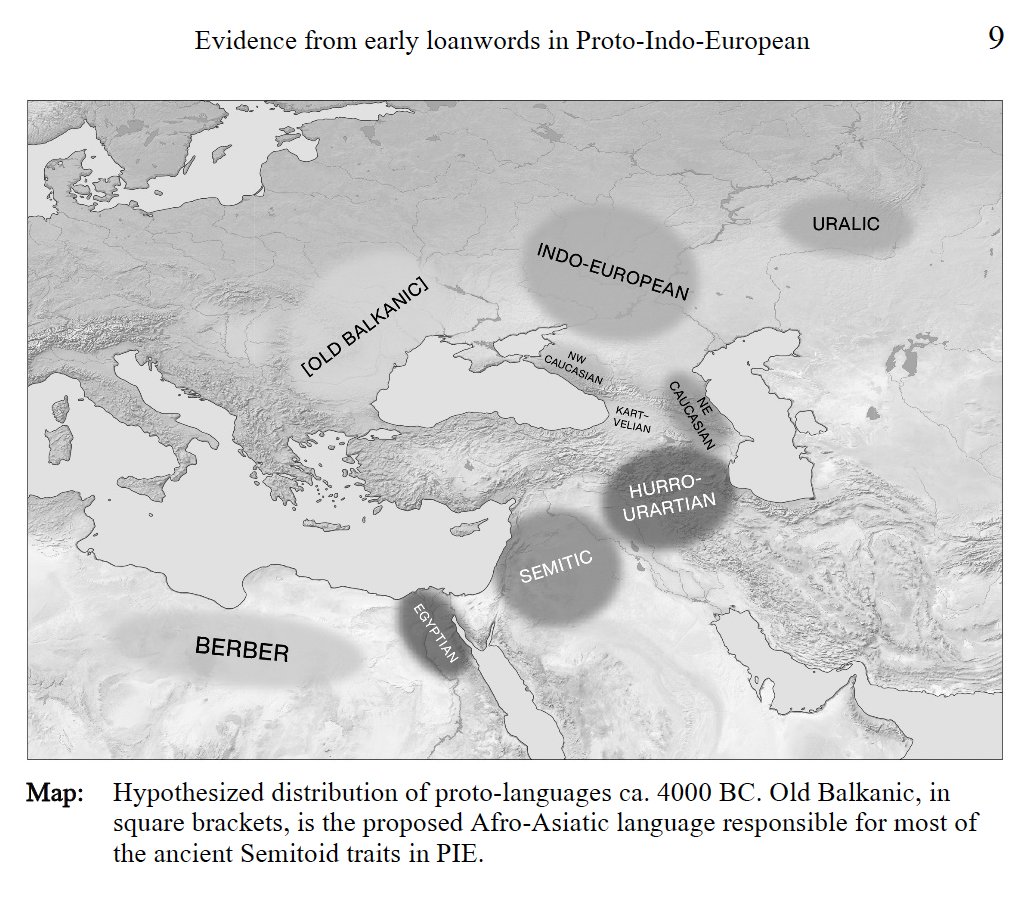
Here the spatial distribution, the "persistent frontier" in Modern day Ukraine. Uralic should be moved to the Altai-Sayan region and is not relevant for the Neolithic interface.
I totally forgot that there's an *action packed* trailer from three years ago to go with it
🐄🐑🪓🏹🐏
🐄🐑🪓🏹🐏

Loading suggestions...