

HTTP is a stateless protocol.
This means every request is independent.
The web application server can’t tell if 2 requests came from the same browser or user.
But the users aren’t stateless.
No one wants to log in to your application every time they make a request.
So - how do you help them?
One solution is to use cookies.
Yes, cookies! But not the one you eat when you’re hungry.
A cookie is basically a key-value pair that’s stored on the browser.
How do they work?
- The user logs in to your frontend application.
- The frontend sends the request to the backend server
The backend server generates a cookie
- It sets the cookie on the browser via the Set-Cookie response header.
- The user makes a new request to view a different page.
- The front end sends the request to the backend and includes the Cookie as part of the header.
- The server checks the cookie for the user and responds with the required data.
Here’s what the process looks like:
Sounds good, doesn’t it?
But there’s a major issue with using cookies.
Cookies are accessible via the browser. You can modify the cookie information.
That’s why it’s not a good idea to use cookies for storing sensitive data about the users.
This is where sessions come into the picture.
The session contains a unique set of characters to identify the user.
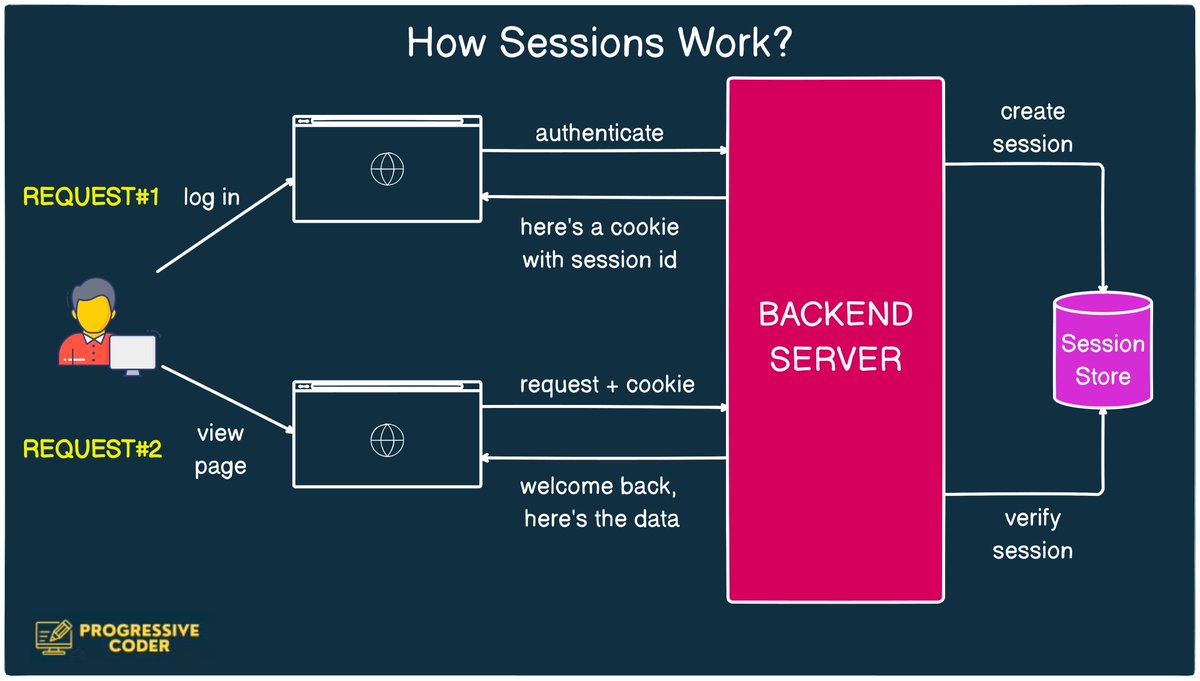
It works as follows:
- The user makes a login request
- The frontend sends the request to the backend server
- The backend creates a session using a secret key and stores it in some sort of session storage (database or cache)
- Next, the server sends a cookie back to the client
- However, the cookie contains the unique identifier for the session
- The user makes a new request to view another page.
- The browser sends the session ID as part of the cookie.
This time only the server can validate whether the session is valid.
Here's what the entire process looks like:
Few important points to mention over here:
✅Cookies can have a “Secure” flag indicating that it should only be sent over HTTPS. This is good for security reasons.
✅Also, “HttpOnly” cookies restrict the cookie’s access to JavaScript reducing the risk of XSS attacks.
✅Cookies (especially 3rd party cookies) raise a bunch of privacy concerns because they can be used to track user behavior.
✅While cookies can be made secure, server-side sessions provide additional layers of security against CSRF attacks and handling sensitive information
✅Also, server-side sessions can be centrally managed. This means you can invalidate sessions, expire or revoke them if needed.
===
That’s all for now!
If you enjoyed this deep dive into Cookies and Sessions, don’t forget to:
- Give the LIKE button a cookie
- REPOST so that everyone gets the right session id in the cookie
- BOOKMARK for future reference
- Follow me for more posts like this
This means every request is independent.
The web application server can’t tell if 2 requests came from the same browser or user.
But the users aren’t stateless.
No one wants to log in to your application every time they make a request.
So - how do you help them?
One solution is to use cookies.
Yes, cookies! But not the one you eat when you’re hungry.
A cookie is basically a key-value pair that’s stored on the browser.
How do they work?
- The user logs in to your frontend application.
- The frontend sends the request to the backend server
The backend server generates a cookie
- It sets the cookie on the browser via the Set-Cookie response header.
- The user makes a new request to view a different page.
- The front end sends the request to the backend and includes the Cookie as part of the header.
- The server checks the cookie for the user and responds with the required data.
Here’s what the process looks like:
Sounds good, doesn’t it?
But there’s a major issue with using cookies.
Cookies are accessible via the browser. You can modify the cookie information.
That’s why it’s not a good idea to use cookies for storing sensitive data about the users.
This is where sessions come into the picture.
The session contains a unique set of characters to identify the user.
It works as follows:
- The user makes a login request
- The frontend sends the request to the backend server
- The backend creates a session using a secret key and stores it in some sort of session storage (database or cache)
- Next, the server sends a cookie back to the client
- However, the cookie contains the unique identifier for the session
- The user makes a new request to view another page.
- The browser sends the session ID as part of the cookie.
This time only the server can validate whether the session is valid.
Here's what the entire process looks like:
Few important points to mention over here:
✅Cookies can have a “Secure” flag indicating that it should only be sent over HTTPS. This is good for security reasons.
✅Also, “HttpOnly” cookies restrict the cookie’s access to JavaScript reducing the risk of XSS attacks.
✅Cookies (especially 3rd party cookies) raise a bunch of privacy concerns because they can be used to track user behavior.
✅While cookies can be made secure, server-side sessions provide additional layers of security against CSRF attacks and handling sensitive information
✅Also, server-side sessions can be centrally managed. This means you can invalidate sessions, expire or revoke them if needed.
===
That’s all for now!
If you enjoyed this deep dive into Cookies and Sessions, don’t forget to:
- Give the LIKE button a cookie
- REPOST so that everyone gets the right session id in the cookie
- BOOKMARK for future reference
- Follow me for more posts like this

I publish a newsletter on System Design every Tuesday.
1600+ software engineers read it for practical tips on how to design a system.
Join free here:
progressivecoder.beehiiv.com
1600+ software engineers read it for practical tips on how to design a system.
Join free here:
progressivecoder.beehiiv.com

Loading suggestions...