
I've been asked this a few times lately, so I decided to share how I approach different plays from an on-chain perspective
I hope this bit of knowledge, earned through blood, sweat, and experience, will help you make better, more informed decisions
Let's look at:
$PRIME
$GECKO
I hope this bit of knowledge, earned through blood, sweat, and experience, will help you make better, more informed decisions
Let's look at:
$PRIME
$GECKO

I've picked these two because they are entirely different in essence, trader behavior and liquidity characteristics.
Quick disclaimer: You already know I'm long $PRIME. I've no exposure to $GECKO, and don't go buy it. It's probably a scam, but serves as a good case study.
Quick disclaimer: You already know I'm long $PRIME. I've no exposure to $GECKO, and don't go buy it. It's probably a scam, but serves as a good case study.
$PRIME
We'll cover:
- The base assumptions
- What I check on chain: holders, traders, liquidity
- What tools I'm using for each part
Note— there are dozens more tools (and bots!) that I use or don't use, that are useful for these checks for brevity's sake, I won't mention them
We'll cover:
- The base assumptions
- What I check on chain: holders, traders, liquidity
- What tools I'm using for each part
Note— there are dozens more tools (and bots!) that I use or don't use, that are useful for these checks for brevity's sake, I won't mention them
Base assumptions:
- Last raise was multiple x's than current price (At the time, below $2)
- Fundamentals: strong
- Narrative wise: web3 gaming, AI
- Sentiment: very positive
- 3 places to get the token: (i) Coinbase (ii) Uni v3 mainnet [3 pools] (iii) Uni on Base
- Last raise was multiple x's than current price (At the time, below $2)
- Fundamentals: strong
- Narrative wise: web3 gaming, AI
- Sentiment: very positive
- 3 places to get the token: (i) Coinbase (ii) Uni v3 mainnet [3 pools] (iii) Uni on Base
So what did I check on chain?
Usually the first step is to determine whether the token is a potential rug pull / honeypot via the usual tools. No need for this token, but is very important for manually aping coins like $GECKO which we'll touch on later.
So, $PRIME is not a rug
Usually the first step is to determine whether the token is a potential rug pull / honeypot via the usual tools. No need for this token, but is very important for manually aping coins like $GECKO which we'll touch on later.
So, $PRIME is not a rug
Holders
- Is the holder count growing or declining?
- What are investors doing with their tokens? (holding? LPing? buying more? Selling?)
This phase requires some more digging to find out who the investors are, and what their addresses are. Helpful: check vesting contracts flows
- Is the holder count growing or declining?
- What are investors doing with their tokens? (holding? LPing? buying more? Selling?)
This phase requires some more digging to find out who the investors are, and what their addresses are. Helpful: check vesting contracts flows
What are the top holders doing?
- Selling? Buying? Holding? LPing?
If LPing – What ranges? How old are the positions? Buy side, sell side? Within the range? What are they trying to achieve with this position?
It's important to identify token flows and potential user behavior
- Selling? Buying? Holding? LPing?
If LPing – What ranges? How old are the positions? Buy side, sell side? Within the range? What are they trying to achieve with this position?
It's important to identify token flows and potential user behavior
If investors or top holders (usually the same) are selling into pumps or just market dumping, maybe something is wrong and you're not aware of it. Maybe they're TPing, and monitoring their wallet outflows might provide better entries.
It's also good for sentiment verification
It's also good for sentiment verification
Traders; Buy side
> Check latest trades of note, usually based on tx frequency per wallet or size (wallets can sometimes ape small but frequently, so don't miss this)
> for size, arbitrary amount in relation to current liquidity is a good starting filter
> filter out mev bots
> Check latest trades of note, usually based on tx frequency per wallet or size (wallets can sometimes ape small but frequently, so don't miss this)
> for size, arbitrary amount in relation to current liquidity is a good starting filter
> filter out mev bots
> Check frequency of buys, volume for different time frames
> are people FOMOing in? Are they being disciplined, patient? TWAPING/DCA'ing in? Are these fresh addresses? People who rode the trade in the past a few times?
Understanding new holders' behavior is key.
> are people FOMOing in? Are they being disciplined, patient? TWAPING/DCA'ing in? Are these fresh addresses? People who rode the trade in the past a few times?
Understanding new holders' behavior is key.
Traders; Sell side
Check recent dumps, like 24hrs. Identify the biggest dumpers.
Can you understand why are they dumping?
How many more tokens do they have and how can that move the price?
How long have they held? (paper vs diamond hands) What is their uPnL/PnL?
Check recent dumps, like 24hrs. Identify the biggest dumpers.
Can you understand why are they dumping?
How many more tokens do they have and how can that move the price?
How long have they held? (paper vs diamond hands) What is their uPnL/PnL?
With all of this, you should now have somewhat of a grasp on:
- Top holders/investors and their behavior
- Buy side action – new/old holders and how eager are they, what is the demand side looking like, etc.
- Sell side action – What is the supply side looking like, sentiment
- Top holders/investors and their behavior
- Buy side action – new/old holders and how eager are they, what is the demand side looking like, etc.
- Sell side action – What is the supply side looking like, sentiment
Moving on to liquidity which I think many people overlook.
Remember frens, you are trading on chain. Nothing is more important than liquidity and how it might behave under certain conditions.
Remember frens, you are trading on chain. Nothing is more important than liquidity and how it might behave under certain conditions.
How much liquidity is there in total
Is it v2? v3? Different bonding curve?
v2
- Who are the biggest LPs?
- How long have they been in the pool?
- Are they likely to pull liquidity?
Is it v2? v3? Different bonding curve?
v2
- Who are the biggest LPs?
- How long have they been in the pool?
- Are they likely to pull liquidity?
v3
- Who are the biggest LPs?
- How long have they been in the pool?
- What ranges do they occupy? What are they trying to achieve?
- Buy under the range
- Sell above the range
- Mixture of positions
- How likely is the price to move and in what direction given different txs
- Who are the biggest LPs?
- How long have they been in the pool?
- What ranges do they occupy? What are they trying to achieve?
- Buy under the range
- Sell above the range
- Mixture of positions
- How likely is the price to move and in what direction given different txs
For $PRIME, it was easy to identify using various tools exactly how much liquidity is spread and where on the curve, which helps identify future price action given the previous checks we did
i.e. if buy side action is >> sell side, and liquidity is crunched, guess what happens?
i.e. if buy side action is >> sell side, and liquidity is crunched, guess what happens?
So, we looked at:
- holders and what they're doing
- buy and sell side action (demand, supply)
- liquidity to facilitate said action
this isn't exact science, and demand and supply can change swiftly. But if you get good at this exercise, you'll learn to do it quickly and to
- holders and what they're doing
- buy and sell side action (demand, supply)
- liquidity to facilitate said action
this isn't exact science, and demand and supply can change swiftly. But if you get good at this exercise, you'll learn to do it quickly and to
identify long-term patterns as well. Again, I can't stress enough how important is understanding the liquidity constraints for each trade.
It was easy for me to predict prime pumping few x's solely based on the things I laid out in this thread and after running these checks
It was easy for me to predict prime pumping few x's solely based on the things I laid out in this thread and after running these checks
(Some of the) Tools I used:
Holders:
- @etherscan
- @parsec_finance
- @nansen_ai
- @dexscreener
Trades:
- the above
- @alphatracexyz -
- @CieloFinance
LP:
- @revertfinance
- info.uniswap
- @etherscan
Monitoring:
- @ArkhamIntel
- @nansen_ai
- @CieloFinance
Holders:
- @etherscan
- @parsec_finance
- @nansen_ai
- @dexscreener
Trades:
- the above
- @alphatracexyz -
- @CieloFinance
LP:
- @revertfinance
- info.uniswap
- @etherscan
Monitoring:
- @ArkhamIntel
- @nansen_ai
- @CieloFinance
I use many other tools such as select telegram bots, on-chain tools I have the privilege of beta-testing, and in-house tools that were developed for these purposes
Many of the tools I mentioned are free and available to use by anyone, everywhere, anytime. Just gotta sit and work
Many of the tools I mentioned are free and available to use by anyone, everywhere, anytime. Just gotta sit and work
If you want to dive deeper into the liquidity portion of this trade, search from:0xshual $prime liquidity or just liquidity.
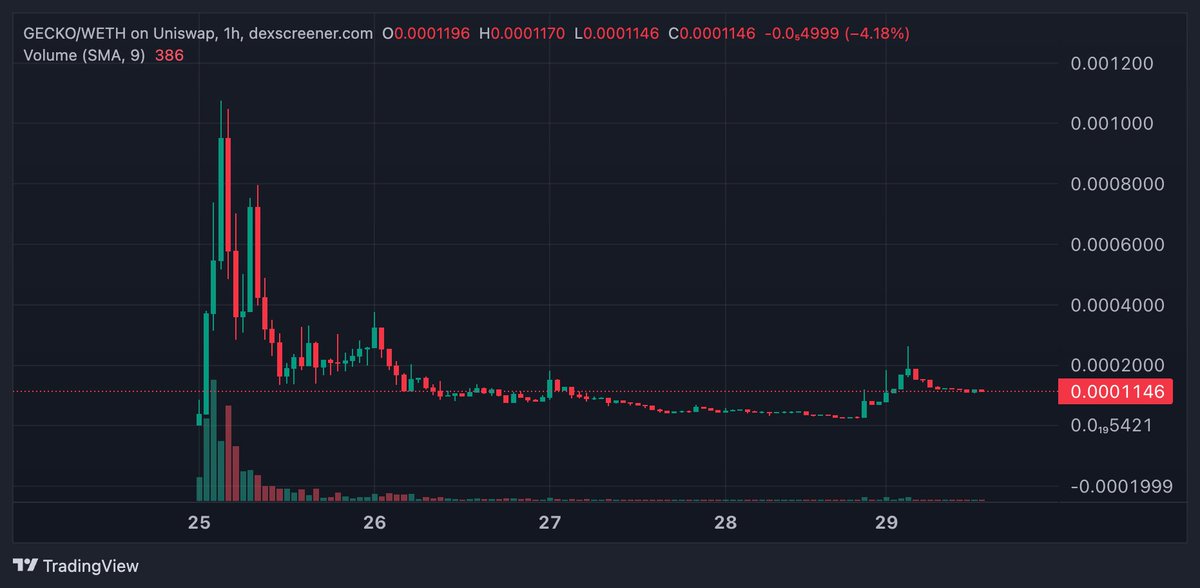
Now let's touch on $GECKO, a meme play with this very familiar-looking chart:
I will lay out the process and you can draw similarities/differences between the two plays yourself.
BTW I wouldn't recommend aping this, this is just a case study.
I will lay out the process and you can draw similarities/differences between the two plays yourself.
BTW I wouldn't recommend aping this, this is just a case study.
The base assumptions:
- 80-85% new launches are rugpulls, 10-15% are pump and dumps, maybe 5-8% are 'legit' memes that just fail to break out significantly over some thresholds that are considered 'milestones' and 1-2% actually moon hard
- getting shilled on CT by several
- 80-85% new launches are rugpulls, 10-15% are pump and dumps, maybe 5-8% are 'legit' memes that just fail to break out significantly over some thresholds that are considered 'milestones' and 1-2% actually moon hard
- getting shilled on CT by several
large-ish accounts. Enough to move the price of any memecoin with 5 figures-low 6 figures market cap
- liquidity locked and burned, people can buy and sell - doesn't look like a rug, not a honey pot
- sentiment is positive due to price action and the cult-like behavior of users
- liquidity locked and burned, people can buy and sell - doesn't look like a rug, not a honey pot
- sentiment is positive due to price action and the cult-like behavior of users
on telegram
- slow grind up makes the chart look good, like it's about to send
I also checked:
- buy and sell txs to determine whether there's a tax
- ran the token through some scanners/tools
- searched for the CA on twitter/telegram to determine who mentioned it, when, etc
- slow grind up makes the chart look good, like it's about to send
I also checked:
- buy and sell txs to determine whether there's a tax
- ran the token through some scanners/tools
- searched for the CA on twitter/telegram to determine who mentioned it, when, etc
What did I check on chain:
Holders
- Is the holders' count growing or declining? (Yes. It's early and the chart is up and to the right. It could be that the same addresses are accumulating, but that isn't necessarily bearish as well.)
- What are the top holders doing?
Holders
- Is the holders' count growing or declining? (Yes. It's early and the chart is up and to the right. It could be that the same addresses are accumulating, but that isn't necessarily bearish as well.)
- What are the top holders doing?
Did they receive their tokens at genesis?
Do they look like insiders? (accumulation near genesis, weird patterns like out-of-the-ordinary sizing, the proximity of txs, etc)
Are they selling? How are they offloading?
How much to go do they have?
How 'up' are they?
Do they look like insiders? (accumulation near genesis, weird patterns like out-of-the-ordinary sizing, the proximity of txs, etc)
Are they selling? How are they offloading?
How much to go do they have?
How 'up' are they?
How drastically can they move the price?
Need to understand whether the top holders are regular degens, sniper bots, 'degen snipers' lets call em that use retail facing tools, insiders, devs and close circle, influencers, etc.
The rest will tell us how likely are they to affect
Need to understand whether the top holders are regular degens, sniper bots, 'degen snipers' lets call em that use retail facing tools, insiders, devs and close circle, influencers, etc.
The rest will tell us how likely are they to affect
The supply side. Meaning if they aped at $10k mcap and it's $500k mcap with 10x the liquidity, they are up A LOT and can move the price significantly. How many holders like these are there? What are they doing? Maybe I should set up a monitoring list and track their token txs
Trades; Buy side
How many addresses are identifiably bots and/or snipers? (%)
- Are they still holding?
- Are they buying more?
- Are they selling? what % of those bots/snipers have sold (and what portion of their stack) vs holding still.
How many addresses are identifiably bots and/or snipers? (%)
- Are they still holding?
- Are they buying more?
- Are they selling? what % of those bots/snipers have sold (and what portion of their stack) vs holding still.
Volume over the last 5m, 10m, 30m, 1h, from launch
Velocity of purcahses
What is the avg. buy size
- either export buys and run the calculation
- or do the eye test to get ballpark figures
This will help us understand why the chart is looking up and to the right, and how likely
Velocity of purcahses
What is the avg. buy size
- either export buys and run the calculation
- or do the eye test to get ballpark figures
This will help us understand why the chart is looking up and to the right, and how likely
is it to continue going based on holders' behavior.
Trades; Sell side
After checking what the top holders are doing, we check volume candles w/ price graph for significant sell-off periods and identify the addresses that sold / are selling into this action
Trades; Sell side
After checking what the top holders are doing, we check volume candles w/ price graph for significant sell-off periods and identify the addresses that sold / are selling into this action
How long have they held?
how much more they have left?
What is their uPnL/realized PnL?
We need to understand whether we are still early to the party, not late enough to still see upside or if we're exit liquidity here, NO MATTER THE CURRENT MARKET CAP.
how much more they have left?
What is their uPnL/realized PnL?
We need to understand whether we are still early to the party, not late enough to still see upside or if we're exit liquidity here, NO MATTER THE CURRENT MARKET CAP.
Sometimes people shill based on market cap targets like, 'send this to $2m' or 'this hits $500k then $1m in the next 2 hrs' etc.
These are arbitrary levels and pump and dump artists utilize them to get you to be their exit liquidity.
These are arbitrary levels and pump and dump artists utilize them to get you to be their exit liquidity.
Liquidity
For low liquidity, young tokens, distribution doesn't matter a lot.
What matters most is:
- How much liquidity is available?
- Is it locked or can be pulled at a moment's notice?
- How deep is it relative to how hard top holders/biggest ROI holders can nuke it?
For low liquidity, young tokens, distribution doesn't matter a lot.
What matters most is:
- How much liquidity is available?
- Is it locked or can be pulled at a moment's notice?
- How deep is it relative to how hard top holders/biggest ROI holders can nuke it?
Again, the tools I used are similar. Dexscreener and Alphatrace are very handy in quickly determining uPnL/PnL, and in general, dexscreener and dextools are very nifty tools at the hands of knowledgable users.
One thing that is worth mentioning about $GECKO and similar plays:
There are roughly 800-1000 call channels on telegram. These have subscribers ranging from a few dozen to tens of thousands. They are being listened to and sniped, ALL THE TIME.
There are roughly 800-1000 call channels on telegram. These have subscribers ranging from a few dozen to tens of thousands. They are being listened to and sniped, ALL THE TIME.
If a token address is being shared there, it WILL move. In fact, the team is counting on it.
That's why, it is best to subscribe to most of them and put them in a folder, so you can paste the CA in the search bar and gauge who shilled and when.
Remember we said 10-15% are pnds?
That's why, it is best to subscribe to most of them and put them in a folder, so you can paste the CA in the search bar and gauge who shilled and when.
Remember we said 10-15% are pnds?
People on twitter but especially telegram are pnd artists. Teams pay (or flat-out co-mingle with) call channels to help them get exit liquidity.
Understand if you're being played.
For $GECKO, a good friend showed me a tool that checks for you how many call channels mentioned
Understand if you're being played.
For $GECKO, a good friend showed me a tool that checks for you how many call channels mentioned
the token and at what market cap. Generally speaking, if you see a coin being listed by many call channels very early on, it's either the next certified banger or this is a pnd in action and you're the mark.
Moreover, $GECKO team put in quite the effort: they had a lock on tg
Moreover, $GECKO team put in quite the effort: they had a lock on tg
that forced users to raid and shill their token HARD before being able to interact, plus they ran a twitter spaces with quite a few users and encouraged them to 'shill the old school ways guys', 'keep raiding', 'get your family and friends in on it so they can make money too'
they were quite aggressive, kept the space going for hours, and went full on goblin mode.
Again, if you spot these behaviors, it's either EXTREMELY bullish, or you're probably looking at a very professional pump and dump artists
Again, if you spot these behaviors, it's either EXTREMELY bullish, or you're probably looking at a very professional pump and dump artists
pro mode is to check deployer and early (and i mean early, and filter out snipers) buys for address clusters one can run against other known address clusters for pump and dumps, rugs, and general dev shitcoinery
that's it for now
not the most organized thread, just a stream of thoughts really. hope this helps you out.
i could have went in to specifics like how to check these things, what to click where, what specific tool and pane to use but you can handle that yourselves i think
not the most organized thread, just a stream of thoughts really. hope this helps you out.
i could have went in to specifics like how to check these things, what to click where, what specific tool and pane to use but you can handle that yourselves i think
Loading suggestions...