
A summary thread of Hythem Sidky's new article: "Consonantal Dotting and the Oral Quran".
I don't usually thread's on other people's publications, but this article is really important, and Hythem has left Twitter, so I figured I'd highlight some of the main takeaways.
I don't usually thread's on other people's publications, but this article is really important, and Hythem has left Twitter, so I figured I'd highlight some of the main takeaways.

It has long been recognised that the Quran as we have it today cannot be explained as a purely oral tradition. The written Uthmanic text plays a definite role in the transmission of the text as we have it today. Sidky: Can we show and date the existence of an oral layer?
In recent years, observing that some of the competing readings are likely to be distinct guesses at the same ambiguous written text, people have started to wonder: so are they all just guesses? Did Muslims receive the text, and then had to independently figure out what it said?
In line with that, a study by Melchert claimed that the teacher student relationships did not really adequately account for teacher-student relationship among the canonical readers. i.e.: Nāfiʿ's reading, according to him did not look notably like his teacher ʾAbū Jaʿfar's.
Sidky (like me) found this a rather surprising result, and puts this to the test. There are ten canonical readers accepted today, with two canonical transmissions each. Ḥamzah-al-Kisāʾī-Ḫalaf stand in a teacher student relationship, as do ʾAbū Ǧaʿfar-Nāfiʿ.
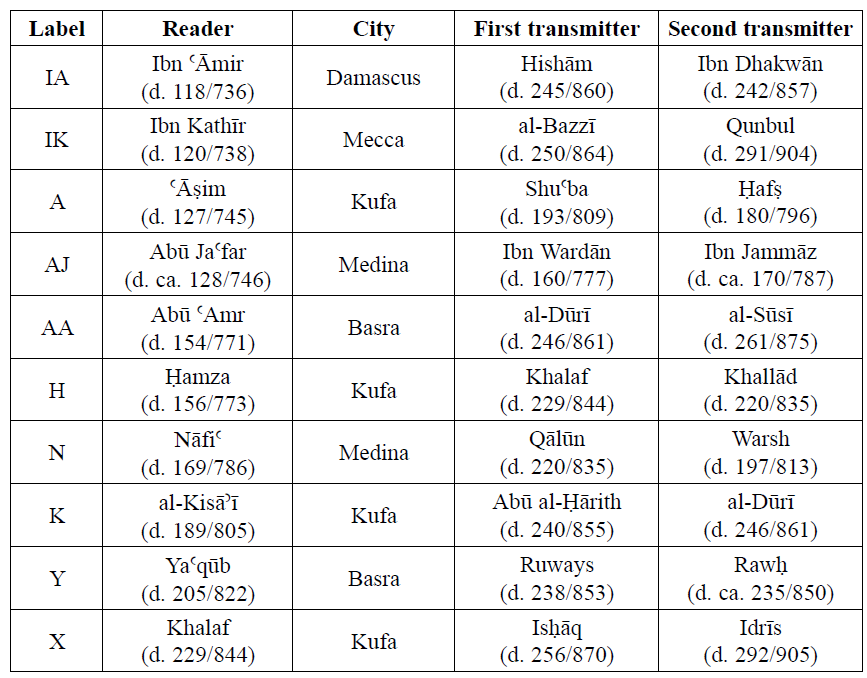
He does this by comparing all the places where the ten canonical readers disagree on consonantal dotting. That is: if you were to write it out in a fully dotted Arabic script, the words would only be differentiated by consonantal dots. There are 292 points of disagreement.
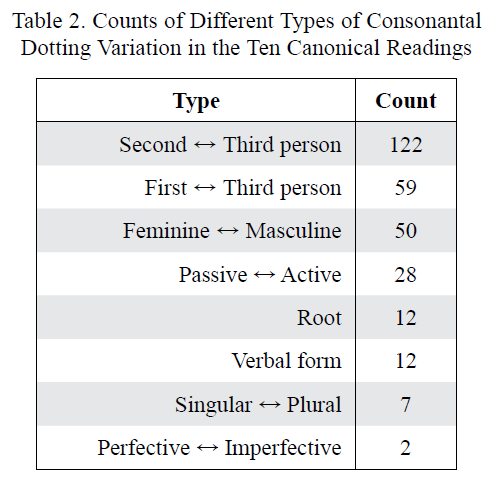
At this point it is already worth pointing out that, with 76,496 words in the Quran, only 292 words being disagreed upon already suggests that there is *something* that causes these readers to agree on so much in recitation of the written text (a point al-Azami made long ago).
Sidky applies a "principal component analysis" (PCA) to these 292 points of disagreement, to see if any of the readings cluster closer together. This creates a 2D map, where having more similar choices in reading clusters you closer together, and different further apart.
The result are illimunating. The "core" Kufans Ḥamzah, al-Kisāʾī and Ḫalaf cluster extremely close togher. They clearly share a common Kufan tradition of consonantal dotting.
So do the Medinans ʾAbū Ǧaʿfar and Nāfiʿ(and surprisingly: Ibn ʿĀmir! This is an unexpected result).
So do the Medinans ʾAbū Ǧaʿfar and Nāfiʿ(and surprisingly: Ibn ʿĀmir! This is an unexpected result).
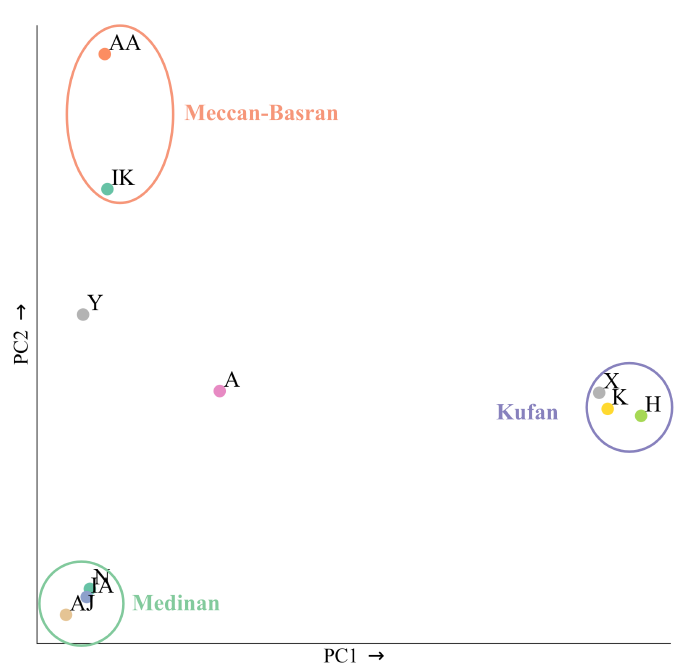
Ibn Kaṯīr and Meccan-turned-Basran ʾAbū ʿAmr and student of Ibn Kaṯīr form a loser cluster, but clearly are closer to one another than to others.
The Basran Yaʿqūb and Kufan ʿĀṣim look to be independent traditions in terms of consonantal dotting.
The Basran Yaʿqūb and Kufan ʿĀṣim look to be independent traditions in terms of consonantal dotting.
The use of PCA has been done in a number of other studies for other aspects of reading, e.g. the pronominal system by Sidky and me (which will hopefully just come out before year's end), which results in similar clusterings. PCA is a very powerful tool for reader interrelations
So this confirms that geography/student-teacher relationships are a pretty powerful explanation for understanding the points of disagreement between the readers (pace Melchert). But what about the points of agreement, i.e. the thousands of places where all readers agree?
Between the ten readers, there are many places where their agreement is rather trivial. Sure you could redot Q2:2 and read ḏālika l-kabābu lā zayta fīhi "that is the Kebab that contains no olive oil", but this is of course a ridiculous reading. Agreement there is trivial.
Trivial agreement doesn't mean much in terms of a shared oral tradition. But if you can find places where all ten readers agree on a reading, where another reading would have been perfectly plausible, then that's significant. Sidky finds ten examples like this.
Sidky is extremely stringent on finding "equally plausible, or even more plausible" readings than what the canonical readers agree on. What's nice is that, for a number of these, we indeed find that transmissions of non-canonical readers actually have these plausible variants.
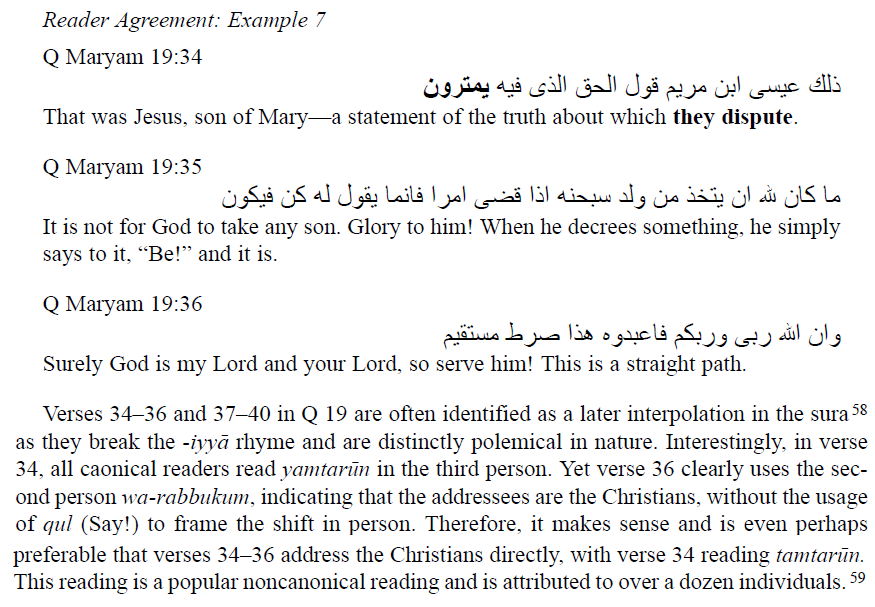
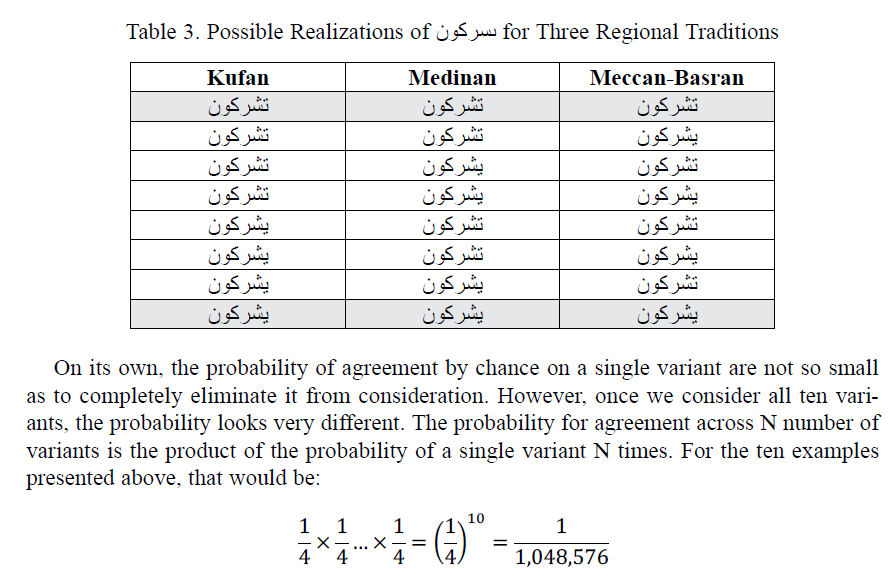
He then calculates the odds of three independent traditions (The Kufan, Medinan and Meccan-Basran clusters) all agreeing on these 10 points, where a different reading would be equally plausible.
This being due to chance is abou one in a million. Extremely unlikely.
This being due to chance is abou one in a million. Extremely unlikely.
Sidky understands that not everyone will accept all 10 cases as being equally plausible. And looking at just 3 independent tradition is actually ignoring Yaʿqūb and ʿĀṣim. So he provides a handy table, for people to calculate the chances themselves with their own evaluation.
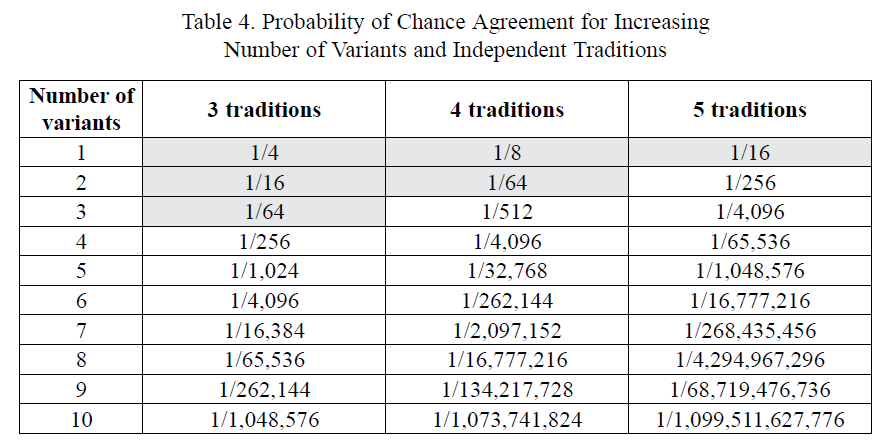
If you only look at 3 traditions agreeing, you need to accept 4 variants to pass the 1/100 threshhold he sets (humanities usually uphold 1/20). For 4 traditions only 3, for 5 traditions only 2!
The result is extremely robust, and 10 examples (typical Sidkyan) overkill.
The result is extremely robust, and 10 examples (typical Sidkyan) overkill.
This is a smart move, as it avoids dismissal of mathematically stunted people to dismiss one or two of the variants suggests, and dismiss the whole result as bunk. That is not enough to do so. You'd have to reject basically all of them.
So, what does this mean? It means that there is no way that all ten canonical readers agree on the consonantal dotting by chance. But it still does not necessarily prove that they get it from oral tradition. Sidky now examines if the agreement doesn't just come from manuscripts.
Contrary to popular belief, all early Quranic manuscripts have some amount of consonantal dotting. So if these ten examples in all manuscripts simply have the expected dotting, this would mean that the agreement between the ten simply comes from the written archetype.
So he meticulously looks at all ten of these variants in all early manuscripts he could get his hands on. Most of these places are undotted, and occasionally when the *are* dotted, the dotting actually indicates the reading the ten readers *don't* agree on (e.g. Q19:34 tamtarūn).

Thus, the written text as found in our earliest Muṣḥafs cannot plausibly be used to explain why the ten readers agree on these ten places (and the many other places one might imagine).
It must come from a genuine oral tradition that runs alongside the written tradition.
It must come from a genuine oral tradition that runs alongside the written tradition.
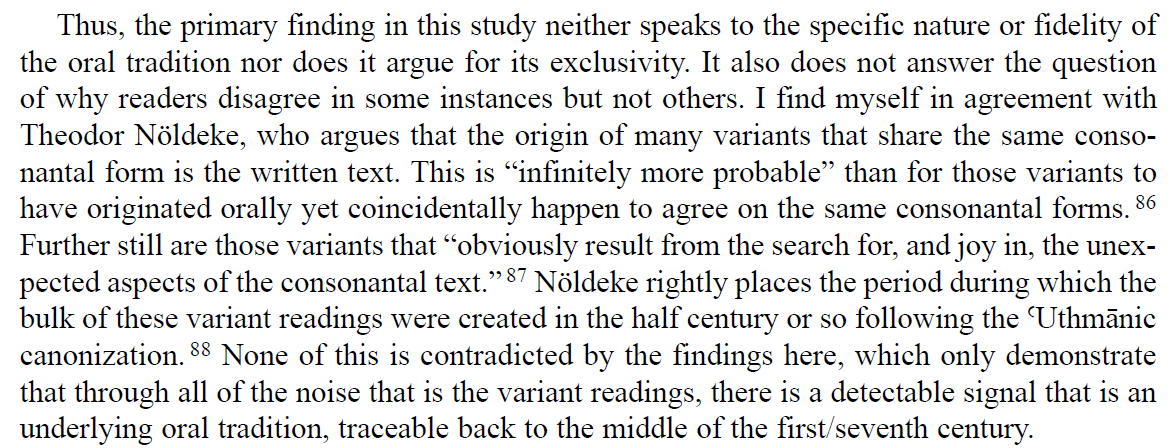
Since the earliest readers among the ten lived and were active in the second half of the first Islamic century, the common oral tradition must be at least that old. Sidky brings some extra historical reports that specify this time a bit more.
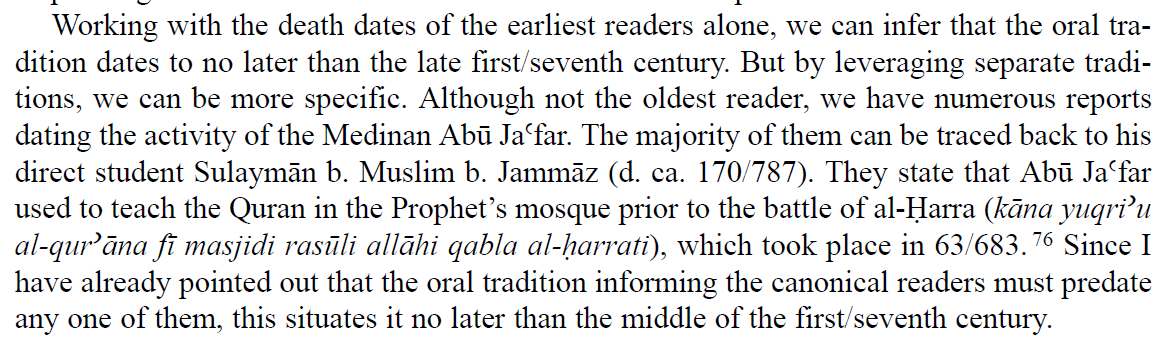
Sidky finished with a couple of important points:
1. Points of disagreement can still come from guesses, theology, grammar, etc.
2. Variants can still come from "the search for and joy in the unexpected aspects of the consonantal text"
1. Points of disagreement can still come from guesses, theology, grammar, etc.
2. Variants can still come from "the search for and joy in the unexpected aspects of the consonantal text"
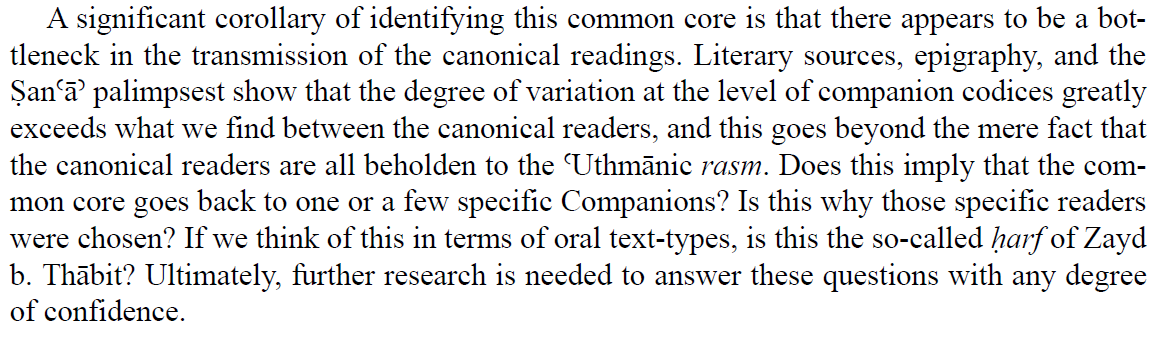
Finally: There is still a significant bottleneck in the reading traditions due to the Uthmanic canonization. Clearly there was much more variation and less agreement between different readers and written copies *before* the Uthmanic canonization. More research is needed.
I hope you all enjoyed that, and I hope I did the paper justice. You can find the paper published in the Journal of the American Oriental Society here:
doi.org
But you can read the PDF on Sidky's Academia page:
academia.edu
doi.org
But you can read the PDF on Sidky's Academia page:
academia.edu
academia.edu/111507928/Cons…
Consonantal Dotting and the Oral Quran
The oral transmission of the Quran has long been the subject of dispute. Some scholars have asserted...
doi.org/10.7817/jaos.1…
Journal of the American Oriental Society
The oral transmission of the Quran has long been the subject of dispute. Some scholars have asserted...
Loading suggestions...