

On this day, in a quiet corner of Uttar Pradesh, a small yet remarkable celebration takes place every year - Lahiri Diwas. It's a day that remembers a Bengali hero lost in the folds of history. His final words are guaranteed to send shivers down your spine. A thread.
1/16
1/16

Rajendranath Lahiri wasn’t just a name; he was a fearless revolutionary who carried out the daring Kakori train robbery. But his story goes beyond that heist. He stood for something bigger—a vision of a free India.
2/16
2/16
Born in 1901 in Bengal (now in Bangladesh), Rajendranath Lahiri moved to Varanasi in 1909. Immersed in the revolutionary fervour of the time, Rajendranath became an integral member of the Hindustan Socialist Republican Association while still studying.
3/16
3/16

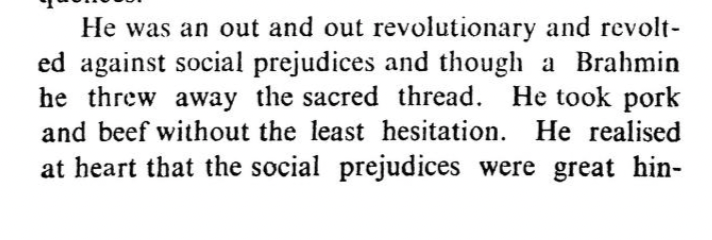
He was a true rebel, challenging social norms. Despite being a Brahmin, he discarded the sacred thread and fearlessly consumed pork and beef. Recognizing that societal prejudices hindered progress, he embraced the ruthless breaking of these barriers—a true rebel at heart.
4/16
4/16
He learned the art of bomb making in Calcutta and played a key role in the Dakshineshwar bomb case, which landed him in jail. Lahiri actively participated in revolutionary activities, including dacoities at Bamrauli, Shivpuri, and Dwarikapuri.
5/16
5/16
He, in a daring move, stopped the Kakori train by pulling the chain in a second-class compartment. Identified as the key figure in the robbery, on April 6, 1927, Rajen Lahiri was pronounced guilty by Judge Hamilton and sentenced to death on December 19, 1927.
6/16
6/16
His fate led him to the Gonda district jail, where, on this very day in 1927, he faced the gallows. Yet, in the face of death, Lahiri displayed an indomitable spirit.
7/16
7/16

From the jail, he penned a letter to his father Informing of his impending hanging within a week. He expressed gratitude to well-wishers, urging them to accept his greetings. Embracing death as a mere transition of the body, he concluded, "I can't write more from jail."
8/16
8/16
Few days before his execution, Lahiri shared his final wish with his brother: " I'll utter 'Vande Mataram.' Let its echoes reach me beyond the jail walls; only then can I find peace in death."
9/16
9/16
On the evening of December 16, the Jailer informed him that the execution date had been moved forward to December 17 suddenly, to eliminate any risk of escape. But Lahiri was nonchalant.
10/16
10/16
On the morning of his hanging, the Jailor witnessed something unexpected: Lahiri engaging in his usual physical training.
"Why?" the bewildered Jailor asked.
11/16
"Why?" the bewildered Jailor asked.
11/16

Lahiri's response echoed his unwavering commitment: "I am not dying today, but I shall once again be reborn in a free India to continue the unfinished task."
Nothing short of a goosebump.
12/16
Nothing short of a goosebump.
12/16
Those words, reverberating with determination, remain etched in the annals of Gonda District Prison—a testament to his unyielding spirit.
13/16
13/16
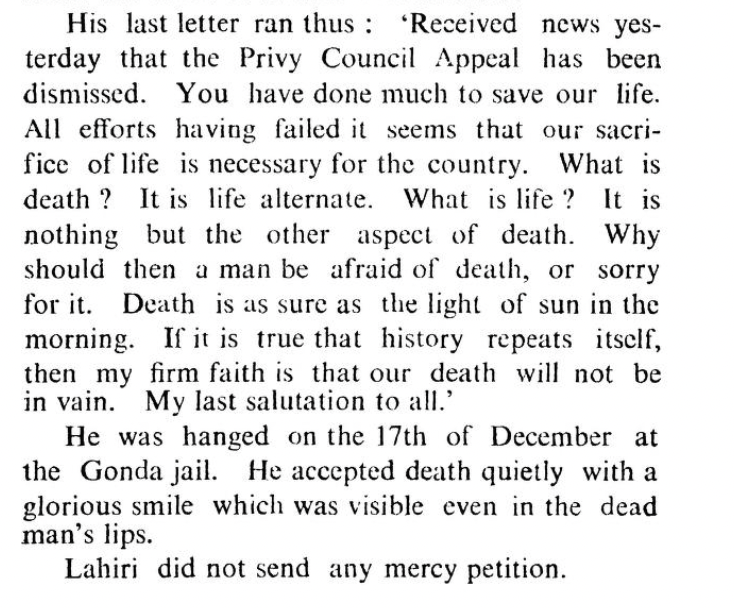
Jogesh Chatterji in his book ‘In search of freedom’ concluded “He accepted death quietly with a glorious smile which was visible even in the dead man’s lips."
"Lahiri did not send any mercy petition.”
14/16
"Lahiri did not send any mercy petition.”
14/16
Today, Lahiri Diwas in Gonda district and jail isn’t just a remembrance; it’s a celebration of his sacrifice & an ode to his unbreakable spirit. Cultural activities paint the canvas of homage, echoing the spirit of a man who believed in a truly free and liberated India.
15/16
15/16
In the Gonda district jail the authority celebrates Lahiri Diwas every year with ‘havan’, ‘shanti paath’ and National Anthem followed by reiteration of his immortal lines: “I am not going to die, but I am going to be born to free India"
16/16
16/16

Sources: Chatterji, Jogesh Chandra, In Search Of Freedom. 1958
Kali Charan Ghosh, The Roll of Honour, 1965
R. K. TANDON, HANGED FOR THEIR PATRIOTISM
Images credit: @WikiCommons
Kali Charan Ghosh, The Roll of Honour, 1965
R. K. TANDON, HANGED FOR THEIR PATRIOTISM
Images credit: @WikiCommons
Loading suggestions...