

Liverpool were not at their best against Manchester United, but the problems they faced are not new.
- They were too direct in possession which meant that they could not sustain attacks with sufficient reliability.
- They were similarly impatient with their positional play.
👇
- They were too direct in possession which meant that they could not sustain attacks with sufficient reliability.
- They were similarly impatient with their positional play.
👇

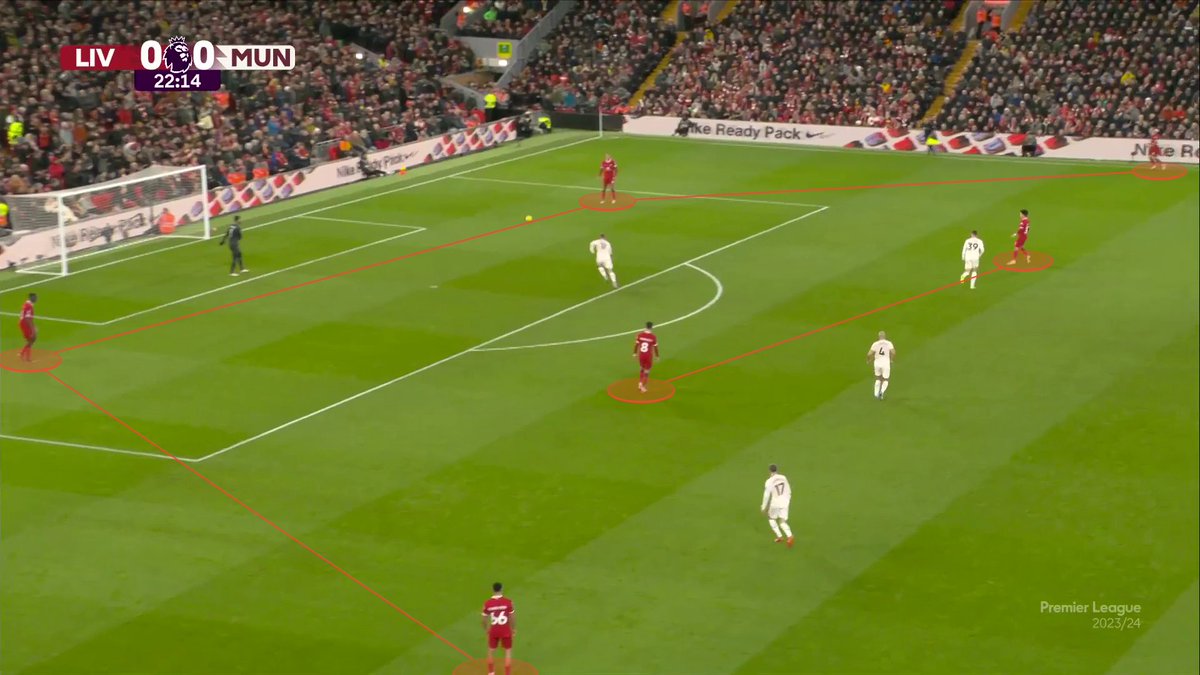
Liverpool rarely created moments like this on the right wing because Salah was consistently positioned within the confines of the 18 yard box.
He did drift wide on occasion because that's where the space was with Trent and Szoboszlai often inverted into midfield, but not enough.
He did drift wide on occasion because that's where the space was with Trent and Szoboszlai often inverted into midfield, but not enough.

This meant that when Liverpool had the ball on the left, they lacked an option to switch play to on the right with all three of Salah, Trent, and Szoboszlai in central positions.
Then, when possession was on the right, the trio lacked a wide option to consistently pick out.
Then, when possession was on the right, the trio lacked a wide option to consistently pick out.


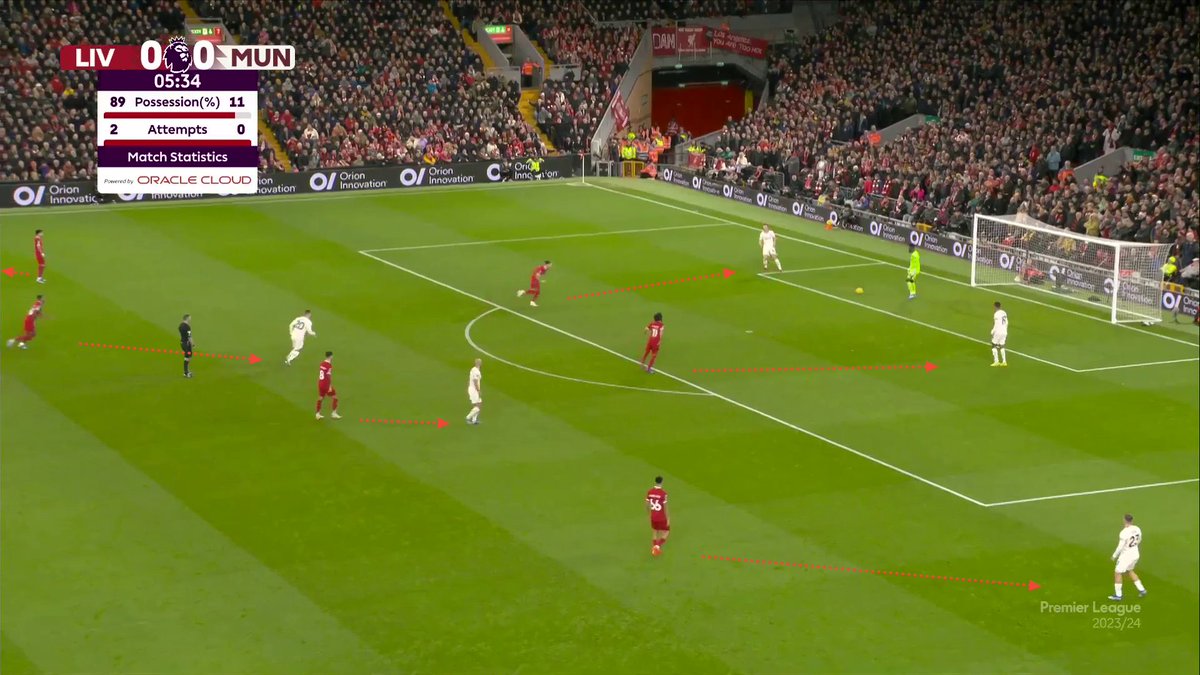
In the build-up, Liverpool had an overload against United's press thanks to:
A) their usage of Allison to create a situational back four & an overload outfield,
and B) United using shadow marking to press Liverpool's defence, but they often played through it with relative ease.
A) their usage of Allison to create a situational back four & an overload outfield,
and B) United using shadow marking to press Liverpool's defence, but they often played through it with relative ease.


Even from goal kicks they had an advantage as United left Højlund in a situation where he had to press the ball-side centre back (depending on who Allison passed to).
Although this created man-to-man situations on the side, circulation or effective combinations saw LFC get out..
Although this created man-to-man situations on the side, circulation or effective combinations saw LFC get out..
However, despite these advantages, Liverpool played too quickly, but that should not come as a surprise when considering the profile of players they had on the pitch.
Konaté, van Dijk, Endo, and Gravenberch were the only players that prioritised retention over directness.
Konaté, van Dijk, Endo, and Gravenberch were the only players that prioritised retention over directness.
Someone like Curtis Jones would have been a smart selection to offer ball retention amongst the directness (with Gravenberch being a less frequently involved passer).
Szoboszlai also had an off day which saw him give possession away more often than he usually does.
Szoboszlai also had an off day which saw him give possession away more often than he usually does.
Combine those issues with the fact that the rest of the team are direct in profile meant that Liverpool largely struggled to sustain effective pressure.
Attacks broke down in deep phases, they gave United an opportunity to get out, and they were not patient enough as a whole..
Attacks broke down in deep phases, they gave United an opportunity to get out, and they were not patient enough as a whole..
However, this has often been the case for Liverpool this season.
These are their main flaws, but their quality in tandem with their balance and structure sees them win most games - just because their balance and structure is somewhat flawed does not mean it's not good overall.
These are their main flaws, but their quality in tandem with their balance and structure sees them win most games - just because their balance and structure is somewhat flawed does not mean it's not good overall.
The same applied at Anfield.
They may have been too direct in possession and imbalanced at times in the final third, but they still did enough to win..
Although their structure & balance was flawed, it still had many good components, as did their man-to-man press, for example.
They may have been too direct in possession and imbalanced at times in the final third, but they still did enough to win..
Although their structure & balance was flawed, it still had many good components, as did their man-to-man press, for example.

Liverpool had many advantages in the game in terms of how they could exploit United, and they did do enough to win with 2.66 xG in their favour to United's 0.52 xG.
However, their flaws exacerbate when they don't win, but these are not *new* problems - they are always there.
However, their flaws exacerbate when they don't win, but these are not *new* problems - they are always there.
This begs the question - despite these issues, can Liverpool still win the title?
Well, if the points tally that will end up winning the league is going to compensate for dropped points (mid 80's), then they can probably challenge..
Their system & quality is 🔝 despite flaws 🛑
Well, if the points tally that will end up winning the league is going to compensate for dropped points (mid 80's), then they can probably challenge..
Their system & quality is 🔝 despite flaws 🛑

Loading suggestions...