

Number of IPOs in 2023: Around 60
Many have given WOW returns. (See table)
But not every #IPO is a jackpot.
Things can also go terribly wrong.
A 🧵on 5 ways to play it smart while investing in IPOs.
Many have given WOW returns. (See table)
But not every #IPO is a jackpot.
Things can also go terribly wrong.
A 🧵on 5 ways to play it smart while investing in IPOs.

1. AVOID GREY MARKET BIAS
Many consider the Grey Market as an unofficial stock market.
Among other things, it is used to trade shares of unlisted companies.
So, many feel they can use the Grey Market Premium (GMP) to estimate an IPO’s listing price.
Check example 👇
Many consider the Grey Market as an unofficial stock market.
Among other things, it is used to trade shares of unlisted companies.
So, many feel they can use the Grey Market Premium (GMP) to estimate an IPO’s listing price.
Check example 👇
Suppose a company launches an IPO.
Issue price = Rs 100 per share.
And the GMP is Rs 20 per share.
This means that in the unofficial market, the expectations are that the stock will list at a price of around Rs 120.
But this isn’t always accurate for many reasons.
Issue price = Rs 100 per share.
And the GMP is Rs 20 per share.
This means that in the unofficial market, the expectations are that the stock will list at a price of around Rs 120.
But this isn’t always accurate for many reasons.
One, these markets are unregulated. So, they are open to serious manipulation.
Two, the GMP is unpredictable and keeps changing.
Take the case of LIC.
Its GMP fell by 90% within a few days.
There are many such examples where the GMP, as a proxy, has let down investors.
Two, the GMP is unpredictable and keeps changing.
Take the case of LIC.
Its GMP fell by 90% within a few days.
There are many such examples where the GMP, as a proxy, has let down investors.
2. DON’T LUST FOR LISTING GAINS
The biggest storyline driving IPO investing is the quick returns one can make.
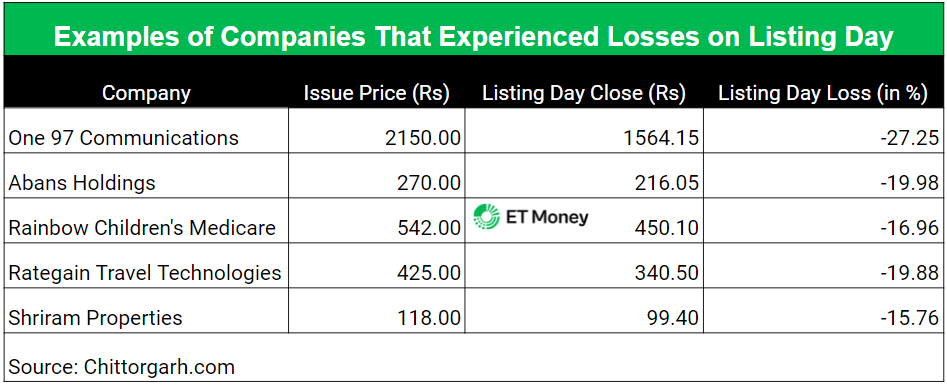
Sure, there are plenty of examples of stock prices rising on the listing day.
But there are also enough instances of stocks taking a beating.
The biggest storyline driving IPO investing is the quick returns one can make.
Sure, there are plenty of examples of stock prices rising on the listing day.
But there are also enough instances of stocks taking a beating.
3. DO SOME PRECISE DIGGING
The secret to identifying a good IPO is to back it up with good research.
Now, people generally do some research.
But reading an article in a newspaper & watching YouTube videos aren’t enough.
What you need to research 👇
The secret to identifying a good IPO is to back it up with good research.
Now, people generally do some research.
But reading an article in a newspaper & watching YouTube videos aren’t enough.
What you need to research 👇
Must understand 6 key points:
1. Business model
2. Industry competition & growth
3. Financial health (Revenue, profit, debt, working capital requirements, etc)
4. Background of promoters
5. Risk factors
The 6th one is the most crucial: The reason for raising capital
1. Business model
2. Industry competition & growth
3. Financial health (Revenue, profit, debt, working capital requirements, etc)
4. Background of promoters
5. Risk factors
The 6th one is the most crucial: The reason for raising capital
Essentially, companies can use the raised capital in 2 ways:
1. Grow their business
2. Give an exit to existing investors
If a considerable part of the raised capital is used for the second reason, this can be a red flag.
1. Grow their business
2. Give an exit to existing investors
If a considerable part of the raised capital is used for the second reason, this can be a red flag.
All this information is generally available in the company’s RHP (Red Herring Prospectus).
You can find this document easily on SEBI’s website.
Investing without digging into these points is akin to gambling.
You can find this document easily on SEBI’s website.
Investing without digging into these points is akin to gambling.
4. LOOK BEYOND VALUATIONS
Earlier, only profitable firms could launch IPOs, which excluded many startups.
But in 2020, SEBI changed some rules.
It allowed many new-age tech firms like Paytm & Zomato to list.
But it complicated matters for investors.
Earlier, only profitable firms could launch IPOs, which excluded many startups.
But in 2020, SEBI changed some rules.
It allowed many new-age tech firms like Paytm & Zomato to list.
But it complicated matters for investors.
Most of these new-age technology companies don’t have many listed peers that can act as a proxy for performance.
Also, even loss-making companies can come up with IPOs.
So, you cannot just rely on valuation metrics like PE & PB.
You need to look beyond them.
Also, even loss-making companies can come up with IPOs.
So, you cannot just rely on valuation metrics like PE & PB.
You need to look beyond them.
You also need to check:
Unsubstantiated growth projections
Market trends
Burn rate
Regulatory landscape
Also, until the stock starts trading, there is no actual price discovery.
Everything is an estimate driven by PE firms & VCs who have their self-interest at play.
Unsubstantiated growth projections
Market trends
Burn rate
Regulatory landscape
Also, until the stock starts trading, there is no actual price discovery.
Everything is an estimate driven by PE firms & VCs who have their self-interest at play.
5. SHUN THE HYPE
Picture this:
Just before the IPO, news flowed that some big investors had put in a few crores.
Many HNIs are investing.
Some of the biggest pension funds are also showing interest.
All this can tempt you to invest in the IPO for some quick gains.
BUT…
Picture this:
Just before the IPO, news flowed that some big investors had put in a few crores.
Many HNIs are investing.
Some of the biggest pension funds are also showing interest.
All this can tempt you to invest in the IPO for some quick gains.
BUT…
You never know if any of these players actually bought or at what price they bought.
Also, these IPOs form a fraction of their portfolios. So, the IPO’s poor performance may not hurt them big time.
Lesson: Take cues from these reports. But don’t rely on them entirely.
Also, these IPOs form a fraction of their portfolios. So, the IPO’s poor performance may not hurt them big time.
Lesson: Take cues from these reports. But don’t rely on them entirely.
WRAP UP
Understand why you want to invest in an IPO.
If you can’t arrive at a logical conclusion, then delay investing in it until there is more information & better price discovery.
It's rare to see companies that don’t go below their listing price in the next few years.
Understand why you want to invest in an IPO.
If you can’t arrive at a logical conclusion, then delay investing in it until there is more information & better price discovery.
It's rare to see companies that don’t go below their listing price in the next few years.
Loading suggestions...