

Today, we honor the life & legacy of Krantijyoti Savitribai Phule on her 193rd Birth Anniversary.
Born on January 3, 1831, in Satara, Maharashtra, she dedicated her life fighting for equality & education for all, irrespective of caste & gender.
#savitribaiphule
A thread 1/13🧵
Born on January 3, 1831, in Satara, Maharashtra, she dedicated her life fighting for equality & education for all, irrespective of caste & gender.
#savitribaiphule
A thread 1/13🧵

Savitribai was married to Jyotirao Phule at the age of 9 while Jyotirao was 13. After their marriage, Jyotirao educated Savitri while they worked at their farm.
She enrolled herself in teacher's training programs & would later go on to become India's first female teacher.
2/13🧵
She enrolled herself in teacher's training programs & would later go on to become India's first female teacher.
2/13🧵

The Phule couple shattered societal norms and established the first school for girls in Pune in 1848.
Alongside Sagunabai Kshirsagar, she taught girls, introducing subjects like mathematics, science, and social studies.
3/13 🧵
Alongside Sagunabai Kshirsagar, she taught girls, introducing subjects like mathematics, science, and social studies.
3/13 🧵
With her newfound knowledge, Savitribai Phule started teaching girls and became the first female teacher and headmistress in India.
By 1851, the Phule couple were managing 3 schools with around 150 enrolled students.
4/13 🧵
By 1851, the Phule couple were managing 3 schools with around 150 enrolled students.
4/13 🧵
Going against societal norms, they were teaching women and children from the so-called lower castes.
Breaking barriers but facing harsh opposition from conservative factions and people who were against educating women and oppressed castes.
5/13 🧵
Breaking barriers but facing harsh opposition from conservative factions and people who were against educating women and oppressed castes.
5/13 🧵
Savitribai and Jyotirao faced resistance, including being expelled from Jyotirao's father's home due to their work - educating women and oppressed castes, which was considered a sin according to Manusmriti and other Brahmanical texts.
6/13 🧵
6/13 🧵
Amidst their success, Savitribai and Jyotirao encountered resistance from many anti-reformist factions, particularly from a group who called themselves the "Nationalists," notably led by Bal Gangadhar Tilak.
7/13 🧵
7/13 🧵
Bal Gangadhar Tilak and the "Nationalists" were against education for women and oppressed castes, as they believed education was against the 'nature' of women and oppressed caste people.
During 1881-1920, they consistently opposed the establishment of girls’ schools.
8/13🧵
During 1881-1920, they consistently opposed the establishment of girls’ schools.
8/13🧵
Savitribai would travel to her school, always carrying an additional saree, as she faced attacks from people who would pelt her with stones, throw cow dung and subject her to verbal abuse since they were against her work of educating women and lower caste children.
9/13 🧵
9/13 🧵
Together with her husband, Savitribai Phule taught women and children from different castes. They established a total of 18 schools.
In the 1850s, they established two educational trusts for promoting the education of Mahars, Mangs and other oppressed castes.
10/13 🧵
In the 1850s, they established two educational trusts for promoting the education of Mahars, Mangs and other oppressed castes.
10/13 🧵
She founded the Mahila Seva Mandal, advocating for women's rights and opposing caste-based discrimination.
They also opened Balhatya Pratibandhak Griha, providing crucial support for pregnant rape victims and ensuring the delivery and protection of their children.
11/13 🧵
They also opened Balhatya Pratibandhak Griha, providing crucial support for pregnant rape victims and ensuring the delivery and protection of their children.
11/13 🧵
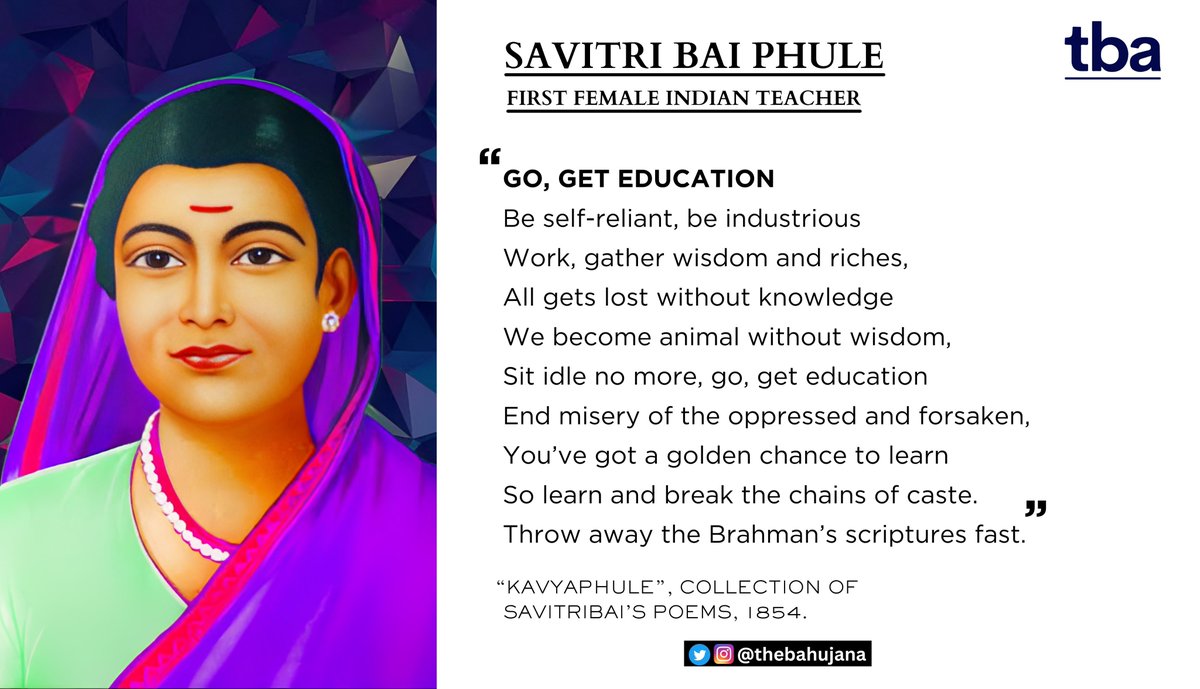
Beyond education, Savitribai was a prolific author and poet. Her works include "Kavya Phule" (1854) and "Bavan Kashi Subodh Ratnakar" (1892).
She penned "Go, Get Education" inspiring the oppressed to liberate themselves through education.
12/13 🧵
She penned "Go, Get Education" inspiring the oppressed to liberate themselves through education.
12/13 🧵
Savitribai Phule was a staunch advocate against child marriage, supported widow remarriage, and tirelessly worked for a society free of caste & gender discrimination.
She passed away on 10th March 1897, while helping patients of the 1897 bubonic plague.
13/13 🧵
She passed away on 10th March 1897, while helping patients of the 1897 bubonic plague.
13/13 🧵
Loading suggestions...