

SEIZURE SEMIOLOGY #TWEETORIAL
#NeuroX #Epilepsy #SeizureSemiology #Nystagmus
🧵1/ What is epileptic nystagmus (EN)?
EN aka nystagmoid seizure is a seizure characterized by nystagmoid eye movements as the principal ictal manifestation.
sciencedirect.com
#NeuroX #Epilepsy #SeizureSemiology #Nystagmus
🧵1/ What is epileptic nystagmus (EN)?
EN aka nystagmoid seizure is a seizure characterized by nystagmoid eye movements as the principal ictal manifestation.
sciencedirect.com


2/ Firstly, let's clarify the definition of nystagmus. It is a type of abnormal oscillatory eye movement which interferes with visual fixation. Nystagmus either has two slow phases (pendular) or a slow phase alternating with a fast phase (jerk).
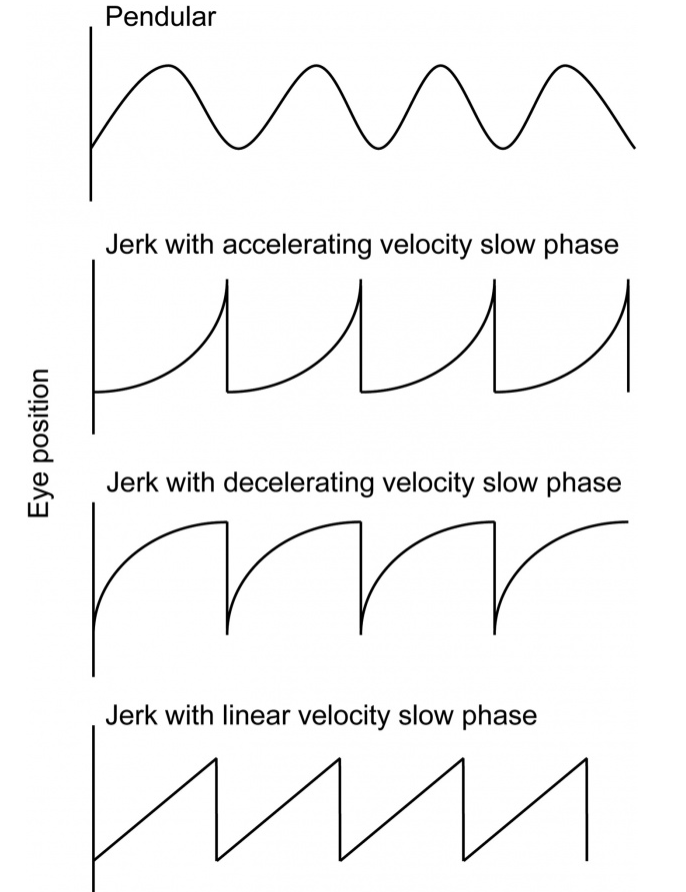
3/ Check out this video from Dr. Robert Daroff's eye movement library demonstrating an example of downbeat nystagmus, characterized by a slow upward movement and a fast (saccade) downward movement. The direction of nystagmus is based on the fast phase.
collections.lib.utah.edu
collections.lib.utah.edu

4/ Ocular oscillations characterized by back-to-back fast movements (saccades) are, technically, not nystagmus. These are saccadic oscillations. They are nystagmoid in appearance. A common example is dissociated abducting "nystagmus" in INO which is really not true nystagmus!
5/ It turns out that most cases of epileptic nystagmus reported in literature do have a slow phase and a fast phase, hence these abnormal ictal eye movements are truly a form of acquired jerk nystagmus. neurology.org

6/ EN is a rarely reported semiology but it might be under-reported or underdiagnosed, especially in the setting of acute symptomatic seizures. These can also be difficult to clearly observe on video-EEG recordings unless the camera is focused on the eyes & is high-definition.
7/ EN is mainly classified into two types- I & II. Type I EN is characterized by contraversive fast phases alternating with ipsilateral post-saccadic slow drifts. Type II EN is characterized by ipsiversive slow phase alternating w/ contralateral corrective saccades.


8/ In both types, the direction of the fast phase (saccades) is contralateral to the seizure-onset zone, hence EN as a seizure semiology has a very high lateralizing value of 100% to the contralateral hemisphere.
9/ The most common seizure-onset zone is in the temporo-parieto-occipital (TPO) junction, hence EN as seizure semiology, has a high localizing value as well. Unfortunately, there aren't many surgical series published w EN, hence a comment on localizing value for EZ can't be made.
10/ The most common EEG seizure pattern reported in the studies is paroxysmal fast activity >10Hz.
seizure-journal.com
seizure-journal.com

11/ In our current study, we used EEG to perform an oculographic analysis of EN in 3 patients without additional EOG electrodes. Since most cases of EN are horizontal and conjugate, electrodes F7 & F8 can be used as EOG to analyze eye position and movement.#bib11" target="_blank" rel="noopener" onclick="event.stopPropagation()">sciencedirect.com
12/ 2 out of 3 patients had type I EN. Previous studies have also shown a much higher frequency of type I EN compared to type II EN. In Kaplan & Tusa, 1993, all patients had type I EN.

13/ Our oculographic analysis shows that type I EN is produced by small contraversive saccades with an overall contraversive gaze deviation. The saccades are followed by post-saccadic ipsilateral slow drifts with decreasing velocity as eyes approach midline but never cross it.
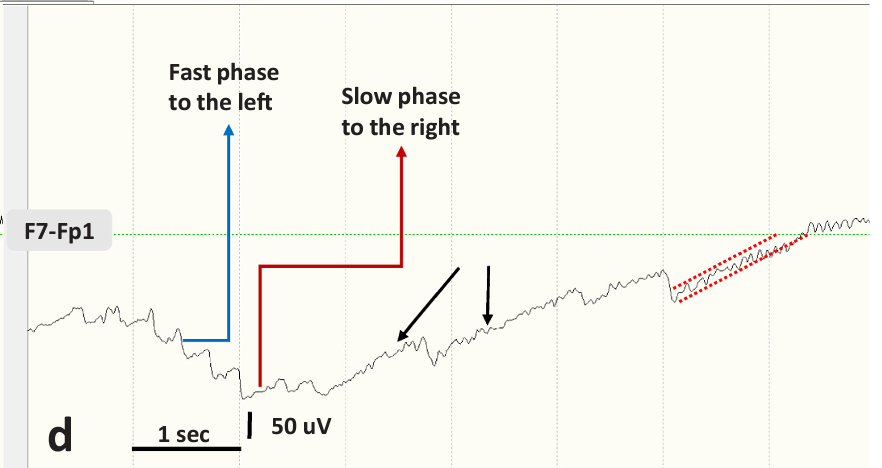
14/ Frequency of nystagmus in type I EN is 2-3Hz & duration is ~15 seconds. The gaze deviation is produced by a "staircase" of saccades and the mechanism is likely activation of saccade-generating areas like FEF and PEF. The slow drifts are caused by a gaze holding defect.
15/ Type II EN is produced by a large ipsiversive slow phase causing an initial ipsilateral gaze deviation, followed by corrective contraversive saccades, both crossing the midline. Freq is 0.5-2Hz & mechanism is likely activation of smooth pursuit region at TPO junction.
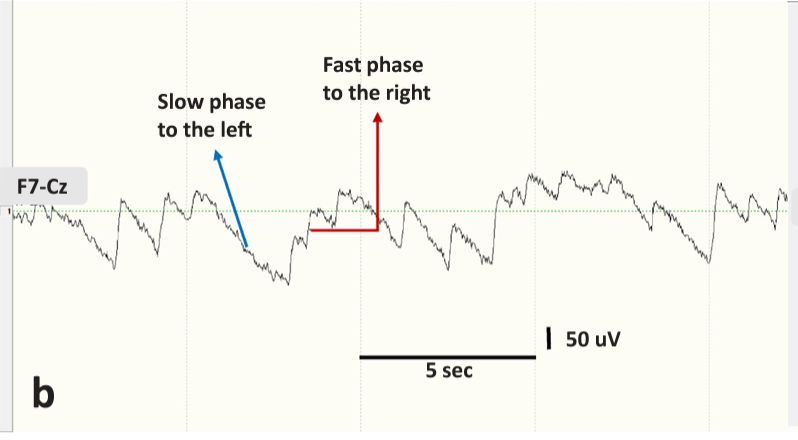
16/ These oculographic analyses require a prolonged time-constant of >=2 seconds to allow for recording & characterization of the slow phases.
17/ CONCLUSION: EN is a rare semiology but detection can be increased by careful analysis of characteristic ocular artifact on EEG with prolonged TC. Both type I & II EN have a 100% lateralizing value to the contralateral hemisphere based on the direction of the saccades.
18/ Here is an author link to our paper with full free access for next 50 days:
authors.elsevier.com
authors.elsevier.com
Loading suggestions...