

TERRIBLE RESULTS FROM THE EYE EXAM and yet… what do they really mean?
Or, are my eyes MAGICAL?
As a scientist, I am vindicated, as a natural vision teacher I have mixed feelings now (2/1/24) which will become much better over time.
Thread:
Or, are my eyes MAGICAL?
As a scientist, I am vindicated, as a natural vision teacher I have mixed feelings now (2/1/24) which will become much better over time.
Thread:


Firstly, I have been very open about the fact that my vision has fluctuated. WHY?
Because my understanding as a student, a researcher, in personal experience and in professional experience -is that people's eyesight fluctuates DRAMATICALLY.
How or why? Simply by the eye muscles exerting different amounts of pressure causing length to alter by fractions of a millimeters.
If you look at the wrongly dated receipt (I got it today not 2020), you see 3 measurements for each eye.
The left eye, that was twitching for me for some reason in the machine, went as long as needing -3.5 correction to as short as needing -2.25 correction.
THAT MEANS the machine SAW MY AXIAL LENGTH change more than a full millimeter within SECONDS.
HOW COULD THAT HAPPEN? My eye cannot actually grow and shrink that fast... IT CAN BE SQUEEZED THOUGH and RELEASED!
Because my understanding as a student, a researcher, in personal experience and in professional experience -is that people's eyesight fluctuates DRAMATICALLY.
How or why? Simply by the eye muscles exerting different amounts of pressure causing length to alter by fractions of a millimeters.
If you look at the wrongly dated receipt (I got it today not 2020), you see 3 measurements for each eye.
The left eye, that was twitching for me for some reason in the machine, went as long as needing -3.5 correction to as short as needing -2.25 correction.
THAT MEANS the machine SAW MY AXIAL LENGTH change more than a full millimeter within SECONDS.
HOW COULD THAT HAPPEN? My eye cannot actually grow and shrink that fast... IT CAN BE SQUEEZED THOUGH and RELEASED!
Here are some problems with their approach: The first machine they use is supposed to just measure the axial length of your eyes. But this machine did not give a printout of the actual length, it jumped straight from length to quarters of diopters of correction. WHY?
Because lenses are not made with continuous precision.
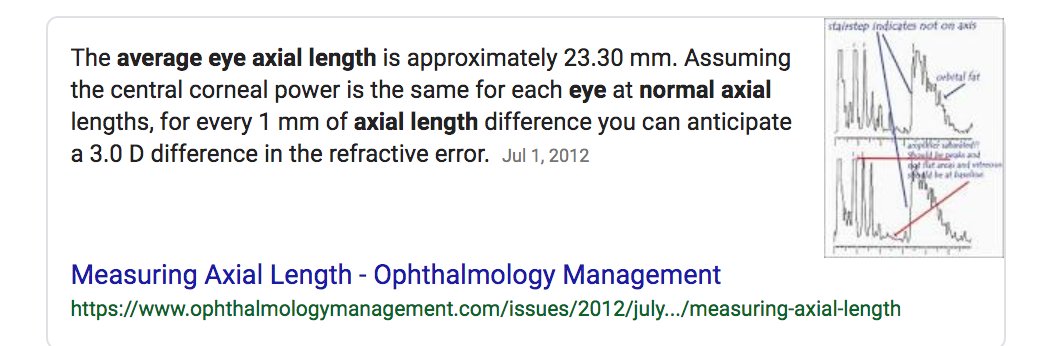
They work in .0833 millimeter steps. (read attached)
Why? It's not because that's how our eye shape is. It's because they want to manufacture lenses cheaper and they don't really care about precise lenses, they'd rather give you stronger lenses than you need, because then you'll be more locked in.
1 mm = 3 diopters difference
.33 mm = 1 diopter difference
.33/4 mm = .0833 mm = .25 diopter difference
So what if your eye is just .04 mm too long? Then what? Probably overcorrect.
The whole field has no interest in reversal!
Because lenses are not made with continuous precision.
They work in .0833 millimeter steps. (read attached)
Why? It's not because that's how our eye shape is. It's because they want to manufacture lenses cheaper and they don't really care about precise lenses, they'd rather give you stronger lenses than you need, because then you'll be more locked in.
1 mm = 3 diopters difference
.33 mm = 1 diopter difference
.33/4 mm = .0833 mm = .25 diopter difference
So what if your eye is just .04 mm too long? Then what? Probably overcorrect.
The whole field has no interest in reversal!
They didn't ask me if I'm tense, if I've been sleeping well, etc... they just test the eyes - with a very unpleasant machine in a poor posture, then have this machine that blows air directly into your eyes (unpleasant), then have you look at an eye chart in low light, in a closed room with a stranger, while having distracting light, and pressure to perform...
And their test showed my huge fluctuations, that should basically be impossible according to standard "theory", and they don't care at all, they just move forward to prescribe lenses...
But then there was the distance eye test... where... my vision fluctuated, and I was able to read 20/40... which corresponds to -1... (and would be impossible if I persisted with a 1.33 mm elongation) but that test was even worse. They have you look through a small hole in an awkward chair where your head and neck are stuck...
And here's a question, what if they took that part of the test outdoors? I can see so much better outdoors. I have tested at 20/20 outdoors.
Which read actually matters?
WELL, part of this IS COPE.
It is true, that my goal would be to actually have consistent relaxation in all situations and distance clarity. But I did NOT achieve it to the point of having that occur at THAT exam.
It's okay though, because I know some specific elements that I can focus on, if I really want to get a better read at the optometrist... ALTHOUGH, either way, that's not really my focus.
I passed the driver's test. In 20 ELEVEN. and 2016 and 2021. They tested at 20/40.
And, none of this disproves the contention that stress and strain blurs vision. That's the biggest thing. It's not just about whether I did it or didn't do it. It's about the truth.
I PERSONALLY failed to coordinate my eyes properly in THAT exam to see at the level of clarity that I'd ideally have...
The exam was also NOT designed for people to see as clearly as possible. Just like most other medical procedures and sales processes... they're not exactly trying to get you off the stuff.
I also did not do any special prep for this exam, and had not taken a test since 2011.
So I promise you, I will take another test very soon, and will get very different results.
On the next test, I will do some extra practices beforehand as well as be more mindful of accepting the poor guidance of the eye doctor - meaning -
I will not let myself sit uncomfortably, or be forced to sit still, AND STARE in order to be measured. These are the exact problems EYE DOCTOR William H. Bates pointed to.
Again, this whole thing is not about me, it's about the truth. It's about what causes eye elongation and blurred vision, NOT how awesome of a coach or athlete or how healthy I am etc...
My eyes got tense, my neck got tense, I did not succeed to fully relax, so I did not walk away with no indicators of needing help seeing... but they couldn't give me a prescription either.
Why would you give someone a prescription if you saw their eye change 1.25 diopters in a few seconds?!!
Well, I guarantee he would have gladly prescribed glasses if I just went with it, would have just found whatever lens seems to produce clarity and then boom okay, buy the glasses. No issue. No thought. NO HEALING.
Glasses and contacts suck. The "corrective" lenses make things look smaller. They are not solving the problem.
That all being said, after asking questions, he suggested seeing an opthalmalogist and getting blood work.
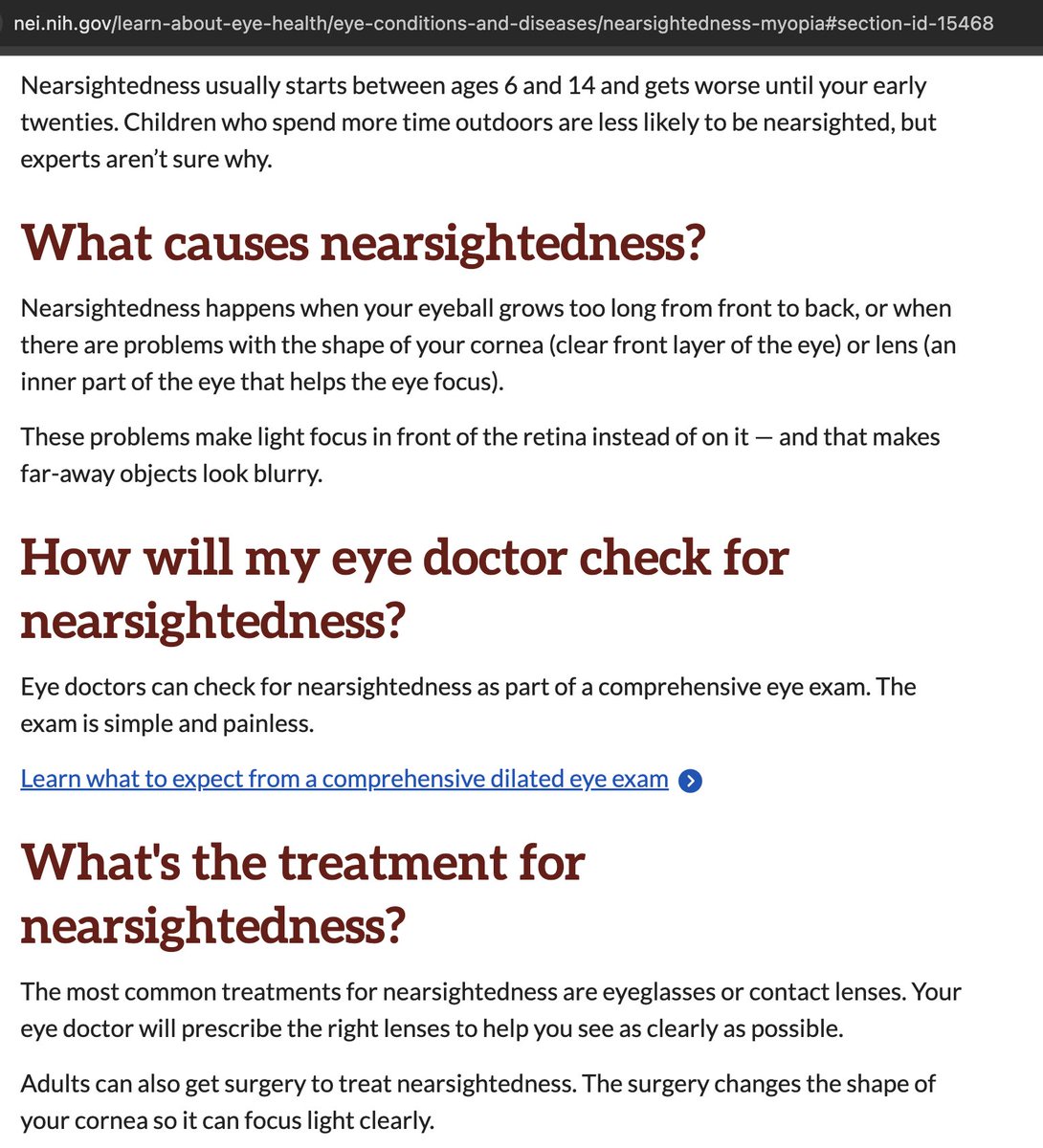
The one thing about that, is regardless of whether that helps or not, HOW COULD MY EYE LENGTH CHANGE???
Even if it's true, I had low blood sugar or something and so... MY EYE LENGTH CHANGED????
All of mainstream medical is just saying (read attached):
And their test showed my huge fluctuations, that should basically be impossible according to standard "theory", and they don't care at all, they just move forward to prescribe lenses...
But then there was the distance eye test... where... my vision fluctuated, and I was able to read 20/40... which corresponds to -1... (and would be impossible if I persisted with a 1.33 mm elongation) but that test was even worse. They have you look through a small hole in an awkward chair where your head and neck are stuck...
And here's a question, what if they took that part of the test outdoors? I can see so much better outdoors. I have tested at 20/20 outdoors.
Which read actually matters?
WELL, part of this IS COPE.
It is true, that my goal would be to actually have consistent relaxation in all situations and distance clarity. But I did NOT achieve it to the point of having that occur at THAT exam.
It's okay though, because I know some specific elements that I can focus on, if I really want to get a better read at the optometrist... ALTHOUGH, either way, that's not really my focus.
I passed the driver's test. In 20 ELEVEN. and 2016 and 2021. They tested at 20/40.
And, none of this disproves the contention that stress and strain blurs vision. That's the biggest thing. It's not just about whether I did it or didn't do it. It's about the truth.
I PERSONALLY failed to coordinate my eyes properly in THAT exam to see at the level of clarity that I'd ideally have...
The exam was also NOT designed for people to see as clearly as possible. Just like most other medical procedures and sales processes... they're not exactly trying to get you off the stuff.
I also did not do any special prep for this exam, and had not taken a test since 2011.
So I promise you, I will take another test very soon, and will get very different results.
On the next test, I will do some extra practices beforehand as well as be more mindful of accepting the poor guidance of the eye doctor - meaning -
I will not let myself sit uncomfortably, or be forced to sit still, AND STARE in order to be measured. These are the exact problems EYE DOCTOR William H. Bates pointed to.
Again, this whole thing is not about me, it's about the truth. It's about what causes eye elongation and blurred vision, NOT how awesome of a coach or athlete or how healthy I am etc...
My eyes got tense, my neck got tense, I did not succeed to fully relax, so I did not walk away with no indicators of needing help seeing... but they couldn't give me a prescription either.
Why would you give someone a prescription if you saw their eye change 1.25 diopters in a few seconds?!!
Well, I guarantee he would have gladly prescribed glasses if I just went with it, would have just found whatever lens seems to produce clarity and then boom okay, buy the glasses. No issue. No thought. NO HEALING.
Glasses and contacts suck. The "corrective" lenses make things look smaller. They are not solving the problem.
That all being said, after asking questions, he suggested seeing an opthalmalogist and getting blood work.
The one thing about that, is regardless of whether that helps or not, HOW COULD MY EYE LENGTH CHANGE???
Even if it's true, I had low blood sugar or something and so... MY EYE LENGTH CHANGED????
All of mainstream medical is just saying (read attached):
Loading suggestions...