
The AIM-7E Sparrow failed in Vietnam. Today, I intend to explain what went wrong, how, and what was done to correct it.
🧵
🧵

The early members of the AIM-7 family were complicated. For the sake of brevity, we're going to skip over the AIM-7A and B. Those were very different missiles from the 7C/D/E, which were known as the Sparrow III.
The AIM-7C was the first semi-active radar homing of the three, introduced in 1958. It was mated to the AN/APA-127 missile guidance set in the F3H-2 (F-3B) Demon.


To understand the problems I will discuss later, it is important to understand how the Sparrow III operates. The radar provides frequency-modulated continuous-wave RF energy. A triangular FMCW is shown below. The transmitted signal is in red, and the received signal is in green.

This looks very complicated, and it is, so we're going to skip most of it. But most of this exists to provide the transmitting radar range (f(R)) and velocity information (fD). For the purposes of the missile, we care primarily about the fD, or Doppler shift.


The Sparrow, being a semi-active missile, does not transmit the FMCW signal, so it has to have a separate receiver to allow the missile to compare the transmitted and received signals.
The Sparrow III, as originally designed, locks on to the fD of the target.
The Sparrow III, as originally designed, locks on to the fD of the target.

As long as there is a closing velocity difference between the transmitting aircraft and the target, this Doppler gating(as shown below) allows the seeker to filter radar returns outside of the target velocity. This provides some chaff and ground clutter rejection.


In the context of Sparrow guidance, "simulated doppler" refers to a variable provided for guidance.

Now, for the AIM-7D. This was designed for the F-4 Phantom's APA-157 missile guidance set. It featured a larger motor, a larger warhead, and unknown seeker improvements. The 7D could only be fired at targets with a closing velocity of 150 knots.
It was quickly recognized that the AIM-7D was not a suitable missile for the F-4, leading to the development of the 7E. The 7E was far more useful, being able to lock on to the velocity gate of targets with a closing velocity of greater than negative 300 knots.
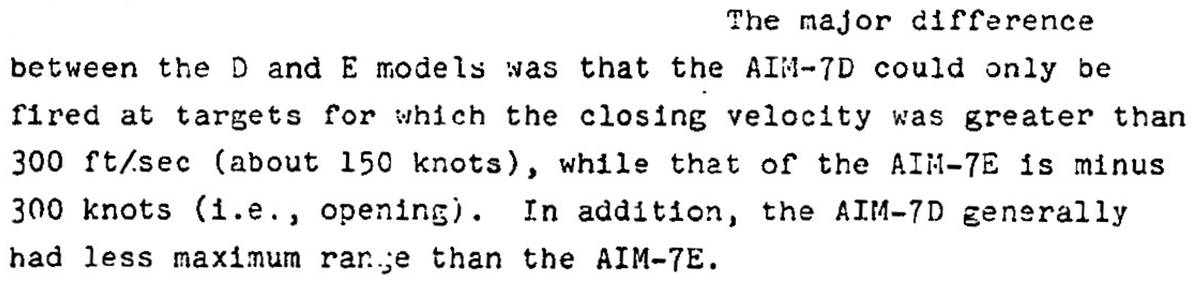
The AIM-7D was very quickly removed from service. The rear-aspect capability of the AIM-7E was very important in Vietnam, where rules of engagement required visual identification of targets before firing, meaning that head-on attacks with AIM-7s rarely occurred.
From here, we will discuss primarily the AIM-7E, as the 7C saw no service in Vietnam and the 7D was wholly inadequate for the role.
When the AIM-7E is selected, and the master arm switch is on SAFE, it begins a process called pseudo-tuning. Unfortunately, I cannot figure out exactly what the purpose of pseudo-tuning was.
Once the switch is on ARM, the missile begins tuning on the simulated doppler signal.
Once the switch is on ARM, the missile begins tuning on the simulated doppler signal.

Tuning on the simulated doppler allows for the missile to complete a successful lock-on when it is launched. When it launches, the missile looks for a target return in a narrow speedgate sweep, which is +/-150 knots of the provided simulated doppler velocity.

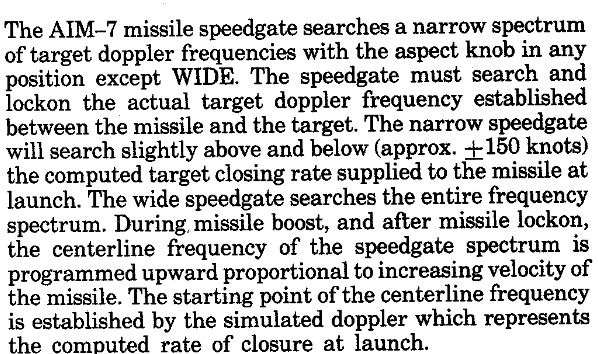
The first problem with the 7E was that of lock speed. The 7E had a long preparation time before it could be fired. This led quickly to using the missile in a "boresight" mode, wherein the missile was fired before a speedgate lock had been accomplished. Mode 5 was the most common.


However, this presents a problem, as described below. This would not have been as significant of an issue if the Sparrow had been employed in its intended high-altitude environment, but the low-altitude nature of air combat in Vietnam led to this problem being exacerbated.

In short, firing without speedgate settling and proper speedgate lock not only negates the advantage of having a velocity gate tracker in the first place!
At low altitudes, ground-scatter returns from CW radiation provide this brighter target for the missile.
Not discussed in that document is also a problem of fusing, explained below.
Not discussed in that document is also a problem of fusing, explained below.

In the Ault report, a few other significant issues are described. The AIM-7E had a captive flight lifespan of only 30 flights before having to be rebuilt. This was one of the many issues encountered on repeated captive flights.
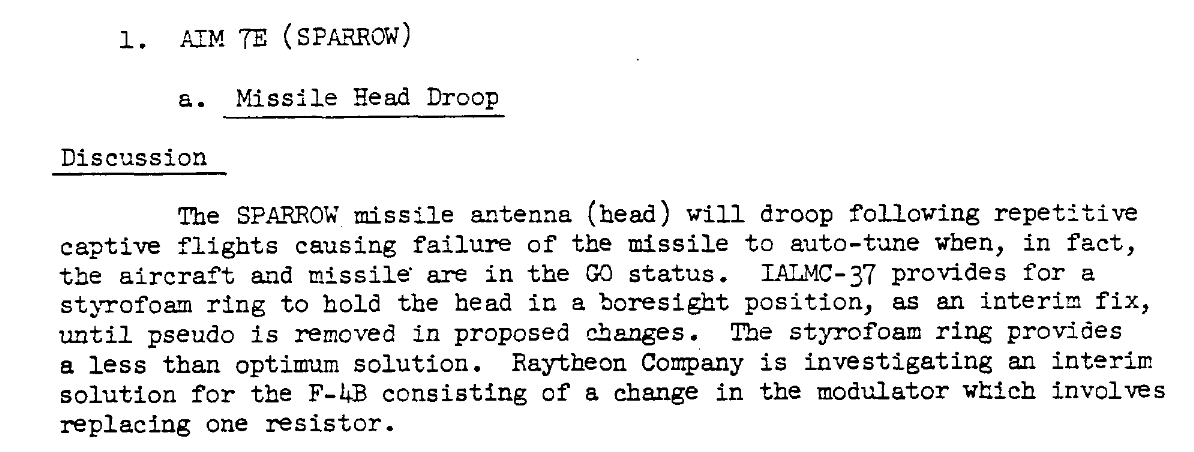

Notably, this discusses the removal of the pseudo-tuning signal, as this is what was causing the weapons control system to report a non-functional AIM-7E, and therefore preventing firing.
The modifications to disable pseudo-tuning are shown below, AF first, Navy second.
The modifications to disable pseudo-tuning are shown below, AF first, Navy second.

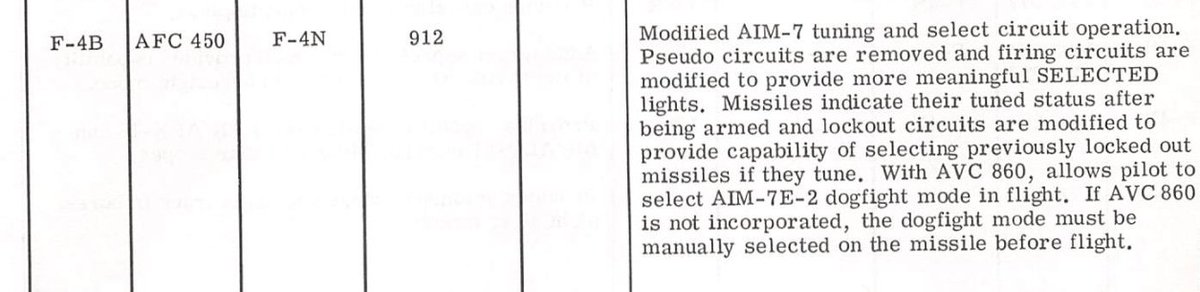
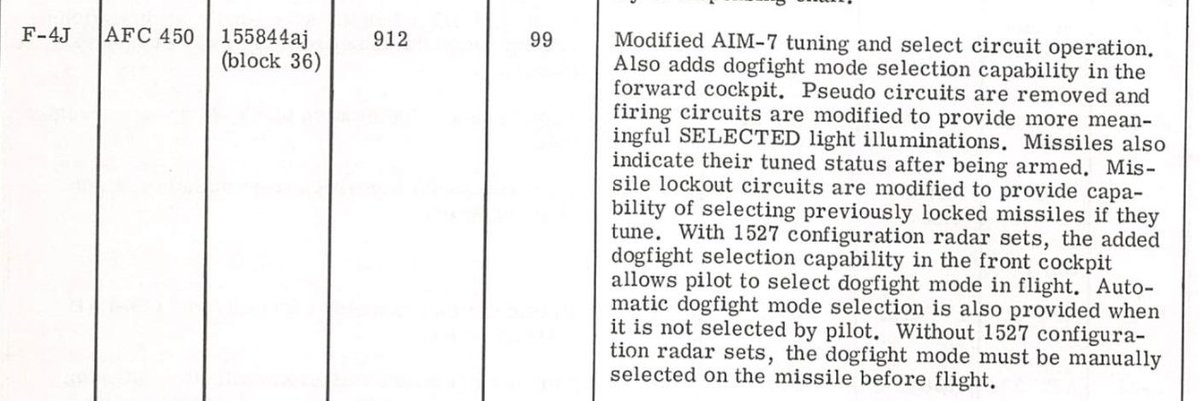
The AIM-7E-2, which, as some of you will have noticed, is mentioned separately and with different capabilities. I don't know all of them, but the major differences are in improving the minimum range and fusing.


AIM-7E-2 provided a much more capable dogfight missile, with a minimum range half that of the 7E, according to the USN.

AIM-7E-2, however, did not solve the problems inherent to FMCW guidance and did not solve the other problems experienced in Vietnam. Those would be much harder to get rid of, and many fixes were simply delayed until the introduction of the AIM-7F.
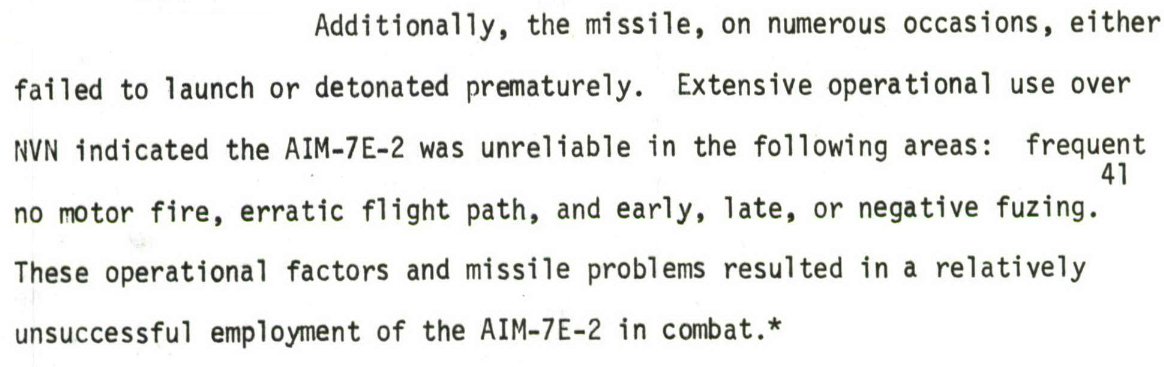
Back to the Ault report. For the purposes of this thread, we will be ignoring the severe issues in Raytheon manufacturing.
The 7E suffered a 25% misfire rate simply from the design of the igniter! This would not be fixed until the introduction of the AIM-7F with dual igniters.
The 7E suffered a 25% misfire rate simply from the design of the igniter! This would not be fixed until the introduction of the AIM-7F with dual igniters.
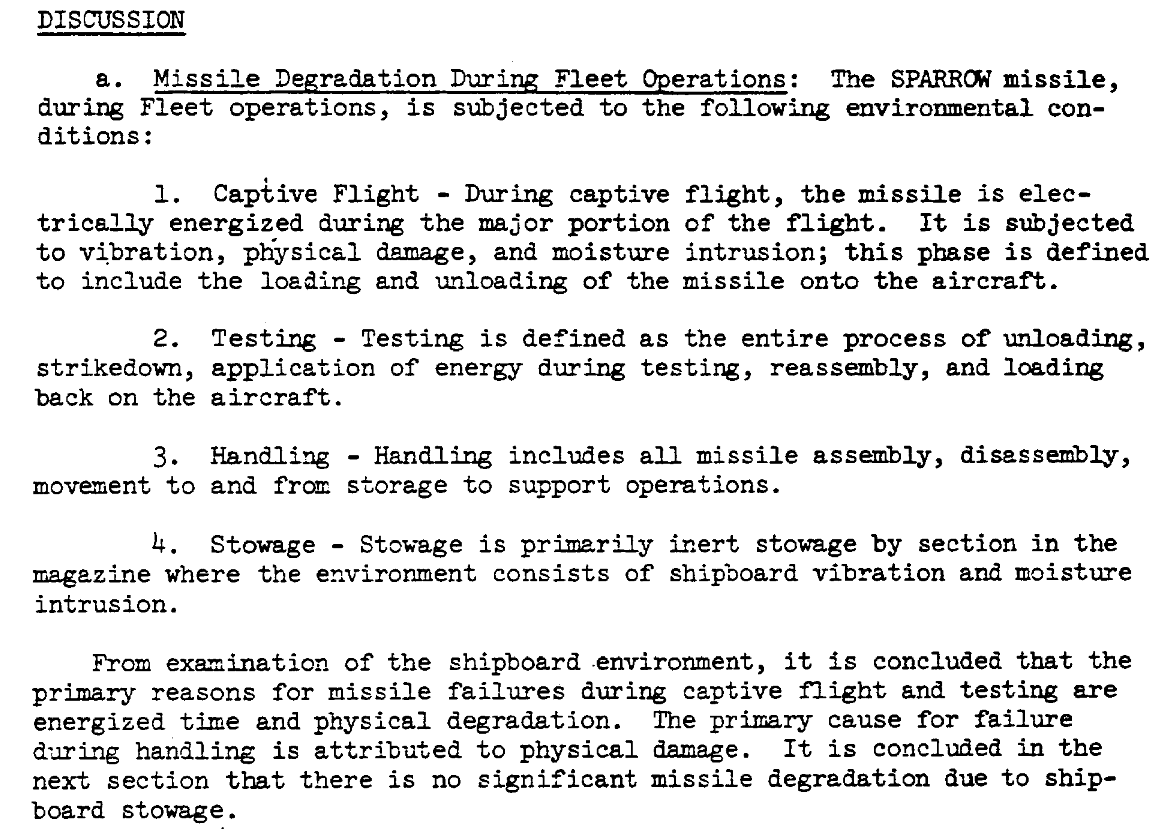
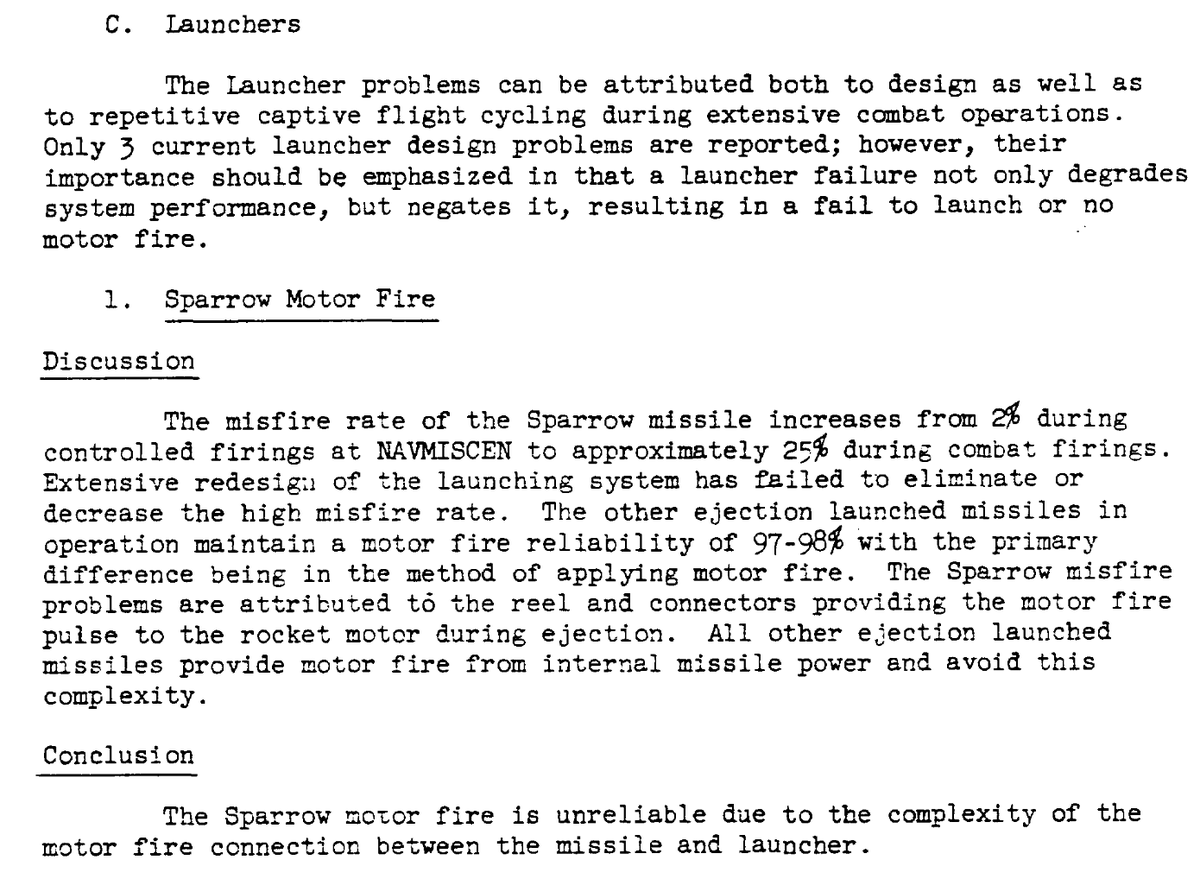
The AIM-7E's reliability plummeted primarily due to captive flights, i.e., ones where the missile was not fired, as well as the strain put on the analog components due to testing and handling. The abysmal results of a survey are shown here:


To some degree, this was an impossible problem to solve on the analog AIM-7E. The Ault report recommended less frequent testing and procedures for the storage of 7Es on aircraft rather than being removed after flight.


As much as I would like to ramble on for longer, writing this thread has taken me the better part of 8 hours, and I think this is a decent place to end. The AIM-7E was inherently flawed in many ways and would require a complete redesign to most of the problems outlined here.
This redesign would arrive in 1976, with the AIM-7F. This missile, while still retaining many features of the AIM-7E, can nearly be considered a new missile altogether. It was solid-state, had improved durability and reliability, longer range, and a new pulse-doppler seeker.
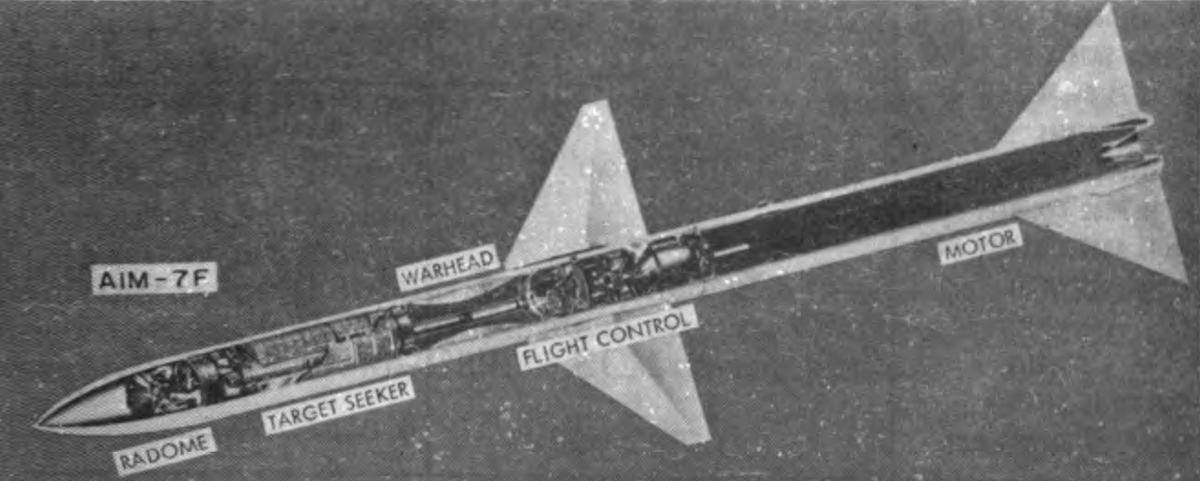
The AIM-7F's incredibly expensive and protracted development will have to be a topic for another day.
Loading suggestions...