

This is my Complete Master's Guide to Tokenomics 👀
I'll break down what the tokenomics of a 500x return #crypto project looks like 👀
Is this useful? Drop me a like and RT, if there's enough demand I'll turn it into a PDF & video with more examples 🧵👇
1/58
I'll break down what the tokenomics of a 500x return #crypto project looks like 👀
Is this useful? Drop me a like and RT, if there's enough demand I'll turn it into a PDF & video with more examples 🧵👇
1/58

This is the updated 2024 version of my Master's Guide to Tokenomics!
If you don't understand tokenomics you're gambling and you will get rekt.
By the end of this thread, you will be a tokenomics pro who can spot a good crypto from a sh*tcoin within minutes.
2/58
If you don't understand tokenomics you're gambling and you will get rekt.
By the end of this thread, you will be a tokenomics pro who can spot a good crypto from a sh*tcoin within minutes.
2/58
🟩 Basic Terms 🟩
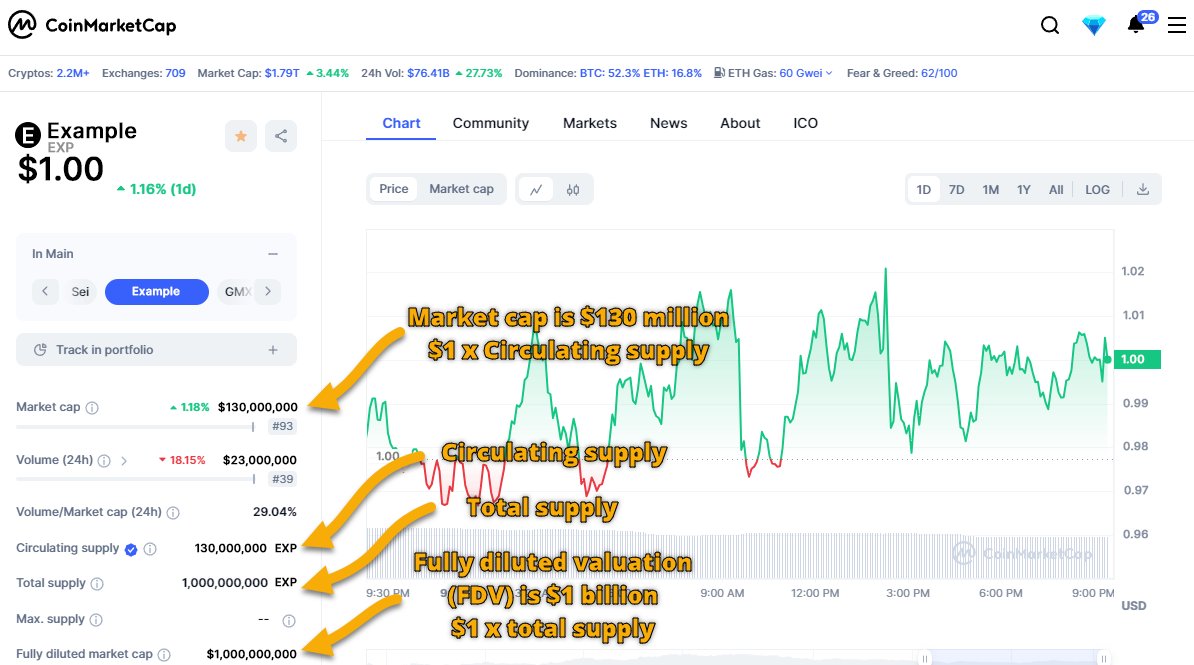
• Circulating Supply: Tokens currently in circulation
• Total Supply: Total tokens that will exist
• Market Cap: Total value in $ of tokens in circulation
• Fully Diluted Value (FDV): Total value in $ of total supply
From Coin Market Cap:
3/58
• Circulating Supply: Tokens currently in circulation
• Total Supply: Total tokens that will exist
• Market Cap: Total value in $ of tokens in circulation
• Fully Diluted Value (FDV): Total value in $ of total supply
From Coin Market Cap:
3/58

Understanding these will help you spot tokenomics issues. E.g. a project with a big difference in circulating vs. total supply could have an issue, why?
As more of the token is released into circulation it causes inflation and dilutes the token's value. More below 👇
4/58
As more of the token is released into circulation it causes inflation and dilutes the token's value. More below 👇
4/58
🟩 Supply 🟩
The token below has only 13% of its supply circulating. As the other 87% are released into circulation the value of the token might fall from its current $1 unless there are value accrual mechanisms, which I will break down later in this thread!
5/58
The token below has only 13% of its supply circulating. As the other 87% are released into circulation the value of the token might fall from its current $1 unless there are value accrual mechanisms, which I will break down later in this thread!
5/58
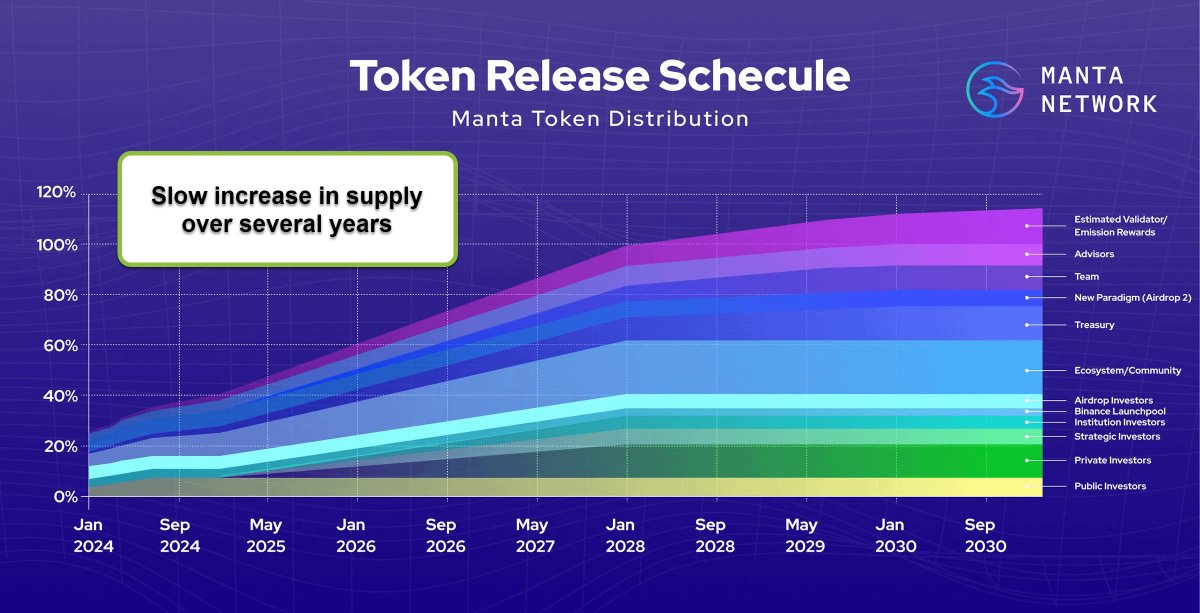
The increase in a token's supply over time is called emissions and the rate of emissions is important.
If the token hits max supply over the next three months the supply increase will be so fast that demand is unlikely to increase with it and the token will lose value.
6/58
If the token hits max supply over the next three months the supply increase will be so fast that demand is unlikely to increase with it and the token will lose value.
6/58
However, if the emissions are slow and max supply won't be hit for years, then the supply increase might not have a significant impact on price over the short term.
But where do you check emissions?
7/58
But where do you check emissions?
7/58
You usually find this info in the token's whitepaper in a table like below. You want to see a nice steady increase over a few years instead of huge spikes or steep increases.
Pro tip: Some projects stretch charts out to make increases look steady when they're not 👀
8/58
Pro tip: Some projects stretch charts out to make increases look steady when they're not 👀
8/58


Emissions can come from staking rewards, airdrops, user rewards for using the dapp and of course, token unlocks. Unlocks come from allocations given to early investors, team, treasury etc. You can find allocations in the whitepaper or using free apps like @Token_Unlocks
9/58
9/58

Allocation distribution is very important. If, for example, 40% of the supply is allocated to early investors and the unlocks happen over a few months, that's a problem.
Early investors are usually motivated sellers since they're often 5x-10x up. Wouldn't you be?
10/58
Early investors are usually motivated sellers since they're often 5x-10x up. Wouldn't you be?
10/58
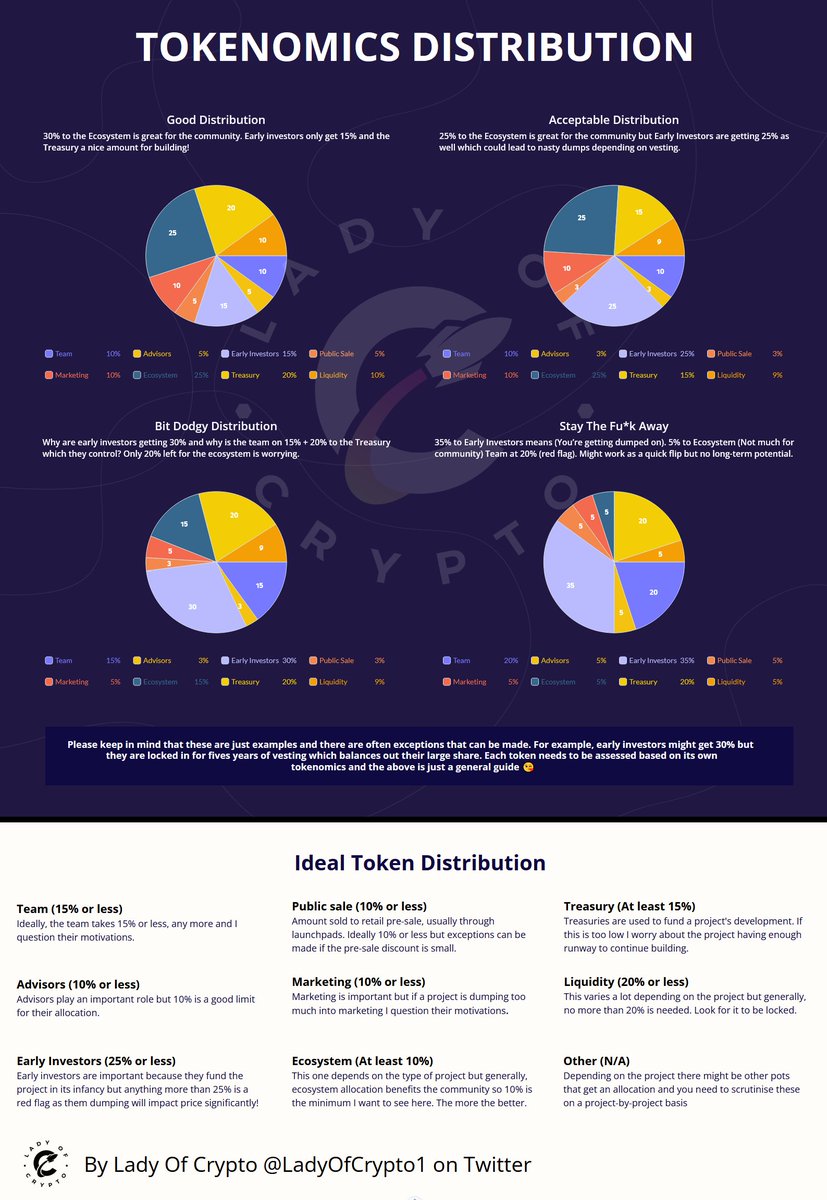
Ideal token distribution IMO.
Note: OL/OL= Or less/more
Team: 15% OL
Advisors: 10% OL
Early investors: 25% OL
Public investors: 10% OL
Marketing: 10% OL
Ecosystem: 10% OL
Foundation/Treasury: 15% OL
Liquidity: 20% OL
There can be more buckets. Let's break it down:
11/58
Note: OL/OL= Or less/more
Team: 15% OL
Advisors: 10% OL
Early investors: 25% OL
Public investors: 10% OL
Marketing: 10% OL
Ecosystem: 10% OL
Foundation/Treasury: 15% OL
Liquidity: 20% OL
There can be more buckets. Let's break it down:
11/58
🟢 Team 🟢
Tokens for the team. I like to see them give themselves less than 15%. Any more and I question their motives.
🟢 Advisors 🟢
They provide expert advice/guidance to projects and are rewarded with tokens. I want to see 10% or less for them.
12/58
Tokens for the team. I like to see them give themselves less than 15%. Any more and I question their motives.
🟢 Advisors 🟢
They provide expert advice/guidance to projects and are rewarded with tokens. I want to see 10% or less for them.
12/58
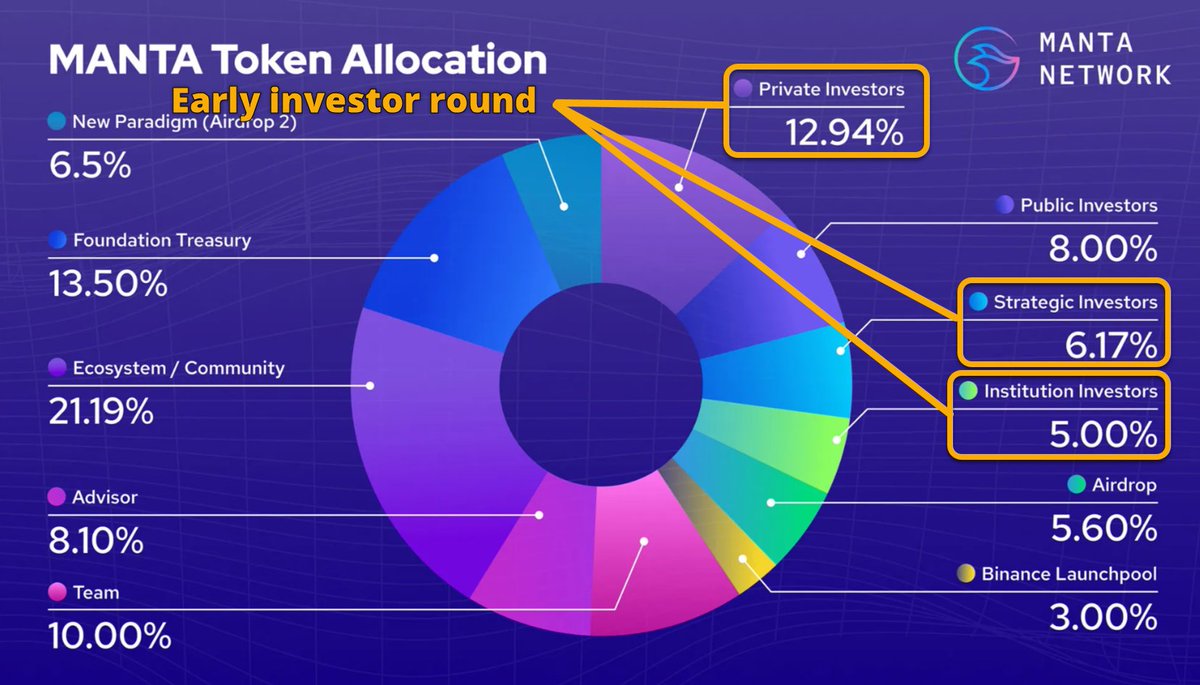
🟢 Early Investor Rounds 🟢
Usually referred to as seed, VC, private, strategic, KOL or institutional. Most projects have multiple rounds.
I want to see less than 25% allocated to early investors unless they have long vesting or buy in at a high FDV (more later)
13/58
Usually referred to as seed, VC, private, strategic, KOL or institutional. Most projects have multiple rounds.
I want to see less than 25% allocated to early investors unless they have long vesting or buy in at a high FDV (more later)
13/58
🟢 Public Sale 🟢
Referred to as IDO/ICO, it's often sold through launchpads to retail investors. I like to see no more than 10%. More than 10% is not a dealbreaker but it can cause significant selling pressure unless it has strict vesting (more later)
14/58
Referred to as IDO/ICO, it's often sold through launchpads to retail investors. I like to see no more than 10%. More than 10% is not a dealbreaker but it can cause significant selling pressure unless it has strict vesting (more later)
14/58
🟢 Marketing 🟢
I like to see 10% or less dedicated to marketing. While marketing is important, dedicating too much to it may not leave enough for the project itself.
Also, marketing is in control of the team so it being high is suspicious as they could dump.
15/58
I like to see 10% or less dedicated to marketing. While marketing is important, dedicating too much to it may not leave enough for the project itself.
Also, marketing is in control of the team so it being high is suspicious as they could dump.
15/58
🟢 Ecosystem 🟢
This is what the community gets through staking, airdrops, rewards etc. I like to see at least 10% here. Many projects will have 20% or more, which is good.
Generally there's no top end here, even 40% is fine if it's vested!
16/58
This is what the community gets through staking, airdrops, rewards etc. I like to see at least 10% here. Many projects will have 20% or more, which is good.
Generally there's no top end here, even 40% is fine if it's vested!
16/58
🟢 Treasury 🟢
This is essential working capital for the project for things like paying employees, securing partnerships and day-to-day expenses.
I like to see over 15% here because working capital is important and running out of funds means the project dies.
17/58
This is essential working capital for the project for things like paying employees, securing partnerships and day-to-day expenses.
I like to see over 15% here because working capital is important and running out of funds means the project dies.
17/58
🟢 Liquidity 🟢
Tokens are given to DEXs/CEXs for liquidity. Some projects need more liquidity than others. As long as liquidity is locked for 2+ years it doesn't matter if up to 20% goes there.
There's nuance here though, locking is not always needed but preferred.
18/58
Tokens are given to DEXs/CEXs for liquidity. Some projects need more liquidity than others. As long as liquidity is locked for 2+ years it doesn't matter if up to 20% goes there.
There's nuance here though, locking is not always needed but preferred.
18/58
🟢 Airdrop🟢
Many projects allocate tokens towards an airdrop. There is no set-in-stone rule for how much should be allocated to airdrops.
Some projects do a few percent, others do 20% or even more. Airdrops are for the community so I don't mind big ones!
19/58
Many projects allocate tokens towards an airdrop. There is no set-in-stone rule for how much should be allocated to airdrops.
Some projects do a few percent, others do 20% or even more. Airdrops are for the community so I don't mind big ones!
19/58
🟢 Other 🟢
Above are the main distribution pots some projects may have others. For example, some projects have a foundation structure so they allocate tokens to the foundation which then does things like giving grants to projects on the ecosystem.
20/58
Above are the main distribution pots some projects may have others. For example, some projects have a foundation structure so they allocate tokens to the foundation which then does things like giving grants to projects on the ecosystem.
20/58
🟩 Vesting 🟩
Vesting controls the release of tokens into circulation to stop any of the parties above getting access to all of their tokens too quickly and dumping.
Good vesting is hard to define, but I will try to break it down 😊 Let's start with basic terms:
21/58
Vesting controls the release of tokens into circulation to stop any of the parties above getting access to all of their tokens too quickly and dumping.
Good vesting is hard to define, but I will try to break it down 😊 Let's start with basic terms:
21/58
🟢 TGE 🟢
This stands for token generation event. It's basically the day the token is first released on the open market.
🟢 TGE Allocation 🟢
The % of their allocated tokens each party will get at TGE, this can vary from 0% to 100% but usually it sits around 10%-20%
22/58
This stands for token generation event. It's basically the day the token is first released on the open market.
🟢 TGE Allocation 🟢
The % of their allocated tokens each party will get at TGE, this can vary from 0% to 100% but usually it sits around 10%-20%
22/58
🟢 Cliff Period 🟢
The amount of time between TGE allocation and the next token unlock. This is usually defined in months and varies greatly.
🟢 Emission Schedule 🟢
After the cliff period, how often unlocks happen and what % i.e. 10% p/m for 12 months!
23/58
The amount of time between TGE allocation and the next token unlock. This is usually defined in months and varies greatly.
🟢 Emission Schedule 🟢
After the cliff period, how often unlocks happen and what % i.e. 10% p/m for 12 months!
23/58
Over the last few years most projects have started doing small TGE unlocks of around 10% for early investors, followed by cliffs of a few months and then vesting of 12+ months.
This is seen as good for the community as early investors cannot dump a lot of tokens quickly!
24/58
This is seen as good for the community as early investors cannot dump a lot of tokens quickly!
24/58
Another school of thought has been to give early investors huge TGE unlocks of 40%-100% so if they want out they can dump.
T gets dumpers out early instead of having constant sell pressure at every unlock for 12 months.
Some evidence suggest this is better.
25/58
T gets dumpers out early instead of having constant sell pressure at every unlock for 12 months.
Some evidence suggest this is better.
25/58
I have stopped focusing too heavily on vesting as I have seen both methods work well.
As an example, vesting requires smart contracts so BRC20 tokens cannot be vested as there are no smart contracts on BTC. So, some BRC20 tokens release 100% of the supply at TGE 👀
26/58
As an example, vesting requires smart contracts so BRC20 tokens cannot be vested as there are no smart contracts on BTC. So, some BRC20 tokens release 100% of the supply at TGE 👀
26/58
But its not just BRC20 some projects are doing this by choice to get dumpers out and let the market decide price!
So I am not too concerned with vesting unless it's team vesting which I consider important as a team with short vesting indicates a lack of conviction!
27/58
So I am not too concerned with vesting unless it's team vesting which I consider important as a team with short vesting indicates a lack of conviction!
27/58
As for the other parties with token allocation. I prefer vesting but if I see a project with large TGE unlocks and short vesting I won't dismiss it off-hand.
Evidence suggests that if there are strong demand mechanics, unlocking large amounts of supply early won't hurt.
28/58
Evidence suggests that if there are strong demand mechanics, unlocking large amounts of supply early won't hurt.
28/58
🟩 Demand 🟩
So we've thoroughly covered supply, let's look at demand. Here are the most common forms of demand for tokens.
• Incentives for holding/staking
• Store of value
• Community
• Utility
Let's break each of these down.
29/58
So we've thoroughly covered supply, let's look at demand. Here are the most common forms of demand for tokens.
• Incentives for holding/staking
• Store of value
• Community
• Utility
Let's break each of these down.
29/58
🟢 Incentives For Holding 🟢
Many tokens offer APY (yield) for staking. Basically, you stake and you get paid in either the staked token or another token.
But recently projects have started giving airdrops to stakers, either airdrops of their own token...
30/58
Many tokens offer APY (yield) for staking. Basically, you stake and you get paid in either the staked token or another token.
But recently projects have started giving airdrops to stakers, either airdrops of their own token...
30/58
Or airdrops of tokens from partner projects. An example of this is Celestia ($TIA).
The price of TIA has seen a sharp increase as people want to stake it for airdrops from other projects building on the chain.
Similar to what's happening with MANTA and DYM! More later 👇
31/58
The price of TIA has seen a sharp increase as people want to stake it for airdrops from other projects building on the chain.
Similar to what's happening with MANTA and DYM! More later 👇
31/58

🟢 Store of Value 🟢
Another driver for demand is that the crypto is a store of value. It is hard to argue that many cryptos outside of $BTC are a store of value but it is a driver for demand so it's worth noting.
32/58
Another driver for demand is that the crypto is a store of value. It is hard to argue that many cryptos outside of $BTC are a store of value but it is a driver for demand so it's worth noting.
32/58
🟢 Community 🟢
A strong community can drive demand. Meme coins are proof of this. Most of them have no utility, no staking and are certainly not a store of value but they hold value and can even do a 1000x based on community.
Most eventually got to 0 though.
33/58
A strong community can drive demand. Meme coins are proof of this. Most of them have no utility, no staking and are certainly not a store of value but they hold value and can even do a 1000x based on community.
Most eventually got to 0 though.
33/58
🟢 Utility 🟢
Last but not least utility. If holding the token provides some sort of utility like a blockchain's native token allowing you to make transactions on that chain it creates demand.
34/58
Last but not least utility. If holding the token provides some sort of utility like a blockchain's native token allowing you to make transactions on that chain it creates demand.
34/58
🟢 Who's Holding? 🟢
Another important question is who is holding and what are their motives?
This is a hard question to answer and it requires researching wallets and getting involved in the community but it can give you valuable insights.
35/58
Another important question is who is holding and what are their motives?
This is a hard question to answer and it requires researching wallets and getting involved in the community but it can give you valuable insights.
35/58
The best types of holders are a strong community because they'll hold through anything. Check the projects Discord/Telegram to assess community strength.
This brings us back to vesting. If a strong community is vested, great. If it's dumpers...
36/58
This brings us back to vesting. If a strong community is vested, great. If it's dumpers...
36/58
Then they will dump every vesting unlock. So when VCs/influencers control 20%+ of the supply I worry about long term sell pressure and I want other forms of demand to counterbalance it.
That's why I prefer most of the tokens in the hands of the community!
37/58
That's why I prefer most of the tokens in the hands of the community!
37/58
🟢 Demand Summary 🟢
When assessing tokenomics you want to look at drivers for demand. The best tokens have at least two if not three of the drivers listed above.
If I see incentives for holding + utility + a strong community holding, I am interested!
38/58
When assessing tokenomics you want to look at drivers for demand. The best tokens have at least two if not three of the drivers listed above.
If I see incentives for holding + utility + a strong community holding, I am interested!
38/58
🟩 Value Accrual 🟩
This is how the token will gain value over time. It ties into demand but it's best to split it off when researching tokenomics. Here are the main ones:
• Deflation
• Locking mechanism
• Utility expansion
• APY and yield
Let's break these down.
39/58
This is how the token will gain value over time. It ties into demand but it's best to split it off when researching tokenomics. Here are the main ones:
• Deflation
• Locking mechanism
• Utility expansion
• APY and yield
Let's break these down.
39/58
🟢 Deflation 🟢
Deflation is decreasing the supply of a token and it's commonly achieved by burning a percentage of transaction fees or periodically buying back and burning large amounts of tokens.
Reducing supply usually increases demand so deflation is good!
40/58
Deflation is decreasing the supply of a token and it's commonly achieved by burning a percentage of transaction fees or periodically buying back and burning large amounts of tokens.
Reducing supply usually increases demand so deflation is good!
40/58
🟢 Utility Expansion 🟢
This is when a token gains more utility over time. You usually find this information by looking at the project's roadmap.
If their roadmap shows that they will add utility over time it could correspond to an increase in value.
41/58
This is when a token gains more utility over time. You usually find this information by looking at the project's roadmap.
If their roadmap shows that they will add utility over time it could correspond to an increase in value.
41/58
🟢 Locked Staking 🟢
Many projects boost staker APY or airdrops if they lock their tokens in staking for a few months.
Locking is a powerful tool to ensure holders stay in and don't dump on every dip or if the project gets FUDed and it rewards loyal long term holders!
42/58
Many projects boost staker APY or airdrops if they lock their tokens in staking for a few months.
Locking is a powerful tool to ensure holders stay in and don't dump on every dip or if the project gets FUDed and it rewards loyal long term holders!
42/58
An issue with APY is that it can often lead to high inflation. For example, if I get 30% APY for staking EXP token an the APY is paid in EXP, this would cause inflation in the supply of EXP...
This is bad because we want deflation not inflation 👇
43/58
This is bad because we want deflation not inflation 👇
43/58
🟩 Inflation Control, Holders & Locks 🟩
Good value accrual is built on three things.
1. Low inflation or even deflation
2. Encouraging users to hold
3. Locking tokens up
If a token gets these three things right it's off to a great start.
44/58
Good value accrual is built on three things.
1. Low inflation or even deflation
2. Encouraging users to hold
3. Locking tokens up
If a token gets these three things right it's off to a great start.
44/58
The problem is that these things often conflict with each other.
• High APY can lead to inflation and sell pressure without a control mechanism.
• Encouraging holders is hard without high APY
• Long lockups often discourage users holding
It's a trilemma.
45/58
• High APY can lead to inflation and sell pressure without a control mechanism.
• Encouraging holders is hard without high APY
• Long lockups often discourage users holding
It's a trilemma.
45/58
🟢 Controlling Inflation 🟢
Projects that find a balance where users are rewarded with enough APY to hold and accept locks while simultaneously not causing out-of-control inflation and sell pressure often do well.
But how can they do this?
46/58
Projects that find a balance where users are rewarded with enough APY to hold and accept locks while simultaneously not causing out-of-control inflation and sell pressure often do well.
But how can they do this?
46/58
Some do this by enforcing vesting on yield earned from staking.
So, if you earn 20% APY from staking a token, that APY is not paid out right away but is vested for months to reduce the pace of inflation.
This also filters out people who stake just to dump.
47/58
So, if you earn 20% APY from staking a token, that APY is not paid out right away but is vested for months to reduce the pace of inflation.
This also filters out people who stake just to dump.
47/58
Other projects pay yield in different tokens like BTC or ETH which removes inflation completely. This is know as real yield.
Just be sure you read the whitepaper to understand where the BTC or ETH is coming from. It's vital to know how yield is generated!
48/58
Just be sure you read the whitepaper to understand where the BTC or ETH is coming from. It's vital to know how yield is generated!
48/58
For example, if the team sells their tokens and buys BTC or ETH to pay stakers yield, that's bad.
This will cause consistent sell pressure and put more tokens into circulation even though it doesn't look like it on the surface. You need to know where the yield comes from!
49/58
This will cause consistent sell pressure and put more tokens into circulation even though it doesn't look like it on the surface. You need to know where the yield comes from!
49/58
Real yield should come from sources like platform fees. An example of this is a DEX charging fees on transactions. Those fees can be used to purchase ETH and then pay part of it out to stakers as yield.
Yield is tricky to get right. Airdrops are an alternative 👇
50/58
Yield is tricky to get right. Airdrops are an alternative 👇
50/58
🟢 Airdrops 🟢
Some projects offer low APY and instead reward loyal long term holders/stakers with airdrops.
TIA, MANTA and DYM are recent examples of this model and it's working out amazingly well for them.
And the airdrops don't cause inflation, why?
51/58
Some projects offer low APY and instead reward loyal long term holders/stakers with airdrops.
TIA, MANTA and DYM are recent examples of this model and it's working out amazingly well for them.
And the airdrops don't cause inflation, why?
51/58
Because airdrops come from new projects building on the chain. If you stake TIA and a new DEX builds on there. When that DEX launches a token it might give a % of its supply as an airdrop to TIA stakers.
This encourages holding of TIA while not causing inflation 🤯
52/58
This encourages holding of TIA while not causing inflation 🤯
52/58
In the 2024/2025 bull run it seems like one of the strongest drivers of value accrual will be incentivizing holders with airdrops.
So, this will be something I look for and it's why I have big bags of TIA and MANTA.
53/58
So, this will be something I look for and it's why I have big bags of TIA and MANTA.
53/58
🟩 Nuance 🟩
As with anything, it is important to recognize there will always be an element of nuance. If a token only has 10% of it's supply in circulation it's easy to dismiss it and say inflation will kill price.
But what if inflation is happening over 10 years and...
54/58
As with anything, it is important to recognize there will always be an element of nuance. If a token only has 10% of it's supply in circulation it's easy to dismiss it and say inflation will kill price.
But what if inflation is happening over 10 years and...
54/58
It has strong value accrual mechanisms, staking is heavily incentivized and it has a strong community?
Maybe in that scenario you would make an exception.
Remember that tokenomics should be assessed on case-by-case basis.
55/58
Maybe in that scenario you would make an exception.
Remember that tokenomics should be assessed on case-by-case basis.
55/58
🟩 How to Tokenomics 🟩
Nuance aside when assessing tokenomics look for:
• A finite supply that is preferably deflationary.
• Strong demand from things like incentivized holding, community and utility.
• Value accrual mechanisms (deflation, APY, airdrops etc)
56/58
Nuance aside when assessing tokenomics look for:
• A finite supply that is preferably deflationary.
• Strong demand from things like incentivized holding, community and utility.
• Value accrual mechanisms (deflation, APY, airdrops etc)
56/58
Almost everything you need to research a token's tokenomics will be in its whitepaper or website.
If you cannot find the info join their telegram or discord and ask on there. Although a project not being open with tokenomics info is a red flag!
57/58
If you cannot find the info join their telegram or discord and ask on there. Although a project not being open with tokenomics info is a red flag!
57/58
I hope you've found this thread helpful. If you did, click the tweet below and then give it a like and a retweet.
If there's enough demand I will turn this into a video and a PDF with more examples 😘
58/58
If there's enough demand I will turn this into a video and a PDF with more examples 😘
58/58
Loading suggestions...